





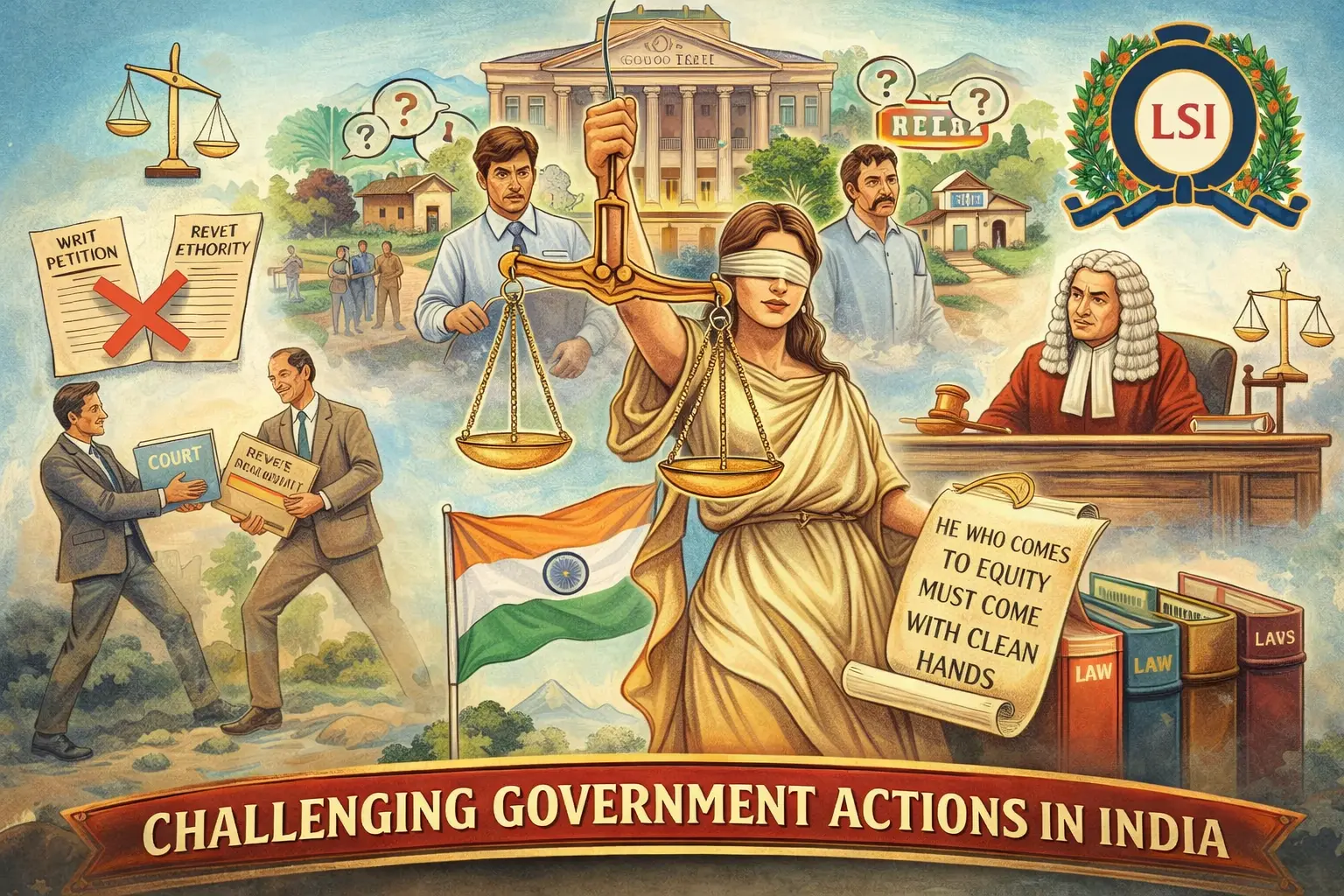
Introduction: The Legal Framework for Challenging Government Actions
In a democratic republic like India, the right to challenge government actions forms the cornerstone of constitutional governance and the rule of law. Citizens, when aggrieved by administrative decisions or executive actions, possess multiple avenues to seek redressal. However, the exercise of these rights must be tempered with an understanding of proper legal procedures, jurisdictional boundaries, and the principles of judicial discipline. The recent judgment by the Jammu & Kashmir and Ladakh High Court in Farooq Ahmad Shiekh v. Financial Commissioner (WP(C) No. 3035/2025) serves as a crucial reminder of these fundamental principles while addressing the complex interplay between different forums of dispute resolution.
The Indian legal system provides a hierarchical structure of courts and tribunals, each with defined jurisdictions and powers. When it comes to challenging government decisions, litigants often face the dilemma of choosing between civil courts, revenue authorities, administrative tribunals, and constitutional courts exercising writ jurisdiction. This choice is not merely procedural but carries substantive implications for the outcome of the case, the remedies available, and the binding nature of the decision rendered.
The judgment under discussion addresses several critical questions that frequently arise in administrative law practice. First, it reaffirms the principle against parallel proceedings—the legal doctrine that prohibits parties from pursuing the same cause of action simultaneously before different forums. This principle is rooted in considerations of judicial economy, prevention of conflicting decisions, and the need to maintain the dignity of judicial institutions. When a competent court has already taken cognizance of a dispute, parties cannot forum-shop by approaching alternative authorities in the hope of obtaining a more favorable outcome.
Second, the judgment clarifies the hierarchical relationship between civil courts and revenue authorities. In India’s administrative structure, revenue authorities exercise quasi-judicial powers in matters relating to land revenue, encroachments, and related disputes. However, their jurisdiction is not unlimited and must yield when a civil court of competent jurisdiction has already seized itself of the matter. This principle reflects the constitutional supremacy of the ordinary courts and ensures that specialized administrative bodies do not encroach upon judicial functions.
Third, and perhaps most significantly, the judgment addresses the consequences of suppressing material facts while approaching courts in their extraordinary writ jurisdiction. The High Court imposed a substantial cost of Rs. 50,000 on the petitioners for failing to disclose that a civil court had already passed orders on the same dispute. This aspect of the judgment underscores the duty of candor that litigants owe to courts, particularly when seeking equitable relief. The maxim “he who comes to equity must come with clean hands” finds practical application here, reminding litigants that procedural propriety is as important as substantive merit.
The broader context of this judgment lies in the increasing complexity of administrative law in India. With the expansion of government functions and the proliferation of regulatory authorities, citizens often find themselves navigating a maze of overlapping jurisdictions. The temptation to pursue multiple remedies simultaneously, or to approach different forums sequentially without proper disclosure, is understandable but legally impermissible. This judgment serves as a cautionary tale about the importance of choosing the correct forum, exhausting available remedies in the proper sequence, and maintaining transparency in all judicial proceedings.
For legal practitioners, this case offers valuable lessons in litigation strategy and professional ethics. It reminds advocates of their duty to advise clients not merely on the merits of their case but also on the proper procedural path to follow. For law students, it provides an excellent illustration of how abstract principles of administrative law, civil procedure, and equity operate in real-world disputes. For ordinary citizens seeking to challenge government actions, it offers both guidance and warning—guidance on the importance of following proper legal channels, and warning about the consequences of attempting to circumvent established procedures.
Case Background: The Dispute Over a Public Pathway in Kupwara
The factual matrix of Farooq Ahmad Shiekh v. Financial Commissioner revolves around a dispute concerning a public link road in Kupwara district of Jammu & Kashmir. The case presents a typical scenario where private interests clash with public infrastructure development, and where the choice of legal forum becomes as contested as the underlying dispute itself.
The genesis of the controversy lay in the construction of a public link road by the Rural Development Department. The private respondents in the case alleged that the petitioners had created obstructions and encroachments on this public pathway, thereby impeding its use by the general public. Acting on this grievance, the private respondents filed an application before the Deputy Commissioner, Kupwara, seeking removal of the alleged obstruction and encroachment. The Deputy Commissioner, exercising powers under revenue law, directed the Tehsildar Lalpora to conduct a spot inspection and remove the obstructions in accordance with law.
This order by the Deputy Commissioner marked the beginning of a protracted legal battle that would eventually reach the High Court. The petitioners, aggrieved by the Deputy Commissioner’s direction, filed an appeal before the Divisional Commissioner, Kashmir. However, the appeal was transferred to the Additional Commissioner, Kashmir, who had been vested with the powers of the Divisional Commissioner for this purpose. The Additional Commissioner, after examining the matter, dismissed the petitioners’ appeal, thereby upholding the order of the Deputy Commissioner.
Undeterred, the petitioners escalated the matter further by challenging the Additional Commissioner’s order before the Financial Commissioner, the highest revenue authority in the erstwhile state. The Financial Commissioner, after due consideration, upheld the orders of the subordinate revenue authorities, thereby completing the hierarchy of revenue appeals. At this stage, having exhausted all remedies within the revenue administrative structure, the petitioners approached the High Court by way of a writ petition under Article 226 of the Constitution of India.
However, there was a crucial fact that the petitioners failed to disclose to the High Court—a fact that would prove fatal to their case. Parallel to the proceedings before the revenue authorities, a civil suit concerning the same disputed pathway was pending before the Munsiff Court, Sogam. More significantly, the civil court had already passed an interim order restraining the petitioners from causing any interference with or making any encroachment upon the said pathway. This restraint order was issued after the civil court took cognizance of the dispute and examined the prima facie case presented before it.
The existence of this civil court order and the pendency of the civil suit were matters within the active knowledge of the petitioners. Yet, when approaching the revenue authorities and subsequently the High Court, the petitioners chose not to disclose these material facts. This suppression was not a mere oversight but a deliberate strategy to pursue parallel remedies in the hope that one forum might grant relief that another had denied. The petitioners did not challenge the civil court’s restraint order before the appropriate appellate court, nor did they seek vacation of that order. Instead, they pursued an entirely separate track through the revenue administrative hierarchy.
The parties involved in this dispute represented typical stakeholders in land and infrastructure conflicts. The petitioners, Farooq Ahmad Sheikh and others, were represented by Senior Advocate R.A. Jan and Advocate Syed Yahya, indicating the seriousness with which they approached the litigation. The respondents included the Financial Commissioner (the highest revenue authority), other revenue officers, and the private parties who had initiated the complaint about the obstruction. The private respondents were represented by Advocates Sheikh Manzoor and Ruaani Ahmad Baba, while the government’s interests were protected by Government Advocate Faheem Nissar Shah.
The legal questions that emerged from this factual scenario were multifaceted. First, could the petitioners legitimately pursue remedies before revenue authorities when a civil court had already taken cognizance of the same dispute? Second, were the revenue authorities justified in proceeding with the matter despite the pendency of a civil suit? Third, what consequences should follow from the petitioners’ failure to disclose the civil court proceedings to the revenue authorities and the High Court? Fourth, what is the proper relationship between civil court jurisdiction and revenue administrative authority when both potentially have jurisdiction over a dispute?
These questions were not merely academic but had practical implications for the petitioners’ property rights, the public’s right to use the pathway, and the broader question of how disputes involving government actions should be adjudicated. The case also raised important issues about litigation ethics, the duty of disclosure, and the limits of forum shopping in Indian law.
From a procedural perspective, the case illustrates the complexity of India’s multi-tiered dispute resolution system. The petitioners had already gone through three levels of revenue administrative hierarchy—the Deputy Commissioner, the Additional Commissioner, and the Financial Commissioner. They had also been subject to orders from a civil court. Finally, they approached the High Court in its extraordinary writ jurisdiction under Article 226. This multiplicity of forums and proceedings, rather than serving the interests of justice, created confusion and raised questions about the petitioners’ bona fides.
The case also highlights the strategic choices that litigants and their counsel must make when challenging government actions. Should one approach revenue authorities who have specialized knowledge of land matters but limited powers? Should one file a civil suit that offers comprehensive remedies but may take longer to resolve? Should one directly approach the High Court in writ jurisdiction, which offers speed and constitutional remedies but requires demonstration of extraordinary circumstances? The petitioners in this case attempted to pursue all these avenues simultaneously or sequentially, without proper coordination or disclosure—a strategy that the High Court would ultimately condemn.
Court’s Observations: Principles of Jurisdiction and Judicial Discipline
Justice Wasim Sadiq Nargal’s judgment in this case is notable for its clear articulation of fundamental principles governing the relationship between different judicial and quasi-judicial forums. The Single Bench’s observations reflect both established legal doctrine and practical wisdom about the administration of justice in a complex legal system.
The court’s primary observation centered on the principle against parallel proceedings. Justice Nargal stated unequivocally: “This Court is of the considered view that once a Civil Court had taken cognizance of the dispute, the petitioners by no stretch of imagination can have parallel proceedings simultaneously for the same issue before another authority.” This statement encapsulates a fundamental rule of procedural law that serves multiple purposes. It prevents the possibility of conflicting decisions on the same issue, conserves judicial resources, and maintains the dignity of judicial institutions by preventing parties from shopping for favorable forums.
The principle against parallel proceedings is not merely a technical rule but reflects deeper concerns about the integrity of the judicial process. When parties are allowed to pursue the same dispute before multiple forums simultaneously, it creates the risk that different authorities might reach contradictory conclusions. Such a situation would not only confuse the parties but would also undermine public confidence in the legal system. Moreover, it would waste the limited resources of courts and tribunals, which are already burdened with heavy caseloads. By firmly rejecting the petitioners’ attempt to pursue parallel proceedings, the High Court reinforced these important systemic values.
The court then addressed the hierarchical relationship between civil courts and revenue authorities, stating: “It is well settled that the jurisdiction of Civil Court is superior and revenue authorities cannot adjudicate upon such issues when the same are already before a Civil Court. The principle against parallel proceedings is settled and revenue authorities are expected to lay their hands off when the same controversy is pending before the Civil Court.” This observation is significant for several reasons.
First, it clarifies that while revenue authorities possess quasi-judicial powers in their domain, these powers are subordinate to the jurisdiction of civil courts. This hierarchy reflects the constitutional structure of the Indian judicial system, where ordinary courts established under the Constitution possess plenary jurisdiction unless specifically excluded by law. Revenue authorities, being creatures of statute, exercise only such powers as are conferred upon them by legislation, and these powers must yield when they conflict with the jurisdiction of constitutional courts.
Second, the court’s observation imposes a positive duty on revenue authorities to ascertain whether a civil court has already taken cognizance of a dispute before proceeding to adjudicate it. The phrase “expected to lay their hands off” is particularly telling—it suggests that revenue authorities should exercise judicial restraint and defer to civil courts when there is an overlap of jurisdiction. This principle serves the important function of preventing administrative overreach and maintaining the supremacy of the ordinary courts in the Indian legal system.
From a critical perspective, this aspect of the judgment raises interesting questions about the practical implementation of this principle. How are revenue authorities supposed to know whether a civil suit is pending on the same issue? Should there be a formal mechanism for checking the status of civil litigation before revenue authorities proceed with their adjudication? The judgment does not address these practical concerns, but they are important for ensuring that the principle enunciated by the court can be effectively implemented.
The court then turned to the specific conduct of the petitioners in this case, noting that they had failed to disclose the civil court proceedings despite having active knowledge of them. The court observed: “When the revenue authorities decided against the petitioners, thereafter they invoked the extraordinary writ jurisdiction of this Court and questioned the orders passed by the Deputy Commissioner, Kupwara, the Additional Commissioner Kashmir, and the Financial Commissioner. This clearly shows that the petitioners have not followed the settled legal process and has tried to pursue the same issue before different forums and ultimately before this court by way of the instant petition.”
This observation is particularly significant because it addresses the issue of forum shopping—the practice of strategically choosing among different courts or tribunals in the hope of obtaining a more favorable outcome. While parties certainly have the right to choose the appropriate forum for their disputes, this right is not unlimited. It must be exercised in good faith, with full disclosure of material facts, and in accordance with established procedural rules. The petitioners’ conduct in this case violated all these requirements.
The court was especially critical of the petitioners’ approach in seeking relief from revenue authorities without first exhausting remedies available before the civil court. The judgment states: “The petitioners’ approach in seeking relief from revenue authorities, without first exhausting the remedies available before the Civil Court, which had already taken up the matter and passed an order in relation to the dispute, could not be ignored.” This observation emphasizes the importance of following the proper sequence of remedies and respecting the orders of competent courts.
The court then invoked equitable principles to condemn the petitioners’ conduct: “What the petitioners could not achieve directly is being achieved by fraud and indirectly by suppressing material facts and this court cannot shut its eyes to such a conduct on the part of the party seeking equitable right. Law of equity does not permit a party to secure indirectly what it is prohibited from claiming directly.” This statement reflects the ancient maxim that “he who comes to equity must come with clean hands.” When parties approach courts seeking discretionary relief, they must do so with complete candor and transparency. Any attempt to mislead the court or suppress material facts will result in the dismissal of their petition, regardless of the merits of their underlying claim.
From a legal theory perspective, this aspect of the judgment illustrates the continuing relevance of equitable principles in modern Indian law. Despite the fusion of law and equity in the Indian legal system, courts continue to apply equitable maxims when exercising discretionary jurisdiction. The requirement of clean hands serves as a powerful tool for ensuring that litigants maintain high standards of honesty and transparency in their dealings with courts.
The court also criticized the revenue authorities for proceeding with the matter despite the pendency of the civil suit. The judgment notes: “The revenue authorities should not have proceeded with the same issue which was the subject matter of the civil suit that was pending before the Munsiff Court Sogam.” This observation suggests that the revenue authorities share some responsibility for the parallel proceedings. They should have been more vigilant in ascertaining whether the dispute was already pending before a civil court and should have exercised restraint in proceeding with their adjudication.
This criticism of the revenue authorities is important because it recognizes that preventing parallel proceedings is not solely the responsibility of litigants. Administrative authorities also have a duty to ensure that they do not encroach upon the jurisdiction of civil courts or contribute to the proliferation of parallel proceedings. This aspect of the judgment could have been developed further to provide guidance on what steps revenue authorities should take to avoid such situations in the future.
Finally, the court imposed a cost of Rs. 50,000 on the petitioners “in order to deprecate such practice of suppression of material facts.” The imposition of costs serves multiple purposes. It compensates the respondents for the time and expense of defending against a petition that should never have been filed. It punishes the petitioners for their improper conduct. And most importantly, it sends a strong message to other litigants that suppression of material facts will not be tolerated and will result in tangible consequences.
The quantum of costs—Rs. 50,000—is substantial and reflects the court’s serious view of the petitioners’ conduct. In recent years, Indian courts have increasingly used costs as a tool to deter frivolous litigation and improper conduct. This trend is welcome as it helps maintain the integrity of the judicial process and discourages parties from abusing the court’s processes.
Impact: Broader Implications for Administrative Law and Litigation Practice
The judgment in Farooq Ahmad Shiekh v. Financial Commissioner has far-reaching implications that extend well beyond the specific facts of the case. It touches upon fundamental questions of jurisdiction, procedure, and litigation ethics that are relevant to a wide range of disputes involving government actions. Understanding these broader implications is essential for legal practitioners, policymakers, and citizens seeking to navigate the complex landscape of administrative law in India.
Clarification of Jurisdictional Hierarchy
One of the most significant impacts of this judgment is its clear articulation of the hierarchical relationship between civil courts and revenue authorities. In many parts of India, particularly in regions with strong revenue administrative traditions, there has been ambiguity about the respective roles of civil courts and revenue authorities in adjudicating land disputes. This judgment removes that ambiguity by firmly establishing that civil court jurisdiction is superior and that revenue authorities must defer when a civil court has already taken cognizance of a dispute.
This clarification has practical implications for how disputes are litigated. Parties who have already approached a civil court cannot simultaneously or subsequently seek relief from revenue authorities on the same issue. Conversely, if revenue proceedings are already underway, parties may be able to halt those proceedings by filing a civil suit, provided they can demonstrate that the civil court has jurisdiction over the dispute. This creates a strategic advantage for parties who move quickly to secure civil court jurisdiction, which may lead to a race to the courthouse in some cases.
From a policy perspective, this hierarchical arrangement raises questions about the efficiency of dispute resolution. Civil courts in India are notoriously overburdened and slow, while revenue authorities often have specialized knowledge of land matters and can potentially resolve disputes more quickly. By establishing a rigid hierarchy that always favors civil courts, the judgment may inadvertently channel more disputes into an already congested civil court system. A more nuanced approach that recognizes the complementary roles of civil courts and revenue authorities, while still preventing parallel proceedings, might better serve the interests of justice.
Deterrence of Forum Shopping
The judgment serves as a strong deterrent against forum shopping—the practice of strategically choosing among different courts or tribunals to maximize the chances of a favorable outcome. By imposing substantial costs on the petitioners and strongly condemning their conduct, the court sends a clear message that attempts to pursue parallel proceedings or to suppress material facts will not be tolerated.
This deterrent effect is important for maintaining the integrity of the judicial system. Forum shopping not only wastes judicial resources but also undermines the principle of equality before the law. If parties with greater resources or sophistication can game the system by pursuing multiple remedies simultaneously, it creates an unfair advantage over parties who follow proper procedures. By cracking down on such practices, courts help ensure that the legal system operates fairly for all parties.
However, it is important to distinguish between improper forum shopping and the legitimate exercise of procedural choices. Parties often have genuine questions about which forum is most appropriate for their dispute, and they should not be penalized for making good-faith decisions about where to file their cases. The key distinction lies in transparency and sequential exhaustion of remedies. Parties who openly disclose all relevant facts and who exhaust remedies in one forum before moving to another are acting properly, even if they ultimately approach multiple forums. It is only when parties attempt to pursue parallel proceedings or suppress material facts that they cross the line into improper forum shopping.
Emphasis on Duty of Disclosure
The judgment places strong emphasis on the duty of litigants to disclose all material facts when approaching courts, particularly when seeking discretionary relief. This duty is especially important when parties invoke the extraordinary writ jurisdiction of High Courts under Article 226 of the Constitution. Writ jurisdiction is an equitable remedy, and parties seeking such relief must come with “clean hands.”
This emphasis on disclosure has important implications for litigation practice. Advocates must ensure that their clients provide complete information about all related proceedings, and they must disclose this information to the court even if it might weaken their case. Failure to do so can result not only in dismissal of the petition but also in imposition of costs and potential disciplinary action against the advocate.
From a broader perspective, this emphasis on disclosure reflects a growing concern among Indian courts about the quality of advocacy and the ethical standards of the legal profession. In recent years, courts have increasingly called out instances of non-disclosure, misleading submissions, and other forms of professional misconduct. This trend is welcome as it helps maintain high standards of professional ethics and ensures that courts can make informed decisions based on complete information.
Guidance for Revenue Authorities
While the judgment primarily addresses the conduct of litigants, it also provides important guidance for revenue authorities. The court’s observation that revenue authorities should “lay their hands off” when a civil court has taken cognizance of a dispute imposes a positive duty on these authorities to exercise restraint and avoid encroaching on civil court jurisdiction.
This guidance has practical implications for how revenue authorities should conduct their proceedings. Before adjudicating a dispute, revenue authorities should inquire whether a civil suit is pending on the same issue. If such a suit exists, the revenue authorities should generally defer to the civil court and refrain from proceeding with their own adjudication. This approach will help prevent parallel proceedings and ensure that disputes are resolved in the appropriate forum.
However, implementing this guidance may require systemic changes. Currently, there is no centralized database that allows revenue authorities to easily check whether a civil suit is pending on a particular issue. Creating such a system would facilitate compliance with the principle established in this judgment. Additionally, revenue authorities may need training on how to identify when a dispute falls within civil court jurisdiction and when they should defer to civil courts.
Implications for Writ Jurisdiction
The judgment has important implications for the exercise of writ jurisdiction by High Courts. By dismissing the petition and imposing costs, the court reinforced the principle that writ jurisdiction is an extraordinary remedy that should not be invoked when alternative remedies are available or when parties have not followed proper procedures.
This approach is consistent with the doctrine of alternative remedies, which holds that High Courts should generally not entertain writ petitions when parties have adequate alternative remedies available through ordinary courts or appellate mechanisms. However, this doctrine is not absolute, and courts retain discretion to entertain writ petitions in appropriate cases, particularly when fundamental rights are at stake or when alternative remedies are inadequate.
The judgment also highlights the importance of full disclosure when invoking writ jurisdiction. Because writ remedies are discretionary and equitable in nature, courts will refuse to exercise this jurisdiction if parties have suppressed material facts or engaged in improper conduct. This principle serves as an important check on the abuse of writ jurisdiction and helps ensure that this powerful remedy is reserved for deserving cases.
Impact on Land and Infrastructure Disputes
Given that this case involved a dispute over a public pathway, the judgment has particular relevance for land and infrastructure disputes. Such disputes are common in India, where rapid urbanization and infrastructure development often bring private property rights into conflict with public interests. The judgment provides guidance on how such disputes should be litigated and which forums are appropriate for their resolution.
For government authorities involved in infrastructure development, the judgment underscores the importance of following proper legal procedures when dealing with encroachments or obstructions. While revenue authorities have powers to remove encroachments, these powers must be exercised with due regard for civil court jurisdiction and for any orders that civil courts may have passed.
For private parties whose property is affected by infrastructure projects, the judgment highlights the importance of choosing the correct forum and following proper procedures. Filing a civil suit may provide more comprehensive relief than approaching revenue authorities, particularly if the dispute involves complex questions of property rights or if there is a need for interim protection.
Broader Implications for Access to Justice
From a broader access to justice perspective, the judgment raises some concerns. While the principles established in the judgment are sound, their application may make it more difficult for ordinary citizens to challenge government actions. The requirement to follow proper procedures, exhaust remedies in the correct sequence, and make full disclosures may be challenging for litigants who lack legal sophistication or resources.
Moreover, the imposition of substantial costs for procedural violations may have a chilling effect on public interest litigation and challenges to government actions. While it is important to deter frivolous litigation and improper conduct, courts must be careful not to create barriers that prevent genuine grievances from being heard. A balanced approach that maintains procedural discipline while ensuring access to justice for all is essential.
The judgment also highlights the need for better legal literacy and access to legal advice. Many of the problems in this case could have been avoided if the petitioners had received proper legal advice at the outset about which forum to approach and what procedures to follow. Improving access to legal aid and legal literacy programs could help prevent similar situations in the future.
Lessons for Legal Practice
For legal practitioners, this judgment offers several important lessons. First, it underscores the importance of conducting thorough due diligence before filing any petition or application. Advocates must ascertain whether any related proceedings are pending in other forums and must disclose this information to the court. Second, it highlights the need to carefully consider which forum is most appropriate for a particular dispute and to follow the proper sequence of remedies. Third, it demonstrates the serious consequences that can follow from suppression of material facts or improper forum shopping.
The judgment also serves as a reminder of the advocate’s duty to the court. While advocates are expected to zealously represent their clients’ interests, this duty is subject to an overriding obligation to assist the court in the administration of justice. This includes making full and fair disclosure of all material facts, even those that may be adverse to the client’s case. Advocates who fail in this duty risk not only the dismissal of their client’s case but also potential disciplinary action.
FAQs: Common Questions About Challenging Government Actions
Q1: What are the different forums available for challenging government actions in India, and how do I choose the appropriate one?
When seeking to challenge government actions in India, citizens have several forums available depending on the nature of the dispute and the relief sought. Understanding these options and choosing the appropriate forum is crucial for the success of your case.
Civil courts have general jurisdiction over most disputes, including those involving government actions that affect property rights, contractual obligations, or civil liabilities. If your dispute involves questions of title to property, enforcement of contracts, or claims for damages, a civil suit may be the appropriate remedy. Civil courts can grant comprehensive relief including declarations, injunctions, and damages.
Revenue authorities, including Tehsildars, Sub-Divisional Magistrates, and Commissioners, have jurisdiction over matters specifically related to land revenue, encroachments on government land, and certain land-related disputes. These authorities can provide quicker relief in straightforward cases but have limited powers compared to civil courts.
High Courts exercising writ jurisdiction under Article 226 of the Constitution can be approached when government actions violate fundamental rights or suffer from jurisdictional errors, procedural impropriety, or manifest illegality. Writ jurisdiction is extraordinary and discretionary, typically invoked when alternative remedies are inadequate or when urgent relief is required.
Administrative tribunals, such as the Central Administrative Tribunal for service matters or the National Green Tribunal for environmental issues, have specialized jurisdiction over specific categories of disputes. These tribunals often provide faster resolution than ordinary courts and have expertise in their respective domains.
The choice of forum should be based on several factors: the nature of the dispute, the relief sought, the urgency of the matter, the availability of alternative remedies, and the jurisdictional requirements of each forum. It is advisable to consult with a qualified advocate who can assess your specific situation and recommend the most appropriate forum. Once you have chosen a forum and initiated proceedings, you should generally exhaust remedies in that forum before approaching another, and you must always disclose the existence of any related proceedings when approaching a new forum.
Q2: What are the consequences of pursuing parallel proceedings in different forums for the same dispute?
Pursuing parallel proceedings for the same dispute in different forums is generally impermissible under Indian law and can have serious consequences, as illustrated by the Farooq Ahmad Shiekh judgment. Understanding these consequences is important for anyone considering challenging government actions.
The primary consequence is that courts will typically dismiss petitions or applications filed in parallel proceedings, particularly if the party has failed to disclose the existence of other proceedings. The principle against parallel proceedings is well-established and is based on considerations of judicial economy, prevention of conflicting decisions, and maintenance of the dignity of judicial institutions.
Courts may impose substantial costs on parties who pursue parallel proceedings, especially when material facts about other proceedings have been suppressed. In the Farooq Ahmad Shiekh case, the High Court imposed costs of Rs. 50,000 on the petitioners for this reason. Such costs serve both as punishment for improper conduct and as deterrence against similar behavior by other litigants.
Parallel proceedings can result in the loss of credibility before all forums. Once a court discovers that a party has been pursuing the same dispute in multiple forums without proper disclosure, it may view all of that party’s submissions with skepticism. This loss of credibility can be difficult to overcome and may affect the outcome of the case.
If parallel proceedings result in conflicting decisions, the decision of the higher or more competent forum will generally prevail. However, the existence of conflicting decisions creates confusion and may require additional litigation to resolve, wasting time and resources.
In some cases, pursuing parallel proceedings may amount to abuse of the court’s process, which can lead to more serious consequences including potential contempt proceedings. Courts take a dim view of attempts to manipulate the judicial system through forum shopping or parallel proceedings.
The proper approach when you have already initiated proceedings in one forum is to exhaust remedies in that forum before approaching another. If you believe that the initial forum was incorrect or inadequate, you should seek appropriate appellate or revisional remedies rather than initiating fresh proceedings in a parallel forum. If circumstances require you to approach a different forum, you must make full disclosure of the earlier proceedings and explain why the new forum is being approached.
Q3: What is the duty of disclosure when approaching courts, and what happens if I fail to disclose material facts?
The duty of disclosure is a fundamental obligation that litigants owe to courts, particularly when seeking discretionary or equitable relief. This duty requires parties to disclose all material facts relevant to their case, including facts that may be adverse to their interests. Understanding this duty is crucial for anyone seeking to challenge government actions through the courts.
Material facts include any information that could reasonably influence the court’s decision on the matter before it. In the context of challenging government actions, material facts would include the existence of any related proceedings in other forums, any orders passed by other courts or authorities on the same or related issues, any previous attempts to obtain similar relief, and any facts that might affect the court’s assessment of the merits of the case or the appropriateness of granting relief.
The duty of disclosure is particularly stringent when parties invoke the writ jurisdiction of High Courts under Article 226 of the Constitution. Writ jurisdiction is an extraordinary and discretionary remedy rooted in equitable principles. The equitable maxim “he who comes to equity must come with clean hands” requires parties seeking such relief to approach the court with complete candor and transparency.
The consequences of failing to disclose material facts can be severe. Courts may dismiss petitions or applications without considering the merits if they discover that material facts have been suppressed. This dismissal is not based on the weakness of the underlying case but on the improper conduct of the party in suppressing facts.
Courts frequently impose costs on parties who suppress material facts, as occurred in the Farooq Ahmad Shiekh case where Rs. 50,000 was imposed. The quantum of costs depends on the seriousness of the suppression and the court’s assessment of the party’s conduct.
Suppression of material facts can result in loss of credibility before the court, affecting not only the current case but potentially future cases as well. Courts maintain records of such conduct, and repeated instances of non-disclosure can lead to more serious consequences.
In extreme cases, suppression of material facts may amount to contempt of court or professional misconduct if advocates are involved. This can lead to disciplinary proceedings against the advocates concerned.
The duty of disclosure extends to advocates as well as parties. Advocates have a professional obligation to ensure that their clients provide complete information and to disclose all material facts to the court. If an advocate discovers that their client has suppressed material facts, they have a duty to either persuade the client to make full disclosure or to withdraw from the case.
To fulfill the duty of disclosure, parties should provide their advocates with complete information about all related proceedings, previous attempts to obtain relief, and any facts that might be relevant to the case. Advocates should specifically inquire about these matters and should include relevant disclosures in their pleadings and oral submissions. When in doubt about whether a particular fact is material, it is better to err on the side of disclosure rather than risk the consequences of suppression.
Conclusion: Navigating the Path to Challenge Government Actions
The judgment in Farooq Ahmad Shiekh v. Financial Commissioner serves as an important guidepost for citizens, legal practitioners, and government authorities navigating the complex terrain of administrative law in India. While the right to challenge government actions is fundamental to democratic governance, the exercise of this right must be tempered with procedural discipline, transparency, and respect for established legal principles.
The case reinforces several fundamental principles that should guide anyone seeking to challenge government actions. First, the principle against parallel proceedings is not merely a technical rule but a vital safeguard for the integrity of the judicial system. When multiple forums are seized of the same dispute, the risk of conflicting decisions, waste of judicial resources, and manipulation of the system becomes unacceptably high. Parties must choose their forum carefully and commit to exhausting remedies in that forum before approaching alternatives.
Second, the hierarchical relationship between civil courts and administrative authorities must be respected. While specialized authorities like revenue officials have important roles to play in administering specific statutory schemes, their jurisdiction is subordinate to that of civil courts. When a civil court has taken cognizance of a dispute, administrative authorities should exercise restraint and defer to the judicial process. This principle ensures that the constitutional supremacy of ordinary courts is maintained while allowing administrative authorities to function effectively within their proper spheres.
Third, the duty of disclosure is not optional but mandatory, particularly when parties seek discretionary relief from courts. The requirement to approach courts with “clean hands” reflects the equitable foundations of much of our procedural law and serves as an important check on abuse of the judicial process. Parties and their advocates must recognize that short-term tactical advantages gained through suppression of facts will ultimately prove counterproductive when discovered by courts.
Looking ahead, several developments may be anticipated in this area of law. Courts are likely to continue emphasizing procedural discipline and imposing costs on parties who engage in forum shopping or suppress material facts. This trend reflects a broader concern about the quality of litigation and the need to maintain high standards of professional ethics in the legal profession.
There may also be moves toward better coordination between different forums to prevent parallel proceedings. Technology could play a role here, with centralized databases allowing courts and administrative authorities to check whether related proceedings are pending elsewhere. Such systems would facilitate compliance with the principles established in judgments like Farooq Ahmad Shiekh and would help prevent inadvertent parallel proceedings.
The judgment also highlights the need for better legal literacy and access to legal advice, particularly for ordinary citizens seeking to challenge government actions. Many procedural violations occur not because of deliberate misconduct but because of lack of understanding of proper legal procedures. Expanding legal aid services and improving public legal education could help address this problem.
For government authorities, the judgment underscores the importance of following proper procedures and respecting the jurisdiction of courts. While administrative efficiency is important, it cannot come at the cost of due process or judicial oversight. Authorities must be willing to defer to civil courts when appropriate and must ensure that their actions can withstand judicial scrutiny.
The broader implications of this judgment extend to the fundamental question of how citizens can effectively hold government accountable in a complex legal system. The answer lies not in pursuing multiple remedies simultaneously or in attempting to circumvent procedural requirements, but in understanding the proper channels for redress and following them diligently. This requires patience, transparency, and often the guidance of competent legal counsel.
As India’s administrative state continues to expand and as government actions increasingly affect the lives of citizens, the principles established in cases like Farooq Ahmad Shiekh will become even more important. They provide a framework for balancing the need for effective government action with the equally important need for accountability and judicial oversight. By following these principles, citizens can effectively challenge government actions when necessary while maintaining the integrity and efficiency of the legal system.
The path to challenging government actions may be complex, but it is not insurmountable. With proper understanding of jurisdictional principles, commitment to procedural discipline, and adherence to ethical standards of disclosure and transparency, citizens can effectively vindicate their rights while contributing to the rule of law. This judgment serves as both a warning against improper practices and a guide to proper procedures—a dual function that makes it an important contribution to Indian administrative law jurisprudence.
How Claw Legaltech Can Help Navigate Administrative Law Challenges
In the complex landscape of administrative law and government challenges illustrated by the Farooq Ahmad Shiekh judgment, having the right technological tools can make a significant difference in litigation outcomes. Claw Legaltech offers a comprehensive suite of AI-powered legal technology solutions designed specifically to help lawyers, litigants, and legal professionals navigate these complexities effectively.
Legal GPT and AI Case Search: Your Research Companions
One of the critical lessons from the Farooq Ahmad Shiekh case is the importance of understanding jurisdictional principles and relevant precedents before approaching any forum. Claw Legaltech’s Legal GPT feature serves as an intelligent legal assistant that can help you understand complex legal concepts, draft petitions and applications with proper legal citations, and answer specific queries about administrative law principles. Whether you need to understand the doctrine against parallel proceedings or want to know the proper procedure for challenging revenue authority orders, Legal GPT provides accurate, citation-backed answers.
Complementing this is the AI Case Search functionality, which allows you to find relevant judgments by simply describing your legal issue in natural language. Instead of spending hours manually searching through case databases, you can quickly locate precedents dealing with similar issues—whether it’s about civil court jurisdiction over revenue matters, consequences of suppressing material facts, or the proper exercise of writ jurisdiction. This feature is particularly valuable when you need to verify whether your proposed litigation strategy aligns with established legal principles.
Case Management and Tracking Tools
The Farooq Ahmad Shiekh case involved proceedings across multiple levels—from the Deputy Commissioner to the Financial Commissioner, parallel civil court proceedings, and finally the High Court. Managing such complex, multi-forum litigation requires meticulous organization and tracking. Claw Legaltech’s Client & Case Management system allows you to maintain comprehensive records of all proceedings, organize case files systematically, and track the history of each matter. This ensures that you never miss disclosing a related proceeding—a mistake that proved costly for the petitioners in this case.
The Smart Calendar feature integrates seamlessly with your case management system to track all hearings, deadlines, and important dates across multiple forums. Given that the judgment emphasized the importance of following proper procedural sequences, having automated reminders for filing appeals, submitting responses, or attending hearings becomes invaluable. The Case Alerts functionality takes this further by providing automatic updates about your cases, ensuring that you and your clients stay informed about all developments.
Judgment Analysis and Documentation
Understanding the full implications of judgments like Farooq Ahmad Shiekh requires careful analysis. Claw Legaltech’s Chat with Judgments feature allows you to have conversational interactions with judgment texts, asking specific questions about the court’s reasoning, the principles established, or the implications for your case. This makes it easier to extract relevant insights from lengthy judgments without missing crucial details.
The Case Summarizer provides concise summaries of judgments with proper citations, helping you quickly understand the key holdings and their relevance to your matter. This is particularly useful when you need to cite multiple precedents in your pleadings or when advising clients about the legal landscape. With access to Claw’s Judgment Database containing over 100 crore rulings from courts across India, you have comprehensive legal research capabilities at your fingertips.
These technological tools from Claw Legaltech don’t replace the need for sound legal judgment and ethical practice, but they significantly enhance your ability to provide effective representation while maintaining the procedural discipline and transparency that the Farooq Ahmad Shiekh judgment demands. By leveraging these features, legal professionals can ensure they follow proper procedures, make full disclosures, and choose the appropriate forums—ultimately serving their clients better while upholding the integrity of the legal system.
Disclaimer: This blog is for informational purposes only and does not constitute legal advice. For specific legal guidance on challenging government actions, please consult a qualified legal practitioner.

