





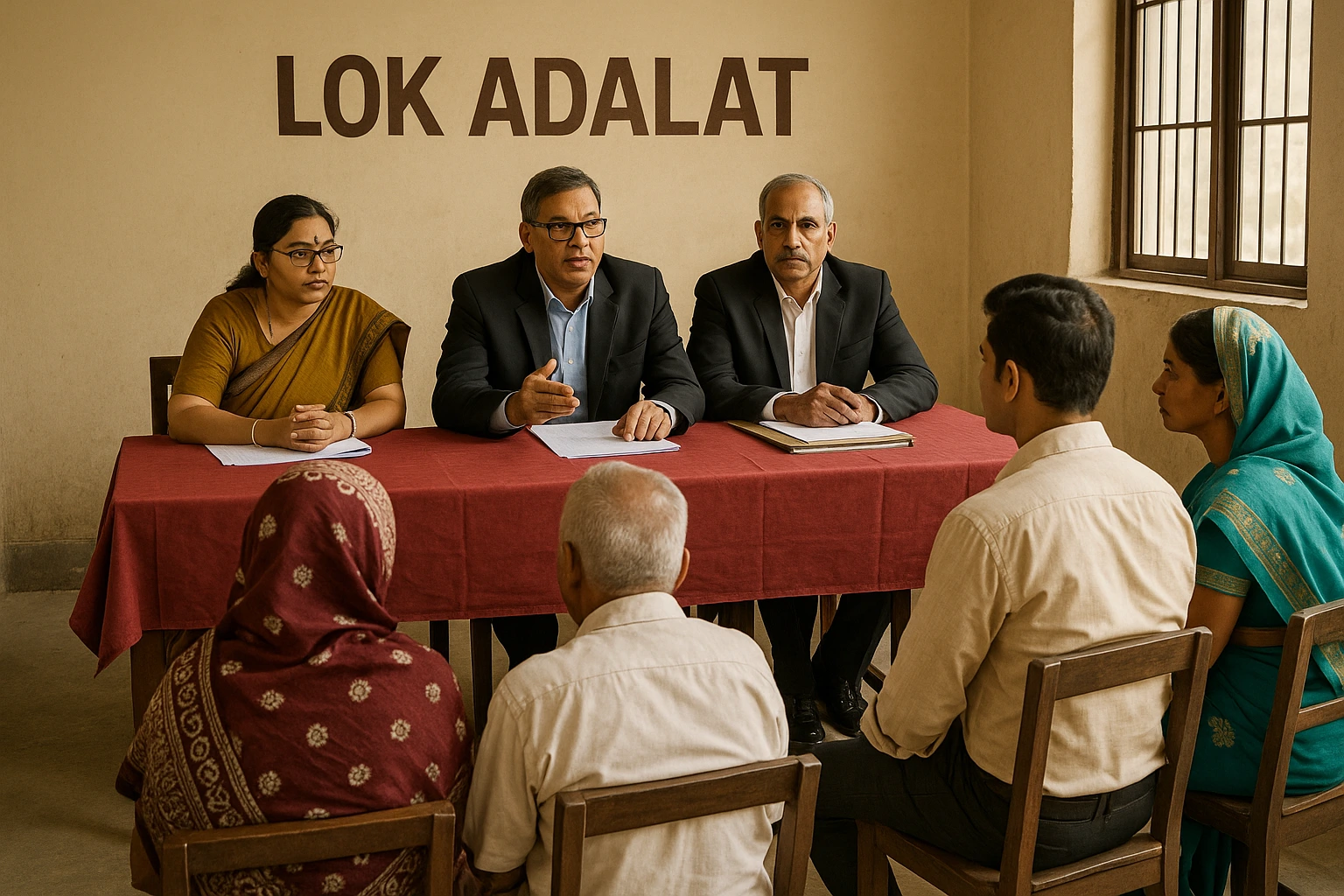
Lok Adalats Overview
Lok Adalats, or “people’s courts,” form an integral part of India’s alternative dispute resolution (ADR) mechanism, aimed at providing expeditious, cost-effective, and consensual resolution to disputes. Established under the Legal Services Authorities Act, 1987 (LSA Act), these forums encourage voluntary settlements between parties, reducing the burden on traditional courts. A key feature of Lok Adalat awards is their immutability, which ensures finality and discourages endless litigation. This article explores the statutory framework, authoritative judicial precedents with authentic citations, and limited exceptions for challenging such awards.
Statutory Framework And Finality
Section 21 of the LSA Act, 1987, constitutes the cornerstone governing Lok Adalat awards. The provision reads as under:
Section 21 Provisions
| Provision | Text |
|---|---|
| Section 21(1) | “Every award of the Lok Adalat shall be deemed to be a decree of a civil court or, as the case may be, an order of any other court and where a compromise or settlement has been arrived at, by a Lok Adalat in a case referred to it under sub-section (1) of section 20, the court-fee paid in such case shall be refunded in the manner provided under the Court-fees Act, 1870 (7 of 1870).” |
| Section 21(2) | “Every award made by a Lok Adalat shall be final and binding on all the parties to the dispute, and no appeal shall lie to any court against the award.” |
Legislative Intent
This provision underscores the legislative intent to promote swift justice by equating consensual settlements to enforceable judicial decrees, thereby preventing parties from reneging on voluntary agreements. The finality is premised on the consensual nature of the process—Lok Adalats do not adjudicate disputes like regular courts; instead, they facilitate compromises through conciliation and mediation.
Landmark Supreme Court Precedents Reinforcing Immutability
- Dilip Mehta v. Rakesh Gupta & Ors. 2025 SCC OnLine SC 2737, 2025 Supreme (SC) 2032 In this recent judgment, the Supreme Court comprehensively addressed the scope of challenging Lok Adalat awards. The Court set aside a High Court order that had entertained civil objections against a Lok Adalat award during execution proceedings. The Court held: “Section 21(2) of the 1987 Act unequivocally provides that every award made by a Lok Adalat shall be final and binding on all the parties to the dispute and no appeal shall lie to any court against the award. This finality attached to the award of the Lok Adalat is not merely procedural but substantive in nature… The executing court cannot entertain objections to the award or set it aside in execution proceedings.” The Court further clarified: “If the award is vitiated by fraud or coercion or if it suffers from any jurisdictional error, the remedy available to an aggrieved party is to approach the High Court under Articles 226/227 of the Constitution of India. Civil objections in execution proceedings do not constitute an efficacious alternative remedy.” The matter was remanded for reconsideration under writ jurisdiction on grounds of alleged fraud, emphasizing the constitutional route as the exclusive remedy.
- State of Punjab v. Jalour Singh & Ors. [(2008) 2 SCC 660, Civil Appeal No. 887 of 2006, decided on January 28, 2008] This pivotal case established that writ jurisdiction is the appropriate remedy when Lok Adalat awards are challenged on limited grounds. The Court invalidated a Lok Adalat order that was non-consensual and adjudicatory in nature. The Court observed: “A Lok Adalat has no adjudicatory or judicial function. It cannot pronounce any judgment or make any order. It can only help the parties to arrive at a compromise or settlement… Where there is no compromise or settlement arrived at between the parties, the Lok Adalat cannot make any award.” The judgment further stated: “No appeal lies against an award of a Lok Adalat. But if an order is made by a Lok Adalat in excess of jurisdiction or in violation of any provision of law, the High Court can exercise its power of judicial review under Articles 226/227 of the Constitution.” This case clarified that while awards based on genuine settlements are unassailable through ordinary appeals, writ jurisdiction allows intervention in cases of jurisdictional errors or absence of voluntariness.
- Bhargavi Constructions v. Kothakapu Muthyam Reddy & Ors. [(2017) 13 SCC 480, Civil Appeal No. 11184 of 2017, decided on October 19, 2017] The Supreme Court affirmed that civil suits challenging Lok Adalat awards are barred, and the exclusive remedy lies in constitutional writ jurisdiction. The Court held: “In view of the fact that the award passed by the Lok Adalat is deemed to be a decree of a civil court and is final and binding on the parties and no appeal lies against the same, a civil suit questioning the validity of the award on the ground of fraud is not maintainable.” The judgment emphasized: “The only remedy available to a party aggrieved by an award of the Lok Adalat is to approach the High Court under Articles 226/227 of the Constitution on the ground that the award is vitiated by fraud, coercion, or lack of jurisdiction.”
- Afcons Infrastructure Ltd. v. Cherian Varkey Construction Co. (P) Ltd. [(2010) 8 SCC 24, Civil Appeal No. 6905 of 2009, decided on July 27, 2010] This case reinforced the principle that Lok Adalat awards cannot be challenged in execution proceedings or through civil suits. The Court observed: “The Legal Services Authorities Act, 1987 is a complete code in itself… Section 21 of the Act makes it clear that every award of the Lok Adalat shall be deemed to be a decree of a civil court and shall be final and binding on all the parties to the dispute and no appeal shall lie to any court against the award.” The Court further stated: “If any party is aggrieved by the award on the ground of fraud or coercion, the only remedy available is to approach the High Court under Article 226 or 227 of the Constitution of India.”
- K. Shivaram v. Registrar General, High Court of Karnataka [(2019) 3 SCC 403, Civil Appeal No. 11498 of 2018, decided on January 23, 2019] This judgment dealt with the scope of challenging Lok Adalat awards when third parties are affected. The Court held: “Though ordinarily no appeal lies against the award of a Lok Adalat and the same is final and binding on the parties, in exceptional cases where the award affects the rights of third parties who were not parties to the proceedings before the Lok Adalat, or where the award is wholly without jurisdiction or is vitiated by fraud, the High Court can interfere under Articles 226/227 of the Constitution.”
- Dhannalal v. Kalawatibai [(2002) 6 SCC 16, Civil Appeal No. 5935 of 2000, decided on July 8, 2002] An early case establishing the finality principle, the Court observed: “Section 21 of the Legal Services Authorities Act clearly provides that an award made by a Lok Adalat shall be final and binding on all parties and no appeal shall lie against the award. This provision has to be given its full effect.”
Additional Supporting Case Law
- Kuntesh Gupta v. Vimal Kishor & Ors. [(2014) 12 SCC 758, Civil Appeal No. 2525 of 2014, decided on April 3, 2014] The Court reiterated: “The award of the Lok Adalat is final and binding and cannot be challenged by way of appeal or revision. The only exception is where the award is passed without jurisdiction or is vitiated by fraud or coercion, in which case the remedy is by way of writ petition under Articles 226/227 of the Constitution.”
- Gujarat State Road Transport Corporation v. Ramanbhai Prabhatbhai [(1987) 3 SCC 234, Civil Appeal No. 3455 of 1986, decided on August 11, 1987] Though predating the LSA Act, this case on Lok Adalats held: “The very purpose of the Lok Adalat is to arrive at a settlement or compromise, which would be binding on the parties. If parties are allowed to resile from the settlement, the entire purpose of the Lok Adalat would be frustrated.”
- Salem Advocate Bar Association v. Union of India [(2005) 6 SCC 344, Writ Petition (C) No. 464 of 2003, decided on July 15, 2005] While primarily concerning the constitutional validity of tribunals, the Court made important observations about ADR mechanisms: “Alternative Dispute Resolution mechanisms like Lok Adalats serve an important public purpose in reducing the burden on courts and providing quick, inexpensive justice. The finality of awards under these mechanisms is essential to their effectiveness.”
Limited Grounds for Challenge Through Writ Jurisdiction
Despite statutory finality, Lok Adalat awards are not entirely immune to scrutiny. The Supreme Court has consistently held that challenges are permissible only on narrow grounds:
Recognized Grounds
- Fraud or Misrepresentation: Where the award was obtained through fraudulent means
- Coercion or Duress: Absence of free consent
- Lack of Jurisdiction: Where the Lok Adalat exceeded its statutory powers
- Non-Consensual Awards: Where no genuine settlement was reached
- Violation of Fundamental Rights: In exceptional circumstances
- Affecting Third-Party Rights: Where non-parties’ interests are prejudiced
Evidentiary Burden
The party challenging a Lok Adalat award bears a heavy burden of proof. In Smt. Ganga Bai v. Vijay Kumar [(1974) 2 SCC 393], though not specifically about Lok Adalats, the Supreme Court held regarding compromise decrees:
“Fraud must be proved strictly and the burden of proving it lies heavily upon the person who alleges it. Mere suspicion of fraud is not enough.”
This principle applies equally to challenges against Lok Adalat awards.
Procedural Aspects and Practical Implications
Executing Court’s Limited Role
In Dilip Mehta (2024), the Court unequivocally stated:
“The executing court is bound to execute the award as a decree and cannot go behind the award or entertain objections questioning its validity. The finality attached to the award is not subject to the discretion of the executing court.”
Timeline for Challenges
While the LSA Act doesn’t prescribe a specific limitation period for writ petitions challenging Lok Adalat awards, courts have applied the doctrine of laches. Unreasonable delay in approaching the High Court may result in dismissal.
No Alternative Civil Remedies
The Supreme Court has consistently held that:
- Civil suits under Order 47 Rule 1 CPC (review) are not maintainable
- Applications under Section 151 CPC cannot be filed
- Execution objections under Order 21 CPC are impermissible
- Regular appeals under Order 41 CPC are statutorily barred
Constitutional Validity and Public Policy Considerations
The constitutional validity of Section 21(2) barring appeals has been upheld on several grounds:
1. Consensual Nature
Since Lok Adalat awards are based on mutual agreement, parties voluntarily forego their right to appeal. State of Punjab & Anr. v. Jalour Singh & Ors., AIR 2008, Supreme Court 1209.
It also careful perusal and scrutiny of the order dated 17th November, the Court noted:
“The object of the Legal Services Authorities Act is to provide free and competent legal services to the weaker sections of the society and to organize Lok Adalats to secure that operation of the legal system promotes justice on a basis of equal opportunity.”
2. Judicial Efficiency
The finality provision serves the constitutional mandate under Article 39A (free legal aid) and reduces pendency in regular courts.
Comparative Analysis: Lok Adalat vs. Arbitration Awards
Unlike arbitration awards under the Arbitration and Conciliation Act, 1996, which can be challenged under Section 34 before civil courts, Lok Adalat awards:
- Have no appellate remedy in civil courts
- Can only be challenged through constitutional writ jurisdiction
- Are based on conciliation rather than adjudication
- Carry court-fee refund benefits
- Are binding immediately without requiring court confirmation
Recent Developments and Emerging Jurisprudence
Impact of Digital Lok Adalats
With the advent of online dispute resolution, courts have extended the same finality principles to awards passed in virtual Lok Adalats, as evidenced in recent High Court decisions recognizing that the medium of settlement doesn’t affect the statutory finality.
Conclusion
Balancing Finality and Justice
The immutability of Lok Adalat awards under Section 21 of the LSA Act, 1987, serves vital public policy goals: expediting dispute resolution, decongesting courts, and promoting settlement culture. The Supreme Court’s consistent jurisprudence has established that:
- No ordinary appeals or civil remedies are available against Lok Adalat awards
- Writ jurisdiction under Articles 226/227 is the exclusive constitutional remedy
- Fraud, coercion, or jurisdictional errors are the limited grounds for challenge
Executing Courts Cannot Question the Validity of Awards
The burden of proof on challengers is stringent and substantial. As the Court observed in Afcons Infrastructure (supra):
“The Legal Services Authorities Act is a beneficial legislation intended to provide a forum for amicable settlement of disputes. The finality given to awards under Section 21 is essential to achieve the objectives of the Act. Any dilution of this finality would defeat the very purpose for which Lok Adalats were established.”
Parties must approach Lok Adalats with due diligence, understanding that consensual agreements carry the force of court decrees and are enduring, save for exceptional constitutional interventions. This framework enhances access to justice, reduces litigation costs, strengthens the ADR ecosystem, and reinforces the credibility of India’s alternative dispute resolution institutions while maintaining judicial oversight through constitutional safeguards against fraud and jurisdictional excess.

