





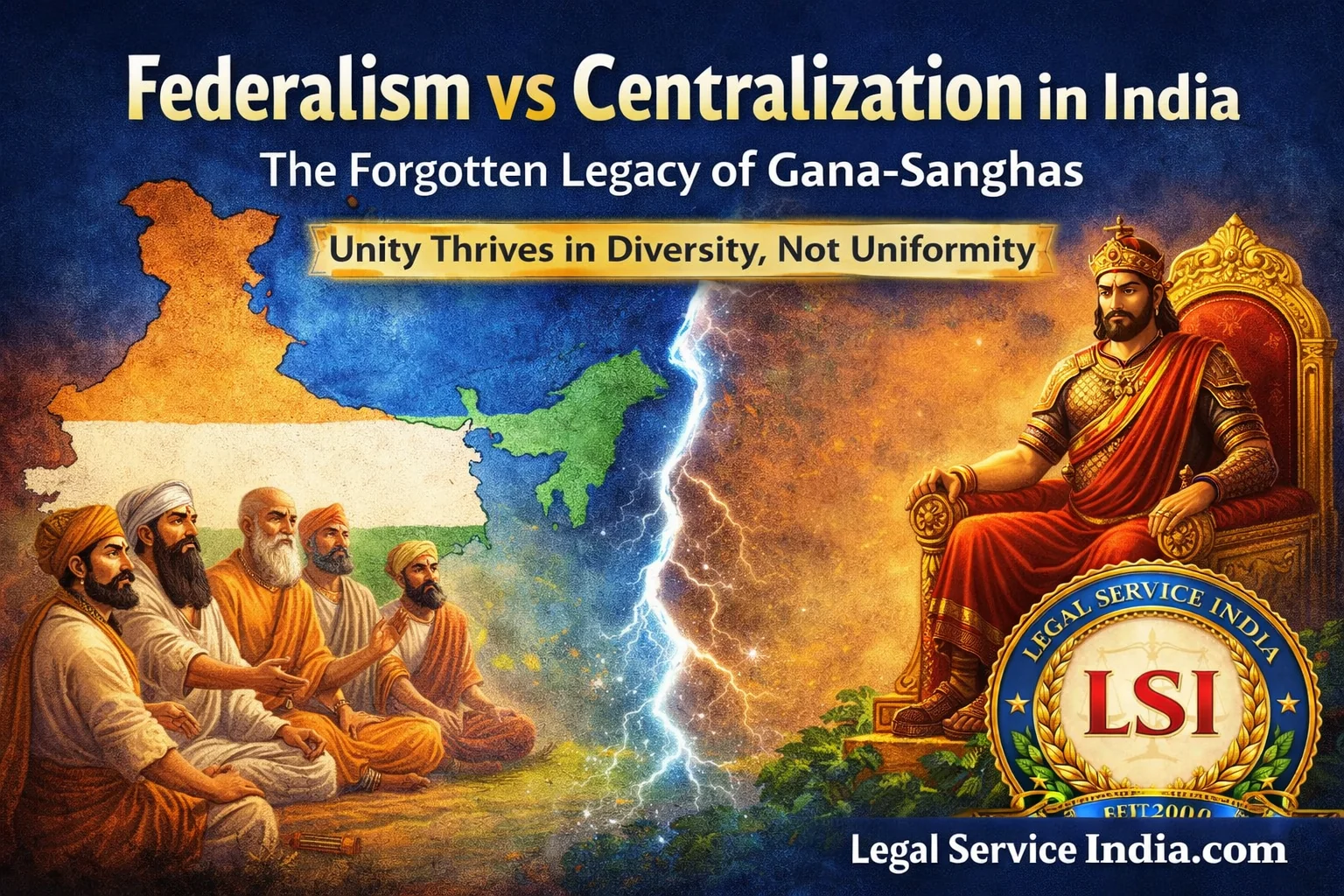
Introduction: The Illusion Of The Monolith
Today, we often see a dangerous trend where being ‘one nation’ is interpreted as being ‘identical’ in every state, from Kashmir to Kerala. In the current political discourse of India “unity” is often confused with “uniformity.”
- Misinterpretation of “one nation” as complete sameness
- Confusion between unity and uniformity in modern discourse
The India’s “Golden Age” was not explained by a single emperor, but through the legacy of Vrijji and Shakyas—ancient, decentralized, and participatory republics (Ganas/Sanghas).
The current scenario and critics of leftist tells us that for a nation to be strong internally, it must have one language, one tax, and one centralized command. However, if we go back to Indian history, we find that our “Golden Age” wasn’t built by an all-powerful emperor, but by a complex system of decentralized republics called as Gana-Sanghas.
- Argument for centralization: one language, one tax, one command
- Historical reality: decentralized Gana-Sanghas
These ancient entities prove that federalism is not a Western import, but an indigenous political survival strategy.
Indigenous Roots Of Consultative Governance
Even the Islam, which entered India thousands years before britishers came to India had in it the cousins of Gana and Sangha called as Majlis and Shaura.
- Majlis: An assembly where the “Argumentative” tradition happen
- Shaura: Means “consultation”
The Majlis works as an assembly where the “Argumentative” tradition happen and the Saura means “consultation.” It is the mandatory process where a leader must consult with the community or experts before making a decision.
The Caliph was not an absolute dictator. He was bound by Shura. The Vrijji republics had assemblies, Islamic history has the Shura. This proves that “Absolute Monarchy” is not the only traditional way to rule in the East—consultation is.
| Tradition | Institution | Function |
|---|---|---|
| Ancient Indian | Gana-Sangha | Participatory republic governance |
| Islamic Governance | Majlis | Deliberative assembly |
| Islamic Governance | Shura | Mandatory consultation in decision-making |
I. The Lost Democracy: Beyond The “Great King” Narrative
The resilient historical narrative of India is often a procession of powerful monarchical rulers —the Mauryas, the Guptas, and the Mughals. However, this focus on “The Great King” unclear a vital indigenous democratic tradition.
- Dominant narrative: powerful monarchies
- Overlooked reality: indigenous democratic systems
As K.P. Jayaswal illustrates in Hindu Polity (Page 25), these republics, such as the Lichchhavis of Vaishali, functioned under a constitution where the Gana (the Assembly) held supreme authority.
Dissimilar to the monarchies of the Gangetic heartland, the Gana-Sanghas rejected the “divine right” of a single ruler. They employed the Ashtakulaka, a judicial council representing eight different clans, to ensure that power was decentralized.
- Rejection of divine right monarchy
- Use of Ashtakulaka (judicial council)
- Representation across clans
This historical precedent is a powerful rebuttal to the claim that democracy is a foreign gift; it shows that India’s civilizational strength was originally rooted in local sovereignty.
II. The Arthashastra Vs. The Sangha: A Study In Political Subversion
The Clashes we see today between State Governments and the Central Government is 2,500 years old. On one side, you had the Gana-Sanghas (Republics), and on the other, the rising tide of Empire (Magadha).
- Gana-Sanghas: decentralized republics
- Magadha: centralized imperial expansion
However, this sovereignty was not without its enemies. The existential conflict between the “Center” and the “Periphery” is best viewed through the lens of Kautilya’s Arthashastra.
In Book XI, “The Policy toward Oligarchies” (Rangarajan Ed., Page 714), Kautilya explains the Sanghas (Republics) as the most difficult opponent to a king’s expansion.
His fear was not of their military might, but of their internal social integration. Because these republics were governed by harmony, they were difficult to manipulate from the outside.
- Strength: internal cohesion
- Weakness (from imperial view): hard to infiltrate
Kautilya’s solution was the use of Bheda—internal subversion and the sowing of dissension.
When modern central authorities bypass state legislatures or use financial leverage to sway regional leaders, they are executing this 2,000-year-old blueprint for the destruction of federalism.
III. The Socio-Economic Pluralism Of The Mahajanapadas
When the Kautilya pursued to break the republics for political control, their strength was embedded in their economic structure. The success of the ancient republics was indivisible from their economic integration. As Romila Thapar states in From Lineage to State (Page 78), these instructions appeared during the “Second Urbanization,” a period of explosive growth in trade.
Separating the rigid, varna-obsessed monarchies, the Gana-Sanghas were socially fluid centers of the Sramana movements, including Buddhism and Jainism. The economic power which they retained came from powerful trade guilds (Shrenis) that functioned independently.
Economic Foundations Of Gana-Sanghas
- Their strength was embedded in decentralized economic structures.
- Trade guilds (Shrenis) functioned independently.
- They flourished during the period of “Second Urbanization.”
- They supported socially fluid Sramana movements like Buddhism and Jainism.
It gives us a lesson that Federalism is an economic engine; the ancient republics expanded or flourished because they allowed local hubs to manage their own resources, proving that uniformity restrains innovation while pluralism or diversity encourages it.
IV. The “Argumentative” Legacy: Public Reason As A Tool Of State
Ultimately, this history of political and economic independence created a unique cultural temperament: the habit of debate. In The Argumentative Indian (Page 12), Amartya Sen posits that the foundation of Indian democracy is not just the ballot box, but the long-standing history of public reason and debate.
The Buddhist Sangha (monastic order) was directly modeled after the political structure of the Gana-Sanghas. It defines that “The Middle Path”—pursuing consensus through dialogue—is a political legacy.
Public Reason And Political Tradition
- Debate and dialogue formed the core of governance traditions.
- The Buddhist Sangha reflected republican political structures.
- “The Middle Path” emphasized consensus through dialogue.
Thus, securing the rights of states and regional voices is not a modern “liberal” obsession; it is a defense of a 2,500-year-old philosophical framework.
The Choice Before Us
Many critics today argue that “Federalism” or “Liberal Democracy” are Western imports imposed on India by the British or the 1950 Constitution. History proves them wrong.
The survival of the modern Indian Republic depends on our ability to return to the spirit of the Gana-Sangha—the assembly where every voice is heard. If we continue to favor the Kautilyan drive for a centralized monolith over the Vrijji tradition of collective deliberation, we risk losing the very diversity that has kept this civilization alive for millennia.
Historical Foundations Of Consultative Governance
- The history of India is not a history of absolute kings, but of consultative assemblies.
- The Buddhist Pali Canon, specifically the Mahaparinibbana Sutta, highlights the importance of assemblies.
- The Buddha praised the Vrijji confederacy for holding frequent public assemblies.
Even when we look at the Buddhist Pali Canon, specifically the Mahaparinibbana Sutta, we see the Buddha himself praising the Vrijji confederacy. He noted that as long as they “held full and frequent public assemblies,” they would prosper and not decline.
Continuity Of Council-Based Governance
| Era | Governance Model | Key Feature |
|---|---|---|
| Ancient India | Gana-Sangha | Assembly-Based Deliberation |
| Buddhist Tradition | Sangha | Consensus Through Dialogue |
| Sultanate Era | Shura/Majlis | Council-Based Governance |
Whether it was the Gana-Sangha of the Buddhists or the Shura/Majlis of the Sultanate era, the ‘Indian’ way of ruling was always through a council. The British brought a rigid, centralized bureaucracy that we have unfortunately inherited.
To save our democracy, we must return to the ‘Consultative Spirit’ that both ancient Vedic and Islamic traditions shared.
India is too vast and too diverse to be governed as a monolith. The attempt to erase regional identities in favor of a singular national identity ignores the very “assembly-based” DNA of our civilization. End Notes:
- Chapters IV to XII (The Gana-Sanghas and their constitutions).
https://www.google.com/search?q=https://archive.org/details/hindupolity032156mbp - Book XI : “The Conduct of Corporations”
https://www.google.com/search?q=https://archive.org/details/Arthasastra_English_Translation - “Romila Thapar, From Lineage to State”
https://dokumen.pub/from-lineage-to-state-social-formations-of-the-mid-first-millenium-bc-in-the-ganga-valley-new-ed-9780195626759.html - The Argumentative Indian
https://ia803109.us.archive.org/17/items/TheArgumentativeIndian_201805/The Argumentative Indian.pdf - S.M. Ikram, Muslim Civilization in India (Covers the pre-British Islamic era)
https://www.google.com/search?q=https://archive.org/details/muslimcivilizati0000ikra

