





Abstract
We live in an age where a Tweet travels faster than a court summons. Before a judge can even open a case file, millions of “jurors” on social media have already decided who is guilty, who is innocent, and who deserves the gallows. This article isn’t just a summary of the law; it’s a critique of the chaotic world of “Media Trials” in India. We dig into the clash between the Right to Know and the Right to a Fair Trial, explore the psychological pressure on judges, and analyze the brand-new 2024-2026 guidelines on police briefings. The question is simple: If the media declares the verdict at 9 PM, what is the point of the courtroom at 10 AM?
Introduction: The Courtroom You Can’t Appeal
Picture This
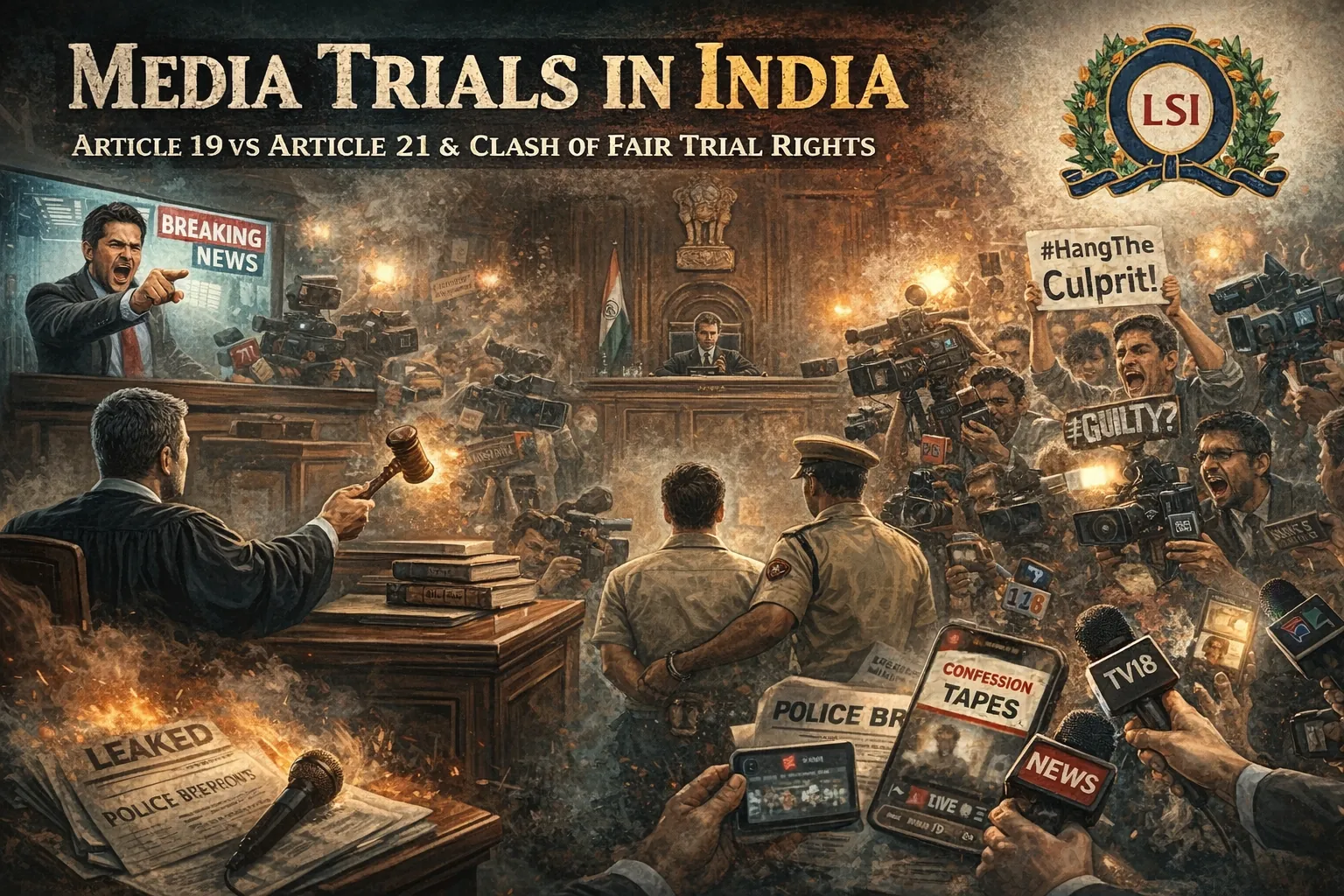
It’s Tuesday night. You’re scrolling through your phone. Suddenly, a notification pops up. “BREAKING NEWS.” A grainy photo of a man maybe a student, maybe a CEO flashes on the screen. The headline screams: “Is He The Monster?”
- Within ten minutes, #HangTheCulprit is trending.
- Within an hour, 50,000 people have tweeted about how he should be punished.
- By morning, his reputation is ash.
- He’s fired.
- His family is harassed.
- The neighbours are staring.
Here’s The Kicker
The police haven’t even filed a chargesheet yet. The forensic report? Pending. The judge? Hasn’t even seen the accused.
But none of that matters. In the court of public opinion, the verdict is already out. The gavel has banged, but it wasn’t held by a judge it was held by a news anchor shouting over a panel of six confused experts.
This Is The Reality Of The “Instant Media Trial”
As law students, we spend years studying the sacred principle of Ei incumbit probatio qui dicit[1] the burden of proof lies on the accuser. We are taught that the “Presumption of Innocence” is the golden thread that holds criminal law together. But let’s be real for a second. In 2026, that principle feels like an antique. It feels like something that belongs in a museum, not on Twitter (X). The presumption of innocence is slowly being strangled by the presumption of guilt-by-hashtag.
The Constitutional Fistfight: Article 19 vs. Article 21
To understand why this is happening, you have to look at the tension at the very heart of our Constitution. It’s essentially a boxing match between two heavyweight Fundamental Rights.
In The Blue Corner, We Have Article 19(1)(a)
This is the Freedom of Speech and Expression. It gives the press the right and the duty to report the news, expose corruption, and question authority. Without this, democracy dies in darkness. We need this.
In The Red Corner, We Have Article 21
This guarantees the Right to Life and Personal Liberty. The Supreme Court has repeatedly said that a “Fair Trial” is the heart and soul of Article 21. A fair trial means a trial free from bias, free from prejudice, and free from a mob screaming for blood outside the courthouse.
When The Rights Collide
The problem arises when the Blue Corner decides to knock out the Red Corner for higher ratings. When a news channel stops reporting facts (“The police have arrested X”) and starts spinning narratives (“X looks like a killer, just look at his eyes!”), they are essentially stripping a citizen of their constitutional armor. They are selling Article 21 for TRPs (Television Rating Points).
The Mechanism of Chaos: How A Media Trial Actually Works
How do we get from a simple arrest to a nationwide witch-hunt? It’s not accidental. It’s a manufactured process that relies on three specific, dirty tactics.
The “Leak” Economy
This is the open secret of legal journalism in India. Police and investigative agencies often “leak” selective details to friendly reporters. Why? To look competent. To show they are “cracking the case.”
The problem is that these leaks are often half-truths. A suspect might admit to being at the scene of a crime, but the leak will say they “confessed to the murder.” By the time the actual statement reaches the Magistrate, the public narrative is set in stone. The police look like heroes, and the accused looks like a villain, regardless of the truth.
The Digital Mob And The Algorithm Of Rage
It’s not just TV anymore. Social media algorithms prioritize anger. A tweet saying “Let’s wait for the evidence, guys” gets 5 likes. A tweet saying “This monster deserves the worst punishment!” gets 5,000 retweets.
The incentive structure of the internet rewards hysteria. This creates a feedback loop:
- The public gets angry
- The news channels become more aggressive to please the public
- The public becomes even angrier
It’s a machine designed to destroy nuance.
The Myth Of The “Police Confession”
This is where legal literacy fails the general public. Every law student knows Section 25 of the Indian Evidence Act (now reflected in the Bharatiya Sakshya Adhiniyam, 2023). It states clearly: A confession made to a police officer cannot be proved against a person accused of any offense.
| Public Perception | Legal Reality |
|---|---|
| “He admitted it on TV — case closed.” | A police confession is legally inadmissible. |
| “Confession tape proves guilt.” | The tape has no evidentiary value in court. |
| “Why would police lie?” | Law assumes possibility of coercion, threat, or pressure. |
Why? Because police can coerce, beat, or threaten suspects into confessing. Yet, night after night, we see channels flashing “CONFESSION TAPES.” The public thinks, “Oh, he admitted it!”
The reality? That tape is legally worthless garbage. But the damage is done. The viewer believes the case is closed.
The Human Element: Judges Are Not Robots
We like to think of judges as supercomputers objective, emotionless, and purely logical. But we forget that judges are human beings. They go home, they watch TV, they have WhatsApp groups. They live in the same society we do.
In the famous case of P.C. Sen (In Re)[2], the Supreme Court admitted something terrifying: judges are susceptible to the “subconscious effect” of media pressure.
Imagine you are a judge handling a high-profile murder case. Every newspaper, every channel, and every person on the street believes the accused is guilty. If you look at the evidence and find it weak, acquitting the accused requires an immense amount of courage. You know you will be vilified. You will be called “corrupt.” You will be mocked on prime time. This pressure can subtly tilt the scales of justice. When the mob is banging on the doors of the courthouse, it’s hard to hear the quiet voice of the law.
A Tale of Two Trials: The Hero And The Villain
To be fair, the media isn’t always the villain. Sometimes, they are the only reason justice happens. But the line between “Activism”[3] and “Vigilantism”[4] is razor-thin.
The Hero Arc: Jessica Lal[5]
We all know the story. Manu Sharma, the son of a powerful politician, shot model Jessica Lal. The trial court initially acquitted him because witnesses turned hostile (likely due to fear or bribes). The system failed.
Here, the media stepped up. They didn’t invent evidence; they highlighted the suppression of evidence. The “Justice for Jessica” campaign shamed the system into correcting itself. The High Court eventually convicted him. This was media activism at its finest shining a light on a dark corner.
The Horror Story: The Talwars
Then came the Aarushi Talwar-Hemraj double murder case. This remains the darkest stain on Indian journalism. When a 14-year-old girl was found dead, the media turned her parents into villains based on pure gossip.
- They analyzed their facial expressions (“Why aren’t they crying enough?”).
- They speculated about their private lives.
- They floated grotesque theories about honor killings with zero proof.
The media decided the parents were guilty years before the trial concluded. It was a spectacle of cruelty that destroyed a grieving family. As the Allahabad High Court later noted when acquitting them, the case was rife with breathless sensationalism rather than hard evidence. The media didn’t want justice; they wanted a story.
The Legal Shield: What Does The Law Say?
The Courts haven’t been silent. They have watched this circus unfold and have tried to intervene, drawing lines in the sand.
The Red Line: R.K. Anand v. Delhi High Court[6]
In this landmark judgment, the Supreme Court laid down the “Lakshman Rekha.” They held that while the media has the right to expose errors in an investigation, they cannot run a parallel trial that prejudices the accused. The freedom of the press is not a license to interfere with the administration of justice.
The 2024-2026 Shift: Controlling The Source
This is the most critical update for any law student writing on this topic today. The judiciary realized they couldn’t control millions of YouTubers. So, they decided to control the source of the information: the Police.
Recently, following a petition regarding “Media Trials,” the Supreme Court directed the Union Ministry of Home Affairs to prepare a comprehensive manual on “Police Briefings.” This was a long time coming. The new directive is clear and strict:
- Police cannot parade accused persons before the media like trophies.
- Briefings must be factual (“We have arrested X”), not speculative (“We think X is a cold-blooded psycho”).
- Revealing vital evidence to the media before the court sees it is now a strict violation.
This is a game-changer. It shifts the blame from the journalist to the police officer who leaks the info. If you cut off the supply of sensational leaks, you starve the media trial of its fuel. It forces the police to do their job in the station, not on the TV screen.
The New Era: BNS And BNSS
We also have to talk about the new criminal laws—the Bharatiya Nyaya Sanhita (BNS) and the Bharatiya Nagarik Suraksha Sanhita (BNSS). These new codes place a massive emphasis on digital evidence and timelines. With trials supposed to be faster under the new laws, the window for a “media trial” theoretically shrinks. But the danger is that digital evidence (like WhatsApp chats) is easily leaked and easily misunderstood by the public. The law has changed, but human nature hasn’t. We still love a scandal more than we love the truth.
Conclusion: Can We Turn Down The Volume?
So, where does that leave us? Is the presumption of innocence dead?
It’s not dead, but it is definitely in the ICU. The digital age has democratized information, but it has also democratized the power to destroy reputations.
As future lawyers, our job is going to be harder than that of the previous generation. We won’t just be fighting opposing counsel in a courtroom; we will be fighting narratives on Twitter. We will have to remind our clients, and the world, that justice is not instant. Justice is a slow, boring, painful process of sifting truth from lies. It’s about reading 500 pages of documents, not reading a 280-character post.
If we want to save the presumption of innocence, we need to stop treating high-profile trials like reality TV shows. We need to stop clicking, stop sharing unverified “breaking news,” and learn to wait for the gavel to bang.
Because today, it’s someone else on that screen. Tomorrow, it could be you.
And trust me, if that happens, you won’t want a million people voting on your guilt with a “Like” button. You will want a judge, a lawyer, and the silence of a real courtroom. That silence is where justice lives. End Notes:
- The burden of proof lies upon him who declares (or asserts), not on him who denies
- P.C. Sen (In re)
AIR1970SC1821 - The policy or action of using vigorous campaigning to bring about political or social change.
- law enforcement undertaken without legal authority by a self-appointed group of people
- Siddhartha Vashisht @ Manu Sharma v. State (NCT of Delhi)
CRIMINAL APPEAL NO. 224 OF 2007 - R.K. Anand v. Delhi High Court
(2009) 8 SCC 106
Written By: Akansha Toppo, Law Student at National Law Institute University

