- Introduction
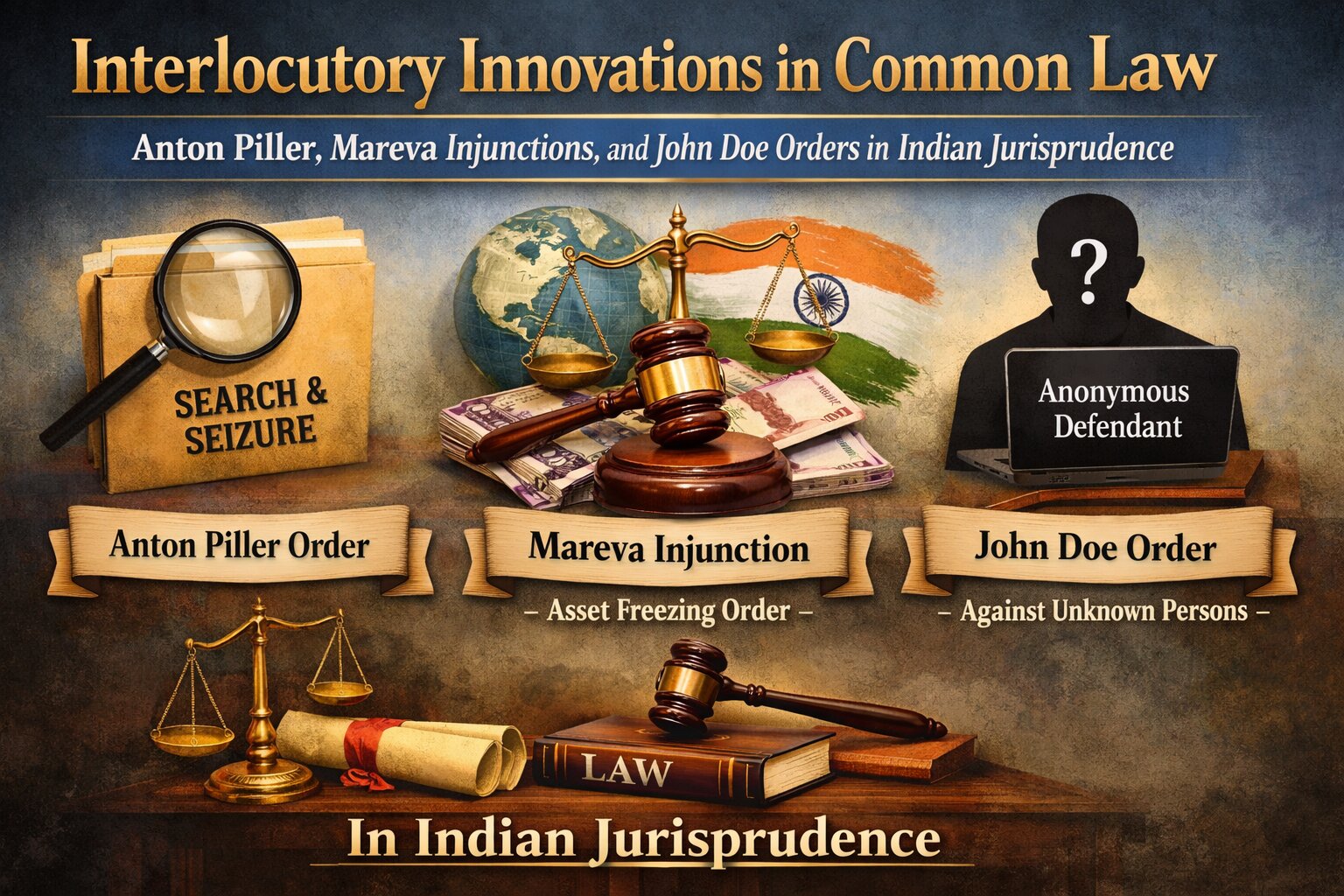
The evolution of interlocutory remedies reflects the judiciary’s constant effort to ensure that justice is not defeated by delay, concealment, or anonymity. Among the most potent of such remedies are the following:
- Anton Piller Orders (search and preservation of evidence)
- Mareva Injunctions (freezing of assets)
- John Doe Orders (injunctions against unknown defendants)
Though originating in English law, these remedies have been creatively adapted by Indian courts to meet modern challenges—especially in commercial litigation, fraud, and intellectual property enforcement.
Anton Piller Orders: Preservation of Evidence
- Origin and Evolution: The concept derives from – Anton Piller KG v. Manufacturing Processes Ltd
This landmark ruling recognized that in exceptional cases, justice requires immediate intervention to prevent destruction of vital evidence.
- Concept and Nature: An Anton Piller order is a civil search order that permits the plaintiff (under court supervision) to:
- Enter the defendant’s premises
- Inspect and copy documents
- Seize or preserve incriminating material
It is:
- Ex parte (without notice)
- Preventive, not punitive
- Executed under strict judicial safeguards
- Essential Conditions: Courts typically require:
- Strong prima facie case
- Serious potential or actual damage
- Clear evidence that the defendant possesses incriminating material
- A real possibility of destruction or concealment
- Safeguards: Given its intrusive nature, courts impose safeguards.
- Presence of an independent commissioner
- No use of force
- Respect for privacy and privilege
- Detailed inventory of seized materials
- Indian Position: Indian courts have embraced Anton Piller–type relief under
- Section 151 CPC (inherent powers)
- Order XXXIX Rules 1 & 2 CPC
Frequently used in:
- Copyright piracy
- Trademark infringement
- Trade secret theft
Courts emphasize proportionality and caution to prevent abuse.
Mareva Injunctions: Freezing of Assets
- Origin: Developed in – Mareva Compania Naviera SA v. International Bulkcarriers SA
This innovation addressed the risk of defendants dissipating assets to frustrate judgments.
- Concept and Scope: A Mareva An injunction restrains a defendant from
- Transferring assets
- Withdrawing funds
- Moving property beyond jurisdiction
It ensures that a future decree is not rendered meaningless.
- Key Requirements: Courts require:
- A good arguable case
- Defendant’s assets within jurisdiction
- A real risk of asset dissipation
- Balance of convenience favouring the plaintiff
- Indian Equivalent: While not expressly codified, similar relief exists under:
- Order XXXVIII Rule 5 CPC (attachment before judgment)
- Section 151 CPC
Indian courts have effectively applied Mareva principles in
- Commercial disputes
- Recovery suits
- Fraud and misappropriation cases
- Judicial Safeguards:
- Orders must not be oppressive or excessive
- The defendant must retain funds for basic living and business expenses
- Full and frank disclosure by the plaintiff is mandatory
John Doe Orders: Injunctions Against Unknown Defendants
- Origin and Indian Adaptation: Known globally as “John Doe” orders and in India as “Ashok Kumar” orders, they gained recognition in cases such as Taj Television Ltd v. Rajan Mandal
- Concept: A John Doe Order is issued against: Unknown or unidentified defendants
It empowers authorities to act against any person found violating the plaintiff’s rights.
- Purpose
- Prevent anticipated infringement
- Combat mass piracy and anonymous wrongdoing
- Provide immediate and broad protection
- Application in India: Widely used in:
- Film piracy prevention
- Sports broadcasting rights
- Digital content protection
Courts may:
- Block websites
- Restrain cable operators
- Authorize search and seizure
- Concerns and Safeguards
While blocking orders are powerful tools for protecting intellectual property, they carry significant risks of “digital collateral damage.” To prevent overreach, modern jurisprudence has shifted from broad mandates to a more disciplined, rights-based approach.
Core Concerns
The primary tension in enforcing blocking orders lies in the balance between property rights and public interest.
- Risk of Overbroad Blocking: Improperly defined orders (such as blocking an entire IP address instead of a specific URL) can lead to “over-blocking.” This inadvertently shuts down legitimate websites or services that happen to share the same server infrastructure as the infringing content.
- Impact on Free Speech and Information Access: The internet is a primary medium for expression. Excessive or permanent blocking can act as a form of “prior restraint,” stifling lawful discourse and preventing users from accessing non-infringing information, which may violate constitutional or fundamental digital rights.
Modern Judicial Safeguards
To mitigate these risks, courts now move away from “set and forget” injunctions, instead insisting on the following three pillars:
|
Requirement |
Description |
|
Greater Specificity |
Orders must target precise URLs or specific file paths rather than entire domains. This ensures the “surgical” removal of illegal content without wounding the surrounding digital ecosystem. |
|
Periodic Review |
Blocking orders are no longer indefinite. Courts often require rights holders to return periodically to prove that the infringement is ongoing and that the block remains necessary and effective. |
|
Proportional Enforcement |
The remedy must be “proportionate” to the harm. Courts weigh the severity of the copyright infringement against the potential burden placed on Internet Service Providers (ISPs) and the rights of innocent third-party users. |
Key Takeaway: The goal of modern safeguards is to ensure that the “shield” of copyright protection does not become a “sword” that cuts off legitimate access to the open web.
Comparative Analysis
|
Feature |
Anton Piller Order |
Mareva Injunction |
John Doe Order |
|
Objective |
Preserve evidence |
Freeze assets |
Restrain unknown wrongdoers |
|
Nature |
Search & seizure |
Asset restraint |
Blanket injunction |
|
Target |
Known defendant |
Known defendant |
Unknown defendants |
|
Risk Addressed |
Destruction of evidence |
Dissipation of assets |
Anonymous infringement |
|
Legal Basis (India) |
Sec. 151, O39 CPC |
O₃₈ R₅ CPC |
Sec. 151 CPC |
Judicial Philosophy in India
Indian courts approach these remedies with measured caution and creativity:
- Balancing Competing Interests
- Plaintiff’s right to protection
- Defendant’s right to privacy and fairness
- Public interest (especially in John Doe orders)
- Principles Applied
- Prima facie case
- Balance of convenience
- Irreparable injury
- Proportionality
- Increasing Judicial Sophistication
Courts are evolving:
- From mechanical grants → to structured scrutiny
- From broad orders → to tailored relief
- From reactive → to preventive justice
Contemporary Relevance
In the digital and globalized era, these remedies are crucial:
- Anton Piller → combats data destruction and cyber fraud
- Mareva → prevents cross-border asset flight
- John Doe → tackles online piracy and anonymous violations
They represent a shift from passive adjudication to proactive justice.
Conclusion: Towards a Proactive Jurisprudence
The evolution of Anton Piller, Mareva, and John Doe orders represents a transformative shift in Indian law—from passive adjudication to a regime of proactive justice. These innovations ensure that:
- Evidence is not rendered ephemeral through destruction.
- Assets are not insulated from recovery through flight or dissipation.
- Justice is not defeated by the shield of digital anonymity.
As we move deeper into the digital age, the “John Doe” order has further birthed the “Dynamic Injunction.” This recent judicial advancement allows a single order to automatically extend to “mirror” or “redirect” websites that spring up to bypass original blocking mandates. It exemplifies the Indian judiciary’s refusal to let the law be outpaced by technological evasion.
However, the extraordinary nature of these remedies demands a high degree of judicial discipline. The transition from broad, “set-and-forget” mandates to a proportional, rights-based approach ensures that the “shield” of legal protection for a plaintiff does not inadvertently become a “sword” that cuts off public access to the open web. Ultimately, these interlocutory innovations embody a core principle of modern jurisprudence:
“The law must not only provide a remedy—it must ensure that the remedy remains as agile and effective as the challenges it seeks to address.”