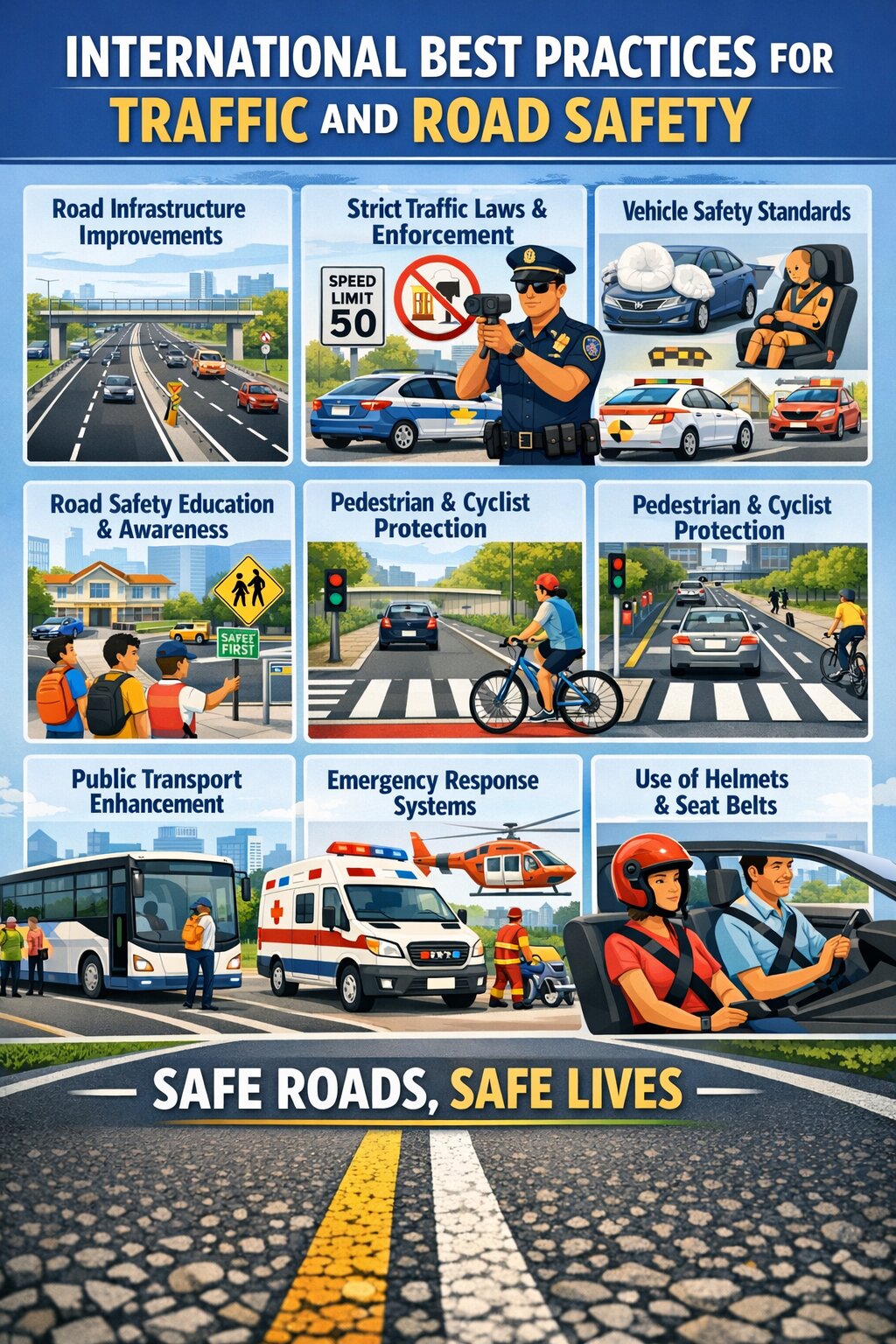
Road traffic injuries constitute one of the world’s most serious yet preventable public health crises. Each year, more than 1.19 million people lose their lives on roads globally, while tens of millions suffer serious, often life-altering injuries. The World Health Organization (WHO) consistently emphasizes that these deaths are not inevitable—they are the result of system failures that can be addressed through evidence-based policies, engineering, and governance.
Over the past three decades, leading countries have moved away from blaming individual road users and toward a system-based understanding of safety, recognizing that human error is inevitable and that the transport system must be designed to prevent such errors from resulting in death or serious injury.
The Safe System Approach: A Global Paradigm Shift
At the heart of international best practice lies the Safe System Approach, also known as Vision Zero (Sweden) or Sustainable Safety (the Netherlands). This framework now underpins road safety policy in countries such as Sweden, the Netherlands, Australia, Norway, and the United Kingdom, and it aligns with the UN Decade of Action for Road Safety 2021–2030, which seeks to halve global road deaths and injuries by 2030 through the WHO Global Plan.
The Safe System Approach rests on four core principles:
- No loss of life or serious injury is acceptable on the road network.
- Humans make mistakes and are physically vulnerable.
- Responsibility is shared between road users and system designers.
- Speed management is fundamental, as crash energy determines injury severity (for example, pedestrian survival drops sharply above 30 km/h).
In practice, this means designing forgiving roads, safer vehicles, and policies that anticipate error. Sweden’s redesigned intersections prioritize pedestrians and cyclists, while Dutch “self-explaining roads” clearly signal appropriate speeds and behaviors through design alone. As a result, these countries record among the world’s lowest road fatality rates, often around 2–3 deaths per 100,000 inhabitants.
Pillar 1: Road Safety Management and Leadership
Strong institutional leadership is essential for sustained safety gains. International best practices include:
- A designated lead road safety agency with authority to coordinate transport, health, police, and urban planning sectors.
- National road safety strategies with ambitious, measurable targets—often aiming for zero deaths.
- Data-driven policymaking, supported by comprehensive crash databases and analytical tools such as the International Road Assessment Programme (iRAP).
- Adoption of ISO 39001, the global standard for road traffic safety management systems.
Countries like Australia and the UK demonstrate the value of continuous performance monitoring and accountability through regular strategy reviews and public reporting.
Pillar 2: Safer Roads and Infrastructure
Engineering interventions deliver some of the most reliable safety outcomes. Key global practices include:
- Speed management through lower urban speed limits (30 km/h where vehicles mix with pedestrians and cyclists) and traffic calming measures such as speed humps, chicanes, and roundabouts.
- Separation of traffic, including protected cycling lanes, pedestrian refuges, median dividers, and Sweden’s innovative 2+1 roads, which dramatically reduce head-on collisions.
- Clear zones, ensuring roadsides are free of hazardous obstacles.
- Road safety audits and inspections conducted at design, construction, and operational stages.
The European Union and Australia prioritize systematic upgrades of high-risk corridors, producing substantial and sustained reductions in serious crashes.
Pillar 3: Safer Vehicles
Vehicle safety regulation has been a major contributor to declining fatality rates in high-income countries. Best practices include:
- Mandatory safety technologies such as seatbelts, airbags, ABS brakes, and electronic stability control.
- Independent consumer information programs like Euro NCAP, which incentivize manufacturers to exceed minimum standards.
- Promotion of Advanced Driver Assistance Systems (ADAS), including automatic emergency braking, lane-keeping assistance, and intelligent speed assistance.
Countries such as Sweden and Australia further reinforce safety by requiring high safety ratings for government and commercial vehicle fleets, accelerating market-wide improvements.
Pillar 4: Safer Road Users and Behavior
While system design is paramount, user behavior remains critical. Effective international strategies include:
- Graduated driver licensing systems that reduce novice driver exposure to high-risk situations.
- Strict laws on seatbelts, helmets, and child restraints, with high compliance.
- Sustained public education campaigns addressing speeding, alcohol, drugs, and distracted driving.
Australia’s hard-hitting mass media campaigns and the Netherlands’ strong focus on protecting cyclists and pedestrians demonstrate how messaging, when aligned with enforcement, can reshape social norms.
Pillar 5: Enforcement and Speed Management
High-performing countries combine strong laws with consistent enforcement:
- Low blood alcohol concentration (BAC) limits, typically 0.05% or lower, and zero tolerance for novice drivers.
- Widespread use of automated enforcement, including speed and red-light cameras.
- Random breath testing, which has proven highly effective in deterring drink-driving.
When enforcement is predictable, fair, and visible—supported by public communication—it produces long-term behavioural change.
Pillar 6: Post-Crash Response
Even with prevention, crashes still occur. Best practices focus on minimizing their consequences through:
- Universal emergency access numbers (such as 112 across much of Europe).
- Well-integrated trauma care systems, from first responders to specialized hospitals.
- Post-crash data analysis and linkage, enabling continuous system improvement.
Rapid response and high-quality trauma care significantly reduce fatalities and long-term disability.
Lessons from Leading Countries
- Sweden: The pioneer of Vision Zero, Sweden has more than halved road deaths since 1997 through speed management, infrastructure redesign, and strong political commitment.
- The Netherlands: Its Sustainable Safety model, combined with world-class cycling infrastructure, results in exceptionally low fatality rates despite high levels of cycling.
- Australia: Known for rigorous enforcement, strong vehicle standards, and targeted rural road interventions, Australia has achieved major reductions in serious crashes over time.
A common thread among these countries is long-term investment, robust data systems, multisectoral coordination, and proactive engineering rather than reactive measures.
The Indian Context
For India, the lessons from international best practices are particularly relevant. With over 150,000 road fatalities annually, the country faces one of the highest burdens of traffic injuries worldwide. According to WHO estimates, India’s road traffic death rate is around 22 per 100,000 population, compared to Sweden’s approximately 3 per 100,000 population—meaning India’s fatality rate is nearly seven times higher than that of Sweden.
Integrating the Safe System Approach into national and state-level strategies—through the Ministry of Road Transport and Highways (MoRTH), State Road Safety Boards, and Smart City initiatives—can transform outcomes. Prioritizing speed management in urban areas, systematic road audits, mandatory adoption of advanced vehicle safety technologies, and strengthening post-crash trauma care are critical steps. By localizing proven global interventions within India’s diverse transport ecosystem, policymakers can move decisively toward reducing fatalities and achieving sustainable mobility.
Conclusion: Toward a Safer Future
Global evidence confirms a clear truth: road deaths are preventable, not inevitable. The Safe System Approach, now adopted by leading nations and endorsed by the WHO Global Plan for Road Safety, offers a scientifically grounded, ethically sound, and operationally proven framework to save lives.
By prioritizing safer speeds, forgiving infrastructure, safer vehicles, effective enforcement, and high-quality post-crash care—and by learning from pioneers like Sweden, the Netherlands, and Australia—countries across income levels can move decisively toward zero road fatalities. Road safety is not just a moral imperative; it is a realistic and achievable public policy goal with profound human and economic benefits.
Call to Action: Localize Global Lessons, Save Lives
India stands at a critical juncture. With one of the highest road fatality burdens in the world, incremental measures are no longer sufficient—the moment demands bold, systemic transformation. International best practices provide a proven blueprint, but their success in India will depend on thoughtful adaptation to local realities.
To achieve meaningful change, India’s policymakers, enforcement authorities, planners, public health leaders, and civil society must collectively champion and operationalize the Safe System Approach within the country’s rapidly evolving mobility framework. Strategic investments in safer infrastructure, rigorous enforcement of life-saving laws, modernization of vehicle safety standards, and the strengthening of trauma and emergency care systems are essential to this transformation.
Through coordinated action and sustained political commitment, India can convert its roads from high-risk corridors into networks of safety and mobility. The imperative is clear: every life saved strengthens public health, advances social justice, and contributes to national development.
Safer roads are possible—if we act now.