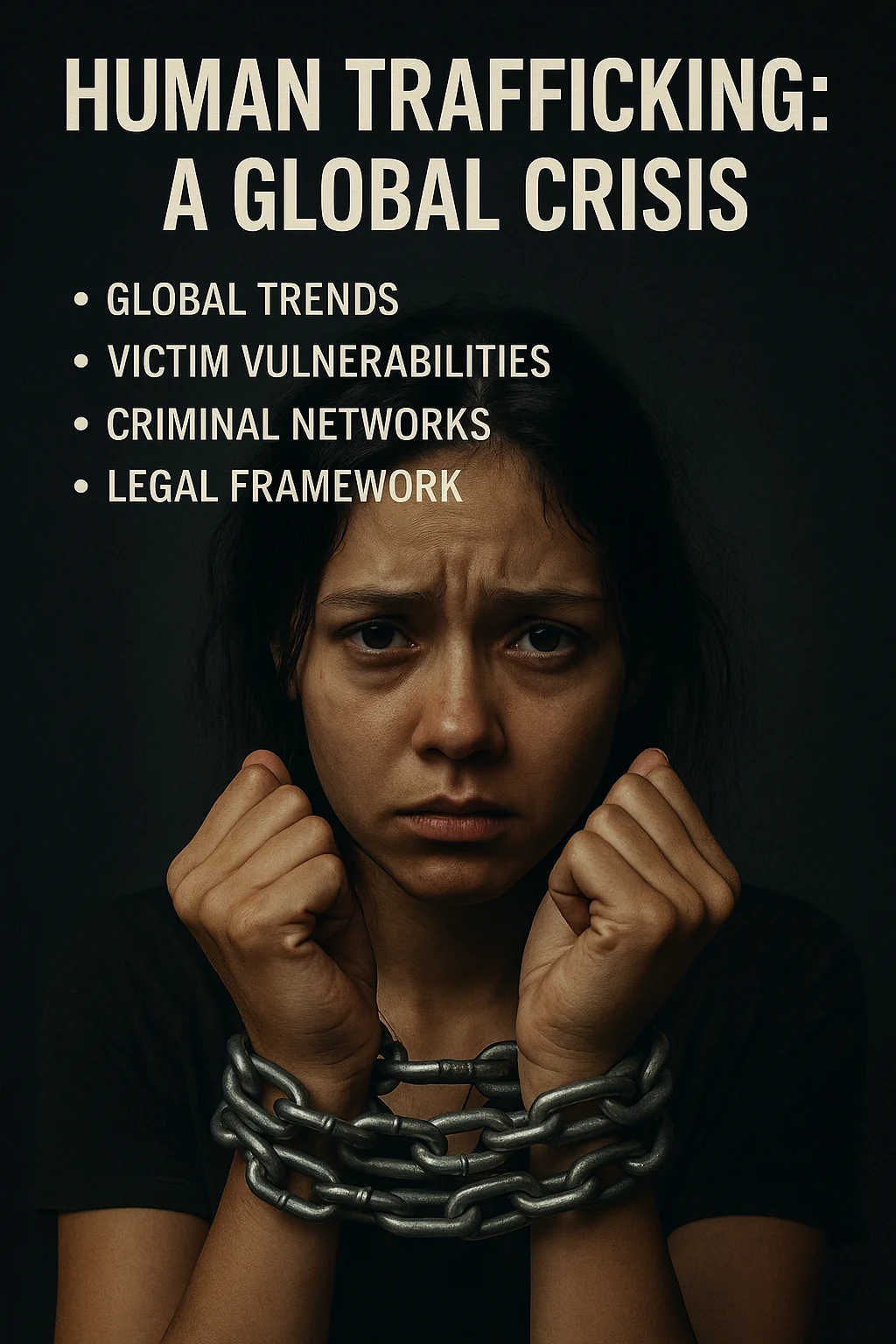
Human Trafficking: A Global Crisis
Human trafficking remains one of the world’s most pervasive and profitable criminal industries. It thrives on vulnerability, is sustained by global demand for cheap labour and sexual services, and persists despite decades of international legal development. Although precise figures are hard to obtain due to the hidden nature of the crime, enough data exists to demonstrate its alarming scale and complexity.
The Global Picture: A Hidden Crime with Massive Profits
International estimates suggest that about 800,000 people are trafficked across borders every year, but only around 5% of victims are ever identified. In one recent year, approximately 40,000 victims were formally recognized worldwide, leaving the overwhelming majority undiscovered and continuously exploited.
Human trafficking is also extraordinarily lucrative. The global trade generates profits of roughly US$31 billion annually, making it one of the world’s largest criminal enterprises.
Movements into Europe illustrate the magnitude of the problem. Around 250,000 people entered the EU illegally, and while not all were trafficked, a significant number were aided by traffickers or smugglers. In the UK, more than 2,000 victims were identified in a single year, though the real number is certainly far higher.
| Key Statistic | Figure |
|---|---|
| People trafficked across borders annually | 800,000 |
| Identified victims globally (one year) | 40,000 |
| Estimated annual profits | US$31 billion |
| Illegal entries into EU (not all trafficked) | 250,000 |
| Identified victims in the UK (one year) | 2,000+ |
Who Is Trafficked — and Why?
Victims
Most victims are women and children. Evidence indicates that roughly 80% are female, and about half are children, with many between 18 and 24 years old. They come from regions facing poverty, discrimination, conflict, or natural disasters — conditions that leave them vulnerable to false promises of work or safety.
Common Origin Regions
- Central, Eastern, and Southern Europe (e.g., Russia, Moldova, Ukraine)
- East and Southeast Asia (e.g., China, Thailand, Vietnam)
- West and Central Africa (e.g., Nigeria)
Yet trafficking is not only a cross-border problem. UK nationals are trafficked internally to major cities, or even abroad, for sexual exploitation or forced labour.
Traffickers
Traffickers are not confined to stereotypes. About 52% are men, 42% women, and 6% operate jointly. Women frequently participate because victims, especially children and female victims, are more likely to trust them.
Networks vary: some traffickers belong to organized criminal groups — such as Chinese snakehead gangs, Japanese Yakuza, or Eastern European mafias — while others act as families, acquaintances, or local recruiters. The involvement of familiar individuals magnifies victims’ trauma and complicates detection.
Why Trafficking Happens: Push and Pull Factors
Push Factors in Origin Countries
- Poverty and lack of economic opportunity
- Gender inequality and discriminatory social structures
- Humanitarian emergencies such as war or persecution
- Natural disasters, like the 2004 tsunami, after which traffickers targeted separated children
Pull Factors in Destination Countries
- High demand for commercial sex
- Demand for cheap and easily exploitable labour
- Consumer appetite for low-cost goods
- Employers seeking to reduce labour costs
The harsh truth is that consumers also play an indirect role: whenever we purchase extremely cheap goods or tolerate exploitative labour practices, we contribute — knowingly or unknowingly — to the market that traffickers supply.
What Exactly Counts as Human Trafficking?
International law defines trafficking through the Palermo Protocol (2000), which identifies three necessary components:
| Component | Description |
|---|---|
| Action | Recruitment, transfer, harbouring, or receipt of persons |
| Means | Coercion, deception, abuse of vulnerability, fraud, force, or payments to control a person |
| Purpose | Exploitation |
Forms of Exploitation
- Sexual exploitation: Prostitution, pornography, lap dancing, and increasingly extreme forms of abuse. Around 43% of all identified victims fall into this category, 98% of whom are women and girls.
- Labour exploitation: Forced work in agriculture, construction, shellfish harvesting, catering, garment manufacturing, and domestic servitude.
- Forced begging and benefit fraud: Including documented cases in which disabled individuals were trafficked for fraudulent benefit claims.
- Forced criminality: Notably, thousands of cannabis farms in England and Wales have exploited trafficked Vietnamese boys, some of whom were wrongly prosecuted.
Trafficking differs from smuggling because the purpose is exploitation, not voluntary movement.
The Legal Framework: Three Branches Working Together
1. International Criminal Law
Provides avenues for prosecuting grave crimes such as enslavement or crimes against humanity, but it is not practical for routine trafficking cases due to limited capacity at the international level.
2. Trans-national Criminal Law
The cornerstone of modern anti-trafficking enforcement. It requires states to:
- Criminalize trafficking domestically
- Cooperate across borders
- Use tools like extradition, joint investigations, and intelligence-sharing
The Palermo Protocol is the leading instrument in this category.
3. Human Rights Law
A vital complement to criminal law. It treats trafficking as a violation of fundamental rights, not just a criminal offence, and emphasizes:
- Victim protection
- Access to remedies
- Prohibition of slavery, forced labour, and servitude (e.g., Article 4 of the European Convention on Human Rights)
Human rights law ensures that victims are treated as rights-holders, not merely as evidence for prosecutors.
The Core Duties of States: Prosecution, Protection, Prevention
International obligations can be summarised as the “3Ps”.
A. Prosecution
Countries must pass effective anti-trafficking laws. The UK has relevant provisions in:
- Sexual Offences Act 2003
- Asylum and Immigration legislation
- Coroners and Justice Act (criminalising slavery and forced labour)
These laws allow extraterritorial jurisdiction, meaning UK nationals can be prosecuted for offences committed abroad.
Weak Enforcement
| Issue | Details |
|---|---|
| Prosecutions vs Convictions | 150 prosecutions in one recent period led to only 8 convictions for trafficking. |
| Forced Labour Cases | Only 15 prosecutions for forced labour over two years despite widespread exploitation. |
| Average Prison Time | Around 5 years, far below the 14-year maximum; actual time served can be as little as two years. |
| Deterrence | Given the enormous profits traffickers make, such sentences offer little deterrence. |
B. Protection
Identification and support of victims are crucial. The UK uses the National Referral Mechanism, involving police, local authorities, and border agencies.
Support Process
- They receive a 45-day reflection period for recovery and decision-making.
- If they agree to cooperate with authorities, they may receive a one-year renewable residence permit.
- Safe housing, medical care, and psychological support are offered through specialised organisations.
Barriers in Protection
- 45 days is often too short to recover from prolonged abuse, including forced sexual exploitation.
- Much assistance lacks a clear statutory basis, making it discretionary.
- Victims who are too traumatised to cooperate with law enforcement may receive no protection at all.
- Compensation is extremely rare, especially once victims return to their home countries.
C. Prevention
Efforts to reduce trafficking must address both causes and demand.
Demand for Sexual Exploitation
The Policing and Crime Act 2009 introduced a £1,000 fine for purchasing sexual services from trafficked persons.
- Wealthy clients may not be deterred.
- Strict liability (no need to prove the buyer knew the person was trafficked) raises debate, but aims to shift responsibility.
- Short limitation periods hinder successful prosecution.
Demand for Cheap Labour
- Employers can face £10,000 fines or two years’ imprisonment, but enforcement capacity is limited and many exploiters go undetected.
Public Awareness
Campaigns such as the “blue blindfold” initiative had limited impact because they failed to reach those most likely to encounter or exploit victims.
What Individuals Can Do
- Do not purchase sexual services, especially where trafficking risk is high.
- Be a conscious consumer — research brands, challenge suspiciously low prices, and support ethical businesses.
- Report suspected trafficking to authorities or helplines.
- Support NGOs, shelters, and charities working directly with victims.
- Advocate for stronger protections and accountability through political engagement.
Conclusion
Human trafficking is a global crisis rooted in exploitation, inequality, and demand. International law provides a robust framework: nations must prosecute traffickers, protect victims, and prevent future exploitation. Yet implementation remains inconsistent and often inadequate. Reducing trafficking requires strong state action, cross-border cooperation, consumer responsibility, and societal commitment.
Acknowledgment
This article draws extensively on the insights and analysis of Professor Tom Obokata, whose work has significantly shaped contemporary understanding of human trafficking and international law. His expertise on transnational organised crime – reflected in publications such as Transnational Organised Crime in International Law (2010) – and his advisory roles with the Northern Ireland Assembly All Party Group on Human Trafficking, the UK Parliamentary Joint Committee on Human Rights, the International Organisation for Migration, and the European Union have contributed greatly to policy and scholarly discourse.
I extend sincere appreciation to Professor Obokata, whose thoughtful perspectives formed the foundation for this piece and continue to illuminate pathways toward a more just and humane response to trafficking worldwide.