





Introduction
The Indian securities market has undergone a significant transformation with the rapid expansion of digital trading platforms and online investment services. Mobile-based applications, algorithm-driven trading systems, and seamless digital payment mechanisms have simplified market participation and broadened investor access across the country.
However, this digital shift has also exposed investors to new forms of fraud, including unauthorized trading, phishing attacks, fake advisory platforms, social media investment schemes, and manipulated online trading interfaces.
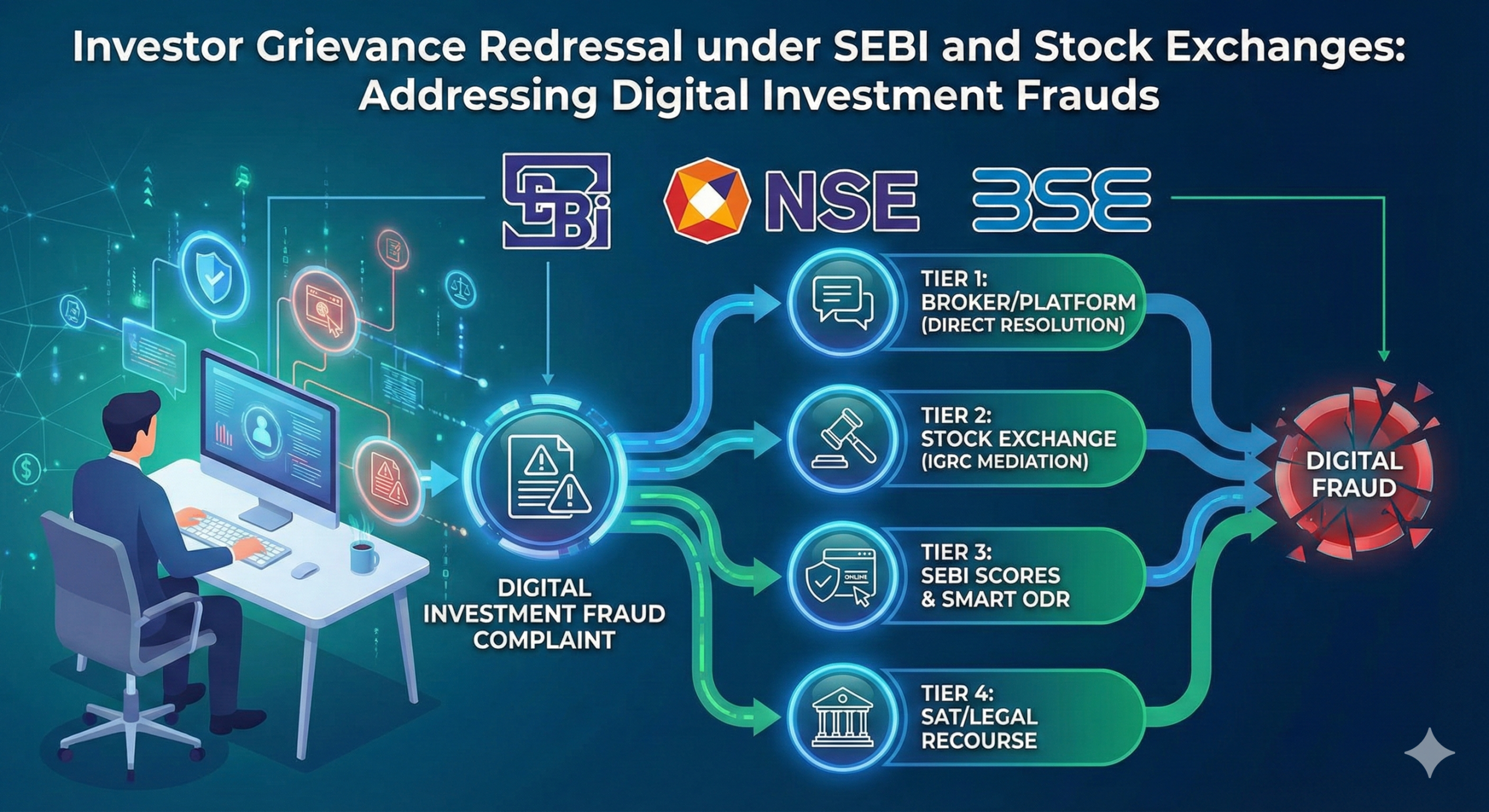
As complaints increase, an effective and transparent investor grievance redressal mechanism becomes crucial. Under the SEBI framework, systems such as SCORES, exchange-level grievance cells, arbitration, and Online Dispute Resolution (ODR) aim to ensure timely resolution of investor complaints.
This article examines how these mechanisms function and whether they are effective in tackling digital investment frauds.
Growth Of Digital Trading And Rise Of Investment Frauds
Expansion Of Online Trading Platforms
Over the past decade, India’s securities market has shifted from traditional broker-assisted transactions to technology-driven, self-directed investing. Online platforms now allow investors to open accounts, execute trades, and transfer funds seamlessly.
While digital access has enhanced efficiency and inclusion, it has also created vulnerabilities. Increased reliance on digital interfaces exposes investors to cybersecurity risks and unauthorized access to trading accounts.
Increase In Retail Investor Participation
The convenience of digital trading has significantly increased retail participation. However, many new investors lack awareness about regulatory safeguards and grievance mechanisms, making them vulnerable to fraud.
Common Types Of Digital Investment Frauds
- Unauthorized Trading – Trades executed without investor consent through misuse of login credentials or manipulation by intermediaries.
- Fake Trading Applications – Fraudulent apps imitating legitimate brokerage platforms and promising guaranteed returns.
- Social Media Investment Scams – False schemes promoted through messaging platforms and influencer channels.
- Phishing And Account Manipulation – Fake emails, malicious links, and identity theft used to gain account access.
The frequency of such misconduct highlights the need for a strong grievance redressal framework.
Meaning Of Investor Grievance
An investor grievance refers to a complaint against a broker, listed company, or intermediary for failure to fulfill legal or regulatory obligations.
A mere fall in market price is not a grievance. The complaint must involve misconduct, negligence, delay in settlement, unauthorized transactions, or regulatory non-compliance.
Types Of Complaints Handled By Stock Exchanges
Stock exchanges typically handle complaints relating to:
- Unauthorized trading
- Delay in fund or securities settlement
- Incorrect contract notes
- Excessive brokerage
- Misuse of client accounts
Summary Of Common Investor Grievances
| Type Of Grievance | Description |
|---|---|
| Unauthorized Trading | Trades carried out without the investor’s consent. |
| Settlement Delays | Delay in transfer of funds or securities after trade execution. |
| Incorrect Contract Notes | Errors or discrepancies in official trade confirmation documents. |
| Excessive Brokerage | Charging brokerage beyond agreed limits. |
| Misuse Of Client Accounts | Unauthorized use of investor accounts or funds by intermediaries. |
Legal And Regulatory Framework
Role Of SEBI Under The SEBI Act, 1992
SEBI is empowered to regulate intermediaries and protect investor interests. It supervises grievance mechanisms and ensures timely responses from regulated entities.
Role Of Stock Exchanges
Stock exchanges maintain investor grievance cells to resolve complaints against trading members and brokers. They monitor compliance and provide an institutional dispute resolution platform.
SCORES Mechanism
The SEBI Complaints Redress System (SCORES) is an online portal where investors can file complaints electronically. It ensures transparency by allowing investors to track complaint status.
Arbitration Mechanism
If disputes remain unresolved, they may be referred to arbitration. Arbitration provides a structured adjudicatory process for resolving monetary and contractual disputes.
Step-By-Step Process Of Filing An Investor Complaint
| Step | Stage | Description |
|---|---|---|
| 1 | Filing a Complaint with the Intermediary | The investor must first approach the concerned broker or intermediary with a written complaint and supporting documents. |
| 2 | Filing through SCORES | If unsatisfied, the investor can escalate the complaint through the SCORES portal. |
| 3 | Escalation to the Stock Exchange | Unresolved complaints may be examined by the exchange-level grievance cell. |
| 4 | Arbitration | If necessary, disputes can be referred to arbitration, where an award is passed after review and hearing. |
| 5 | Online Dispute Resolution (ODR) | The ODR platform enables virtual hearings and faster resolution, especially in digital disputes. |
Effectiveness Of The Existing Mechanism
The grievance redressal system is structured and multi-layered. Digital platforms like SCORES and ODR have improved accessibility and transparency.
However, challenges remain:
- Difficulty tracing digital fraud
- Delays due to technical evidence review
- Limited jurisdiction over unregistered or offshore platforms
Continuous technological adaptation and stricter enforcement are necessary to maintain effectiveness.
Challenges In Addressing Digital Investment Frauds
- Rise of unregistered digital platforms
- Cyber-enabled identity theft and phishing
- Rapid cross-platform fund transfers
- Limited investor awareness
- Cross-border jurisdictional issues
These factors complicate enforcement and recovery efforts.
Suggestions And Reforms
To strengthen investor protection:
- Deploy AI-based monitoring tools for suspicious activity
- Strengthen cybersecurity safeguards and multi-factor authentication
- Ensure strict time-bound grievance disposal
- Increase investor awareness initiatives
- Enhance coordination between SEBI, stock exchanges, and cybercrime authorities
Conclusion
The growth of digital trading has improved investor access but also increased exposure to fraud. The SEBI framework, along with stock exchange mechanisms such as SCORES, arbitration, and ODR, provides structured remedies.
However, evolving digital risks demand continuous regulatory adaptation, stronger enforcement, and technological innovation to ensure effective investor protection.

