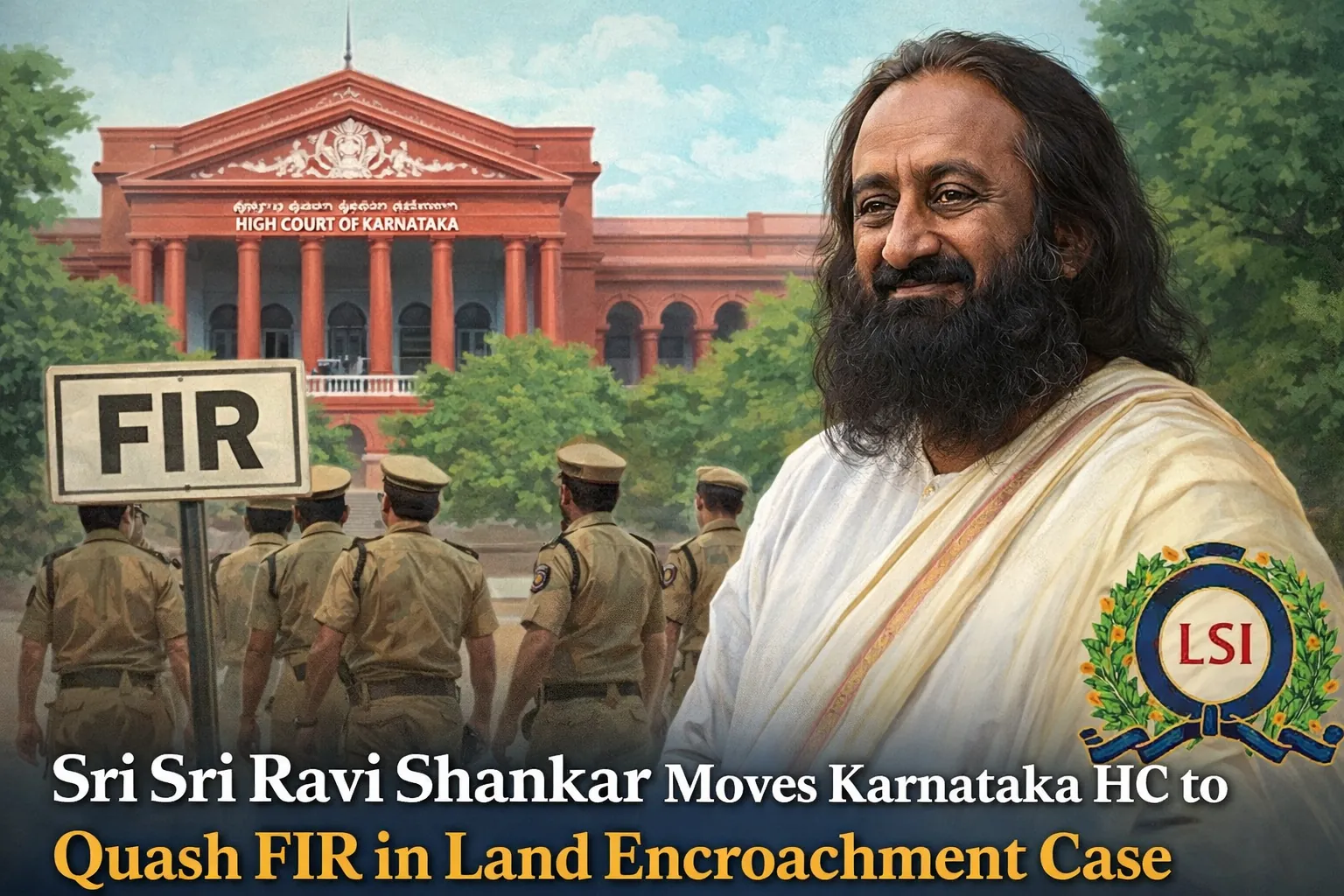
Bengaluru: Karnataka High Court to Hear Sri Sri Ravi Shankar’s Petition
Bengaluru: The Karnataka High Court is set to hear next month a petition filed by renowned spiritual leader Sri Sri Ravi Shankar, seeking to quash a First Information Report (FIR) registered against him in an alleged land encroachment case. The matter has drawn widespread attention not only because of the stature of the petitioner, but also because it raises important legal questions about criminal liability, investigative powers, and judicial oversight.
At its core, the case deals with whether a prominent public figure can be subjected to criminal investigation without specific and direct allegations, and how far courts can intervene to prevent misuse of criminal law.
Background of the Dispute
The FIR was registered by the Bangalore Metropolitan Task Force (BMTF) Police, an agency responsible for investigating illegal constructions and land encroachments in the Bengaluru region. The complaint relates to alleged encroachment of government land in Kaggalipura village, Bengaluru South Taluk.
Several individuals were named in the FIR, including Sri Sri Ravi Shankar. The allegation broadly is that certain persons had illegally occupied or altered public land, which is classified as government property under the Karnataka land records system.
However, according to Sri Sri Ravi Shankar’s legal team, he neither owns nor possesses the land in question, and his name has been included without any concrete material or evidence connecting him to the alleged act.
What the FIR Alleges
The FIR invokes provisions of the Karnataka Land Revenue Act, 1964, which governs ownership, occupation and administration of land in the State.
Key Provisions Under the Karnataka Land Revenue Act
- Section 192A – removal of unauthorised occupation
- Section 94 – declaration of certain lands as government property
In some cases, police also invoke provisions of the Indian Penal Code, such as:
Relevant Provisions of the Indian Penal Code
- Section 447 – criminal trespass
- Section 427 – mischief causing damage
The purpose of such FIRs is to initiate investigation and possibly remove illegal occupants from public land.
Sri Sri Ravi Shankar’s Legal Challenge
Sri Sri Ravi Shankar approached the Karnataka High Court seeking quashing of the FIR, which means he is asking the court to completely nullify the criminal proceedings against him.
His petition is based on two constitutional and statutory powers:
| Legal Provision | Purpose |
|---|---|
| Article 226 of the Constitution of India | Writ jurisdiction of the High Court |
| Section 482 of the Code of Criminal Procedure (CrPC) | Inherent powers of High Court to prevent abuse of process |
Main Arguments Raised by His Side
- No Specific Allegations
The FIR does not disclose any specific act committed by him. There is no clear description of how he personally encroached the land. - No Ownership or Possession
He does not hold title to the land, nor is he in physical possession of it. - Mechanical Naming of a Public Figure
His inclusion appears to be arbitrary and motivated, merely because of his association with spiritual institutions. - Abuse of Criminal Process
The criminal law is being misused, which can cause serious reputational damage without legal basis.
Proceedings So Far in the High Court
During the initial hearing, the State objected on a technical ground that the affidavit supporting the petition was sworn by a devotee, not by Sri Sri Ravi Shankar himself. The court allowed time to cure this defect.
Initially, the court was reluctant to stay the investigation without examining the record. However, on a subsequent hearing, the High Court granted interim protection and stayed further investigation against him.
Observation of the Court
The court made an important observation:
On a prima facie reading of the complaint, there are no specific allegations directly attributable to Sri Sri Ravi Shankar.
The stay was made conditional and subject to procedural compliance. The matter is now listed for final hearing next month, where the court will decide whether the FIR deserves to be quashed entirely.
Law Governing Land Encroachment in Karnataka
Under Karnataka law, land is broadly classified into:
- Government land (Sarkari land)
- Private land
- Forest land
- Civic land (BBMP, BDA, etc.)
Authorities Who Can Initiate Encroachment Proceedings
Encroachment proceedings can be initiated by:
- Tahsildar
- Deputy Commissioner
- BMTF
- Revenue officials
Encroachment is primarily a revenue issue, and criminal prosecution is supposed to be the last resort, used only when intentional illegal occupation is clearly established.
In many cases, land disputes are civil in nature, but are converted into criminal cases to exert pressure.
When Can High Courts Quash an FIR?
This case is fundamentally about the power of High Courts to prevent abuse of criminal law.
Under Indian jurisprudence, courts can quash FIRs when:
- No prima facie offence is made out
- Allegations are vague or absurd
- Proceedings are malicious or politically motivated
- Criminal law is used for settling civil disputes
Landmark Supreme Court Judgments
The Supreme Court has laid down these principles in landmark cases such as:
- State of Haryana v. Bhajan Lal
- Pepsi Foods v. Special Judicial Magistrate
- Neeharika Infrastructure v. State of Maharashtra
The Karnataka High Court is applying these very tests in Sri Sri Ravi Shankar’s case.
Role of the Art of Living Foundation
An important dimension is the role of the Art of Living Foundation, founded by Sri Sri Ravi Shankar.
Legally, there is a distinction between:
- Personal liability of an individual, and
- Institutional liability of a trust or society.
Even if a trust is involved in land ownership, it does not automatically make the spiritual head personally criminally liable, unless there is evidence of direct involvement.
This case highlights the need to clearly differentiate:
Being a spiritual leader ≠ being legally responsible for every act of an organisation.
Public Figures and Criminal Law
Cases involving celebrities, spiritual leaders and public figures raise serious ethical concerns.
An FIR itself:
- Is not proof of guilt
- But causes irreversible reputational damage
- Triggers media trials
- Affects credibility and public perception
Indian courts have repeatedly cautioned that criminal law should not become a tool of harassment, especially when fame becomes the only basis for naming someone as an accused.
Why This Case Matters Beyond One Guru
This case is not just about Sri Sri Ravi Shankar. It has wider implications for:
- NGOs and religious institutions
- Trustees and office bearers
- Investigating agencies
- Protection of individual rights
The final outcome will clarify:
- How much evidence is needed before naming someone in an FIR
- Whether police can include public figures without material proof
- The limits of investigative discretion
Timeline of Events
| Stage | Event |
|---|---|
| 1 | FIR registered by BMTF |
| 2 | Petition filed in Karnataka High Court |
| 3 | Initial hearing – procedural objections |
| 4 | Interim stay on investigation granted |
| 5 | Final hearing scheduled next month |
Frequently Asked Questions (FAQs)
Can a High Court stop police investigation?
Yes, in rare cases where the FIR is prima facie defective or abusive.
Does quashing mean the accused is innocent?
No. It only means criminal proceedings cannot continue on that FIR.
Can the case be reopened later?
Yes, if fresh evidence emerges.
Is land encroachment always a criminal offence?
Not necessarily. Most cases are administrative or civil.
Conclusion
The Karnataka High Court’s upcoming decision in Sri Sri Ravi Shankar’s case will be closely watched across the legal and public sphere. It sits at the intersection of land law, criminal procedure, constitutional safeguards, and public accountability.
Beyond the personality involved, the case is a reminder that criminal law must remain a shield for justice, not a weapon for harassment, and that courts continue to play a crucial role as guardians of due process in India’s legal system.