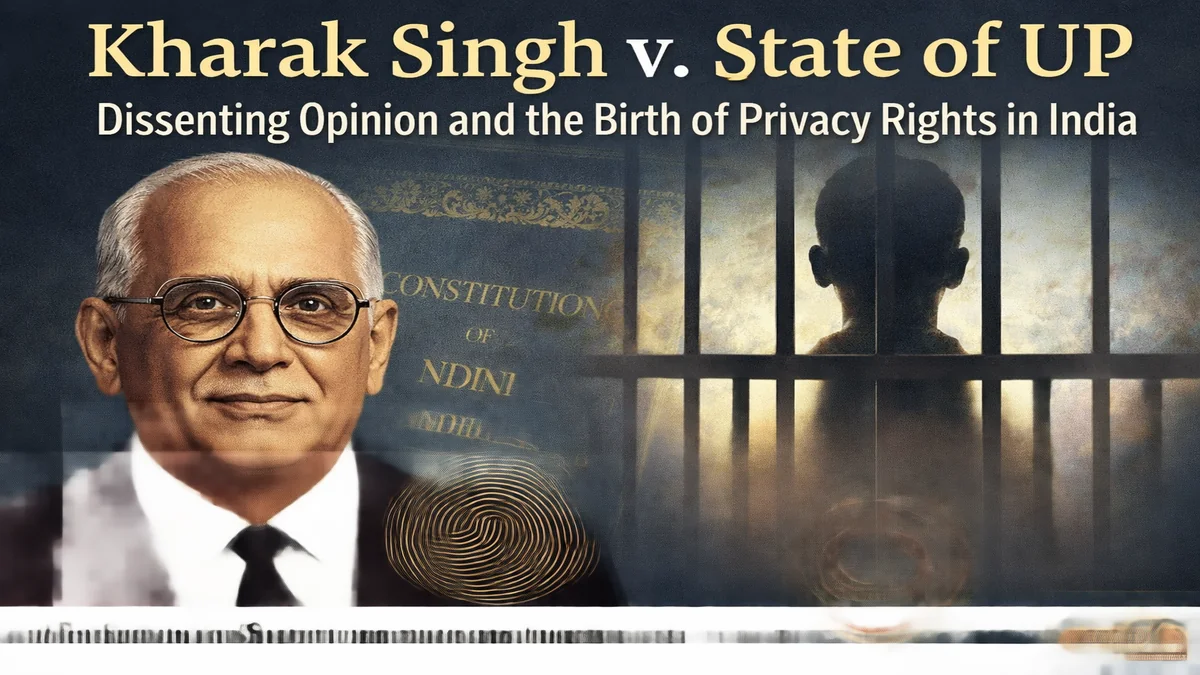
Whether surveillance under Chapter 22 of UP Regulation infringes any citizen’s fundamental rights guaranteed under Part III of the Indian Constitution?[4]
Whether the right to privacy is a fundamental right?[5]
Analysis of Dissenting Opinion
The Supreme Court held that when the whereabouts of a person are unknown, attempts made to track his whereabouts do not amount to stalking. However, Justice Rao also focused on the psychological impact of surveillance or stalking upon the targets.
Stalking is imbibed under Section 354D of IPC[6]. Measuring the amount of compensation for restoring the victim back to its original position, which he was enjoying before the occurrence of the act, is important. But it is difficult to measure mental injury.
The majority opinion holds that the petition is partly allowed and Regulation 236(b), authorizing domiciliary visits, is struck down as it violates Article 21 of the Indian Constitution (entitling the petitioner to issue mandamus against the respondent) because life and liberty are beyond the sphere of physical restraints and bonds of prison. Article 20(3) of the Constitution[7] prohibits self-incrimination.
Conclusion
The crux derived from dissent is as follows:
Privacy rights are physical and psychological rights.
Regulation 236 is unconstitutional in its entirety as it infringes Article 19(1)(d) and Article 21.
Pertinently, the judgment is not unanimously agreed upon.
Updates and Subsequent Developments
The dissenting opinion in Kharak Singh vs State of UP later gained significant constitutional importance, particularly in shaping the evolution of the right to privacy in India.
The reasoning emphasizing the psychological impact of surveillance was expressly relied upon in later constitutional adjudication, including the recognition of privacy as a fundamental right.
In Justice K.S. Puttaswamy (Retd.) vs Union of India (2017), the Supreme Court unanimously held that the right to privacy is a fundamental right under Articles 14, 19, and 21, effectively endorsing the dissenting view expressed in this case.
The judgment is now widely cited in constitutional law discourse as an example of a dissent that ultimately became the law of the land.
End-Notes
SCC OnLine SC 10.
Ibid.
Ibid.
Ibid.
Ibid.
The Indian Penal Code, 1860.
Ibid.
Award-Winning Article Written By: Ms.Anamika Tyagi
🎖️ Recognition · Legal Author 📚
2 Published Articles
ANAMIKA TYAGI
Anamika is pursuing her PhD in Environmental Law (specifically Water Law) under the guidance of Prof. (Dr.) Madhuri Parikh at the esteemed Institute of Law, Nirma University, Ahmedabad. She is an independent researcher and an Advocate enrolled at the Bar Council of Gujarat. She has been practicing at the Principal City Civil Court, Gandhinagar. She has also completed her L.L.M in Constitutional and Administrative Laws from Nirma University. She has a B.B.A L.L.B. (5 year integrated) from Gujarat University.
She has interests in different aspects of Law including Constitutional and Administrative Law, Environment and Cyber Law, Human Rights Law, etc. She has 8 years of research experience in multidisciplinary fields: Law, Sociology, Psychology, etc. She has done internships, conferences, workshops, etc. in different fields of Law.
Her work “Reiterating the Principle of Absolute Liability in the Light of Oleum Gas Leakage Case” was posted on Social Science Research Network (SSRN).
Her work “Gender Justice: A Pathway to Human Rights” was published as a Chapter in book Advancement of Human Rights in India: Contemporary and emerging challenges (Sage Publications), which is also co - authored and edited by Dr. Shrut Brahmbhatt.
Her Case Comment on “Jagjeet Singh vs Ashish Mishra” (Voices Unheard: Empowering Victims at every stage of Justice) was published in the Legal Specs Journal. She has also theoretically and practically worked on the same via workshop.
Her works are published in National and International Journals.
Her works are cited by the authors in Journals, including Legal Service India.
Her forthcoming paper will be on the Permanent Crisis of Water in India, including different Concepts, Laws and Pollution.
She is available at different social media websites: Linkedin, Academia, Scribd, ResearchGate, SSRN, etc. Her hobbies are poetry, singing, etc.