Introduction
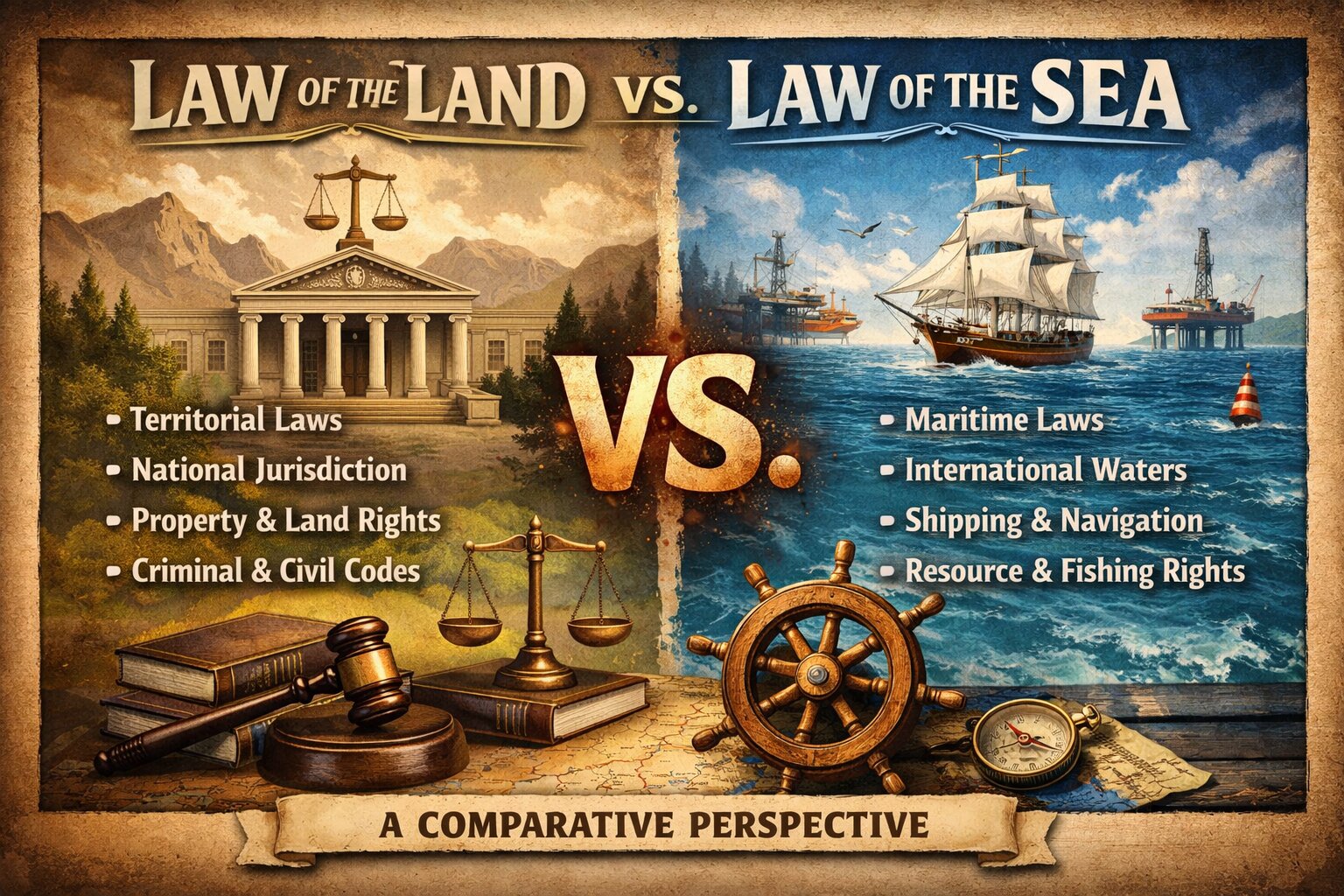
Law is the architecture of order, but its foundations differ dramatically depending on whether it governs land or sea. On land, legal systems are anchored in territorial sovereignty, providing stability through constitutions, statutes, and courts. At sea, however, law emerges from international cooperation, balancing national interests with the shared heritage of humanity.
The Law of the Land (Lex Terrae) is rigid, culturally specific, and deeply tied to the sovereignty of states. In contrast, the Law of the Sea (Lex Maritima) is fluid, zone-based, and shaped by treaties such as the United Nations Convention on the Law of the Sea (UNCLOS). Together, these frameworks illustrate how legal systems adapt to the environments they regulate—land being static and bounded, sea being dynamic and borderless.
In today’s interconnected world, where disputes often straddle both domains—from ports and harbours to contested maritime zones—the interplay between these two systems is more relevant than ever. Understanding their differences, overlaps, and contemporary challenges is essential for navigating the future of global governance.
Law of the Land vs. Law of the Sea
This table highlights how legal systems differ when applied to land (territorial sovereignty) versus the sea (shared international space).
|
Feature |
Law of the Land |
Law of the Sea |
Explanation |
|
1. Jurisdiction |
Based on fixed territorial boundaries |
Based on maritime zones measured from coastline |
Land law is static, while sea law shifts with nautical measurements. |
|
2. Legal Source |
Constitutions, statutes, judicial precedents |
International treaties (UNCLOS), customary international law |
Land law derives from national authority; sea law from global consensus. |
|
3. Sovereignty |
Absolute within territory |
Gradually diminishes with distance from coast |
Nations have full control on land, but only partial rights offshore. |
|
4. Ownership Principle |
Private and public ownership recognized |
High seas treated as res communis (common heritage) |
Land can be owned; the high seas belong to all humanity. |
|
5. Governing Authority |
National governments |
Coastal states + international community |
Land is governed domestically; seas require shared governance. |
|
6. Scope |
Applies to land territory |
Applies to seas, oceans, seabed, and airspace above |
Maritime law covers broader, fluid domains. |
|
7. Enforcement |
Police, courts, administrative agencies |
Naval forces, coast guards, international tribunals |
Enforcement shifts from local institutions to global mechanisms. |
|
8. Dispute Resolution |
Domestic courts |
International forums like ITLOS |
Land disputes are national; sea disputes are international. |
|
9. Boundary Determination |
Clearly demarcated borders |
Zones: territorial sea, EEZ, continental shelf |
Land borders are fixed; maritime zones are layered. |
|
10. Freedom of Movement |
Subject to national laws |
Freedom of navigation in high seas |
Land movement is restricted; seas allow global passage. |
|
11. Resource Rights |
Full control over land resources |
Limited rights beyond territorial waters |
Nations own land resources; sea resources are shared. |
|
12. Environmental Regulation |
Domestic environmental laws |
International marine obligations |
Land protection is national; sea protection is collective. |
|
13. Legal Uniformity |
Varies country to country |
More uniform due to conventions |
Land law differs widely; sea law is standardized globally. |
|
14. Criminal Jurisdiction |
Territorial principle dominant |
Flag state and coastal state jurisdiction |
Crimes on land fall under local law; at sea, jurisdiction depends on ship registration and location. |
|
15. Commercial Activity |
Governed by national commercial laws |
Regulated by maritime and trade conventions |
Land commerce is domestic; sea commerce is international. |
|
16. Security Concerns |
Internal law and order |
Piracy, maritime security, cooperation |
Land threats are internal; sea threats require global response. |
|
17. Property Rights |
Strongly protected and enforceable |
Limited or non-existent in high seas |
Land ownership is secure; sea ownership is restricted. |
|
18. Historical Development |
Rooted in sovereignty of states |
Developed from seafaring customs |
Land law evolved from state power; sea law from navigation traditions. |
|
19. Application of Customs |
Local customs may apply |
International customary practices dominate |
Land law reflects local culture; sea law reflects global practice. |
|
20. Mobility of Subject Matter |
Static (land immovable) |
Dynamic (ships, floating structures move) |
Land is fixed; sea subjects move across jurisdictions. |
Legal Framework
The legal frameworks that govern land and sea embody distinct philosophies but often intersect in practice.
The Law of the Land (Lex Terrae) refers to the internal legal system of a sovereign nation. It is the backbone of governance, ensuring stability within defined borders. Its authority flows from constitutions, statutes, and common law traditions. Enforcement is carried out by domestic police forces and national courts, covering areas such as property rights, contracts, criminal justice, and civil liberties. By nature, it is rigid, culturally specific, and deeply tied to national history.
The Law of the Sea (Lex Maritima), in contrast, governs interactions on the world’s oceans, where sovereignty is diluted and cooperation is essential. Its foundation lies in international treaties, most notably the United Nations Convention on the Law of the Sea (UNCLOS), often called the “Constitution for the Oceans.” Enforcement is shared between international tribunals (like ITLOS in Hamburg) and flag states. Jurisdiction is divided into zones:
- Territorial Waters (12 nautical miles): Full sovereignty.
- Exclusive Economic Zone (200 nautical miles): Rights to resources such as fish and oil.
- High Seas (beyond 200 miles): No sovereignty—treated as the common heritage of mankind.
Where the Two Worlds Collide is in transitional spaces such as internal waters—ports, harbours, and bays. Here, domestic law applies, but maritime principles like “innocent passage” also protect foreign vessels. Another unique distinction is legal personhood: on land, individuals are the primary subjects of law, while at sea, the vessel itself can be treated as a legal entity—liable, suable, or arrestable independently of its owner.
Contemporary Challenges in Jurisdictional Law
- Environmental Challenges
- Climate Change: Rising sea levels blur coastal boundaries, complicating jurisdiction and threatening to redraw maps of sovereignty and maritime entitlements.
- Marine Environmental Protection: Oil spills, plastic pollution, and overfishing demand stronger international enforcement of environmental obligations.
- Security Challenges
- Maritime Security & Piracy: Increasing piracy in regions like the Gulf of Aden and South China Sea challenges international cooperation and enforcement mechanisms.
- Cyber Operations at Sea: Ships and offshore installations are vulnerable to cyberattacks, raising novel questions about liability and jurisdiction in digital warfare.
- Geopolitical Disputes: Strategic waterways (e.g., South China Sea, Arctic routes) highlight tensions between freedom of navigation and territorial claims.
- Technological Challenges
- Artificial Islands: Nations attempt to extend sovereignty by creating land in disputed waters, raising questions about whether man‑made structures can generate new maritime zones under UNCLOS.
- Deep-Sea Mining: The race to exploit seabed minerals in the High Seas tests the principle of “common heritage of mankind” and sparks debates over equitable resource distribution.
- Space-Sea Nexus: Emerging technologies like floating spaceports and offshore launch platforms blur jurisdictional lines between maritime law and aerospace law.
- Humanitarian & Infrastructure Challenges
- Migration & Refugees by Sea: Mass movements of people across oceans test humanitarian law, coastal state obligations, and the balance between border control and human rights.
- Data Cables & Infrastructure: Submarine cables that carry global internet traffic are critical assets, yet vulnerable to sabotage, raising questions of protection under international law.
Together, these issues show how static sovereignty on land and fluid cooperation at sea are being tested by technology, climate, and geopolitics. The future of jurisdictional law will depend on how nations reconcile national interests with global responsibilities.
Conclusion
The Law of the Land and the Law of the Sea represent two contrasting yet complementary philosophies of governance. One is anchored in sovereignty, stability, and territorial control; the other is fluid, cooperative, and rooted in the idea of shared heritage. Together, they demonstrate how legal systems adapt to the environments they regulate—land being static and bounded, sea being dynamic and borderless.
In today’s world, these frameworks are being tested by unprecedented challenges: artificial islands, deep-sea mining, climate change, piracy, and even the emerging nexus between maritime and aerospace law. Each of these developments forces us to reconsider how far sovereignty extends and how much cooperation is required to safeguard common interests.
Ultimately, understanding the interplay between land and sea law is not just an academic exercise. It is central to how humanity balances national ambitions with global responsibilities. The future of international order will depend on our ability to respect territorial integrity while embracing collective stewardship of shared spaces. In this delicate balance lies the promise of both justice and sustainability for generations to come.
As humanity ventures further into uncharted domains—whether the deep sea, outer space, or cyberspace—the lessons from land and sea law will guide us in balancing sovereignty with stewardship. In this balance lies the foundation of a just and sustainable global order.