Introduction
Left-Wing Extremism (LWE) remains one of India’s most complex internal security challenges. Despite sustained counter-insurgency operations, infrastructure expansion, and welfare interventions, LWE continues to exploit governance deficits, terrain advantages, and socio-economic grievances. While central armed police forces (CAPFs) and specialized units play a critical role, the district police remains the first responder, intelligence collector, and permanent face of the state in LWE-affected regions.
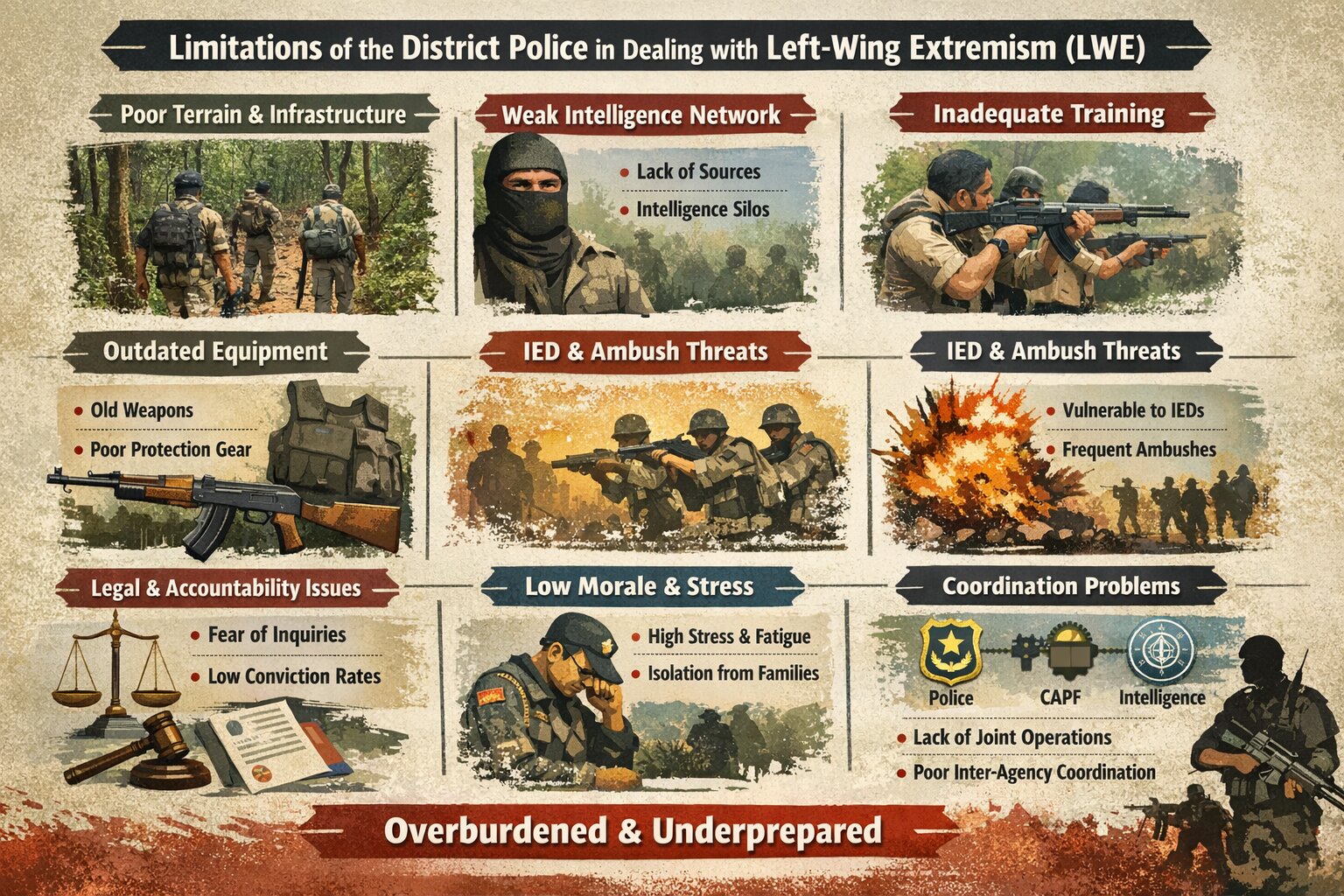
However, the district police faces structural, operational, institutional, and psychological limitations that severely constrain its effectiveness against a highly adaptive insurgent movement led primarily by CPI (Maoist). These limitations are most visible in heavily affected states such as Chhattisgarh, Jharkhand Odisha, and parts of Maharashtra, and Telangana.
This article critically examines the key limitations of district police forces in dealing with LWE, across terrain, intelligence, manpower, training, equipment, legal, social, and governance dimensions.
- Structural and Institutional Limitations
Conventional Policing Orientation
District police forces are traditionally designed for law-and-order duties, crime investigation, traffic management, and VIP security. LWE, however, represents an armed insurgency, requiring military-style planning, long-duration field presence, and counter-guerrilla tactics.
Most district police stations:
- Lack operational planning cells
- Are unfamiliar with small-team jungle warfare
- Follow reactive rather than proactive security postures
This mismatch leaves police vulnerable during ambushes, area domination patrols, and road opening parties.
Dual Burden of Law and Order
In LWE districts, police are expected to simultaneously:
- Control political agitations
- Manage elections and festivals
- Investigate conventional crimes
- Conduct counter-LWE operations
This overextension dilutes focus, reduces training time, and results in fatigue, increasing the probability of tactical errors.
- Terrain and Geographical Constraints
Forested and Hostile Geography
LWE thrives in dense forests, hills, and remote tribal belts, such as the Bastar division of Chhattisgarh or the forested regions of Jharkhand.
District police face:
- Poor road connectivity
- Absence of mobile networks
- Limited GPS and mapping support
- High dependence on foot patrols
- Lack of accommodation for setting up camps
Maoist cadres, by contrast, possess intimate terrain knowledge and pre-surveyed escape routes.
Vulnerability to IEDs
District police patrols are disproportionately affected by Improvised Explosive Devices (IEDs) due to:
- Inadequate detection equipment
- Limited bomb disposal units at district level
- Insufficient training in counter-IED drills
Repeated casualties, shortage of personnel, erode morale and reinforce defensive postures, allowing Maoists to dominate movement corridors.
- Intelligence Deficiencies
Weak Human Intelligence (HUMINT)
Effective counter-insurgency depends on local intelligence, but district police struggle to develop reliable informant networks due to:
- Fear of Maoist retaliation among villagers
- Absence of witness protection mechanisms
- Frequent transfer of officers disrupting continuity
Maoists exploit kinship ties, tribal solidarity, and coercion to neutralize police intelligence efforts.
Over-Reliance on Technical Intelligence
While mobile interception and surveillance have improved, LWE areas suffer from:
- Poor network coverage
- Limited real-time intelligence
- Delayed dissemination from state intelligence units
District police often receive intelligence too late or too vague to enable actionable operations.
- Training and Skill Gaps
Inadequate Counter-Insurgency Training
Many district police personnel:
- Receive minimal jungle warfare training
- Lack exposure to small-team tactics
- Are unfamiliar with Maoist standard operating procedures
Short refresher courses cannot substitute for long-term immersion training provided to specialized forces.
Lack of Leadership Development
Counter-LWE operations demand junior leadership capable of:
- Independent decision-making
- Managing fear and uncertainty
- Adapting to fluid battlefield conditions
However, district police leadership is often:
- Hierarchical and rigid
- Risk-averse due to fear of inquiries
- Over-centralized in decision-making
This hampers operational initiative at the field level.
- Equipment and Logistics Constraints
Obsolete Weapons and Protection
Many district police units continue to use:
- Outdated INSAS or .303 rifles
- Inadequate bulletproof jackets
- Limited night-vision devices
Against Maoists armed with looted automatic weapons and explosives, this technological asymmetry is deadly.
Poor Logistics and Mobility
Operational effectiveness is undermined by:
- Insufficient all-terrain vehicles
- Delays in ration and ammunition supply
- Poor medical evacuation facilities
Long deployments without rest or rotation further degrade combat readiness.
- Psychological and Morale Challenges
Fear of IEDs and Ambushes
Continuous exposure to:
- Sudden explosions
- Mutilating injuries
- Loss of colleagues
creates a persistent psychological stress environment, leading to hesitation, tunnel vision, and conservative patrolling.
Social Isolation
District police personnel are often:
- Stationed far from families
- Living in fortified camps
- Distrusted by local populations
This isolation weakens emotional resilience and increases burnout.
- Legal and Accountability Constraints
Fear of Legal Action
Police personnel operate under intense scrutiny from:
- Judicial inquiries
- Human rights commissions
- Media investigations
While accountability is essential, procedural uncertainty often leads to excessive caution, allowing Maoist cadres to escape.
Weak Prosecution Outcomes
Even when arrests are made:
- Evidence collection is poor
- Witnesses turn hostile
- Trials are delayed
Low conviction rates reduce deterrence and demoralize police.
- Lack of Inter-Agency Coordination
Fragmented Command Structure
District police must coordinate with:
- State armed police
- CAPFs
- Intelligence agencies
- Forest and revenue departments
Absence of unified command often leads to:
- Intelligence silos
- Overlapping operations
- Friendly force casualties
Limited Control Over CAPFs
While CAPFs operate in districts, district SPs often lack operational control, reducing coherence and accountability in joint operations.
- Governance and Developmental Deficits
Police as the Face of a Weak State
In many LWE areas:
- Roads exist without teachers
- Schools function without attendance
- Health centres lack doctors
The district police becomes the visible arm of an otherwise absent state, attracting public anger and Maoist propaganda.
Alienation of Tribal Communities
Historical displacement, forest rights issues, and mining-related grievances create:
- Distrust of authorities
- Sympathy for Maoist narratives
District police, lacking cultural training and language skills, struggle to bridge this divide.
- Political and Administrative Pressures
Short-Term Performance Metrics
Political leadership often demands:
- Body counts
- Quick “area clearance”
- Visible results before elections
This pressure encourages:
- Risky operations
- Poor planning
- Neglect of long-term confidence building
Frequent Transfers
Rapid transfer of district officers:
- Breaks intelligence networks
- Disrupts rapport with communities
- Undermines institutional memory
Counter-insurgency, however, requires continuity and patience.
Conclusion
The limitations of the district police in dealing with Left-Wing Extremism are not merely operational, but deeply structural and systemic. Expecting a conventionally trained, resource-constrained, and overburdened district police force to defeat a motivated, adaptive insurgency is unrealistic without comprehensive reform.
Effective counter-LWE strategy must:
- Reorient district police towards counter-insurgency specialization
- Strengthen intelligence and community engagement
- Upgrade training, equipment, and leadership autonomy
- Integrate security with governance and development
- Upgrade district police infrastructure and manpower capacity
- Institutionalise outcome-based audits of security and development expenditure in LWE-affected regions
Until district police capacity is transformed from reactive law enforcement to proactive internal security management, LWE will continue to exploit its weaknesses—turning police patrols into targets rather than protectors.