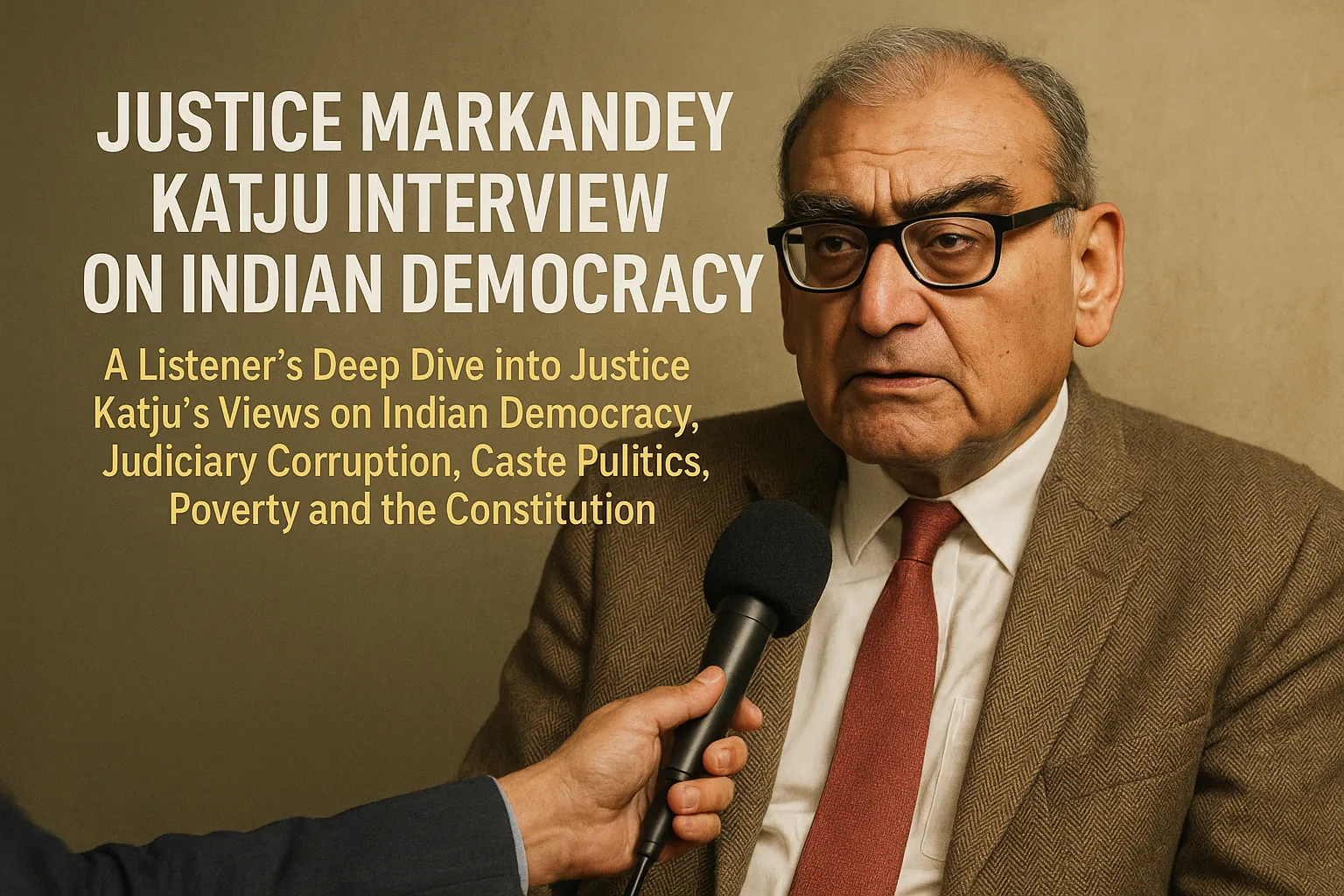
Listening to Justice Katju: Anger, Truths and Discomfort
Watching this interview felt less like listening to a retired judge and more like sitting through a controlled explosion.
Justice Markandey Katju doesn’t talk so much as attack ideas, institutions and people—voters, politicians, judges, even the Constitution itself. As I listened, I found myself swinging between irritation, agreement, disbelief and a strange kind of grudging respect. Because beneath all the provocation, there is a consistent thread: a deep rage at poverty, hypocrisy and caste-ridden politics.
This is my attempt to process what I heard as an ordinary listener, not as a cheerleader or a prosecutor, but as someone trying to make sense of one man’s blistering diagnosis of India.
“All Institutions Have Collapsed”
The interview starts with a bang: according to him, reform in India is impossible without revolution. Not difficult. Not slow. Simply impossible.
Parliament, judiciary, bureaucracy—he calls them “hollow”. He doesn’t offer the usual polite caveats. For him, the system is not sick; it is already clinically dead and we are just decorating the corpse with slogans about democracy and growth.
I could feel the interviewer trying to pull him toward specifics—Bihar elections, vote theft, leadership changes. But Katju keeps doing something interesting: whenever the discussion slips into day-to-day politics, he pulls it back to a blunt question:
“What difference will it make to the life of the common man?”
It is a brutal filter. New Chief Minister, old Chief Minister, different party—if poverty, unemployment and hunger remain the same, he counts it as noise, not change.
I didn’t agree with all his conclusions, but that one question lingered with me: Does this political drama actually change the life of the rickshaw puller, the street vendor, the unemployed graduate?
The Most Uncomfortable Part: “The People Are Not Fit for Democracy”
The harshest moments in the interview are not about politicians—they are about voters.
He says, again and again, that 90% of people are “fools”, that the Indian public is unfit for democracy because they vote almost entirely on caste and religion, not on merit or a clean record. He goes so far as to say that people in Bihar, or even in India as a whole, do not deserve the right to vote if they continue voting this way.
I’ll be honest: this made me recoil.
On one hand, it’s easy to dismiss this as elitist contempt. On the other, he describes a pattern we all secretly know: candidates with serious criminal cases getting elected, voting blocs mobilised purely on caste equations, parties openly crafting “Hindu vs Muslim” or “this caste vs that caste” narratives before every poll.
What disturbed me most wasn’t just what he said—it was the part of me that recognised pieces of truth in his anger.
He doesn’t blame just the poor or uneducated. He gives the Dehradun University example: professors with PhDs from Harvard, Yale, LSE—“educated” on paper—who, according to him, would still refuse to accept their daughter marrying a Dalit boy. For him, that single test exposes what really lives in their minds: not rationality, but caste.
It’s a cruel litmus test, but again, you see what he’s pointing at. Beneath our degrees and English, how much of our thinking is still feudal?
The Constitution: Sacred Text or Sophisticated Illusion?
Then comes his most explosive claim: he openly says he “denies” the Constitution.
Not in the legal sense—obviously he was sworn to uphold it as a judge—but in the moral sense. He calls the Constitution a device to “fool the public”, to make people believe they are “kings” in a democracy so that they don’t revolt against the small elite that actually rules.
His argument, in simple terms, is:
- The Constitution promises fundamental rights—free speech, liberty, equality, freedom of religion.
- But when a large majority of the population is poor, hungry and unemployed, these rights are practically meaningless.
- A man who can’t feed his children doesn’t care about “freedom of expression”; he cares about food, work and medicine.
- So these rights function more like a sedative than a shield: “You have rights, you are free, don’t revolt.”
Listening to this, I felt both attacked and exposed.
We grow up taught to revere the Constitution almost religiously. To hear a former Supreme Court judge call it a sophisticated con trick feels almost blasphemous. Yet, when he asks, “What does a starving man do with your freedom of speech?” it hits a raw nerve.
Is he being unfair? Absolutely, in parts. The Constitution has also been a tool of empowerment, especially through courts, social movements and rights-based campaigns. But his point is sharp: if poverty is not tackled, rights become decorative.
Reservation, Dalits and the Politics of Crutches
On reservation, he is equally ruthless—and this will anger a lot of people.
Speaking at a Dalit gathering (which he narrates in the interview), he tells them:
- There are only a limited number of government jobs.
- Even if 100% of them were reserved for Dalits, only a microscopic fraction would benefit.
- Yet political leaders sell the dream that “reservation will benefit all Dalits”.
- This, he calls a political stunt and part of “divide and rule”.
He uses a harsh metaphor: reservation as crutches that keep you dependent instead of encouraging you to prove yourself in the general category and show that your intelligence is equal or better.
Do I agree with him? Not fully.
Reservation, historically, is not just about jobs; it’s about representation, dignity and creating a minimum foothold in spaces that were violently closed to Dalits for centuries. His framing ignores structural discrimination in education, hiring and housing.
But once again, he makes a point that’s hard to completely dismiss: reservation by itself cannot uplift millions when there are simply not enough jobs. It can help a small section, while poverty and humiliation continue for the rest. And it certainly suits politicians to keep shouting “reservation!” instead of talking about massive job creation and quality public education.
What I felt listening to him was less “he is right” or “he is wrong” and more: he is attacking everyone’s comfort zone at once—upper castes, Dalits, liberals, conservatives. No one comes out undisturbed.
The Numbers Behind the Anger: Jobs, Hunger, Health, Education
Underneath his sweeping attacks, there is a core he keeps returning to: material reality.
He talks about:
- Millions of young people entering the job market every year and only a tiny fraction getting formal jobs.
- Educated youth—PhDs, engineers, MBAs—applying for peon posts.
- India’s poor performance on hunger and malnutrition, with children undernourished and women anaemic.
- A health system where good private hospitals are unaffordable and government hospitals look like crowded railway stations.
- An education system where a handful of good schools exist but are priced out of reach for the poor.
You can argue about his exact numbers, but the lived reality he describes is familiar: precarious work, expensive healthcare and poor schooling for the masses.
In those moments, his rage feels less like theatrics and more like frustration that these issues are never at the centre of our politics. Instead, we argue about temples, mosques, caste quotas and election strategy.
Permanent Election Mode, Zero Development Mode
One of his most striking observations is that India is always in election mode.
With so many states and union territories, there is either an election happening or preparation for one. According to him, this produces a political class obsessed with:
- Polarising on caste and religion,
- Creating communal tension,
- Keeping people emotionally charged and divided.
Because that’s how votes are secured. Economic development, he says, naturally becomes secondary.
He compares this with China—no elections, and, in his view, full focus on economic growth. It is a simplistic comparison, of course, but as a listener I couldn’t deny the basic discomfort: are our leaders spending more energy on winning the next election than on building the next decade?
Judges Who Talk Too Much and the Question of Contempt
The portion about the judiciary is perhaps where his insider status shows most.
He strongly criticises:
- Judges who speak too much in open court and make sarcastic or provocative remarks instead of letting their judgments do the talking.
- The culture of using contempt of court to shut down criticism.
He narrates his own stance as a judge: say whatever you want to me in court—call me a fool, donkey, thief—I will not file contempt. He says he would only be offended if someone stopped him from doing his judicial work, such as snatching files or disrupting proceedings.
It’s a refreshing, almost old-fashioned view of free speech: ignore insults; fear only obstruction of justice.
He also talks about the shoe-throwing incident at the Chief Justice of India. He condemns it clearly, calls it wrong, but immediately asks: why did the judge need to make certain remarks about a temple and restoration? For Katju, judges must maintain a controlled restraint in public speech. Anything else invites trouble.
As someone watching, I found this part oddly reasonable compared to his other explosive lines. It felt like a genuine concern for judicial dignity buried inside his usual sharp tongue.
Careerist CJIs and the Ghost of H.R. Khanna
Then he moves to individuals—especially former Chief Justices—whom he labels “careerists”.
He contrasts:
- Judges like H.R. Khanna, who gave a famous dissent during the Emergency, knowing it would cost him the Chief Justiceship.
- With others whom he accuses of shaping decisions to ensure they are not superseded, especially in sensitive cases like Ayodhya or disputes under the Places of Worship Act.
Whether one agrees with his personal attacks or not, the larger fear he is voicing is serious: what happens when the top judges of the country start thinking like ambitious bureaucrats—calculating promotions and favours—rather than guardians of the Constitution?
Again, as a listener, I don’t have the evidence to endorse his allegations, but I understand the anxiety behind them. A judiciary that fears the government or chases its approval is a scary thought.
His Solution: Revolution. My Reaction: Fear and Questions.
After an hour of demolition—of democracy, Constitution, reservation, voters, judges, politicians—the interviewer finally asks the obvious question: What is the alternative?
Katju’s answer never changes: a great mass struggle, a revolution led by modern, scientific, patriotic leaders, rising above caste and communalism, lasting 10–20 years, with big sacrifices.
He insists that:
- Present leaders are “worthless”.
- Institutions are beyond repair.
- Only a total reset can bring rapid industrialisation and a decent life for all.
Listening to this, I felt two opposite emotions:
- Admiration for his clarity: he is not pretending incremental reforms will fix deep rot.
- Fear of the vacuum: revolutions are not clean software updates; they are bloody, unpredictable and often replace one form of oppression with another.
He seems confident that “history” will throw up good leaders at the right time. I’m not so sure. History is also full of demagogues and dictators born from chaos.
What I Carried Away from the Interview
By the time the interview ended, I wasn’t left with a neat ideological package. If anything, I was left with discomfort—and maybe that’s the point.
Here’s what stayed with me:
- He forces us to look at the ugly role of caste and religion in our politics, beyond the polite language of “identity” and “social justice”.
- He reminds us that poverty makes a mockery of rights if we don’t attack it head-on.
- He exposes how easily we worship “democracy” and “Constitution” in the abstract without asking if they are actually improving people’s lives.
- He is unfair and extreme in places, but he is at least brutally honest about what he thinks; there is no hedging, no PR, no diplomacy.
Do I agree with him that the public is “stupid” and unfit for democracy? No. That dismisses centuries of struggle, learning and gradual change.
Do I agree that all institutions are beyond repair? I’m not ready to give up completely.
But I also can’t pretend his anger comes from nowhere. When jobs are scarce, children are malnourished, health care is broken, and elections are fought on hatred instead of hope, a voice like his—loud, abrasive, uncomfortable—does serve a purpose.
It shakes us.
And maybe, before we argue with him, we need to sit with the one question he keeps hammering into the conversation:
Whatever you are defending—democracy, Constitution, reservation, elections—has it really changed the life of the poorest person you know?