Introduction
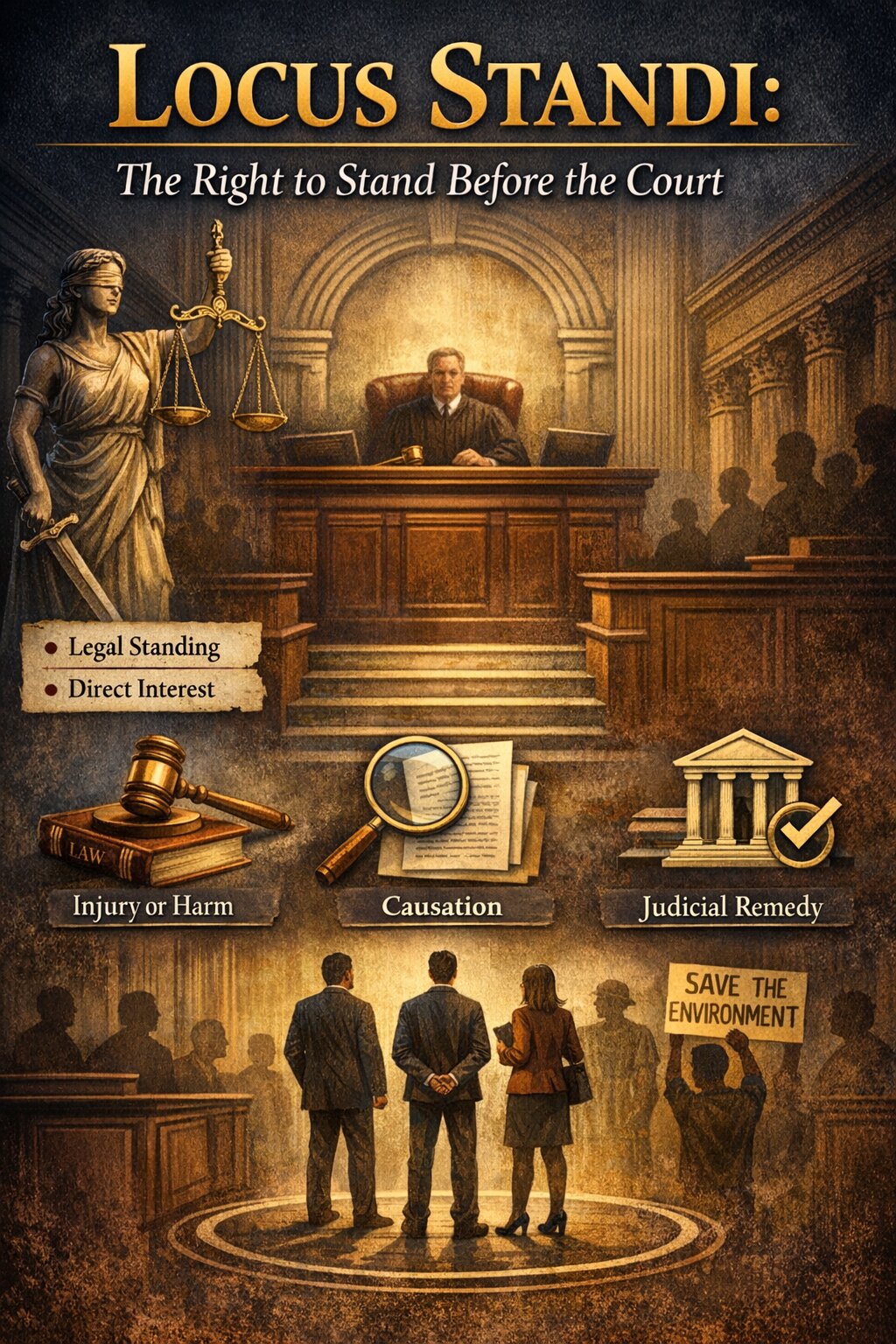
Locus standi, a Latin term meaning “place to stand,” is a fundamental legal principle that determines whether a party has the legal right or capacity to initiate a legal action or appear before a court. In essence, it requires a litigant to demonstrate a sufficient connection to the matter at hand, typically through personal harm or a direct stake in the outcome, to justify judicial intervention. Without locus standi, courts may dismiss a case at the threshold, preventing frivolous or unrelated claims from clogging the judicial system. This doctrine ensures that only those genuinely affected can seek remedies, promoting efficiency and fairness in legal proceedings.
The concept evolved through common law traditions and gradually developed into a fundamental doctrine governing access to courts in modern legal systems. Historically, it was rigidly applied, limiting access to courts to those directly impacted. However, modern interpretations, influenced by social justice movements and public interest concerns, have liberalized it in many places, allowing broader participation in litigation, especially in environmental, human rights, and constitutional matters.
Historical Background
The doctrine of locus standi traces its roots to early English common law, where it was used to restrict court access to prevent abuse of process. A notable early reference appears in the 1858 English case of Ware v. Regent’s Canal Co., which emphasized the need for a personal interest in the dispute. In the United States, it gained constitutional significance under Article III of the U.S. Constitution, which limits federal judicial power to “cases” and “controversies,” implying a requirement for actual harm.
In India, influenced by British colonial law, locus standi was initially strict, as seen in pre-independence rulings. Post-independence, the Indian judiciary began relaxing it through landmark judgments in the 1980s, transforming it into a tool for social justice via Public Interest Litigation (PIL). Similarly, in the UK, the Senior Courts Act 1981 formalized the “sufficient interest” test, marking a shift from rigid to more flexible standards.
Internationally, the principle appears in bodies like the World Trade Organization (WTO) Dispute Settlement Understanding (DSU), where it ensures only members with relevant interests can initiate disputes, though without a strict “legal interest” requirement. Over time, globalization and human rights advocacy have prompted relaxations, as seen in the Council of Europe’s European Court of Human Rights, which grants automatic locus standi to individuals.
Elements and Requirements of Locus Standi
To establish locus standi, a party must generally satisfy several core elements, though these vary by jurisdiction. The following table outlines the key requirements based on common legal frameworks:
|
Element |
Description |
Example |
|
Injury-in-Fact |
A concrete and particularized harm to a legally protected interest. |
Pollution affecting a person’s health. |
|
Causation |
A direct causal link between the defendant’s conduct and the injury suffered. |
Government policy causing financial loss to a business. |
|
Redressability |
A favourable court decision must be capable of remedying the harm. |
Court injunction stopping unlawful activity. |
|
Sufficient Interest |
The claimant must have a genuine and direct stake in the matter. |
A person whose legal rights are directly affected. |
These elements ensure that courts adjudicate real disputes rather than advisory opinions. In civil law systems, similar concepts like “interest to act” prevail, emphasizing practical necessity for the suit.
Locus Standi in Different Jurisdictions
India
In India, locus standi is enshrined in constitutional and procedural laws, particularly under Articles 32 and 226 of the Constitution, which allow writ petitions for fundamental rights enforcement. Traditionally, the doctrine was strictly applied under conventional procedural rules of civil litigation, requiring the plaintiff to demonstrate a direct personal injury. However, the Supreme Court liberalized it through PIL, allowing “public-spirited” individuals to file on behalf of marginalized groups.
Key cases include:
S.P. Gupta v. Union of India (1981): Relaxed standing rules for judicial independence issues, stating any citizen can approach the court if rights are violated.
People’s Union for Democratic Rights v. Union of India (1982): Permitted labour unions to sue for workers’ rights.
D.S. Nakara v. Union of India (1983): Extended standing to pensioners challenging discriminatory policies.
This evolution has addressed environmental pollution, human rights, and corruption, though critics argue it risks judicial overreach. In arbitration, third parties generally lack standing unless bound by agreement.
United States
U.S. standing doctrine is constitutionally mandated under Article III, requiring injury, causation, and redressability, as clarified in Lujan v. Defenders of Wildlife (1992). It is prudential, preventing generalized grievances.
Prominent cases:
Allen v. Wright (1984): Denied standing to parents challenging IRS tax exemptions for discriminatory schools, lacking direct causation.
Massachusetts v. EPA (2007): Granted states standing to sue for environmental regulations, recognizing special sovereign interests.
Exceptions include taxpayer standing in limited cases (e.g., Establishment Clause violations) and associational standing for organizations. The U.S. approach remains conservative compared to India.
United Kingdom
In the UK, standing is governed by the “sufficient interest” test under Section 31(3) of the Senior Courts Act 1981. It applies mainly to judicial review, where claimants must show a connection to the decision challenged.
Landmark cases:
R v. Inland Revenue Commissioners, ex parte National Federation of Self-Employed and Small Businesses Ltd (1982): Emphasized contextual assessment of interest.
R v. Secretary of State for Foreign Affairs, ex parte World Development Movement Ltd (1995): Allowed a pressure group standing for aid misuse, citing expertise and public importance.
The UK has seen liberalization, influenced by EU law (pre-Brexit), but remains more restrictive than India’s PIL model.
International Law
In international forums, locus standi varies. The WTO DSU does not require a “legal interest” for panel requests, focusing on trade impacts. The International Court of Justice (ICJ) limits standing to states in contentious cases, but advisory opinions allow broader input.
In human rights bodies:
European Court of Human Rights: Individuals have automatic standing.
African Court on Human and Peoples’ Rights: Similar liberal access for NGOs in public interest cases.
In environmental law, countries like South Africa and Tanzania have expanded standing for marine pollution and public interest suits.
Exceptions and Liberalizations
Exceptions to strict locus standi include:
Public Interest Litigation (PIL): Prevalent in India and Nigeria, allowing strangers to sue for societal harms.
Associational/Representative Standing: Organizations can sue on behalf of members.
Victim Standing in Human Rights: Direct or indirect victims in international courts.
Statutory Standing: Laws like environmental acts grant broad access (e.g., South Africa’s National Environmental Management Act).
Critics note that over-liberalization can lead to judicial activism, while proponents argue it enhances access to justice.
Key Case Laws Across Jurisdictions
India: Bandhua Mukti Morcha v. Union of India (1984) – Allowed NGO standing for bonded labourers.
US: Sierra Club v. Morton (1972) – Denied environmental group standing without personal injury.
UK: R v. HM Treasury, ex parte Smedley (1985) – Recognized parliamentary interest as sufficient.
International: South West Africa Cases (1966, ICJ) – Denied Ethiopia and Liberia standing against apartheid.
Conclusion
Locus standi remains a vital gatekeeping principle in legal systems, balancing access to justice with the need to prevent frivolous litigation. While historically restrictive, the doctrine has gradually evolved—particularly in India through the development of Public Interest Litigation—to expand access to courts for addressing collective harms such as environmental degradation, social injustice, and human rights violations. As societies confront increasingly complex public issues, the doctrine continues to adapt, ensuring that courts remain effective forums for genuine grievances while maintaining judicial discipline and procedural integrity.