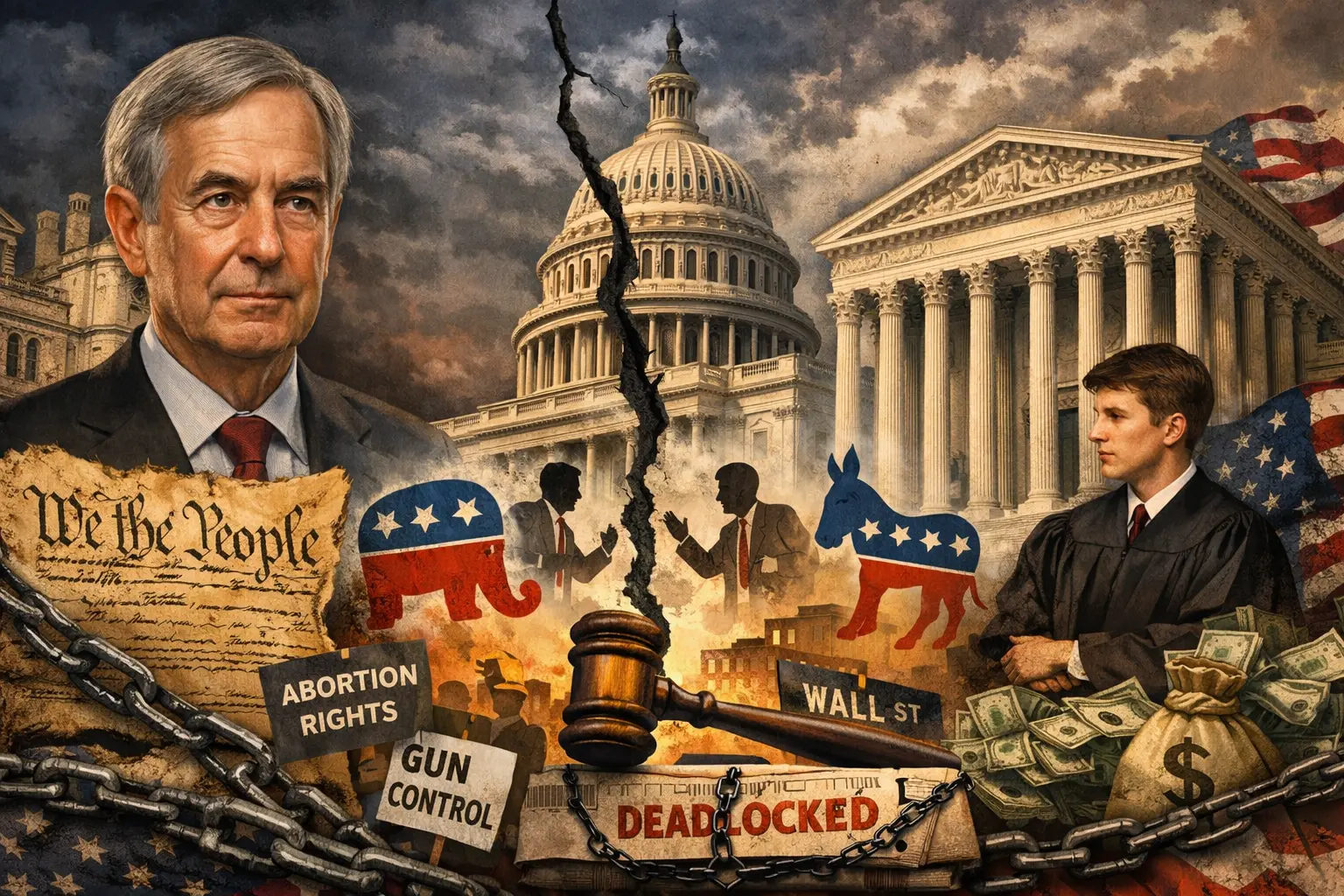
A Former UK Supreme Court Justice’s Stark Warning on Constitutional Failure
In this incisive constitutional analysis, Lord Jonathan Sumption, former Justice of the UK Supreme Court, delivers a stark critique of the United States Constitution and its ability to govern a deeply polarised society. He argues that a constitution’s true purpose is not rigid legal supremacy, but the practical accommodation of disagreement through functioning democratic institutions. Examining legislative paralysis, judicial dominance, constitutional rigidity, and the erosion of shared political culture, Lord Sumption warns that America’s constitutional design works only in periods of stability and falters in times of stress. His intervention raises urgent questions about democratic accountability, judicial supremacy, and whether a constitution that cannot evolve can endure in an era of intense political division.
A Fundamental Question About Constitutional Purpose
In a powerful and unsettling address, Lord Jonathan Sumption, former Justice of the UK Supreme Court and distinguished legal historian, delivered a searing critique of the American constitutional system. Speaking not as a partisan, but as a constitutional theorist, Lord Sumption posed a fundamental question: What is the purpose of a constitution—and is the United States Constitution still capable of fulfilling it?
His answer was as blunt as it was thought-provoking.
What a Constitution Is Meant to Do
At its core, Lord Sumption argued, a constitution is not merely a legal document. It is a framework of rules and political practices designed to enable collective decision-making in a divided society. Its true purpose is to accommodate differences—of opinion, belief, ideology, and interest—so that citizens can coexist within a single political community.
A constitution succeeds not when everyone agrees, but when disagreement can still be resolved through functioning institutions.
America’s Extreme Polarisation Problem
Lord Sumption acknowledged that political polarisation is not unique to the United States. Other advanced democracies face deep divisions over contentious issues such as:
- Abortion
- Same-sex partnerships
- Gun control
- Public health and healthcare provision
What distinguishes the United States, however, is not the existence of division, but the failure of its institutions to manage it.
Institutional Paralysis: A System Jammed from Within
According to Lord Sumption, America’s constitutional machinery has become dangerously gridlocked:
- Congress is paralysed by procedural weapons like the filibuster, allowing minorities to block legislation with majority support.
- Supreme Court appointments can be stalled indefinitely through simple political obstruction.
- Leadership crises in the House of Representatives can prevent even the basic functioning of government.
- Fiscal brinkmanship allows political factions to threaten national bankruptcy by withholding essential revenues.
This, he argued, is not healthy constitutional tension—it is systemic failure.
Judicial Power Without Democratic Escape
A central concern in Lord Sumption’s critique is the finality of U.S. Supreme Court decisions. Because the Constitution is the supreme law of the land, judicial interpretations cannot be reversed through ordinary democratic processes.
The consequences are profound:
- Presidential elections become proxy battles for Supreme Court control.
- Presidents can reshape constitutional meaning for generations by appointing young, ideologically aligned justices.
- Major questions of social policy are decided by courts rather than elected institutions.
In this environment, judicial review ceases to be a safeguard and becomes a substitute for democratic politics.
When Shared Political Culture Collapses
Lord Sumption identified the true vulnerability of the U.S. Constitution: its dependence on a shared political culture.
The system of checks and balances only works when all sides share a basic commitment to making the system function—even at the cost of losing an argument. When that shared commitment collapses, the branches of government fall into perpetual conflict.
Instead of dispersing power, checks and balances produce total stalemate.
Ironically, he observed, this breakdown occurs precisely when a functioning constitution is needed most.
Historical Echoes of Constitutional Breakdown
This is not the first time the American system has faced such stress. Lord Sumption pointed to earlier constitutional crises:
- The 1850s, in the lead-up to the Civil War
- The 1930s, during clashes between Congress and the Supreme Court over the New Deal
What makes today’s crisis more dangerous is the Constitution’s extreme rigidity.
The Problem of Constitutional Rigidity
Unlike many democracies, the United States lacks an effective constitutional “safety valve.” Amendments require overwhelming political consensus—two-thirds of Congress and ratification by two-thirds of the states—making reform virtually impossible in a polarized society.
As a Result
- Entrenched judicial doctrines can persist for decades
- Democratic correction becomes unattainable
- Political frustration intensifies rather than resolves
The Supreme Court as a Political Actor
Lord Sumption was particularly critical of periods when the U.S. Supreme Court has pursued overt political agendas. He cited historical examples where judicial power entrenched conservative interests:
- Obstruction of labour protection laws before World War II
- Resistance to civil rights reforms for nearly a century after the Civil War
- Decisions enabling unlimited corporate spending in elections
- Judicial invalidation of gun control laws despite recurring mass violence
When such rulings are constitutionalised, he warned, they become almost impossible to undo—“until the crack of doom.”
A Constitution That Works Only in Good Times
Lord Sumption’s most damning conclusion was this:
The American Constitution functions tolerably well in periods of stability, but fails catastrophically in times of stress.
As the United States enters what he described as a period of relative economic and geopolitical decline, the inability to adapt constitutionally may prove fatal to effective governance.
A Final, Unsettling Verdict
Lord Sumption ended with a personal reflection that resonated deeply with the audience:
“I would not wish to live under such a constitution.”
It was not an attack on America as a nation, but a warning about constitutional design, democratic accountability, and the dangers of mistaking rigidity for strength.
Why This Speech Matters Today
For lawyers, constitutional scholars, and policymakers worldwide, Lord Jonathan Sumption’s critique offers a rare external diagnosis of American constitutional dysfunction—one that challenges long-held assumptions about the virtues of immutability, judicial supremacy, and unchecked constitutional reverence.
In an era of rising polarisation across democracies, his words invite a broader, urgent question:
Can a Constitution Survive if It Cannot Evolve?
Related Article:
Lawyers In United Kingdom
| Lawyers in London, UK | Lawyers in Birmingham | Lawyers in Dublin, Ireland |
| Lawyers in Manchester | Lawyers in Lancaster | Lawyers in Edinburgh, Scotland |
| Lawyers in Southampton | Lawyers in Bradford |