Introduction
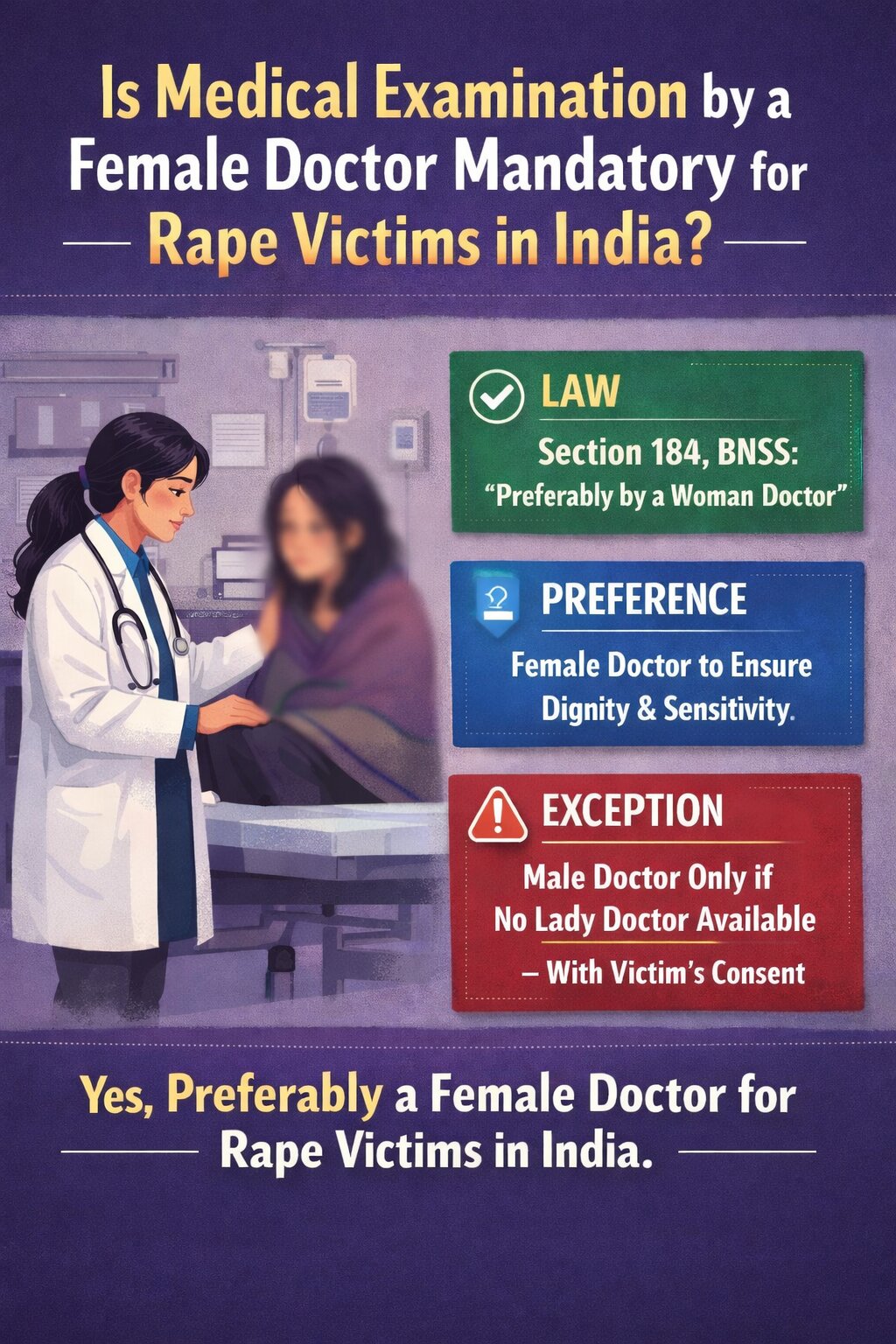
In India, the medical examination of rape survivors is a critical forensic and therapeutic intersection. For adult survivors, Section 184 of the Bharatiya Nagarik Suraksha Sanhita, 2023 (BNSS)—which replaced Section 164A of the CrPC—establishes the procedural framework. While it emphasizes promptness and consent, it does not strictly mandate a female doctor for adults. In contrast, for child victims (under 18 years), Section 27(2) of the POCSO Act, 2012 creates an absolute statutory mandate for examination by a woman doctor.
Statutory Framework
A. Section 184 BNSS: Adult Victims
- Consent is Paramount: No examination can be conducted without the express consent of the woman or a person authorized to give consent on her behalf.
- Preference, Not Mandate: The law prefers a female registered medical practitioner. However, if unavailable, a male doctor may proceed, provided a female attendant is present to ensure dignity and privacy.
- Timeline: The victim must be sent for examination within 24 hours of the police receiving information.
- Report Forwarding: The medical report must be forwarded to the Investigating Officer (I.O.) within seven days.
B. Section 27 POCSO Act: Child Victims
- Mandatory Female Doctor: Section 27(2) is categorical: “In case the victim is a girl child, the medical examination shall be conducted by a woman doctor.”
- Child-Friendly Environment: The examination must occur in a non-threatening setting, often in the presence of a parent or a person the child trusts.
- No FIR Required: Medical care and forensic evidence collection cannot be delayed for the want of a formal FIR or police requisition (Section 19 POCSO).
Section 397 BNSS: Mandatory Free Medical Treatment for Victims
Section 397 of the Bharatiya Nagarik Suraksha Sanhita (BNSS), 2023, imposes a non-negotiable statutory obligation on all medical facilities—including Central/State Government, local body, and private hospitals—to provide immediate first-aid and medical treatment free of cost to victims of sexual offences under the Bharatiya Nyaya Sanhita (BNS) and the POCSO Act.
Key Mandates:
- Universal Applicability: Applies to all hospitals regardless of ownership or management.
- Immediate Care: Treatment must be provided “immediately” without waiting for an FIR or police requisition.
- Cost-Free: Services must be rendered free of charge to the victim.
- Mandatory Reporting: Hospitals are legally required to inform the police immediately after such incidents are reported to them.
MoHFW Guidelines (2014)
The Ministry of Health and Family Welfare (MoHFW) issued “Medico-legal care for survivors/victims of sexual violence,” which remains the gold standard for clinical practice:
- Ban on the Two-Finger Test (TFT): Explicitly prohibits the “two-finger test” to assess vaginal laxity or “habituation,” labelling it unscientific and a violation of dignity.
- Right to Refuse: A survivor has the right to refuse any specific part of the medical examination.
- Free Treatment: Under Section 397 BNSS, all hospitals (Government or Private) are mandated to provide free first-aid and medical treatment to victims of sexual crimes.
Landmark Judicial Pronouncements
|
Case Law |
Legal Principle |
|
Lillu @ Rajesh v. State of Haryana (2013) |
The SC held the Two-Finger Test (TFT) to be unconstitutional, violating the right to privacy and dignity under Article 21. |
|
State of Jharkhand v. Shailendra Kumar Rai (2022) |
The SC reiterated the ban on TFT, directing that any professional conducting it would be guilty of misconduct. It ordered the removal of the test from medical curricula. |
|
State of Karnataka v. Manjanna (2000) |
Ruled that hospitals cannot refuse or delay medical exams due to a lack of police requisition. |
|
State of Punjab v. Gurmit Singh (1996) |
Established that the victim’s testimony is sufficient for conviction if it inspires confidence; medical corroboration is not an absolute necessity. |
|
Karnataka HC (2024) Observation |
Recommended that the legislature amend Section 184 BNSS to make female doctors mandatory for adults to align with modern privacy standards. |
Summary Table: Female Doctor Mandate
|
Category |
Law |
Is Female Doctor Mandatory? |
Safeguard if Unavailable |
|
Adult Woman |
Sec 184 BNSS |
No (Preferred/Efforts must be made) |
Presence of a female attendant is mandatory. |
|
Girl Child |
Sec 27 POCSO |
Yes (Statutory Mandate) |
Must seek a female doctor; male doctor only in dire emergency to save life. |
Conclusion
The Indian legal system operates on a dual-track: strict statutory protection for children and a “preference-based” model for adults. While the BNSS provides the procedural backbone, judicial overtones increasingly lean toward a total “female-only” examination model for all women to prevent secondary victimization. The shift from the CrPC to the BNSS maintains the “no-delay” principle, ensuring that the search for a female doctor does not compromise the collection of time-sensitive forensic evidence.