Introduction
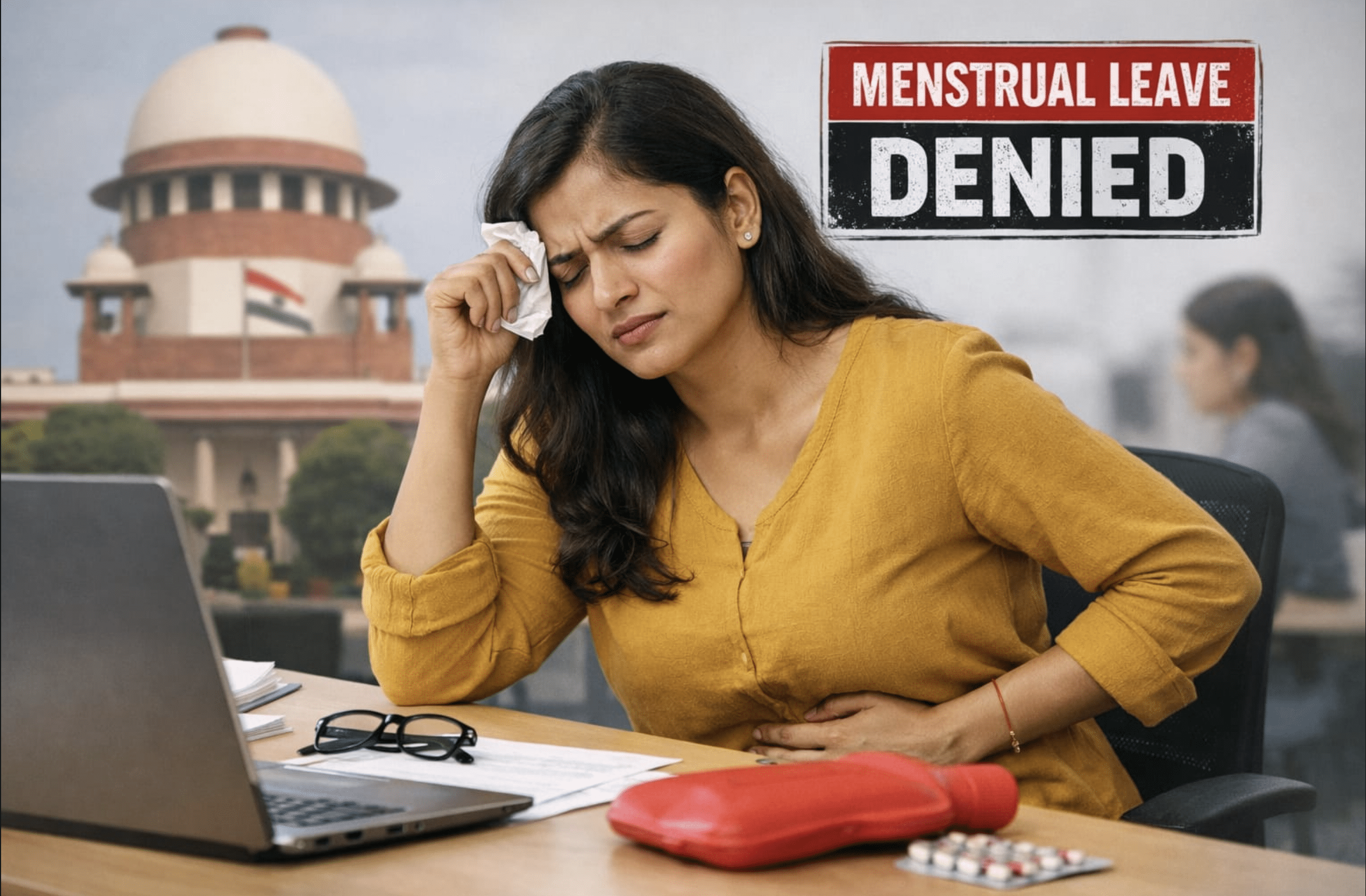
The Supreme Court recently declined to hear a Public Interest Litigation (PIL) seeking paid menstrual leave for women across all Indian establishments. The petition, filed by Shailendra Mani Tripathi on 13 March 2026, urged the court to direct the union government, as well as the states and union territories, to implement legislation and policies acknowledging the monthly physiological difficulties women experience.
Chief Justice of India Surya Kant and Justice Joymalya Bagchi expressed serious concerns regarding a legal requirement for menstrual leave. They feared it might actually harm women’s employment opportunities. The judges noted that employers might become reluctant to employ women, fearing additional obligations, which could ultimately decrease women’s presence in the workforce. Chief Justice Surya Kant warned that such a petition could create the impression that women aren’t on par with men due to “natural issues” affecting their work during certain times.
Senior advocate Mr. Shamshad, representing the petitioner, argued that several private organizations “voluntarily” grant menstrual leave to women employees. While acknowledging the positive aspects of voluntary menstrual leave, Chief Justice Surya Kant cautioned that making it mandatory could unintentionally harm women’s career prospects.
The Biological Reality
Menstruation is a natural process that occurs once a month, where a woman’s body sheds the lining of the uterus. This lining, along with blood, comes out of the body through the cervix, which is located at the bottom of the uterus, and out through the vagina. This process occurs in a woman’s body when she does not become pregnant, meaning that the egg does not become fertilized, so she does not need the extra lining in the uterus.
- Menarche marks the first menstrual period.
- Occurs during puberty between 8 and 15 years old.
- The menstrual cycle typically lasts about 28 days.
- Variations in cycle length are normal.
Ancient Stigma
For ages, menstruation was not just considered a natural biological process; instead, it was wrapped in stigma and framed as a “curse” to be endured in silence. Women in ancient times were even forced to live in separate huts during their periods, as they were considered to be “impure.” This was not only physically isolating but also mentally, as the women were made to feel as if they were being ostracized.
Dealing with menstruation was also extremely uncomfortable for women, as they were not provided with the modern facilities that are now easily available to deal with menstruation. Before the advent of sanitary pads, women were forced to use rough cloths and sanitary belts, which were extremely uncomfortable.
Furthermore, women’s health issues were also ignored, as the pain of menstruation was not considered serious and was rather dismissed as “hysteria.” Living with severe health issues like endometriosis was ignored, and women were forced to live with the pain without any proper medical attention.
In the modern world of the 21st century, menstruation is not a taboo subject but is discussed openly. The modern world is moving towards better management of menstruation through awareness, better management, and better alternatives like menstrual cups and period underwear and towards eradicating period poverty and unfair taxes.
Global Jurisprudence
The ongoing global conversation about menstrual leave involves balancing the protection of women’s health with addressing practical economic concerns. In recent years, particularly leading up to 2026, more countries and organizations have recognized the importance of implementing such policies.
However, the debate has shifted beyond mere desirability. Now, the focus is on designing and implementing menstrual leave frameworks that protect women’s dignity and well-being while avoiding barriers to their equal participation, career growth, and workplace opportunities.
Country-wise Policies
| Country | Policy Details |
|---|---|
| Taiwan (2002) | 1 day/month, max 3 days/year, ~50% wages |
| Indonesia (2003) | Up to 2 days/month; employer coordination required |
| South Korea | 1 day/month, usually unpaid |
| Spain (2023) | 3–5 days’ leave for medically verified pain |
Voices From The States
In India, several states have introduced changes regarding menstrual leave policies.
- Bihar (1992): 2 paid days/month for government employees
- Odisha (2024): 1 paid day/month
- Kerala: Up to 3 days/month for students and women
- Sikkim: Up to 3 days/month
- Karnataka (2025): Mandatory leave in public & private sectors
Additionally, organizations such as Zomato, Swiggy, and Byju’s have implemented menstrual leave policies for employees working in these organizations.
This raises a crucial question: if these states and private institutions can recognize the struggles faced by women, why can’t the central government do the same? Although a three-decade success of the Bihar model proves empirically that menstrual leave doesn’t hinder women’s professional integration, on the contrary, it formalizes a biological necessity.
Why Leaves Matter
- 35 crores of women menstruate
- 12 crores of adolescent girls face hygiene challenges annually
- 2.3 crores drop out of school due to lack of facilities
- 40% experience premenstrual symptoms
- 80% suffer from dysmenorrhea
Recognizing these challenges, providing menstrual leave fosters a more understanding and supportive workplace. It acknowledges the real physical demands of menstruation and allows individuals to prioritize their health without fear of job loss or financial hardship. Furthermore, such policies help dismantle the stigma surrounding menstruation and encourage open discussions.
Typically, sick leave is reserved for general health issues impacting an employee’s ability to work. However, many menstruators end up using it for period-related discomfort. Studies indicate that out of 500 working women in India, around 270 take leave during their menstrual cycle. Introducing separate menstrual leave ensures sick leave is reserved for other medical needs while providing individuals with the space to manage their periods comfortably and without added pressure.
Constitutional Mandate
| Article | Provision | Relevance |
|---|---|---|
| Article 14 | Equality before law | Ignoring biological realities leads to inequality |
| Article 15 | No discrimination | Lack of leave may cause indirect discrimination |
| Article 21 | Right to life & dignity | Health and dignity compromised without leave |
This can also be seen as a violation of the Convention for the Elimination of All Forms of Discrimination Against Women (CEDAW). CEDAW states that discrimination against women is seen as a difference between genders, which leads to inequality between the two genders. This inequality does not exist because of the lack of acceptance of menstrual leave.
The Ambedkar Test
“I measure the progress of a community by the degree of progress that women have achieved.” – B.R. Ambedkar. This sentence is a complete reflection of the opinion that a society’s progress is based on how it treats its women. It is in this light that the menstrual leave policy is not just a welfare policy but a reflection of a progressive society that treats its women with the dignity and respect they deserve.
“Periods are natural, but the stigma around them is unnatural.” “Science is natural, but the silence around that is unnatural.” “During the menstrual period, improper hygienic habits may lead to certain health issues faced by women.” For example, “If proper sanitary conditions are not maintained, Reproductive Tract Infections (RTIs) may occur, which are caused by the growth of pathogenic bacteria in a sensitive physiological phase.” “Also, if proper attention is not given to menstrual health, the risk of developing critical diseases such as cervical cancer, though not caused by menstruation, may increase.” “Also, urinary tract infections may occur in women, as the possibility of bacteria entering the urinary system is higher.”
Thus, from a health and rights-based perspective, ensuring proper menstrual hygiene is essential for safeguarding dignity and preventing avoidable medical complications.
Menstrual hygiene is not an issue of favor, charity, or a side issue, but the issue of health, education, dignity, and quality. Women do not need sympathy; they need equality. They do not need silence; they need dignity. Women do not need tokenism; they need rights.
Written By: Sonali Yadav, 2nd Year Law Student, University of Lucknow.