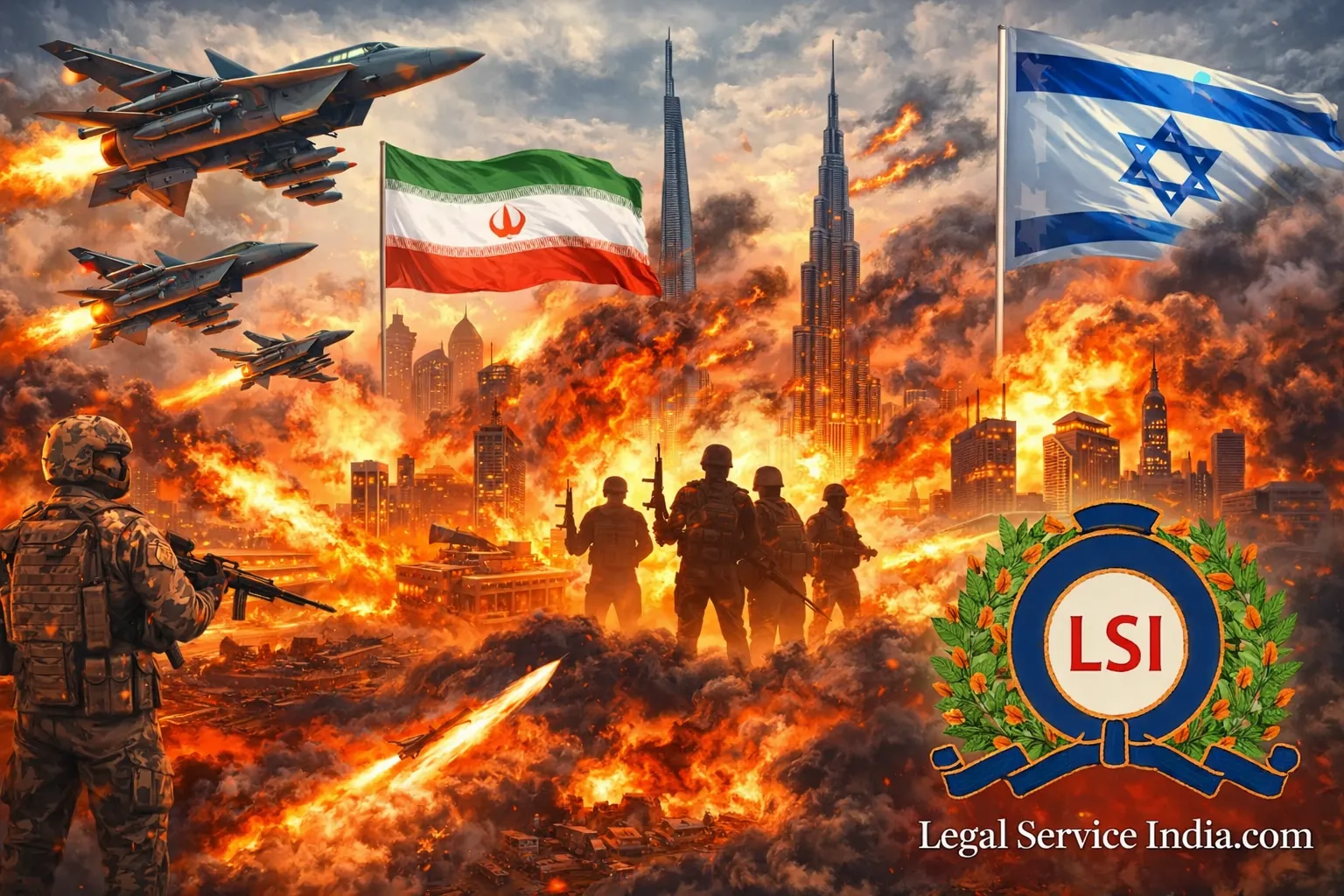
The Middle East Has Once Again Become The Center Of Global Attention
The Middle East has once again become the center of global attention. Reports of coordinated military strikes, retaliatory missile launches, and rising geopolitical tensions have created a situation that many analysts describe as one of the most dangerous moments in recent international history.
Within a matter of hours, military operations escalated dramatically across the region. The United States and Israel reportedly launched coordinated strikes against targets linked to Iran, triggering a chain of retaliatory actions that rapidly expanded the conflict beyond its original boundaries.
Missiles lit up the night skies across the Middle East. American military bases became targets. Strategic locations across multiple countries entered a state of high alert. Major cities, including Dubai, faced drone threats, and airspace restrictions began appearing across parts of the Gulf region.
The events raised a critical question for the entire world: How did the global situation deteriorate so quickly to the brink of a large-scale war?
To understand this crisis, it is necessary to examine the military escalation, the geopolitical stakes, and the deeper nuclear tensions that have been building for years.
A Sudden Military Escalation Across The Middle East
The immediate trigger for the crisis was a series of coordinated military operations conducted by the United States and Israel against Iranian targets. These operations reportedly involved fighter jets, missile systems, and drone strikes following a massive American military buildup across the region.
Shortly after the strikes, Iran launched a retaliatory campaign.
Ballistic missiles were fired toward multiple American military installations across the Middle East. Within hours, several countries in the region—including the United Arab Emirates, Qatar, Kuwait, Bahrain, and Saudi Arabia—reported security threats or military alerts.
- United Arab Emirates
- Qatar
- Kuwait
- Bahrain
- Saudi Arabia
Civilian infrastructure also experienced disruptions. Reports indicated drone activity near major landmarks in Dubai, including areas surrounding the Burj Khalifa. Authorities in the United Arab Emirates temporarily shut down airport operations as a precautionary measure.
These developments signaled that the conflict had moved beyond a limited military confrontation. Instead, it had begun to affect multiple countries simultaneously, raising fears of a regional war.
Leadership Losses And Escalating Rhetoric
One of the most alarming aspects of the conflict was the reported elimination of several high-ranking Iranian officials during the strikes.
According to reports circulating during the crisis, individuals holding key strategic positions in Iran’s military leadership—including the Minister of Defense, the head of military intelligence, and senior commanders—were killed during Israeli operations.
There were also claims that Iran’s Supreme Leader had died during the escalation, though such reports often require careful verification during fast-moving conflicts.
In response to the attacks, Iranian officials issued strong warnings, declaring that American and Israeli assets across the region were now legitimate military targets. Statements from Iranian leadership promised a retaliatory operation described as potentially one of the most devastating military responses in history.
Such rhetoric significantly increased fears of a wider war.
Understanding The Nuclear Trigger Behind The Crisis
The deeper cause of the confrontation lies in the international concern surrounding Iran’s nuclear program.
In May 2025, the International Atomic Energy Agency (IAEA) reported that Iran had enriched uranium to approximately 60 percent purity. While this figure may sound technical, it has major implications for global security.
What Uranium Enrichment Means
Uranium is a naturally occurring metal found beneath the Earth’s surface. However, natural uranium contains only about 0.7 percent of the isotope U-235, which is the component required to sustain nuclear reactions.
Through a process known as uranium enrichment, the concentration of U-235 is increased.
Different enrichment levels serve different purposes:
| Enrichment Level | Typical Use |
|---|---|
| 3–5% | Nuclear power plants |
| 10–20% | Medical and research applications |
| Around 90% | Weapons-grade nuclear material |
When uranium enrichment approaches 90 percent, it becomes suitable for building nuclear weapons.
The international community became alarmed because enrichment at 60 percent places a country dangerously close to the weapons-grade threshold.
According to many analysts, reaching that level means a nation could potentially produce a nuclear weapon within a relatively short period of time.
Historical Precedents: Preventing Nuclear Weapons
The possibility of Iran becoming a nuclear power is not the first time such fears have triggered military action in the Middle East.
Israel has historically taken aggressive steps to prevent hostile states from developing nuclear capabilities.
The 1981 Attack On Iraq
In 1981, Israel conducted Operation Opera, an airstrike targeting Iraq’s nuclear reactor near Baghdad. Eight Israeli fighter jets crossed into Iraqi airspace and destroyed the Osirak reactor facility.
The strike effectively ended Iraq’s nuclear weapons ambitions at that time and significantly weakened Saddam Hussein’s strategic plans.
The 2007 Strike On Syria
Similarly, in 2007 Israel carried out another covert operation targeting a suspected nuclear facility in Syria. That strike prevented Syria from advancing its nuclear program.
These precedents illustrate a consistent Israeli doctrine: prevent hostile regional powers from acquiring nuclear weapons before they become operational.
Why Iran’s Nuclear Program Is Viewed Differently
Many countries already possess nuclear weapons. The United States, Russia, China, France, and the United Kingdom are recognized nuclear powers. Other countries such as India, Pakistan, and North Korea also possess nuclear capabilities.
Even Israel is widely believed to maintain nuclear weapons, though it has never officially confirmed this.
This raises a natural question:
If so many countries already possess nuclear weapons, why does Iran’s program create such intense global concern?
Several reasons explain this.
Key Reasons For Global Concern
| Reason | Core Concern |
|---|---|
| Hostility Toward Israel | Strong anti-Israel rhetoric and military capability raise fears of a nuclear strike. |
| Regional Militant Network | Iran’s alliances across the Middle East increase Israel’s strategic vulnerability. |
| Strait of Hormuz Control | Iran could disrupt one of the world’s most critical oil shipping routes. |
| Regional Nuclear Arms Race | Iran obtaining nuclear weapons could push neighboring countries to develop their own. |
1. Hostility Toward Israel
Iranian leadership has repeatedly issued strong statements against Israel.
Iran’s Supreme Leader once described Israel as a “cancerous tumor” that must be removed. Such statements have reinforced Israel’s fears that a nuclear-armed Iran could potentially attempt a direct attack.
Israel is geographically small, and analysts often point out that a single nuclear strike could cause catastrophic damage to the country.
Moreover, Iran already possesses ballistic missiles capable of reaching Israeli territory in roughly eight minutes.
2. Iran’s Network Of Regional Allies
Even without nuclear weapons, Iran has built a powerful network of allied militant organizations across the Middle East.
These groups include:
- Hezbollah in Lebanon
- Hamas in Gaza
- Houthi forces in Yemen
- Various militias operating in Syria
Through these alliances, Iran has effectively surrounded Israel from multiple directions.
For decades, Israel has viewed this regional strategy as an existential threat. Since the Iranian revolution of 1979, Israel has maintained a constant state of strategic alert regarding Iran.
Israel’s military philosophy reflects this perception of danger. Rather than waiting for attacks to occur, Israel often favors pre-emptive strikes designed to eliminate threats before they fully develop.
3. Control Over The Strait Of Hormuz
Another major concern involves the Strait of Hormuz, one of the most important maritime trade routes in the world.
The Strait of Hormuz is a narrow waterway connecting the Persian Gulf with the Gulf of Oman and the Arabian Sea. It lies between Iran to the north and Oman to the south.
This passage is crucial to the global energy system.
Approximately 20 percent of the world’s daily crude oil supply passes through the Strait of Hormuz. Oil-producing countries such as Saudi Arabia, Iraq, Kuwait, and the United Arab Emirates rely on this route to export their energy resources.
If Iran were able to block or disrupt this passage, the consequences could be severe:
- Global oil supplies would drop dramatically
- Energy prices would surge
- Inflation would increase worldwide
- Global economic growth could slow or even collapse
Because of this strategic importance, many countries—including the United States—consider stability in the Strait of Hormuz to be essential for global economic security.
4. The Fear Of A Regional Nuclear Arms Race
Another reason the world is deeply concerned about Iran’s nuclear ambitions is the possibility of a regional nuclear arms race.
If Iran successfully develops nuclear weapons, neighboring countries may feel compelled to build their own.
Leaders in Saudi Arabia have already suggested this possibility publicly. The Saudi Crown Prince has stated that if Iran obtains a nuclear weapon, Saudi Arabia would likely pursue one as well.
If multiple countries across the Middle East begin developing nuclear weapons, the region could become one of the most dangerous nuclear flashpoints in the world.
A Wider Conflict Emerging
What makes the current situation especially alarming is that the conflict has expanded beyond Israel and Iran.
Reports suggest that Iranian retaliation has targeted multiple Gulf nations, including the United Arab Emirates, Qatar, Kuwait, Bahrain, and Saudi Arabia.
Some attacks reportedly struck military installations linked to American forces, while others affected civilian areas.
As a result, the entire Middle East has entered a state of heightened alert.
There is also concern that regional alliances could form against Iran, potentially bringing several countries into direct conflict simultaneously.
Countries Reportedly Affected By Retaliatory Attacks
- United Arab Emirates
- Qatar
- Kuwait
- Bahrain
- Saudi Arabia
Nature Of Reported Attacks
| Type Of Target | Description |
|---|---|
| Military Installations | Some attacks reportedly struck facilities linked to American forces. |
| Civilian Areas | Other attacks affected populated civilian regions. |
The Global Risk: Russia And China
One of the biggest fears among international observers is the possibility that major global powers could become involved.
If Russia or China were to support Iran directly in a military confrontation with the United States and Israel, the conflict could expand beyond the Middle East and escalate into a much larger global confrontation.
Such a scenario would dramatically increase the risk of a world war.
Potential Global Escalation Scenario
- Direct support for Iran by major global powers
- Military confrontation with the United States and Israel
- Expansion of conflict beyond the Middle East
- Significant rise in the risk of a world war
The Nightmare Of Nuclear War
At its core, the crisis highlights one of the most frightening possibilities in modern geopolitics: nuclear conflict.
A nuclear war would have devastating consequences not only for the countries directly involved but for the entire world.
Environmental damage, economic collapse, and humanitarian disasters could follow any nuclear exchange.
For this reason, many international leaders and analysts continue to emphasize diplomacy and de-escalation as the only viable long-term solutions.
Possible Consequences Of Nuclear Conflict
- Severe environmental damage
- Global economic collapse
- Humanitarian disasters
- Long-term geopolitical instability
Conclusion
The Iran–Israel confrontation of 2026 illustrates how quickly geopolitical tensions can spiral into a potentially catastrophic crisis.
Military strikes, retaliatory missile attacks, nuclear concerns, and strategic control over global energy routes have combined to create one of the most volatile situations in recent history.
The stakes extend far beyond the Middle East. The stability of global energy markets, international security, and even the possibility of nuclear war are all connected to how this conflict unfolds.
For now, the world watches anxiously, hoping that diplomacy prevails and that the current tensions subside before they escalate into a wider war.
Because if history has taught us anything, it is this: war—especially nuclear war—is a tragedy that humanity cannot afford to repeat.