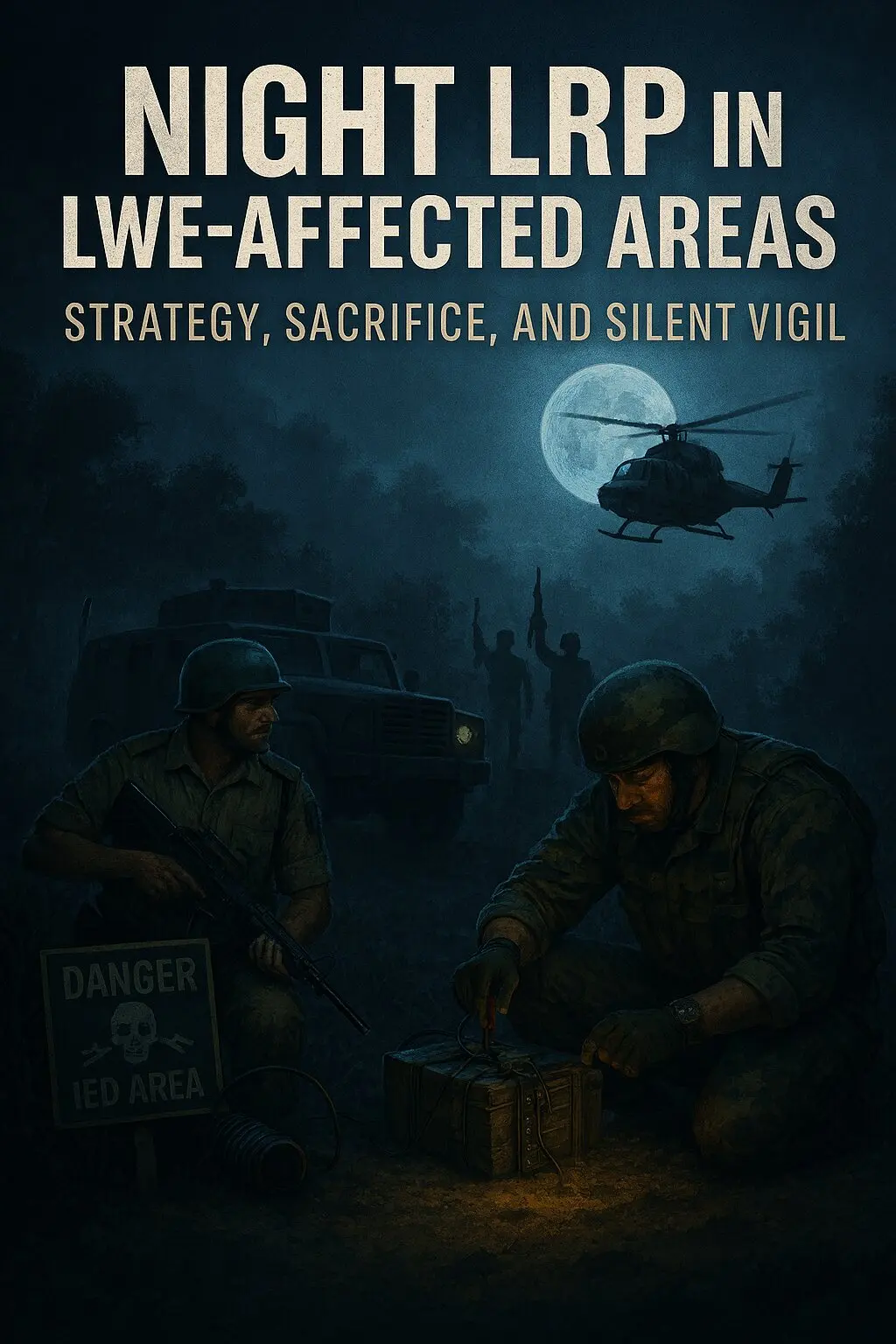
Night Long Range Patrolling (LRP) in Left-Wing Extremism (LWE)-affected areas represents one of the most demanding and strategically significant operations undertaken by security forces in India. Conducted in remote forested belts across states such as Chhattisgarh, Jharkhand, Odisha, and Maharashtra, and previously in West Bengal, night LRPs are designed to counter the guerrilla tactics employed by insurgent groups like the Communist Party of India (Maoist).
Unlike routine policing, night LRPs are high-risk, intelligence-driven missions conducted in hostile terrain under the cover of darkness. They are not merely patrols; they are calculated exercises in endurance, stealth, and survival.
The Strategic Rationale
Night Long Range Patrolling (LRP) in Left-Wing Extremism–affected areas is far more than a routine security exercise; it is a decisive instrument of counter-insurgency strategy. Conducted under the cover of darkness in dense forests, hill tracts, and rugged terrain, these patrols seek to dominate hostile territory, disrupt the operational freedom of insurgent groups such as the Communist Party of India (Maoist), and deny them safe havens. The mission extends beyond mere physical movement—night LRPs are structured to gather actionable intelligence, detect and neutralize improvised explosive devices, intercept armed cadres in transit, and dismantle temporary camps and supply lines.
Left-Wing Extremist groups traditionally exploit their familiarity with terrain, local networks, and the advantage of surprise. Operating from dense forests and remote villages, they rely on ambush tactics and swift withdrawal into inaccessible zones. Night LRPs are conceived as a deliberate counter-strategy to neutralize this asymmetry. By penetrating insurgent-dominated areas after dark, security forces reverse the tactical equation, transforming darkness from a shield for extremists into an operational domain controlled by trained and disciplined personnel.
The objectives of Night LRP are therefore both physical and psychological. These patrols aim to dominate territory in tangible and perceptual terms, prevent the regrouping of extremist cadres, disrupt logistics and hideouts, and reassure local populations of the state’s sustained presence and resolve. Equally significant is the psychological impact on insurgent networks, which are unsettled by unpredictability and constant pressure. In essence, Night LRP represents a fusion of endurance, intelligence, tactical precision, and psychological initiative within the complex theatre of internal security operations.
Requirements of Equipment and Other Essentials for Night LRP
Night navigation drills are specialized training exercises designed to prepare personnel for movement and orientation in low-visibility conditions without compromising stealth. In Left-Wing Extremism (LWE)–affected regions, where insurgent groups such as the Communist Party of India (Maoist) operate in dense forests and rugged terrain, these drills are indispensable for operational safety and mission success. They train personnel to function confidently in darkness, where a single navigational error can expose a patrol to ambush or disorientation.
The core of night navigation training lies in mastering both traditional and modern tools. Personnel are trained in silent, light-disciplined use of maps and compasses when GPS signals are weak or unavailable, while also becoming proficient in handheld GPS devices without compromising operational security. Equally important is terrain recognition under minimal illumination—identifying ridgelines, dry riverbeds, tree lines, and foot tracks by silhouette and spatial awareness. Silent movement techniques, formation integrity without artificial light, and strict distance control ensure cohesion and stealth throughout the patrol.
These drills also emphasize contingency preparedness. Teams rehearse lost-contact procedures to regroup swiftly if temporarily separated and practice navigating pre-planned emergency extraction routes in case of ambush or casualty. Effective night navigation training reduces confusion, prevents accidental separation, and minimizes the risk of cross-firing or friendly mishaps. In counter-insurgency environments, mastery of night navigation transforms darkness from a vulnerability into a controlled tactical advantage.
The Terrain and Operational Complexity
The geography of LWE-affected regions presents formidable challenges. Thick sal forests, undulating plateaus, narrow foot tracks, dry riverbeds, and minimal road connectivity characterize these areas. During monsoons, visibility drops and ground conditions become treacherous.
Night LRPs are typically conducted by small, well-trained teams equipped with night vision devices, communication tools, and essential survival gear. The patrol may cover long distances on foot, often without artificial light to avoid detection. Each step is deliberate. The possibility of improvised explosive devices (IEDs) or ambush positions demands constant alertness.
Silence becomes discipline; fatigue becomes the enemy.
Physical and Psychological Demands
Night operations test not only physical stamina but also mental resilience. Personnel must remain vigilant for extended hours, navigating uneven terrain while maintaining formation and communication. The body’s natural circadian rhythm works against alertness at night, increasing the importance of training and team coordination.
The psychological strain is equally intense. The uncertainty of hostile contact, the fear of concealed explosives, and the isolation from immediate reinforcement demand exceptional composure. Unlike conventional urban operations, there are no streetlights, no quick evacuation routes, and often no mobile network coverage.
Yet, despite these hardships, night LRPs are executed with discipline because their strategic value outweighs discomfort.
Intelligence and Local Dynamics
Effective night LRPs are rarely random. They are guided by intelligence—human sources, intercepted communications, and prior surveillance. In areas influenced by the Communist Party of India (Maoist), local sympathies may be divided, and intelligence gathering becomes sensitive.
Trust-building with villagers is therefore critical. When communities perceive security forces as protectors rather than intruders, actionable information flows more reliably. Conversely, mistrust can compromise operational success. Thus, night LRPs must be integrated with daytime community outreach and civic action programs.
Risk Management and Modernization
In recent years, modernization efforts have strengthened the operational capability of forces engaged in LWE areas. Mine-protected vehicles, improved bulletproof gear, satellite communication systems, and drone reconnaissance have enhanced preparedness. However, technology cannot fully substitute human vigilance, especially in thick forest cover where electronic signals may falter.
Strict standard operating procedures (SOPs) govern movement, halts, and response to suspected threats. Patrol leaders continuously assess terrain, morale, and intelligence inputs. Coordination with district police and central armed forces ensures layered security.
The Human Dimension
Behind every night LRP lies a human story. The personnel undertaking these missions leave behind families who may not fully comprehend the nature of the risk involved. Communication is limited, and the uncertainty of operations can weigh heavily on loved ones.
For the officers and constables, however, the mission carries a sense of purpose. Reclaiming areas affected by insurgency is not merely about confrontation; it is about enabling governance, reopening schools, constructing roads, and restoring confidence among residents. Every successful patrol contributes to the gradual normalization of life.
Ethical and Legal Framework
Night LRPs operate within the constitutional mandate to maintain law and order and protect citizens. Adherence to legal safeguards is essential to maintain legitimacy. Respect for human rights, avoidance of excess force, and accountability mechanisms reinforce public trust.
In counter-insurgency environments, perception can be as critical as operational success. Ethical conduct strengthens the moral authority of the state and distinguishes legitimate security action from insurgent violence.
Challenges and the Road Ahead
Despite improvements, challenges persist. Intelligence gaps, difficult weather conditions, and evolving insurgent tactics require constant adaptation. Insurgents may plant pressure-activated IEDs, create decoy trails, or exploit local grievances.
To enhance effectiveness, continuous training, technological upgrades, psychological counselling, and welfare measures for personnel are vital. Equally important is synchronized development—roads, telecommunications, healthcare, and education must accompany security efforts. Security without development risks being temporary; development without security may be unsustainable.
Differences Between Night and Day Long Range Patrolling (LRP)
In Left-Wing Extremism (LWE)-affected areas, particularly against groups such as the Communist Party of India (Maoist), both Night and Day LRPs are strategically important. However, they differ significantly in objectives, risks, tactics, and operational dynamics.
|
Aspect |
Night LRP |
Day LRP |
|
Primary Objective |
Surprise, stealth, psychological dominance |
Area domination, visibility, public reassurance |
|
Visibility Conditions |
Limited visibility; reliance on night vision devices and silent movement |
Clear visibility; easier terrain assessment and navigation |
|
Element of Surprise |
High – insurgents often assume tactical advantage at night |
Moderate – movement is visible and more predictable |
|
Risk Factor |
Higher risk of ambush, disorientation, and IED encounters |
Higher risk of being observed from a distance |
|
Psychological Impact |
Creates uncertainty and pressure within insurgent ranks |
Demonstrates open control and confidence |
|
Intelligence Gathering |
Focused on covert surveillance and interception |
Includes interaction with villagers and overt information collection |
|
Community Engagement |
Limited due to darkness and security concerns |
Greater scope for confidence-building measures |
|
Physical Strain |
Increased fatigue due to circadian rhythm disruption |
Physically demanding but biologically aligned with alertness cycle |
|
Movement Style |
Slow, stealthy, noise-controlled, tactical formations |
Relatively faster, more flexible formations |
|
Operational Symbolism |
Reclaiming darkness as an operational space |
Assertion of visible state authority |
Night LRP emphasizes stealth, unpredictability, and psychological warfare, converting darkness from an insurgent advantage into a controlled tactical domain. In contrast, Day LRP focuses on overt area domination, community outreach, and logistical ease. While Night LRP tests endurance and precision under extreme conditions, Day LRP reinforces visible governance and operational transparency. Together, they form complementary pillars of counter-insurgency strategy in LWE-affected regions.
Risks of Night LRP
Night LRP in Left-Wing Extremism–affected areas carries substantial operational risks due to limited visibility, hostile terrain, and the constant threat posed by insurgent groups such as the Communist Party of India (Maoist). Darkness increases the likelihood of disorientation, accidental separation of teams, and navigation errors in dense forests and hilly tracts.
The risk of ambush remains high, as insurgents may exploit natural cover and pre-planted Improvised Explosive Devices (IEDs) along suspected routes. Communication can be constrained by terrain and the need for radio silence, reducing immediate support options.
Physical fatigue and disruption of the body’s natural alertness cycle further strain personnel, affecting reaction time and decision-making. Additionally, medical evacuation becomes significantly more difficult at night, compounding the consequences of any casualty. Thus, while Night LRP offers strategic advantages, it demands exceptional training, coordination, and mental resilience to mitigate its inherent dangers.
Night Long Range Patrolling (LRP) also carries heightened risks arising directly from darkness and operational constraints. The possibility of cross-firing increases when visibility is severely limited and fellow personnel are not clearly identifiable in dense forest or broken terrain. The deliberate non-use of torchlight to maintain stealth further compounds the danger, making roads, tracks, and natural obstacles difficult to see. As a result, personnel may stumble over roots, rocks, trenches, or uneven ground, leading to falls and injuries. Limited visibility can also cause temporary loss of visual contact within the team, increasing the risk of confusion during sudden engagements. These factors demand strict fire discipline, close formation control, constant communication, and exceptional coordination to prevent avoidable mishaps during night operations.
Conclusion
Night Long Range Patrolling in LWE-affected regions is more than a tactical manoeuvre—it is a profound statement of resilience, sacrifice, and silent vigilance. Each patrol embodies the determination of India’s security forces to reclaim the most difficult terrains from insurgent control, turning darkness itself into an operational ally.
These missions demand extraordinary endurance, discipline, and courage. They test the limits of human stamina and psychological strength, yet they also symbolize the unwavering commitment of personnel to safeguard communities far removed from the mainstream. Every step taken in the forests at night is a step toward restoring governance, enabling development, and reaffirming the rule of law.
The risks are immense—ambushes, IEDs, fatigue, and isolation—but the rewards are equally significant. Successful night LRPs deny extremists their safe havens, reassure vulnerable populations, and reinforce the state’s presence where it is most contested. They remind us that security is not confined to daylight or urban centres; it extends to the remotest corners of the nation, even under the cover of night.
Ultimately, Night LRP is not just an operational tactic—it is a moral commitment. It reflects the courage of those who walk silently through danger so that others may live without fear. It is a testament to the enduring spirit of India’s police and CAPF, who carry the weight of risk so that the promise of peace and constitutional order may prevail.