





Introduction
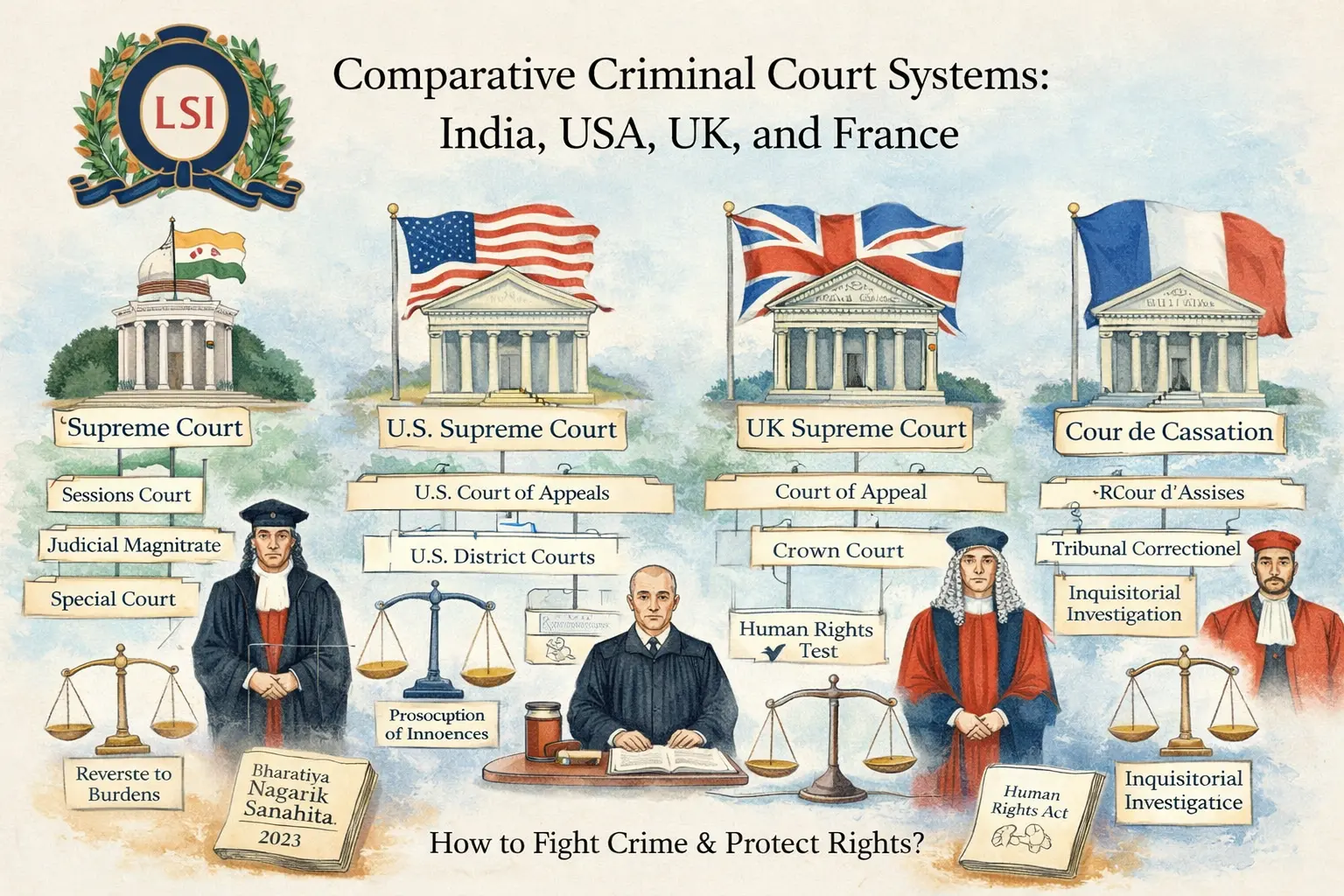
Structurally, India (now under the Bharatiya Nagarik Suraksha Sanhita, 2023) and the UK operate unified hierarchies topped by a single apex court, while the U.S. runs a dual system of federal and state courts, and France maintains a unitary, code-based judiciary with distinct trial tiers. Procedurally, India, the UK, and the U.S. follow largely adversarial models that rely on party-led proof, jury participation to varying degrees, and the prosecution’s duty to establish guilt “beyond reasonable doubt,” with limited statutory reverse-onus exceptions (e.g., narcotics, money laundering, terrorism) sometimes read down to evidential burdens.
France, on the other hand, follows the inquisitorial system, where judges take an active role in investigating cases, and the presumption of innocence is firmly built into procedure while the state keeps the main burden of proof. Across all four countries, the main challenge is the same: how to fight crime and protect victims without weakening the right to a fair trial. Each system answers this challenge differently depending on its structure (federal or unitary), style of evidence (adversarial or inquisitorial), and legal tests (proportionality, rational connection, or human rights review) that decide when reverse burdens can be allowed.
Organisation Of Criminal Courts And Their Jurisdiction: A Comparative Study Of India, USA, UK, And France
The organisation of criminal courts forms the backbone of a nation’s justice delivery system. The structure, jurisdiction, and procedural framework determine how swiftly and fairly criminal cases are adjudicated. While the substantive criminal law prescribes offences and penalties, it is the criminal court hierarchy that ensures due process and the rule of law. Different jurisdictions organise their criminal courts in line with their constitutional structures, legal traditions, and socio-political contexts. This article compares the court systems of India, the United States, the United Kingdom, and France, with emphasis on jurisdictional distribution and relevant case law.
Organisation of Criminal Courts in India
In India, the criminal court landscape has been comprehensively restructured under the Bharatiya Nagarik Suraksha Sanhita (BNSS), 2023, replacing key provisions of the earlier Cr. PC framework. Under Chapter II of the BNSS, the structure begins with Section 6, which identifies four primary classes of criminal courts in every state:
- Courts of Session
- Judicial Magistrates of the First Class
- Judicial Magistrates of the Second Class
- Executive Magistrates
Sessions Divisions and Session Courts
Section 7 mandates that each state be divided into one or more Sessions divisions, formed in alignment with district boundaries and subject to the High Court’s consultation.
According to Section 8, each Sessions division must have a Court of Session led by a Sessions Judge appointed by the High Court; this section also provides for Additional Sessions Judges and addresses how vacancy or multi-division oversight should be handled, ensuring continuity of judicial.
Judicial Magistrates Establishment
The BNSS then defines the establishment and authority of Judicial Magistrates through Section 9, which assigns the state government, after High Court consultation, the responsibility of establishing First and Second Class Judicial Magistrate courts in each district, and further permits the creation of Special Courts of Judicial Magistrates with exclusive jurisdiction over specific types of cases.
In addition, Section 10 empowers the High Court to appoint a Chief Judicial Magistrate for each district and Additional Chief Judicial Magistrates, as well as designate Sub-divisional Judicial Magistrates who may exercise supervisory control over subordinate magistrates.
Section 11 allows the High Court to appoint qualified individuals, perhaps from other government service positions, as Special Judicial Magistrates, who may exercise magistrate powers for specific case types or localities for limited terms.
Jurisdiction And Hierarchy
Section 12 grants the Chief Judicial Magistrate, under High Court oversight, the authority to delimit and modify the local jurisdiction of magistrate courts within the district; absent any specific designation, magistrates’ jurisdiction spans the entire district.
Section 13 clarifies the hierarchical chain of command:
- All Judicial Magistrates report to the CJM
- The CJM is subordinate to the Sessions Judge
- The CJM has the authority to distribute workload among magistrates
Executive Magistrates Hierarchy
The system further elaborates the hierarchy of Executive Magistrates in Sections 14 through 17, designating District Magistrates and Additional District Magistrates for administrative and law-and-order responsibilities, and providing for sub-divisional and Special Executive Magistrates in specific contexts.
Position Of Higher Judiciary
Thus, the BNSS defines a clear hierarchy, with the Supreme Court and High Courts at the apex, though these courts are affirmed and maintained under constitutional provisions rather than BNSS-specific provisions, as the BNSS’s scope lies in structuring lower criminal courts.
Several recent High Court decisions have already engaged BNSS provisions in practical contexts, reinforcing its operational importance in criminal procedure today (e.g., in preliminary remand rulings and bail-related inquiries).
Special Courts Under Special Laws
Special Courts are also established under various special legislations such as:
- The Prevention of Corruption Act, 1988
- The Protection of Children from Sexual Offences (POCSO) Act, 2012
- The Narcotic Drugs and Psychotropic Substances (NDPS) Act, 1985
- The Prevention of Money Laundering Act (PMLA), 2002
These courts follow specialised procedures and often have exclusive jurisdiction over specific categories of offences.
Organisation of Criminal Courts in the United States
Federal Court Structure
The United States follows a federal–state dual judicial system. At the federal level:
| Level | Court | Function |
|---|---|---|
| Trial Level | U.S. District Courts | Trial courts for federal offences such as interstate crimes, terrorism, and federal narcotics cases |
| Appellate Level | U.S. Courts of Appeals | Intermediate appellate courts for federal matters |
| Final Authority | U.S. Supreme Court | Final appellate authority on constitutional interpretation |
State Court Structure
At the state level, each state has its own hierarchy of trial courts, intermediate appellate courts, and a state supreme court.
- State trial courts of general jurisdiction hear most criminal cases, including serious felonies.
- State appellate courts review convictions and sentences.
- State supreme courts act as the final arbiters of state law.
The U.S. Supreme Court may hear cases from state supreme courts if they involve a substantial question of federal law.
Jurisdiction Principles
Jurisdiction in the U.S. is determined by the principles of federalism, whereby federal courts have jurisdiction over matters expressly provided in Article III of the U.S. Constitution, while state courts retain plenary jurisdiction over criminal matters not reserved for the federal system.
Organisation Of Criminal Courts In The United Kingdom
The criminal court system in the United Kingdom reflects its long-standing common law heritage. At the base of the hierarchy are the Magistrates’ Courts, which handle summary offences and conduct preliminary hearings for indictable offences. These courts are presided over either by lay magistrates or by District Judges. More serious criminal cases are tried in the Crown Court, which hears indictable offences before a judge and jury and also entertains appeals from the Magistrates’ Courts. Above the Crown Court is the Court of Appeal (Criminal Division), which reviews convictions and sentences from the Crown Court. At the apex of the UK criminal court system is the Supreme Court of the United Kingdom, which hears appeals involving points of law of public importance, particularly those arising from the Court of Appeal.
Hierarchy Of Criminal Courts In The UK
| Level | Court | Primary Function |
|---|---|---|
| Base Level | Magistrates’ Courts | Handle summary offences and preliminary hearings for indictable offences |
| Trial Court | Crown Court | Tries serious criminal cases before judge and jury; hears appeals from Magistrates’ Courts |
| Appellate Level | Court Of Appeal (Criminal Division) | Reviews convictions and sentences from the Crown Court |
| Apex Court | Supreme Court Of The United Kingdom | Hears appeals involving points of law of public importance |
Abolition Of The Judicial Role Of The House Of Lords
The House of Lords in the United Kingdom, once the nation’s highest court of appeal, was effectively stripped of its judicial powers in 2009 following the implementation of the Constitutional Reform Act 2005.[1] Before this reform, appellate functions were carried out by the Lords of Appeal in Ordinary, commonly known as Law Lords, who sat in a special judicial committee of the House of Lords to decide civil appeals from across the UK and criminal appeals from England, Wales, and Northern Ireland. The reform aimed to strengthen the separation of powers by creating an entirely independent Supreme Court of the United Kingdom, which officially began functioning on 1 October 2009.[2] On that date, the judicial role of the House of Lords was abolished, and the serving Law Lords became the first Justices of the new Supreme Court.[3] Since then, the House of Lords has remained solely a legislative chamber, focusing on scrutinising and revising legislation, while the Supreme Court has served as the UK’s highest judicial authority, separate from the parliamentary process.
Organisation Of Criminal Courts In France
France’s criminal judiciary operates within a civil law framework characterised by an inquisitorial procedure, primarily regulated by the Code de procedure penale (French Code of Criminal Procedure)[4]. The system is structured hierarchically, with jurisdiction divided according to the seriousness of the offence—contraventions (minor offences), delits (intermediate offences), and crimes (the most serious offences).
Classification Of Offences In France
- Contraventions – Minor offences
- Delits – Intermediate offences
- Crimes – Most serious offences
Trial Courts In France
Tribunal De Police
At the base of the hierarchy is the Tribunal de Police, which deals with minor contraventions such as petty traffic violations, public order disturbances, and minor regulatory breaches[5].
Tribunal Correctionnel
For more serious but non-felonious conduct, the Tribunal Correctionnel has jurisdiction over delits, roughly equivalent to misdemeanours in common law systems. These include offences like theft, fraud, and assault causing limited injury, which typically carry penalties of up to 10 years’ imprisonment[6].
Cour D’Assises
The most serious criminal matters, categorised as crimes, are tried before the Cour d’Assises. This court is distinctive in its composition: it consists of three professional judges and six lay jurors in first instance trials (or nine jurors in appeals), who together determine both guilt and sentence[7]. Crimes under its jurisdiction include murder, rape, armed robbery, and major drug trafficking cases.
Cour De Cassation
Above these trial courts sits the Cour de Cassation, France’s highest judicial authority for criminal matters. Unlike the supreme courts of common law jurisdictions, the Cour de Cassation is not a court of retrial; rather, it functions as a court of cassation, reviewing judgments solely on points of law to ensure uniform interpretation and application of legislation across the nation[8]. If an error of law is found, the case is sent back (“casse et renvoye”) to a lower court for retrial.
Types of Criminal Jurisdiction under BNSS
Territorial Jurisdiction
Jurisdiction in criminal courts under the Bharatiya Nagarik Suraksha Sanhita, 2023 (BNSS) is determined by several factors, the foremost being territorial jurisdiction. Section 177 of the BNSS lays down the general rule that every offence shall ordinarily be inquired into and tried by a court within whose local jurisdiction it was committed.
However, Sections 178 to 184 provide exceptions for situations where an offence is committed partly in one area and partly in another, where it is a continuing offence spanning multiple jurisdictions, or where the place of commission is uncertain. In such cases, the trial may take place in any court having potential jurisdiction.
- Offence committed in multiple locations
- Continuing offence across jurisdictions
- Uncertain place of commission
For example, in a case of online financial fraud committed from Delhi against a victim in Mumbai, both locations would have jurisdiction over the matter. This principle was also recognised in Navinchandra N. Majithia v. State of Maharashtra[9], where the Supreme Court held that even a fraction of the cause of action arising within a court’s jurisdiction can confer competence to try the matter.
Subject-Matter Jurisdiction
Subject-matter jurisdiction under the BNSS depends on the seriousness of the offence and the punishment prescribed. Section 193 vests jurisdiction in Sessions Courts to try offences punishable with imprisonment exceeding seven years, life imprisonment, or the death penalty.
By contrast, Sections 26 to 28 empower a Judicial Magistrate of the First Class to impose imprisonment up to three years or a fine up to ₹50,000, and a Judicial Magistrate of the Second Class to impose imprisonment up to one year or a fine up to ₹10,000.
| Court | Maximum Imprisonment | Maximum Fine |
|---|---|---|
| Sessions Court | Above 7 Years / Life / Death Penalty | As Prescribed |
| Judicial Magistrate First Class | Up To 3 Years | ₹50,000 |
| Judicial Magistrate Second Class | Up To 1 Year | ₹10,000 |
The Supreme Court in State of Karnataka v. Kuppuswamy Gownder[10] emphasised that jurisdiction must be assessed strictly according to the statutory classification of offences and prescribed punishments.
Pecuniary Jurisdiction
While pecuniary jurisdiction is primarily a civil law concept, in criminal law it has limited relevance—mainly in relation to the power to impose fines. Under the BNSS, these powers are aligned with the sentencing jurisdiction of each court, thus indirectly establishing pecuniary boundaries.
Appellate And Revisional Jurisdiction
Appellate and revisional jurisdiction is expressly delineated under the BNSS. Appeals from Magistrates lie to the Sessions Court (Sections 408–414), and appeals from Sessions Courts lie to the High Court (Sections 415–423).
High Courts possess revisional powers under Sections 432–439, allowing them to examine the correctness, legality, or propriety of any order passed by subordinate courts.
- Appeal from Magistrate → Sessions Court
- Appeal from Sessions Court → High Court
- Revisional Power → High Court
This supervisory jurisdiction has been underscored in Amar Nath v. State of Haryana[11], where the Court observed that revisional powers are to be used sparingly, primarily to correct jurisdictional errors and prevent miscarriage of justice.
Special Court Jurisdiction
The BNSS also recognises special jurisdiction for cases triable exclusively by Special Courts constituted under statutes such as the Prevention of Corruption Act, 1988, the Protection of Children from Sexual Offences Act, 2012 (POCSO), and the Narcotic Drugs and Psychotropic Substances Act, 1985 (NDPS).
Section 5 of the BNSS provides that provisions of special laws override the general provisions of the BNSS where there is any inconsistency.
Procedural Innovations Affecting Jurisdiction
Significantly, the BNSS introduces procedural innovations affecting jurisdiction. Section 530 expands jurisdiction to courts where electronic evidence is stored or accessible, thereby accommodating cybercrime and other technology-related offences.
Sections 346 and 258 mandate time-bound trials, indirectly influencing case allocation to prevent backlog.
Moreover, the introduction of e-FIR and Zero FIR under Section 173 allows complaints to be registered at any police station, with subsequent transfer to the appropriate jurisdictional station, ensuring that territorial technicalities do not obstruct prompt initiation of proceedings, as supported in Lalita Kumari v. Government of Uttar Pradesh[12], where the Supreme Court affirmed the mandatory nature of FIR registration.
The United States Dual Court System – Federal And State Jurisdictions
In contrast to India’s unified single court structure, the United States operates under a dual court system, a model rooted in the federal nature of its Constitution. This means that there are two parallel sets of courts: one for the federal government and another for each individual state. Both court systems function independently within their respective jurisdictions, yet they often intersect in matters where federal and state laws overlap.
Federal Judiciary Structure
The federal judiciary in the United States, established under Article III of the U.S. Constitution, is vested with the authority to hear cases involving federal statutes, treaties, constitutional issues, and other matters specifically assigned by law[13].
- U.S. Supreme Court – Final authority on federal and constitutional law
- U.S. Courts of Appeals (13 Circuits) – Appellate review
- U.S. District Courts (94 Courts) – Trial courts
- U.S. Magistrate Judges – Preliminary proceedings and misdemeanours
At its apex stands the U.S. Supreme Court, which holds the final authority on questions of federal and constitutional law, and also hears appeals from state supreme courts in cases involving federal law or constitutional interpretation[14].
Below it are the U.S. Courts of Appeals, commonly known as Circuit Courts, comprising thirteen circuits that review appeals from federal district courts[15].
At the trial level are the U.S. District Courts, ninety-four in number, which handle federal criminal and civil cases[16].
Supporting the district judges are U.S. Magistrate Judges, who assist in preliminary proceedings, bail determinations, and the conduct of trials for certain misdemeanour offences[17].
State Court Systems
Each of the fifty states in the United States maintains its own judiciary, vested with the authority to adjudicate cases under its respective state constitution and statutes. While the organisational structure of these courts varies among states, most follow a broadly similar hierarchy.
Typical State Court Hierarchy
| Level | Court Type | Primary Function |
|---|---|---|
| Top | State Supreme Court | Highest judicial authority within the state for final appeals in matters of state law |
| Upper-Middle | Intermediate Appellate Courts | Review appeals from the lower trial courts to ensure legal correctness and fairness in proceedings |
| Middle | Trial Courts of General Jurisdiction | Handle serious criminal offences such as felonies, as well as major civil disputes |
| Base | Lower Courts (Magistrate or Municipal Courts) | Preside over misdemeanours, conduct preliminary hearings, and adjudicate minor matters such as traffic violations[18] |
Jurisdictional Division In USA
In the United States, the division of jurisdiction between federal and state courts is determined primarily by the nature of the offence and the authority under which it is defined.
Federal Jurisdiction
- Offences created under federal statutes
- Terrorism
- Interstate drug trafficking
- Immigration violations
- Cybercrimes crossing state or national boundaries
- Criminal acts committed on federal property such as military bases or national parks
These cases are prosecuted in the federal court system, with federal agencies such as the FBI, DEA[19], or Homeland Security often leading the investigations.
State Jurisdiction
- Assault
- Burglary
- Robbery
- Sexual offences
- Murder committed entirely within the state’s territorial boundaries
State law enforcement agencies and prosecutors handle these matters in the state court system.
Concurrent Jurisdiction And Dual Sovereignty
In certain instances, a single act may violate both federal and state laws, giving rise to concurrent jurisdiction. This allows both federal and state authorities to prosecute the same conduct, provided that constitutional safeguards against double jeopardy are respected.
However, the U.S. “dual sovereignty” doctrine permits successive prosecutions by federal and state governments for the same conduct, as they are considered separate sovereigns with distinct legal interests. This overlapping authority can lead to cooperative or parallel proceedings, particularly in cases involving complex criminal networks, organised crime, or large-scale financial fraud[20].
Key Features Of The UK Criminal Court System
The criminal court system in the United Kingdom is shaped by several defining features that distinguish it within the broader common law world.
Common Law Tradition
At its foundation lies the common law tradition, under which judicial decisions not only resolve individual disputes but also create binding precedents that guide future cases, ensuring consistency and adaptability in criminal law[21].
Separation Between Trial And Appellate Functions
- Trial courts (Magistrates’ Courts and the Crown Court) determine questions of fact through examination of evidence and witness testimony
- Appellate courts (Court of Appeal – Criminal Division and the Supreme Court) address questions of law and correctness of legal procedures rather than revisiting factual determinations
Jury System
Another hallmark of the system is the continued use of the jury system, especially in serious criminal trials held before the Crown Court. Here, a panel of twelve ordinary citizens is entrusted with determining the guilt or innocence of the accused, reflecting the principle of public participation and democratic legitimacy in the administration of justice[23].
Specialised Criminal Courts
| Court | Purpose |
|---|---|
| Youth Courts | Deal with offences committed by individuals under eighteen with procedures protecting welfare and privacy[24] |
| Coroners’ Courts | Conduct inquisitorial inquiries into sudden, violent, or unexplained deaths and ensure transparency and accountability[25] |
Together, these features reflect the UK’s commitment to balancing fairness, efficiency, and public confidence within its criminal justice system.
The French Criminal Court System – A Civil Law Model
France follows a civil law system rooted in the Napoleonic Code, which is fundamentally different from the common law systems of India, the USA, and the UK. The criminal justice framework is based on inquisitorial procedures rather than the adversarial trial model. This means that judges take an active role in investigating and examining the evidence, rather than relying on the prosecution and defence to present competing cases.
The organisation of criminal courts in France reflects the structure of its civil law tradition, governed primarily by the Code de procedure penale.
Police Courts (Tribunal De Police)
At the lowest tier are the Police Courts (Tribunal de Police), which adjudicate contraventions or minor offences such as traffic violations and petty assaults.
- Presided over by a single professional judge
- Deals with minor offences (contraventions)
- Sentencing powers limited to fines, minor restrictions, or short custodial sentences
- Custodial sentences generally capped at a few months in duration[26]
Correctional Courts (Tribunal Correctionnel)
More serious cases are heard by the Correctional Courts (Tribunal Correctionnel), which exercise jurisdiction over delits, or mid-level offences, including theft, fraud, and non-aggravated assaults.
- Typically composed of a panel of three professional judges
- Jurisdiction over mid-level offences (delits)
- Authority to impose fines or imprisonment up to ten years
Assize Courts (Cour D’Assises)
At the highest trial level are the Assize Courts (Cour d’Assises), which deal with the most serious crimes, such as murder, rape, and armed robbery.
- Mixed panel: three professional judges + six jurors (first instance)
- Nine jurors in appellate hearings
- Jurors deliberate together with judges on guilt and sentencing
- Reflects inquisitorial nature unlike UK and US jury separation
Appeals – Cour D’Appel
Appeals from Police and Correctional Courts are directed to the Cour d’Appel, composed entirely of professional judges, which reviews both factual and legal issues to ensure fairness and correctness in proceedings.
Supreme Criminal Court – Cour De Cassation
At the apex lies the Cour de Cassation, France’s highest criminal court, which does not retry cases but instead reviews decisions solely for errors of law, thereby ensuring the uniform interpretation and application of statutes across the French judiciary. This strict division of functions reinforces the distinction between fact-finding at the trial level and legal interpretation at the highest appellate stage[27].
Key Features Of The French Criminal Court System
The French criminal court system is distinguished by several features that set it apart from common law jurisdictions.
Inquisitorial Procedure
First, it follows an inquisitorial procedure, under which judges are not passive arbiters but instead take an active role in investigating and assessing evidence.
- Judges directly question witnesses
- Examine evidence independently
- Guide proceedings to discover truth
Mixed Panels Of Judges And Jurors
Second, in serious cases, France adopts the practice of mixed panels, where both professional judges and lay jurors deliberate together.
- Three judges + six jurors (or nine in appeals)
- Joint decision on guilt and sentencing
- Different from purely jury-based systems
Classification Of Offences
Another distinctive feature is the clear classification of offences into three categories.
| Category | Type Of Offence | Court |
|---|---|---|
| Contraventions | Minor offences | Police Courts |
| Delits | Mid-level offences | Correctional Courts |
| Crimes | Serious felonies | Assize Courts |
This tripartite structure ensures that cases are directed to the appropriate court according to their seriousness, thereby maintaining efficiency and proportionality in the justice process[28].
Juge D’instruction (Investigating Judge)
Finally, a unique and powerful institution within the French system is the juge d’instruction (investigating judge), who plays a crucial role in serious criminal matters during the pre-trial phase.
- Supervises police inquiries
- Orders searches
- Summons witnesses
- Compiles dossier including evidence for and against accused
- Aims to ensure impartial and balanced investigation
Although recent reforms have sought to limit this role, it remains a defining feature of French criminal justice. Collectively, these elements reflect the civil law tradition’s emphasis on judicial responsibility, state-led investigation, and a cooperative rather than adversarial approach to fact-finding[29].
Comparison With India, USA, And UK
The French criminal justice system contrasts sharply with those of India, the United States, and the United Kingdom in terms of structure and procedural philosophy.
Inquisitorial Vs Adversarial Model
- France: Judge-driven inquisitorial model
- India & UK: Lawyer-driven adversarial model
Jury Trials
- France: Mixed panel (judges + jurors)
- USA: Pure jury determination of guilt
Court Structure Differences
| Country | Primary Classification |
|---|---|
| France | Contraventions / Delits / Crimes |
| India | Magistrates → High Courts → Supreme Court |
| UK | Summary / Indictable |
| USA | Misdemeanours / Felonies |
This tripartite classification ensures proportional allocation of judicial resources and a more nuanced treatment of offences. By comparison, India and the UK generally categorise offences into “bailable/non-bailable” or “summary/indictable,” while the USA differentiates between “felonies” and “misdemeanours,” lacking the same level of institutionalised offence-based court division.
Overall, the French system reflects the civil law tradition’s distinct orientation toward judicial involvement and specialised adjudication, marking a notable departure from the adversarial practices of common law jurisdictions.
Recommendations For Reforms In India
When we think about reforms under the BNSS, India can learn from other countries. From the United States, India can adopt stronger rules to make sure the defence gets full access to evidence, while also checking that the process is not misused. From the UK, India can see how well-trained magistrates and limited public involvement can speed up small cases and build trust in the justice system. France shows the importance of neutral investigations; India’s BNSS has already added forensic checks and victim rights, but more independent oversight, like special prosecutors or judicial review, would make investigations fairer.
Comparative Lessons From Other Countries
| Country | Key Learning For India |
|---|---|
| United States | Stronger defence access to evidence with safeguards against misuse |
| United Kingdom | Well-trained magistrates and limited public involvement for quicker resolution of minor cases |
| France | Neutral investigations with independent oversight such as judicial review |
Technology Reforms
Technology reforms are also important. Digitalisation will only work if courts have better infrastructure, proper training, and safe handling of electronic evidence. The BNSS already gives uniform rules across India, but it should also allow some flexibility for districts with fewer resources, while still protecting rights and timelines. With crimes like cybercrime and cross-border offences increasing, India also needs stronger international cooperation, learning from practices in the US, UK, and Europe.
Hybrid Model Approach
In the bigger picture, each country’s system is different. The US and UK give more control to the parties through adversarial trials, while France’s inquisitorial system gives judges more power to ensure neutral investigations. The BNSS tries to combine both: it keeps safeguards like the right to counsel and presumption of innocence, but also brings in stricter timelines, forensic rules, and stronger victim rights. The best path forward for India is a hybrid model, keeping protections for the accused while also making trials faster and investigations more impartial.
Conclusion
The organisation of criminal courts in India, the USA, the UK, and France reflects their different legal traditions, India and the UK following the common law adversarial model, the USA combining adversarial trials with strong constitutional safeguards, and France applying the inquisitorial system with active judicial control. While adversarial models emphasise party rights and cross-examination, inquisitorial systems focus on judicial oversight and efficiency. A comparative study shows that each system has strengths and limitations, offering lessons for India to combine fairness with efficiency in its criminal justice reforms.
Presumption Of Innocence And Burden Of Proof
Introduction
The presumption of innocence is a core safeguard under the principle of legality, requiring the prosecution to prove guilt beyond reasonable doubt and protecting individuals from arbitrary punishment. It is recognised in international law (UDHR, ICCPR) and linked to the maxim that no one can be convicted unless their conduct was criminal under an existing law. This ties to the principle of non-retroactivity, which bars retrospective criminalisation, upheld in cases like Calder v. Bull[30] and SW & CR v. UK[31], ensuring that laws apply only prospectively.
Alongside this, the right to silence—rooted in the maxim nemo debet prodere ipsum and codified in Article 20(3) of the Indian Constitution—prevents courts from treating silence as guilt and guards against self-incrimination[32]. The Indian Supreme Court has reaffirmed this safeguard in Selvi v. State of Karnataka[33] which prohibited compulsory narco-analysis and polygraph tests as violations of personal liberty. Internationally enshrined in the UDHR and ICCPR, this principle is also reflected in the U.S. decision Miranda v. Arizona[34], which established the “Miranda rights,” ensuring suspects are informed of their right to silence and counsel before interrogation. Together, these safeguards uphold fairness, liberty, and due process in criminal justice.
Presumption of Innocence
The presumption of innocence is a basic rule in criminal law that says a person must be considered innocent until proven guilty. This comes from the Latin maxim ei incumbit probation qui dicit, non qui negat, meaning “the burden of proof is on the one who claims, not on the one who denies.”
Historical Origins
- Ancient Roman law — Sixth-century Digest of Justinian
- Long-standing tradition in English criminal law
In Woolmington v. DPP[35], Lord Sankey famously said that in criminal law, there is one “golden thread”, the prosecution must prove the accused’s guilt.
Indian and International Judicial View
- Kali Ram Vs. State of H.P.[36] — If two views are possible on the evidence, one favoring guilt and the other innocence, the view favourable to the accused should be adopted.
- R. v. Oakes[37] — Safeguards human dignity and liberty, reflects trust in people as law-abiding citizens, and ensures justice in society.
Burden on the Prosecution
According to Barton L. Ingraham, the presumption of innocence requires that the entire burden of proof lies with the prosecution, meaning it must establish every essential element of the alleged crime.
| Element | Requirement |
|---|---|
| Actus Reus | Accused committed the criminal act |
| Mens Rea | Possessed the required guilty mind |
| Causation | Harm resulted directly from their conduct |
| Occurrence of Harm | Such harm in fact occurred |
Importantly, all these elements must be demonstrated beyond a reasonable doubt, ensuring that no person is convicted unless guilt is proven with the highest standard of certainty.[38]
Rights of the Accused in Trial
- The defendant generally has no duty to prove anything.
- The accused can remain silent and not present any defence at all.
- No negative inference should be drawn if the accused does not testify.
- The judge or prosecutor may not comment on their silence.
- The court may acquit if the prosecution fails to prove the case beyond reasonable doubt.
The factfinder (judge or jury) must wait until all evidence is presented and can only convict if the prosecution proves every essential element beyond a reasonable doubt. If the prosecution fails to do this, the judge can dismiss the charges or direct an acquittal.
Standard of Proof
The rule of presumption of innocence means that guilt must always be proven and never assumed. An accused cannot be convicted merely on the basis of prejudice, suspicion, or circumstances such as arrest, imprisonment, or trial, as these do not amount to proof of guilt. Instead, conviction must rest solely on clear, strong, and legally admissible evidence that leaves no room for reasonable doubt.
“The burden of proof is on the prosecutor. Every person is presumed innocent until proven guilty, and if there is reasonable doubt, the accused must be acquitted.” — Chief Justice Lemue Shaw, Webster’s Case[39]
Burden of Proof
In criminal proceedings the burden lies on the prosecution to prove its case against the accused beyond all reasonable doubts. This is well-known legal dictum to legal and non-legal mind.
This ordinarily means that the prosecution should establish its case not only by adducing convincing evidence but also prove all essential elements of the offence. This is not without exceptions or limitations. The principle of criminal law that the burden of proof always lies on the prosecution/complainant is no exception at all[40].
Reverse Burden of Proof
There may be statutory exceptions to this general principle. Normally, the prosecution must prove every part of the offence and the accused’s guilt beyond a reasonable doubt. However, some laws use a “reverse burden of proof.”
This means that once the prosecution proves certain basic facts, the burden shifts to the accused to prove their innocence or create doubt about their guilt. In such cases, the accused may only need to prove their defence on the “balance of probabilities” (more likely than not) instead of the higher standard of “beyond a reasonable doubt.”[41]
Human Rights Concerns
- Critics argue reverse burdens can breach the presumption of innocence.
- May allow conviction based on suspicion.
- Sometimes accepted in England under Human Rights Act 1998 if interpreted as reverse evidential burdens.
- Other forms incompatible with Article 6(2) of the European Convention on Human Rights.
Judicial Justification
Some judges, like Isaacs J in Williamson v. Ah On, have said that reversing the burden can be justified in exceptional cases—otherwise wrongdoers could exploit the normal rules of proof to escape justice.[42]
Still, reverse burdens remain controversial because they shift part of the prosecution’s job onto the accused, which challenges one of the most fundamental principles of criminal law.
Legal And Evidential Burden Of Proof
In criminal trials, the prosecution normally has to prove the accused’s guilt beyond a reasonable doubt. This duty includes both the legal burden (proving guilt) and the evidential burden (producing evidence). Sometimes, however, laws shift part of this burden onto the accused.
Difference Between Legal And Evidential Burden
As explained by Lord Hope, a legal burden requires the accused to prove a fact—such as a defence—on the balance of probabilities, which can affect the final verdict. An evidential burden, on the other hand, is lighter: the accused only needs to present enough evidence to raise an issue. Once raised, the prosecution must disprove it beyond a reasonable doubt.
| Type Of Burden | Meaning | Effect |
|---|---|---|
| Legal Burden | Accused must prove a fact or defence on the balance of probabilities | May affect the final verdict |
| Evidential Burden | Accused only needs to raise an issue with some evidence | Prosecution must disprove beyond reasonable doubt |
This distinction was highlighted in R v. Lambert[43], where the House of Lords held that a reverse legal burden could conflict with the presumption of innocence under Article 6(2) of the European Convention on Human Rights. Similarly, in Sheldrake v. DPP[44], Lord Hope reiterated that while evidential burdens are generally acceptable, legal burdens must be narrowly justified and proportionate.
General Principle
The general principle is that placing the legal burden of proof (where the accused must prove something on the balance of probabilities) on a defendant should be rare. Most criminal laws presume innocence and, where they place a burden on the accused, it is usually an evidential burden only—unless a statute clearly says otherwise. Many jurisdictions hold that an evidential burden does not violate the presumption of innocence.
Scholarly Opinions
- Professor Andrew Ashworth explains that the presumption of innocence is crucial because the State has far more power and resources than an accused person, and without this safeguard the trial would be unfair.
- He also notes that mistakes in judging evidence can lead to wrongful convictions, and since conviction brings serious moral blame and stigma, strong protections are necessary.
- Glanville Williams (1961) adds that if a law bans an act but allows certain exceptions known mainly to the accused, the prosecution only needs to prove the act, while the accused must show the exception applies.
- The accused must then present evidence that they fall within an exception—but the prosecution still keeps the main persuasive burden.[45]
Case Law Application
This was applied in R. v. Turner[46], where the court said the prosecution did not need to disprove every possible exception; instead, the defendant must prove any exception that applies to them. Similarly, in Hill v. Baxter[47], a defendant claiming he was unconscious due to sudden illness had to prove it, because it was a fact only he could know.
Glanville Williams explained that when a statute prohibits an act but also allows certain exceptions, the prosecution only needs to prove that the accused committed the act. It is then for the accused, who has special knowledge of whether an exception applies, to bring evidence of that exception. However, the ultimate burden of proving guilt (the persuasive burden) still lies with the prosecution. In cases where facts are peculiarly within the accused’s knowledge, the prosecution may only need to provide slight evidence before the issue goes to trial.[48]
Reverse Onus And Statutory Burden Of Proof On The Defendant/Accused
Even though the general rule is that the prosecution must prove the accused’s guilt beyond a reasonable doubt, in certain situations, the burden of proof may shift to the accused, a principle known as reverse onus. This typically occurs when the accused invokes a defence or statutory exception, and the law, either explicitly or implicitly, requires them to establish it.
Types Of Defences
- Express (clearly stated in the statute)
- Implied (understood from the statute’s language)
Legislatures have the power to pass laws that shift the burden of proof to the defendant, even though this may go against the fundamental principle of the presumption of innocence.
Example: Prevention Of Corruption Act, 1988
For example, under the Indian Prevention of Corruption Act, 1988, if a public servant is accused of accepting money or another benefit, it is presumed to be a bribe unless the defendant proves otherwise.
Modern Challenges
- Terrorism
- Corruption
- Money laundering
- Human trafficking
- Rising crime rates
In recent times, challenges like terrorism, corruption, money laundering, human trafficking, and rising crime rates have put pressure on procedural safeguards such as the presumption of innocence. Governments may argue that reversing the burden of proof helps convict offenders more effectively when evidence is hard to obtain. However, most legal scholars and criminal law experts insist that the presumption of innocence is a long-standing and vital safeguard in any fair justice system.
Balancing Rights And Community Safety
The tension between protecting individual rights and ensuring community safety is not new. But with the increasing seriousness of certain crimes, legislators are re-examining how to balance these competing interests, deciding how far the law should go in shifting the burden from the prosecution to the defendant while still protecting basic human rights.
Statutory Provisions Of Burden Of Proof In India
In criminal law, the general rule is that the prosecution bears the legal burden of proving all essential elements of an offence and of showing that no general defence (such as insanity) applies. However, in some cases, the accused bears an evidential burden, meaning they must produce evidence to support a particular defence under the Indian Penal Code or other statutes.
General Rules Under The Indian Evidence Act, 1872
The Indian Evidence Act, 1872 Sections 101 to 106 (The BSA Sections 104 to 109) lay down general rules on the burden of proof. While these provisions do not always specify whether the burden rests with the prosecution or the defence, Section 109 of BSA explicitly states that when any fact is especially within a person’s knowledge, that person must prove it. This principle often justifies reverse burden provisions, as it can be extremely difficult for the prosecution to establish facts that lie solely within the accused’s knowledge.
| Provision | Subject | Key Principle |
|---|---|---|
| Sections 101–106 Evidence Act | General Rules Of Burden Of Proof | Determines responsibility of proving facts |
| Section 109 BSA | Special Knowledge | Person having special knowledge must prove the fact |
Example: Dowry Death Presumption
A clear example is Section 113-B of the Evidence Act (Section 118 of BSA), which deals with dowry death. Once the prosecution shows that a woman has died within seven years of marriage and had been subjected to dowry-related cruelty, the court presumes that the husband or his relatives caused the death, and the burden shifts to the accused to prove their innocence.
- Death within seven years of marriage
- Evidence of dowry-related cruelty
- Legal presumption against husband or relatives
- Burden shifts to the accused
Constitutional Position
While the presumption of innocence is recognised as a cornerstone of criminal law in India, protected by Articles 20 and 21 of the Constitution, the burden of proof has been shifted in certain offences, especially socio-economic crimes, crimes against women and children, and offences against SC/ST communities. These crimes affect society at large rather than just individual victims, and lawmakers have argued that presuming guilt in such cases is necessary for effective enforcement.
Constitutionality Of Reverse Burden Of Proof
Indian courts have dealt with the issue of reverse burden of proof in many cases. Normally, in criminal law, the prosecution must prove guilt beyond a reasonable doubt. But in reverse burden cases, once certain basic facts are proved by the prosecution, the accused must prove their innocence, and the standard for them is only the “preponderance of probabilities” (i.e., more likely than not), which is a lower threshold.
| Standard Of Proof | Applied To | Meaning |
|---|---|---|
| Beyond Reasonable Doubt | Prosecution | Highest criminal law standard |
| Preponderance Of Probabilities | Accused (Reverse Burden Cases) | More likely than not |
Some legal experts argue that reverse burden laws can feel like absolute liability, meaning they punish without requiring proof of a guilty mind (mens rea), because they shift the proof responsibility onto the accused from the start.
Noor Aga v. State Of Punjab
In Noor Aga v. State of Punjab[49], the Supreme Court held that reverse burden clauses are constitutionally valid, even when they require the accused to prove innocence. The Court said: The presumption of innocence under Article 14(2) of the ICCPR, though similar, is distinct from Article 21 of the Indian Constitution. In criminal cases, the prosecution must first prove foundational facts beyond a reasonable doubt. Only then does the burden shift to the accused, who needs to meet the lower standard of proving on the balance of probabilities. Without proof of such foundational facts, core allegations like possession under Section 35 of the NDPS Act cannot stand.
Comparative Analysis on Presumption of Innocence and Burden of Proof
India, USA, UK and France
India
The presumption of innocence, though not expressly written in the Indian Constitution, has been judicially recognized as a fundamental right flowing from Articles 20, 21, and 22. Early colonial cases such as Queen Empress v. Ramana[50] and Ashraf Ali v. Emperor[51] affirmed that an accused must be presumed innocent until proven guilty. Later, in Maneka Gandhi v. Union of India[52], the Supreme Court expanded the ambit of Article 21, holding that the right to a fair trial and due process is integral to the right to life and personal liberty, thereby confirming the presumption of innocence as a constitutional guarantee.
Reverse Onus Provisions in Indian Law
Despite this recognition, many Indian criminal statutes incorporate reverse onus provisions, which shift certain evidential or legal burdens onto the accused once foundational facts are established.
| Law | Relevant Section |
|---|---|
| Protection of Children from Sexual Offences Act, 2012 | Section 29 |
| Prevention of Money Laundering Act, 2002 | Section 24 |
| Narcotic Drugs and Psychotropic Substances Act, 1985 | Sections 35 & 54 |
| Prevention of Corruption Act, 1988 | Section 20 |
| Dowry Death Cases (IPC) | Section 304B |
| SC/ST (Prevention of Atrocities) Act, 1989 | Section 8 |
In Noor Aga v. State of Punjab[53], the Supreme Court clarified that before invoking a reverse burden under NDPS, the prosecution must first establish foundational facts such as possession. Thus, while reverse burdens are allowed, they must be narrowly construed to safeguard due process. These provisions are generally justified on the grounds of public policy, evidentiary difficulty, or the seriousness of offences, but they remain controversial for diluting the presumption of innocence—a cornerstone principle of both Indian constitutional jurisprudence and international human rights law.
United States
Like India, the U.S. Constitution also does not expressly mention the presumption of innocence. However, the Supreme Court has developed it through the Due Process Clauses of the Fifth and Fourteenth Amendments. In Coffin v. United States[54], the Court explicitly recognized the presumption of innocence as a fundamental component of criminal justice.
The Rational Connection Test
Later, in Tot v. United States[55], the Court formulated the “rational connection test”, holding that statutory presumptions or reverse burdens must bear a logical connection between the proven fact and the presumed fact. If no rational connection exists, the presumption violates due process.
- Leary v. United States[56]
- Sandstrom v. Montana[57]
These cases invalidated presumptions that effectively shifted the burden of proof on to the accused without adequate justification. The consistent approach in U.S. jurisprudence has been that while evidentiary presumptions are permissible, they cannot undermine the prosecution’s duty to prove guilt beyond reasonable doubt.
United Kingdom
After the Human Rights Act 1998, UK courts began interpreting statutory presumptions in light of Article 6(2) of the ECHR, which guarantees the presumption of innocence, and developed the intelligible relation test, requiring that any reverse burden be rationally connected to the proven facts and not arbitrary.
Key Judicial Decisions
- R v Lambert[58] [2001] UKHL 37 — legal burden read down to evidential burden
- Sheldrake v DPP[59] — reverse burdens must be proportionate
- Salabiaku v France[60] — presumptions allowed within reasonable limits
In R v Lambert, dealing with Section 28 of the Misuse of Drugs Act 1971, the House of Lords held that imposing a legal burden on the accused to prove lack of knowledge was incompatible with Article 6(2), and instead read it down to an evidential burden, meaning the accused only needed to raise some evidence while the prosecution retained the ultimate duty to prove guilt beyond reasonable doubt. Thus, UK law post-HRA permits reverse burdens only in narrow circumstances, ensuring that the prosecution’s primary responsibility to prove guilt is preserved.
France
France’s criminal justice system, rooted in the civil law inquisitorial tradition, incorporates the presumption of innocence as a cornerstone of due process. Unlike common law adversarial systems, the French model places a more active duty on the investigating magistrates and prosecutors to discover the truth, ensuring that the burden of proof firmly remains with the State.
Constitutional and Human Rights Basis
- Article 9 — French Declaration of the Rights of Man and of the Citizen, 1789[61]
- Article preliminaire — French Code de Procedure Penale
- Article 6(2) — European Convention on Human Rights
In practice, this means that the entire weight of establishing criminal liability lies with the prosecution, including both the public prosecutor (ministere public) and the investigating judge (juge d’instruction). The accused is not compelled to disprove allegations; instead, the magistrate actively gathers inculpatory and exculpatory evidence. Unlike systems that occasionally place evidentiary or even legal burdens on defendants, French courts adhere to a stricter interpretation: burden-shifting presumptions are largely disfavoured, as they conflict with the constitutional guarantee of presumption of innocence.[62]
Lex Mitior Principle
An important nuance, however, is France’s recognition of lex mitior, a principle of criminal legality derived from Article 7 of the ECHR and Article 15(1) of the International Covenant on Civil and Political Rights (ICCPR), under which if the law changes after the commission of an offence, the lighter (more lenient) law applies retroactively to the accused.[63] While lex mitior generally favors defendants, there are limited situations in which presumptions or reverse burdens interact with this principle. Where earlier statutes imposed harsher evidential obligations on the accused, subsequent reforms applying lex mitior may reduce or nullify those obligations, strengthening the presumption of innocence retrospectively.
Overall, the French inquisitorial model preserves the primacy of the presumption of innocence by allocating the investigative and prosecutorial burden entirely to State authorities. Reverse burdens are exceptional and must be narrowly tailored, rationally connected to legitimate aims, and subject to lex mitior when laws change. This reflects the civil law tradition’s commitment to both substantive justice and procedural fairness, ensuring that no individual bears the risk of proving their own innocence in a system where liberty and dignity are paramount.
Suggestions For Reforming The Burden Of Proof Provisions In Indian Law
India should recalibrate its legislative drafting by restricting reverse burden clauses only to narrowly defined offences—such as organized crime, narcotics, and terrorism—where evidentiary difficulties genuinely justify such departures. Currently, Parliament has expanded reverse burdens into diverse statutes like the PMLA, Prevention of Corruption Act, and dowry death provisions, which dilutes the presumption of innocence under Articles 20 and 21. Courts should enforce stricter proportionality standards, similar to the U.S. “rational connection” and the UK “intelligible relation” tests, to ensure that such burdens are constitutionally sustainable.
Areas Where Reverse Burdens Should Be Limited
- Organized crime
- Narcotics offences
- Terrorism related crimes
Statutes Currently Using Reverse Burdens
| Statute | Concern |
|---|---|
| PMLA | Dilution of presumption of innocence |
| Prevention of Corruption Act | Shifts burden to accused |
| Dowry death provisions | Assumption of guilt |
Comparative Constitutional Approaches
United States Model
The U.S. model, developed under the Due Process Clauses of the Fifth and Fourteenth Amendments, demonstrates how courts can balance legislative presumptions with constitutional safeguards. By requiring a “rational connection” between the presumption and the proven facts, the U.S. system effectively filters out arbitrary or speculative presumptions. India could adopt this principle judicially, ensuring that reverse burdens survive only if they bear a logical and necessary link to criminal conduct.
United Kingdom Approach
After the Human Rights Act 1998, UK courts clarified in R v Lambert that reverse burdens should, as far as possible, be construed as evidential rather than legal burdens. This approach minimizes the erosion of presumption of innocence while still addressing practical enforcement needs. India could borrow this interpretative strategy, reading down statutory provisions to impose only an evidential burden unless Parliament has expressly mandated otherwise.
France Inquisitorial System
France’s inquisitorial system embeds presumption of innocence into its procedural code, keeping the primary burden on investigators and prosecutors. Reverse burdens remain rare, except in narrowly tailored circumstances such as lex mitior (application of lighter laws retroactively). This model reflects a strong institutional respect for presumption of innocence, reminding India that such a principle is not merely aspirational but can be structurally safeguarded within criminal procedure.
Conclusion
The presumption of innocence is one of the most important principles in criminal justice, ensuring that every accused person is treated as innocent until proven guilty. It balances the rights of the accused with society’s interest in punishing crime. However, in India this safeguard has weakened, as many laws now assume guilt in the name of speedy trials and public interest. Such reverse burdens go against Articles 14, 21, and 22 of the Constitution and international human rights norms, making it very difficult for accused persons to prove their innocence. This shift risks unfair convictions and undermines the rule of law.
A comparative look at other countries shows that reverse burdens should only be used in exceptional cases, be narrowly defined, and reviewed by courts for fairness. India should draw from France’s strong protection of innocence, the U.S. focus on rational connection, and the UK’s preference for lighter evidential burdens. Such a balanced approach would protect fundamental rights while still allowing effective action against serious crimes.
References
- K.N. Chandrasekharan Pillai, R V Kelkar’s Criminal Procedure, 2010, EBC
- Dr. Avatar Singh, Principles of the Law of Evidence, Central Law Publication, 22nd Edn., 2016
- Vibhute, K. I., PSA Pillai’s Criminal Law, 11th Edition, 2010, Lexis Nexis
- Glanville William, Criminal Law: The General Part (Stevens: London, 1961), p. 904 (para 293)
- Supreme Court of the United Kingdom, “History of the Court,” available at: supremecourt.uk
- Judicial system in France, UK, US a comparison, https://www.scribd.com/document/262743384/judicial-system-in-france-uk-pdf
- Code de procedure penale [French Code of Criminal Procedure], available at: Legifrance.gouv.fr
- Sukanya Sarvade, A Comparative Study of the Judicial System in India And France, International Journal of Research Publication and Reviews, Vol 5, no 4, pp 2129-2132, April 2024
- Ingraham, B. L. (1996). The right of silence, the presumption of innocence, the burden of proof, and a modest proposal: A reply to O’Reilly. The Journal of Criminal Law and Criminology (1973-), 86(2), 559–595
- Andrew Ashworth, Four Threats to the Presumption of Innocence, 10(4) International Journal of Evidence & Proof (2006) 241–279
End Notes:
- Constitutional Reform Act 2005, c. 4 (UK).
- Supreme Court of the United Kingdom, “History of the Court,” supremecourt.uk.
- Ibid.
- Code de procedure penale [French Code of Criminal Procedure], available at: Legifrance.gouv.fr.
- Code de procedure penale, arts. 521–549
- Code penal [French Penal Code], arts. 381–382; Code de procedure penale, arts. 381–387.
- Code de procedure penale, arts. 231–380
- Cour de Cassation, “Role and Function,” official website.
- Navinchandra N. Majithia v. State of Maharashtra, (2000) 7 SCC 640
- State of Karnataka v. Kuppuswamy Gownder, (1987) 2 SCC 74.
- Amar Nath v. State of Haryana, (1977) 4 SCC 137.
- Lalita Kumari v. Government of Uttar Pradesh, (2014) 2 SCC 1.
- U.S. Const. art. III, ss. 1–2
- 28 U.S.Code, s 1254; Marbury v. Madison, 5 U.S. (1 Cranch) 137 (1803)
- 28 U.S.C. ss. 41–49; Miller v. Gammie, 335 F.3d 889 (9th Cir. 2003).
- 28 U.S.C. ss.81–131; see also United States v. Hudson, 11 U.S. (7 Cranch) 32 (1812).
- Federal Magistrates Act of 1968, Pub. L. No. 90–578, 82 Stat. 1107 (codified as amended at 28 U.S.C. ss. 631–639).
- Judicial system in France, UK, US a comparison, https://www.scribd.com/document/262743384/judici al-system-in-france-uk-pdf
- Drug Enforcement Administration. It’s a federal agency responsible for enforcing the controlled substance laws and regulations of the United States
- Judicial system in France, UK, US a comparison, https://www.scribd.com/document/262743384/judici al-system-in-france-uk-pdf
- A.W. Bradley & K.D. Ewing, Constitutional and Administrative Law, 17th ed. (Pearson, 2022), pp. 92–94.
- R v. Davis [2008] UKHL 36, see also https://www.judiciary.uk/about-the-judiciary/training-support/judicial-office/
- R v. Wang [2005] UKHL 9; J. Jackson & S. Summers, The Internationalisation of Criminal Evidence (CUP, 2012), pp. 45–48.
- Children and Young Persons Act 1933, c. 12, ss. 45–47; Youth Justice and Criminal Evidence Act 1999, c. 23.
- Coroners and Justice Act 2009, c. 25, ss. 1–11
- Code de procedure penale (French Code of Criminal Procedure), Articles 521–549.
- Sukanya Sarvade, A Comparative Study of the Judicial System in India And France, International Journal of Research Publication and Reviews, Vol 5, no 4, pp 2129-2132 April 2024.
- Code penal and Code de procedure penale, Arts. 111–131 (classification of offences).
- Sukanya Sarvade, A Comparative Study of the Judicial System in India And France, International Journal of Research Publication and Reviews, Vol 5, no 4, pp 2129-2132 April 2024.
- Calder v. Bull, 3 U.S. (3 Dall.) 386 (1798).
- SW & CR v. United Kingdom, [1995] ECHR 47
- State of Bombay v. Kathi Kalu Oghad, AIR 1961 SC 1808
- (2010) 7 SCC 263
- Miranda v. Arizona, 384 U.S. 436 (1966)
- Woolmington v. Director of Public Prosecutions [1935] AC 462 (HL)
- Kali Ram Vs. State of H.P. (1973) 2 SCC 808
- 1986 CanLII 46 (SCC)
- Barton L. Ingraham, The Right of Silence, the Presumption of Innocence, the Burden of Proof, and a Modest Proposal: A Reply to O’Reilly, Journal of Criminal Law and Criminology, vol. 86, issue. 2, 1996
- Commonwealth v. Webster, 59 Mass. (5 Cush.) 295 (1850).
- Woolmington v. Director of Public Prosecutions [1935] AC 462 (HL)
- State of Maharashtra v. Natwarlal Damodardas Soni (1980) 4 SCC 669
- Williamson v. Ah On (1926) 39 CLR 95 (High Court of Australia)
- R v. Lambert [2002] 2 AC 545
- Sheldrake v. DPP [2004] UKHL 43
- Andrew Ashworth, Four Threats to the Presumption of Innocence, 10(4) International Journal of Evidence & Proof (2006) 241–279.
- R v. Turner, (1816) 5 M & S 206, 105 ER 1027.
- Hill v. Baxter, (1958) 1 All ER 193.
- Glanville William, Criminal Law: The General Part (Stevens: London, 1961), p. 904 (para 293).
- (2008) 16 SCC 417
- Queen Empress v. Ramana, (1886) ILR 9 Mad 375.
- Ashraf Ali v. Emperor, AIR 1914 All 199.
- Maneka Gandhi v. Union of India, (1978) 1 SCC 248.
- (2008) 16 SCC 417.
- 156 U.S. 432 (1895).
- 319 U.S. 463 (1943)
- 395 U.S. 6 (1969)
- 442 U.S. 510 (1979)
- [2001] UKHL 37
- [2005] 1 AC 264
- (1988) 13 EHRR 379
- Declaration of the Rights of Man and of the Citizen, 1789, Art. 9.
- Mireille Delmas-Marty, Criminal Law in Action: An Inquisitorial System at Work (Kluwer, 1995) 47–49.
- European Convention on Human Rights, Art. 7; International Covenant on Civil and Political Rights, 1966, Art. 15(1)
