Introduction: The Importance of Medical Confidentiality
In the consultation room, a special relationship develops between a doctor and a patient. Patients often share not only their physical problems but also very personal details about their lives and health. They do this with the expectation that their information will remain private. This trust creates an important understanding that doctors will protect the patient’s personal medical information.
Patient confidentiality is therefore a fundamental principle of medical practice. It helps build trust between doctors and patients. If patients fear that their information may be disclosed, they may avoid seeking medical help or may hide important details, which can affect proper diagnosis and treatment. Over time, this ethical duty has also become a legal principle that protects patient privacy while allowing limited disclosure when necessary for public health and safety.
Historical Foundations: From Hippocrates to Modern Ethical Codes
The idea of medical confidentiality goes back to the ancient Hippocratic tradition. The Hippocratic Oath, written around the fifth century BCE, required doctors to keep secret anything they saw or heard during the treatment of patients that should not be made public. This made secrecy an important duty for physicians.
This ethical responsibility has continued for centuries and still influences modern medical practice. Today, international guidelines such as the Declaration of Geneva, adopted by the World Medical Association, emphasize respect for patient dignity, privacy, and autonomy. Therefore, protecting medical information is not only a legal requirement but also a long-standing ethical duty in the medical profession.
The Indian Jurisprudential Landscape: From Ethical Duty to Constitutional Right
In India, patient confidentiality has gradually developed from a simple professional duty into a right supported by constitutional and legal protections.
- Constitutional Recognition of Privacy: A major turning point came in the landmark case Justice K.S. Puttaswamy v. Union of India. In this decision, the Supreme Court declared that the right to privacy is a fundamental right under Article 21 of the Constitution. The Court explained that privacy is closely connected with dignity, liberty, and personal autonomy.
This judgment strengthened the protection of personal information, including sensitive data such as medical records and health information.
- Professional Regulation under the National Medical Commission: The duty of doctors to maintain patient confidentiality is also governed by professional rules under the Code of Medical Ethics Regulations, 2002, issued by the National Medical Commission (earlier the Medical Council of India).
Some important provisions include:
- Clause 2.2: Doctors must maintain secrecy about patient information with care and discretion.
- Clause 7.14: Confidential information may only be disclosed in limited situations, such as when required by law, when necessary for public health, or when it is needed to prevent serious harm to the patient or others.
These rules make confidentiality a professional responsibility, and doctors who violate it may face disciplinary action.
Statutory Protection under Data Protection Law
With the growth of digital health records and online medical services, it has become necessary to protect personal health data through clear laws. In India, the Digital Personal Data Protection Act, 2023 provides the main legal framework for protecting personal data, including medical information.
Under this law, hospitals and healthcare providers act as Data Fiduciaries, meaning they must collect and handle patient data in a lawful and secure manner. They must obtain the patient’s consent before collecting or using personal health information. The law also follows principles such as purpose limitation and data minimization, which mean that only necessary information should be collected and used for specific purposes.
The Act also provides strict penalties for violations. In serious cases, organizations may face fines of up to ₹250 crore. Overall, this law represents an important step in strengthening the protection of health data in India’s growing digital healthcare system.
Global Perspectives: Comparative Legal Frameworks
Patient confidentiality is recognized as an important right across the world, but different countries use different laws to protect it.
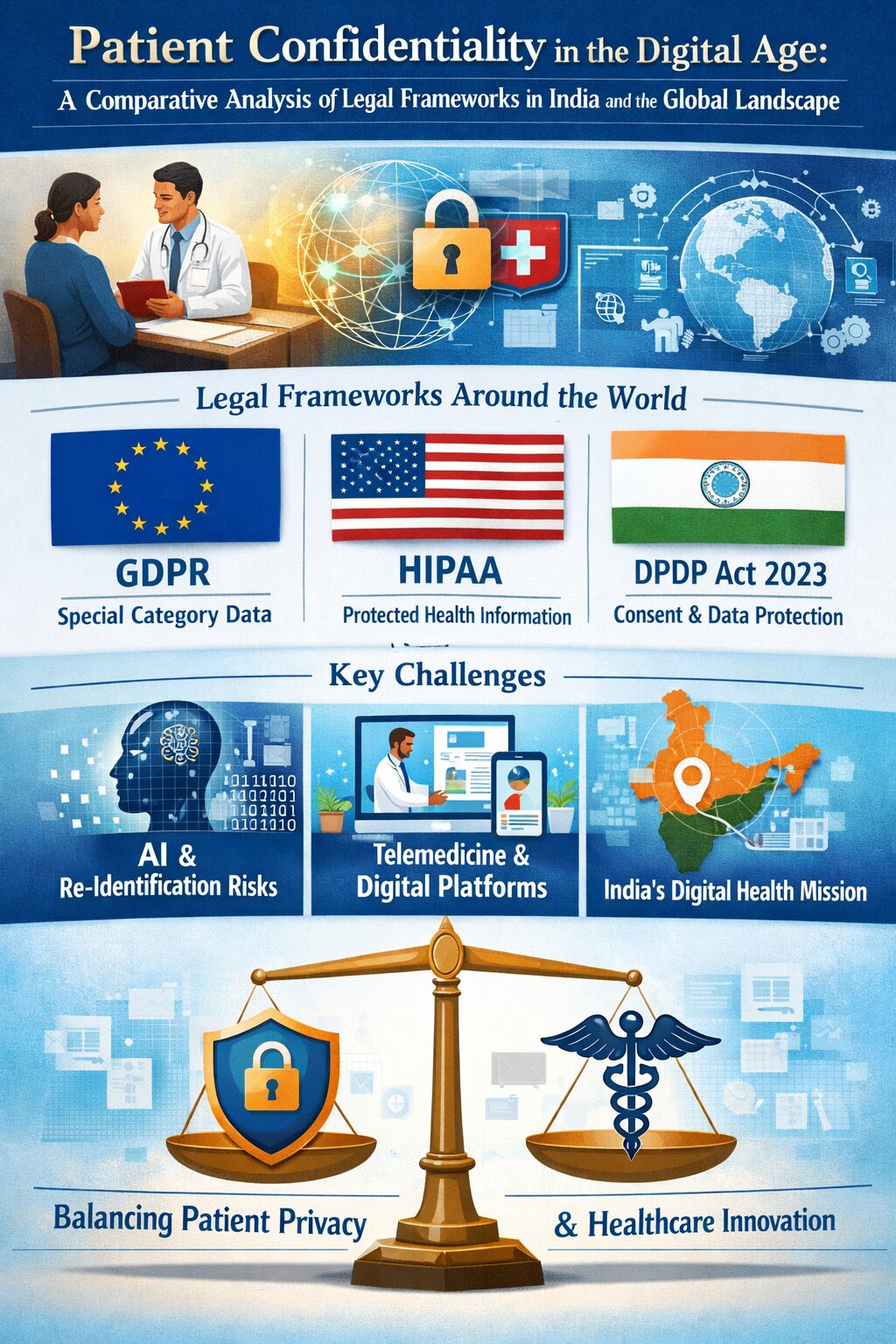
In the European Union, the main law is the General Data Protection Regulation (GDPR). This law treats health information as a special category of personal data, which means it receives very strong protection. It also gives individuals rights such as asking for their personal data to be erased.
In the United States, patient data is mainly protected under the Health Insurance Portability and Accountability Act (HIPAA). This law protects Protected Health Information (PHI) held by hospitals, doctors, insurance companies, and related healthcare organizations.
In India, patient data is protected by the Digital Personal Data Protection Act, 2023, which focuses strongly on obtaining the patient’s consent before collecting or using personal data.
Among these systems, the EU’s GDPR is often considered the strongest because it applies broadly and allows heavy penalties—up to 4% of a company’s global annual turnover for serious violations. In comparison, the U.S. system under HIPAA focuses mainly on the healthcare sector and the organizations that handle medical information.
The Technological Frontier: AI, Big Data, and Emerging Risks
Modern technologies such as artificial intelligence and large digital health databases have created new challenges for protecting patient confidentiality.
One major concern is re-identification. Even when health data is anonymized, advanced computer systems can sometimes combine different sources of information and identify the person behind the data.
Another challenge comes from the rapid growth of telemedicine and digital health platforms. Online consultations, health apps, and cloud storage services often involve third-party companies. This increases the number of people and systems that may have access to sensitive medical information.
In India, the government’s Ayushman Bharat Digital Mission aims to create a nationwide digital health system with integrated health records. While this initiative can improve healthcare services and access, it also raises concerns about cybersecurity, proper data management, and the protection of patient privacy.
Therefore, the main challenge for lawmakers today is to ensure that new technologies improve healthcare without weakening the trust between doctors and patients.
Conclusion: Safeguarding the Trust at the Heart of Medicine
Patient confidentiality is one of the most important principles in medical ethics and law. From the early teachings of physicians in ancient times to modern constitutional protections and data-protection laws, the idea that a patient’s medical information must remain private has steadily grown stronger.
Today, as healthcare systems use digital records and online platforms, protecting medical information has become even more important. Laws and regulations must keep evolving to address new technological challenges while still protecting basic values such as dignity, personal autonomy, and trust.
Ultimately, patient confidentiality is not just a legal rule; it is the foundation of the doctor–patient relationship. When patients trust that their private information will be protected, they can speak openly with their doctors. If this trust is broken, healthcare becomes less humane and more like a simple transaction. Therefore, the law must continue to protect patient privacy as medical science and technology progress.