Introduction
Person-Borne Improvised Explosive Devices (PBIEDs) are a form of improvised explosive device (IED) carried or worn by an individual, designed to detonate in close proximity to a target for maximum lethality. This category includes suicide bombers, where the carrier intentionally sacrifices themselves to ensure the device’s activation, often referred to as Suicide Person-Borne IEDs (SPBIEDs). PBIEDs differ from other IED variants like vehicle-borne IEDs (VBIEDs) in their mobility and ability to penetrate security perimeters undetected, blending into crowds or approaching targets directly. Their low cost, simplicity, and psychological impact make them a frequently employed tactic among terrorist groups, insurgents, and non-state actors.
The use of PBIEDs has proliferated in asymmetric warfare, particularly in regions like the Middle East, South Asia, and Africa, where groups such as ISIS, Al-Qaeda, the Taliban, and Boko Haram employ them to inflict mass casualties, disrupt stability, and generate media attention. While non-suicide PBIEDs exist—such as devices planted on unwilling individuals or proxies—the majority of documented cases involve voluntary suicide missions driven by ideological, religious, or coercive motivations.
Historical Evolution
The roots of suicide attacks, including those involving explosives, trace back centuries, though modern PBIEDs emerged in the late 20th century. Early examples include the Jewish Zealots in the 1st century AD, who used self-sacrificial knife attacks against Roman soldiers to incite rebellion, and the 11th-12th century Ismaili Assassins, who employed daggers in targeted killings, often accepting death as part of their mission.
In the 19th century, Russian anarchist Ignaty Grinevitsky became the first recorded suicide bomber in 1881, detonating a bomb that killed Tsar Alexander II and himself. During World War II, Japanese Kamikaze pilots conducted aerial suicide attacks, sinking ships like the USS St. Lo in 1944.
Contemporary PBIEDs gained prominence in the 1980s with Hezbollah’s operations in Lebanon. The 1983 Beirut bombings, including the U.S. Embassy attack killing 63 and the Marine barracks blast killing 241, marked a turning point, leading to Western troop withdrawals.
The tactic spread in the 1990s and 2000s. The Liberation Tigers of Tamil Eelam (LTTE) in Sri Lanka used female suicide bombers, notably assassinating Indian Prime Minister Rajiv Gandhi in 1991. Chechen “Black Widows” conducted attacks in Russia, including the 2002 Moscow theatre siege. Al-Qaeda’s 2000 USS Cole bombing in Yemen killed 17 sailors using a boat-borne variant.
Post-9/11, PBIEDs surged in Iraq, Afghanistan, and Syria. ISIS affiliates like Islamic State Khorasan Province (ISK) increased suicide attacks after the 2021 Taliban takeover. In Africa, Boko Haram and Al-Shabaab have used coerced or voluntary bombers, including children and women.
Recent adaptations include surgically implanted devices, as warned by MI-5 in 2011, and forced bombings, such as alleged/reported cases of Russians using Kenyan recruits as unwitting bombers in 2026.
Design and Construction
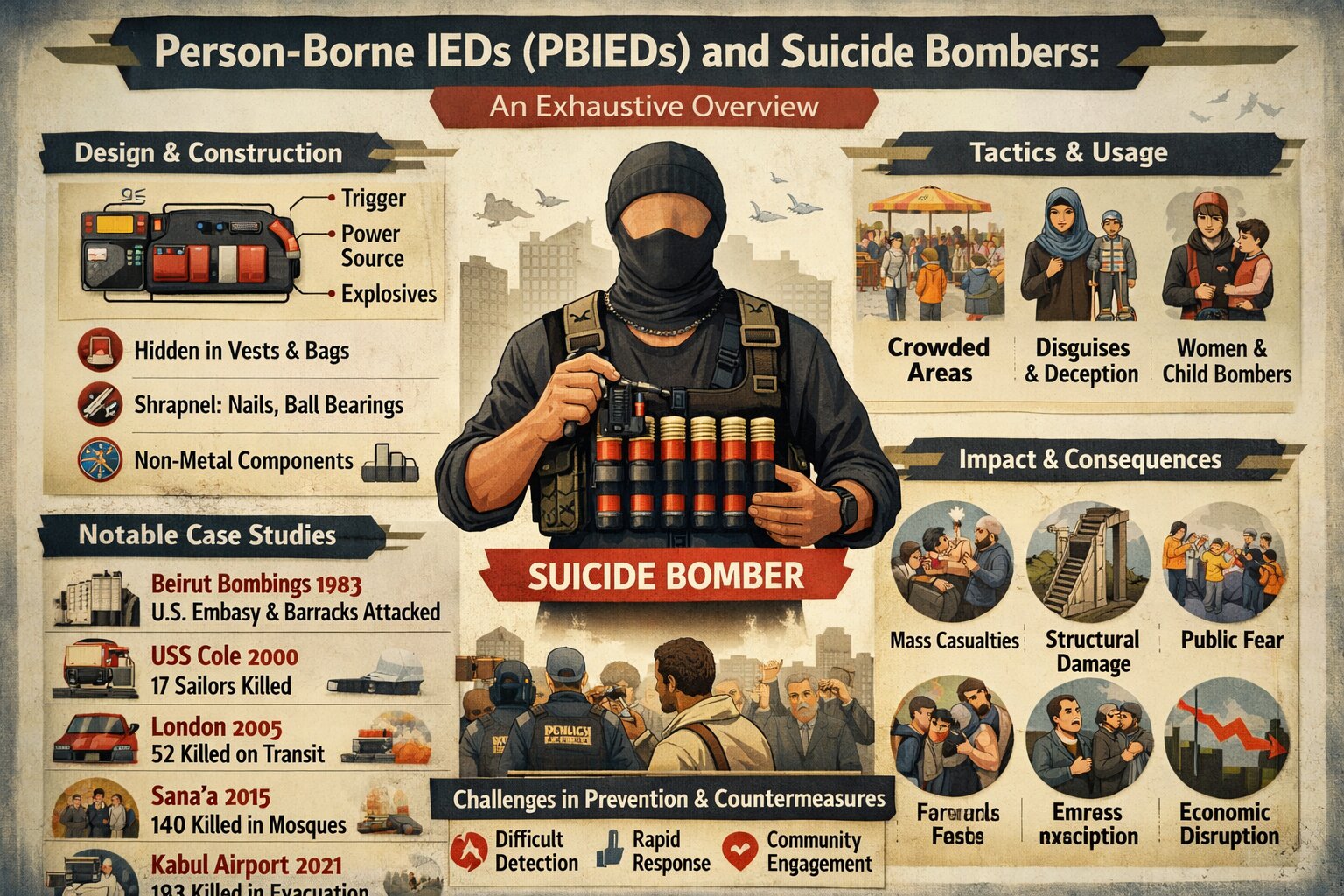
PBIEDs are bombs worn on the body. They usually have three main parts: a power source, a trigger, and the explosive. The trigger sets off the explosive, which is often homemade using easily available materials. These devices are hidden in vests, belts, backpacks, or under clothing to avoid detection.
Many suicide vests contain sharp objects like nails or ball bearings to cause more injuries. Some bombs are small, while others carry very large explosive loads. Triggers may be hand-operated, timed, or remotely controlled. To avoid security checks, some devices use non-metal parts. Designs have been shared online by groups such as ISIS.
Tactics and Usage
PBIEDs allow attackers to move easily and strike crowded places like markets, checkpoints, or public events. Bombers often walk in and may use disguises, such as pretending to be pregnant or disabled. These attacks are sometimes part of larger, coordinated operations. Women and children are used in some cases because they attract less suspicion, often through force or pressure, as seen with Boko Haram.
Notable Case Studies
- Beirut Embassy and Barracks Bombings (1983): Attacks by Hezbollah killed hundreds and led to foreign troop withdrawals.
- USS Cole Bombing (2000): A suicide attack by Al-Qaeda killed 17 sailors.
- London Bombings (2005): Four bombers killed 52 people on public transport.
- Sana’a Mosque Bombings (2015): Suicide attacks killed about 140 worshippers.
- Kabul Airport Attack (2021): A suicide bomber killed many civilians during evacuations.
Impact and Consequences
PBIEDs cause severe harm through blast pressure, flying fragments, and collapsing structures. Many victims suffer serious internal injuries and burns. Beyond physical damage, these attacks spread fear, reduce public trust, and disrupt daily life. Economically, they damage buildings, markets, and transport systems, leading to long-term losses and social instability.
Countermeasures and Prevention
Countering PBIEDs requires a layered security approach that integrates prevention, detection, and response. Intelligence-led policing forms the first line of defence, focusing on early identification of radicalisation pathways, recruitment networks, and suspicious behavioural patterns. Timely intelligence collection, analysis, and inter-agency sharing significantly increase the chances of disrupting plots before execution, especially in densely populated civilian environments.
Community engagement is central to long-term prevention. Community policing, public awareness initiatives, and structured deradicalisation programmes help reduce local support for extremist violence and encourage early reporting of warning signs. By addressing ideological drivers, coercion, and grievance narratives at the grassroots level, these measures weaken the social ecosystems that enable suicide attacks to emerge and sustain themselves.
At the physical security and detection level, layered access control is critical. Controlled entry points, barriers, and adequate standoff distances limit bomber access to high-value or crowded targets. Detection tools such as full-body scanners, explosive detection dogs, and behavioural observation techniques help identify potential attackers, particularly when operated by well-trained personnel capable of making rapid, proportionate decisions. Urban planning increasingly incorporates blast-resistant design principles to mitigate casualties if an attack occurs.
Finally, response and resilience mechanisms determine the scale of damage once a threat materialises. Well-trained security forces, clear standard operating procedures, and rapid response teams are essential to neutralise attackers swiftly. In exceptional circumstances, individual acts of courage—such as that of Michael Ollis, who shielded others from a bomber in 2013—can save lives. Emerging technologies, including ethically governed AI-based detection systems, further enhance preparedness, while resilience-focused planning helps restore public confidence after incidents.
Problems in Preventing PBIEDs and Suicide Bombers
Preventing PBIED attacks is difficult because the attacker uses the human body to hide the weapon and move naturally in public spaces. Bombs can be concealed under clothing or inside bags, making detection challenging even with security checks. Suicide bombers can change plans at the last moment, reducing the value of advance intelligence. Crowded civilian areas limit the use of aggressive screening without disrupting daily life or violating rights. Disguises, use of women or children, and coercion further complicate identification. Non-metal components can bypass detectors, while online radicalisation and lone-actor attacks reduce warning signs. Together, these factors make PBIED prevention one of the most complex challenges in modern security.
Conclusion
PBIEDs and suicide bombers continue to pose an evolving terrorist threat due to their tactical effectiveness, low cost, and adaptability to changing security environments. Drawing on historical precedents and incorporating new methods and technologies, such attacks challenge intelligence, policing, and protective systems worldwide. Although recorded incidents declined during 2019–2020—falling to about 124 attacks in 2020 compared to higher levels in earlier years—this reduction does not indicate threat elimination. Non-state armed groups retain the capability to innovate and resurge. Sustained vigilance, combining advanced detection technologies, sound policy frameworks, robust intelligence sharing, and international cooperation, remains essential to mitigate future risks and protect civilian populations.