Federal Power, Political Privilege And Evidentiary Standards Collide In A High-Stakes Constitutional Courtroom
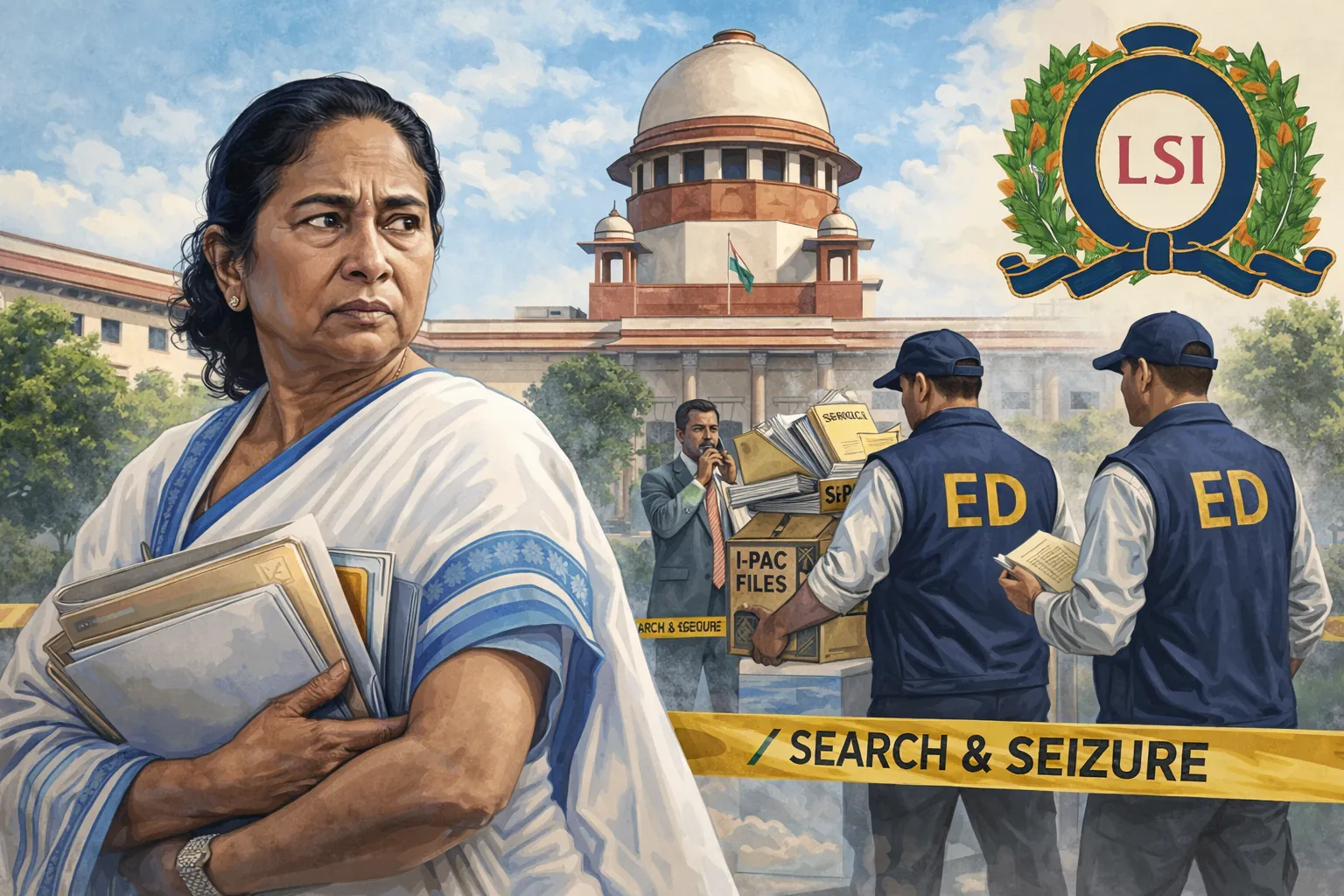
India’s continuing confrontation between investigative agencies and elected governments has now entered yet another constitutional theatre — the Supreme Court. In a striking submission during hearings relating to the Enforcement Directorate’s search at political consultancy firm I-PAC, the ED told the Court that it cannot assume that West Bengal Chief Minister Mamata Banerjee removed only Trinamool Congress’ confidential political material from the premises during the raid.
The statement may appear narrow, but legally it carries sweeping implications: it touches privilege, federalism, seizure procedure, and the constitutional limits of criminal investigation in political spaces.
This dispute is no longer about a raid — it is about who controls political information in a democracy when criminal law steps inside the political arena.
Background: The I-PAC Search And Political Sensitivity
The Enforcement Directorate conducted searches at the office of political consultancy organization I-PAC (Indian Political Action Committee), a firm known for managing election campaigns for several political parties, including the Trinamool Congress (TMC).
During the operation, the presence of Chief Minister Mamata Banerjee at the premises — and allegations regarding removal of documents — transformed what would otherwise be a routine financial investigation into a constitutional controversy.
The State’s Position Broadly Implied:
- Political campaign material belonged to the party
- It was confidential electoral data
- Investigators had no right to seize it
The ED Countered:
- Investigators cannot verify that only political party material was removed — therefore the act cannot be insulated from investigation merely by labeling it “party confidential data.”
This single line has now triggered questions about the boundary between political secrecy and criminal evidence.
The Legal Core: Can Political Confidentiality Override Investigation?
The controversy sits at the intersection of three doctrines:
1. Search And Seizure Under The Prevention Of Money Laundering Act (PMLA)
Under Section 17 of the PMLA, authorities may search premises and seize records if they have reason to believe that material is connected to proceeds of crime.
Crucially:
- The statute does not exempt political consultancy firms or political party-related data.
- Therefore, the legal test becomes evidentiary — not political.
Courts have repeatedly held that the character of premises does not determine immunity.
Relevant Principle:
In Pooran Mal v. Director of Inspection (1974), the Supreme Court held that evidence obtained during search is not automatically inadmissible merely because the search is disputed, unless constitutional rights are violated.
2. Privilege Vs Investigative Necessity
Indian law recognises certain privileges — for example:
- Attorney-client privilege
- Parliamentary privilege
- Self-incrimination protection under Article 20(3)
But political strategy documents have no statutory privilege class.
The ED’s argument therefore becomes jurisprudentially significant:
Political confidentiality is not a recognized evidentiary privilege in criminal law.
The Court must therefore decide whether political functioning can create a new category of protected communication — a step that could radically alter investigative powers.
3. Federalism And Agency Power
The larger constitutional tension lies beneath the surface:
- State governments increasingly argue central agencies are being used for political intrusion.
- Courts have dealt with similar tensions before.
In State of West Bengal v. Committee for Protection of Democratic Rights (2010), the Supreme Court held that central agencies can investigate even without state consent if constitutional courts order it.
Thus the doctrine today is clear:
- Federalism cannot become a shield against criminal investigation
- But investigation cannot become a weapon against federal autonomy
This case tests exactly where that balance lies.
The Evidentiary Question: Burden Of Proof
The ED’s submission subtly shifts burden:
| Party | Position |
|---|---|
| The State | Suggests removed files were political |
| The ED | Says investigators cannot assume that |
Legally, criminal procedure favors preservation of potential evidence.
Courts generally adopt the principle:
When relevance cannot be ruled out, seizure is justified; admissibility can be decided later.
This follows the investigative logic recognized in V.S. Kuttan Pillai v. Ramakrishnan (1980) — searches are meant to discover truth, not confirm pre-declared categories.
Why This Case Matters Beyond Politics
This dispute may create precedent in three emerging areas of law:
1. Data-Driven Politics
Modern campaigns rely on:
- voter profiling
- behavioral analytics
- demographic databases
If courts recognize political consulting data as privileged, future financial investigations into election funding may become nearly impossible.
2. Political Parties As Legal Entities
Indian law still treats parties ambiguously — not quite private bodies, not quite public authorities.
The case may clarify:
- Are political campaign databases private intellectual property or potential financial evidence?
3. Expanding Scope Of Digital Evidence
The Court may need to determine whether:
- electoral data analytics
- campaign communication records
can constitute proceeds-of-crime linked evidence.
Possible Outcomes Before The Supreme Court
The Court has multiple doctrinal paths:
| Doctrine | Meaning |
|---|---|
| A. Agency-Favoured View | Political confidentiality does not override seizure powers; admissibility decided later. |
| B. Limited Protection Doctrine | Certain campaign-related data protected unless direct financial nexus shown. |
| C. New Political Privilege Doctrine | Creation of a restricted privilege for electoral strategy — least likely but constitutionally transformative. |
The Larger Constitutional Question
At its heart, the case asks:
In a democracy, when law enforcement enters the political sphere, should criminal law pause — or should politics submit to the rule of law like any other domain?
The Supreme Court is not merely deciding about a raid.
It is defining the legal status of political information itself.
Conclusion
The ED’s statement — that it cannot assume only TMC’s confidential files were removed — is not a technical objection but a constitutional assertion: labeling documents as “political” cannot immunize them from investigation.
If accepted, it reinforces the principle that no democratic actor exists outside evidentiary scrutiny.
If rejected, India may see the birth of a new legal doctrine — political confidentiality privilege — reshaping criminal investigation in electoral democracy.
Either way, the judgment will likely become a landmark precedent in the law of search, seizure, and the constitutional relationship between politics and prosecution.