Introduction
Left Wing Extremism (LWE) remains one of the most complex internal security challenges in India. Rooted in ideological opposition to the state and sustained by local grievances, LWE has evolved into a hybrid threat combining guerrilla warfare, psychological operations, and exploitation of difficult terrain. The epicentre of this challenge lies in forested, tribal-dominated regions across central and eastern India, often referred to as the “Red Corridor.” Security forces operating in these areas face not only armed cadres of organisations like CPI (Maoist) but also harsh geography, limited infrastructure, and sensitive socio-political environments.
Precautions taken by police and security forces in LWE-affected areas therefore go far beyond conventional policing or counter-terrorism measures. They require a calibrated blend of operational preparedness, intelligence-led action, community engagement, legal compliance, and psychological resilience.
Understanding the Nature of the LWE Threat
Before discussing specific precautions, it is essential for security forces to clearly understand the nature of the LWE threat.
LWE groups follow a protracted people’s war strategy, aiming to gradually erode state authority through sustained violence, parallel governance, and ideological indoctrination. Their tactics include ambushes, use of Improvised Explosive Devices (IEDs), targeted assassinations, intimidation of civilians, and attacks on infrastructure such as roads, telecom towers, and polling stations.
Precaution begins with mindset. Forces must recognise that LWE areas are not conventional battlefields. The adversary blends into the civilian population, uses local knowledge of terrain, and relies heavily on intelligence gathered through sympathisers. Underestimating this adaptive and patient adversary has, in the past, led to serious operational setbacks.
Intelligence-Led Operations as the First Line of Precaution
- Human Intelligence (HUMINT)
In LWE-affected areas, intelligence is the most critical protective shield for police and security forces. Unlike urban terrorism, technical surveillance has limited reach in dense forests and remote villages. Human intelligence, therefore, becomes paramount.
Precautions include:
- Developing discreet and reliable local sources.
- Ensuring confidentiality to protect informants from reprisals.
- Avoiding over-reliance on a single source.
- Cross-verifying inputs through multiple channels.
Officers must be trained to distinguish between genuine intelligence and deliberate misinformation planted by extremists to lure forces into ambushes.
- Intelligence Fusion and Sharing
Another vital precaution is seamless intelligence sharing between state police, central armed police forces, intelligence agencies, and district administration. Silos and delays can prove fatal in LWE environments, where operational windows are narrow and threats evolve rapidly.
Operational Precautions During Movement and Patrolling
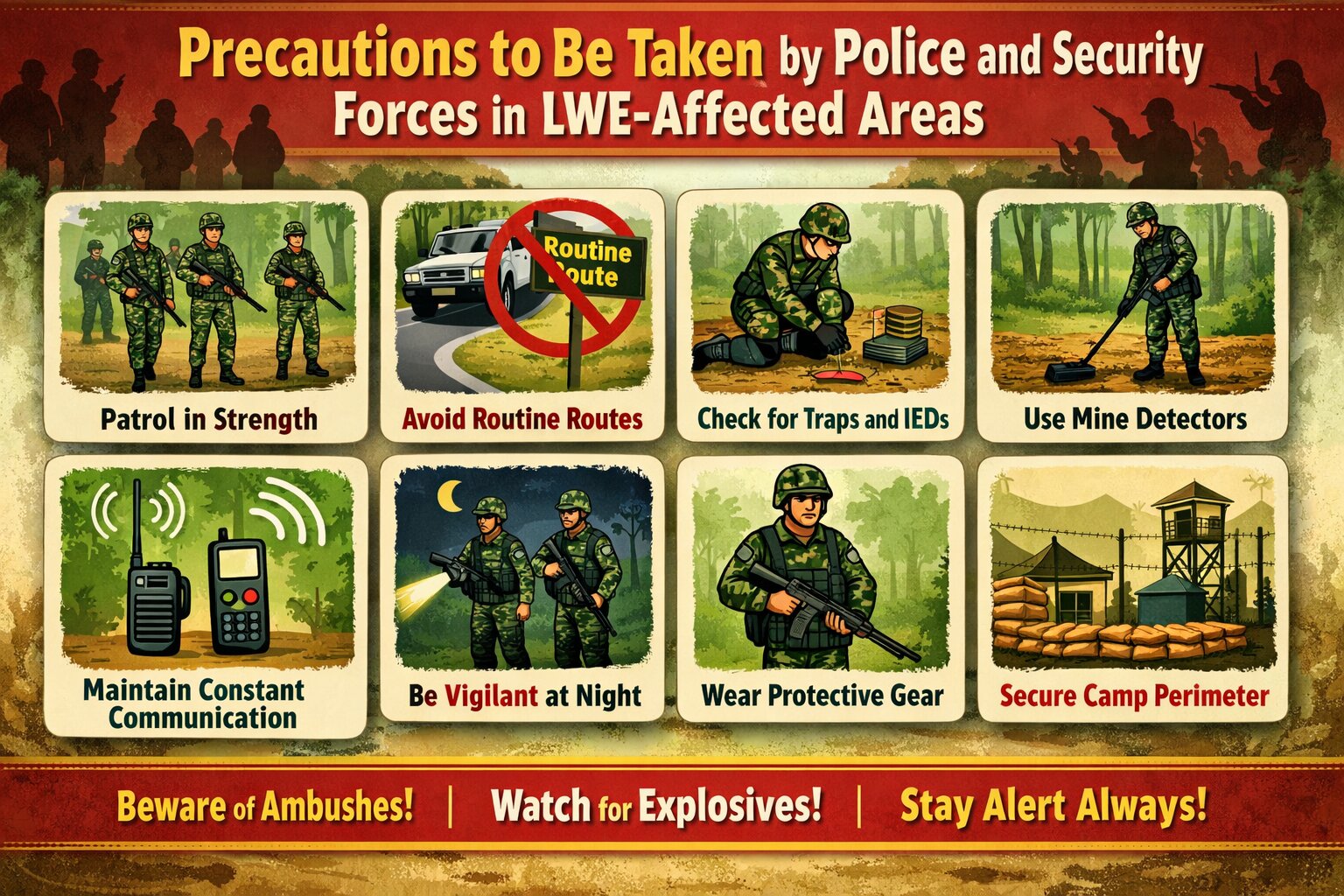
- Route Sanitisation and Anti-IED Measures
Movement remains the most vulnerable phase for forces in LWE areas. A large proportion of casualties occur due to IED blasts during road opening patrols and foot marches.
Key precautions include:
- Thorough route domination and sanitisation before movement.
- Use of trained bomb detection and disposal teams.
- Avoiding predictable routes and timings.
- Maintaining adequate spacing between personnel to reduce blast impact.
Forces must treat every culvert, mound, abandoned structure, and freshly disturbed soil as a potential IED threat.
- Foot Patrol Discipline
In dense jungles and hilly terrain, foot patrols are unavoidable. Precautions include:
- Maintaining strict noise and light discipline.
- Avoiding bunching and skyline exposure.
- Ensuring rear and flank security.
- Continuous observation of ground indicators such as footprints, cut vegetation, or tripwire signs.
Complacency during long patrols is one of the biggest operational risks and must be actively countered by leadership at all levels.
Camp Security and Defensive Precautions
- Selection and Fortification of Camps
Security force camps in LWE areas are often isolated and exposed. Precautions begin with careful site selection, avoiding low-lying areas, dense foliage, or locations close to civilian settlements that extremists can exploit as cover.
Essential measures include:
- All-round defensive perimeters.
- Properly constructed watchtowers and bunkers.
- Clear fields of vision by controlled vegetation clearance.
- Adequate lighting with backup power.
Internal Security and Access Control
LWE groups have, in the past, used disguised reconnaissance and insider facilitation. Strict access control, identity verification, and monitoring of supply chains are critical precautions to prevent intelligence leaks or sabotage.
Training and Tactical Preparedness
Area-Specific Training
A major precaution is ensuring that deployed forces are trained specifically for LWE conditions. Conventional urban policing or crowd control training is insufficient.
Training must cover:
- Jungle warfare and survival skills.
- IED recognition and countermeasures.
- Small-team tactics and ambush drills.
- First aid and casualty evacuation in remote terrain.
Units unfamiliar with the terrain and tactics of LWE groups are significantly more vulnerable during initial deployment.
Leadership at Junior Levels
Given the dispersed nature of operations, junior leaders often make critical decisions independently. A vital precaution is empowering and training section and platoon commanders to assess threats, modify plans, and avoid predictable patterns.
Psychological Preparedness and Morale
- Coping with Stress and Fatigue
Extended deployments in hostile, isolated environments take a psychological toll. Fatigue, fear, and monotony can erode alertness.
Precautions include:
- Rotational deployment policies.
- Regular interaction with senior officers.
- Access to counselling and mental health support.
- Encouraging rest and recovery whenever operationally feasible.
A mentally exhausted force is more vulnerable than an under-equipped one.
- Countering Maoist Psychological Warfare
LWE groups use propaganda, threats, and symbolic violence to demoralise forces and local populations. Security personnel must be sensitised to these tactics and trained not to overreact or internalise extremist narratives.
Civilian Interaction and Community-Oriented Precautions
- Winning Trust Without Compromising Security
One of the most delicate precautions in LWE areas is balancing force protection with positive civilian engagement. Excessive force or insensitive behaviour can alienate communities and push them towards extremist sympathy.
Precautions include:
- Respectful conduct during searches and questioning.
- Avoiding collective punishment.
- Ensuring women and vulnerable groups are treated with dignity.
- Swift redressal of genuine civilian grievances.
Trust-building reduces the extremist support base and enhances intelligence flow.
- Coordination with Civil Administration
Police and security forces must work closely with district administration on development, welfare delivery, and grievance redressal. Security operations unsupported by governance create a vacuum that LWE groups exploit.
Legal and Human Rights Compliance as a Strategic Precaution
Strict adherence to law is not just a moral obligation but a strategic precaution. Illegal detention, custodial abuse, or fake encounters can severely damage the legitimacy of counter-LWE operations.
Precautions include:
- Clear understanding of legal powers and limitations.
- Proper documentation of arrests and seizures.
- Respect for due process and judicial oversight.
- Sensitisation to tribal rights and customary practices.
Legitimacy is a force multiplier; its erosion benefits extremists.
Technology and Equipment-Related Precautions
- Appropriate Equipment for Terrain
Forces must be equipped with gear suitable for jungle and rural operations, including:
- Lightweight protective equipment.
- Reliable communication systems with redundancy.
- Night vision devices and GPS navigation tools.
Using ill-suited equipment increases fatigue and reduces operational effectiveness.
- Use of Surveillance Technology
Drones, ground sensors, and satellite imagery can enhance situational awareness, but precautions must be taken to prevent over-dependence. Technology should supplement, not replace, human judgment and local intelligence.
Inter-Force Coordination and Unity of Command
LWE-affected areas often see multiple forces operating simultaneously—state police, central forces, and specialised units. A crucial precaution is ensuring unity of command, clarity of roles, and mutual respect.
Lack of coordination can lead to:
- Friendly fire incidents.
- Intelligence gaps.
- Operational confusion.
Joint planning, common communication protocols, and regular coordination meetings are essential safeguards.
Electoral and Infrastructure Security Precautions
During elections and major development projects, LWE groups attempt to disrupt state presence. Special precautions include:
- Area domination well in advance of events.
- Secure movement of polling personnel and materials.
- Protection of contractors and workers without militarising civilian spaces excessively.
Securing democratic processes weakens the ideological narrative of extremists.
Long-Term Precautions: Beyond Kinetic Operations
Sustainable security in LWE areas depends on addressing root causes such as underdevelopment, alienation, and governance deficits. While this extends beyond the direct mandate of police, forces must act as enablers rather than obstacles to long-term peace.
Precautions here include:
- Avoiding actions that disrupt livelihoods unnecessarily.
- Supporting surrender and rehabilitation policies.
- Facilitating safe access for development agencies.
Every operation should be assessed not only for immediate tactical success but also for its long-term impact on local stability.
Conclusion
Precautions in LWE-affected areas are not limited to bulletproof jackets or fortified camps. They encompass mindset, intelligence discipline, operational caution, psychological resilience, legal compliance, and humane engagement with civilians. Police and security forces operate in an environment where mistakes carry strategic consequences, and success is measured as much by the absence of violence as by the presence of trust and governance.
By adopting a comprehensive, patient, and people-centric approach—while maintaining operational vigilance—security forces can protect themselves, safeguard civilians, and gradually reclaim space from extremist influence. In the long run, the most effective precaution against Left Wing Extremism is not force alone, but the consistent demonstration of a capable, lawful, and compassionate state.