





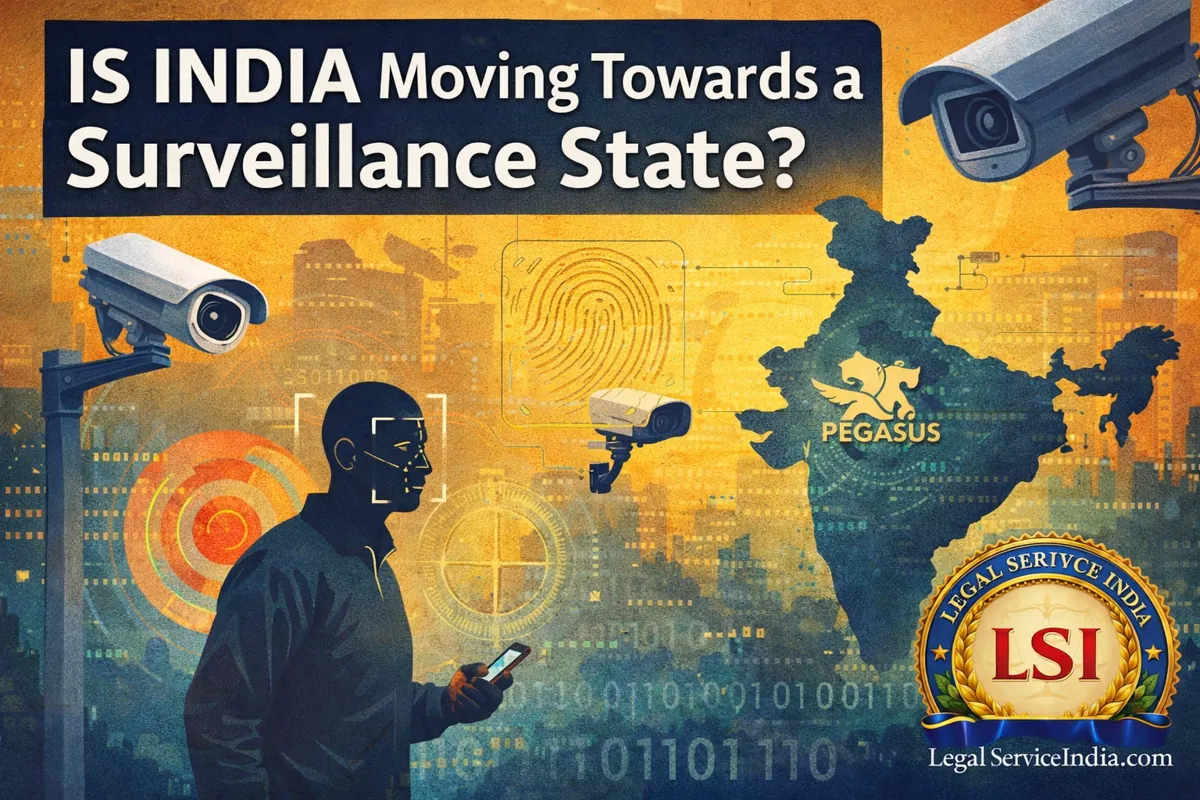
Privacy vs Surveillance: Is India Moving Towards a Surveillance State?
In the digital age, where personal data has become the new currency, the conflict between individual privacy and state surveillance has intensified. India, as one of the fastest-growing digital economies, stands at a constitutional crossroads balancing national security with civil liberties. The critical question remains: Is India gradually transitioning into a surveillance state?
The article addresses the conflict between people’s right to privacy and the government’s ability to watch them in India, especially now that digital monitoring and technology are getting enhanced.
Growing Digital Concerns
In a time when one click can show you private information about someone, the question is no longer whether privacy is being violated, but how much of that violation is acceptable. The swift proliferation of digital technologies has facilitated unparalleled levels of surveillance, engendering significant apprehensions regarding the diminishment of individual liberties.
In India, this debate became constitutionally significant with the landmark ruling in Justice K.S. Puttaswamy v. Union of India, in which the Supreme Court clearly stated that the Right to Privacy is a fundamental right under Article 21. But as more and more people use surveillance tools like biometric data collection, facial recognition systems, and spyware technologies like Pegasus, the limits and scope of this right are always being tested.
Constitutional Recognition of Privacy
In the case of Justice K.S. Puttaswamy v. Union of India, a nine-judge bench of the Supreme Court agreed that the Right to Privacy is a crucial component of the Right to Life and Personal Liberty under Article 21 of the Constitution. The Court stressed that privacy is important for human dignity, freedom, and the ability to freely exercise basic rights. It overturned earlier decisions that said privacy was not a fundamental right. This made constitutional protections for people stronger in a society that is becoming more digital.
Importantly, the Court also made it clear that the right to privacy is not absolute and can be limited in reasonable ways. The Court set up a three-part test to make sure that any State invasion of privacy is justified. This test is now the standard for judging the legality of surveillance measures:
Three-Part Test for Surveillance Legality
| Principle | Explanation |
|---|---|
| Legality | There must be a law that allows the intrusion. |
| Legitimate Aim | The action must aim to achieve a legitimate state goal, like public order or national security. |
| Proportionality | The level of interference must be necessary and appropriate for the goal that is being sought. |
This judgment serves as a constitutional safeguard against arbitrary State action, ensuring that any infringement of privacy is subject to strict scrutiny. However, with the rapid growth of surveillance technologies, the practical application of these principles continues to be a matter of ongoing debate.
Growth of Surveillance Mechanisms in India
India has seen a significant increase in surveillance systems in the last few years. This is mostly because of new technology and the growing need to maintain law and order. Many individuals often say that these kinds of actions are necessary for national security and good government, but they have also raised concerns about privacy and the possibility of misuse.
CCTV Surveillance Expansion
Closed-Circuit Television (CCTV) cameras are one of the most obvious ways that people are being watched. They are put all over cities and towns. People use these systems to keep crime from happening, control traffic, and keep people safe. But the lack of clear rules about how to store, access, and use data makes people wonder about accountability and misuse.
Aadhaar and Biometric Data Collection
Another major development is the implementation of the Aadhaar system, which involves the collection of biometric data such as fingerprints and iris scans of citizens. While Aadhaar has streamlined welfare distribution and identity verification, it has also led to concerns about data security, unauthorized access, and mass profiling of individuals.
Facial Recognition Technology (FRT)
Additionally, the use of Facial Recognition Technology (FRT) by police shows a move toward more invasive forms of surveillance. These systems let people find or track people in public places in real time, often without their knowledge or permission. People are more afraid of random surveillance because there isn’t a clear legal framework for how to use this kind of technology.
Legal Framework and Oversight Concerns
The government acquires its surveillance powers from different laws, such as the Information Technology Act of 2000 and rules about monitoring and intercepting communications. However, substantial numbers of individuals believe that these powers are too broad and don’t have enough oversight from the courts or Parliament.
Pegasus Spyware Controversy
The Pegasus spyware scandal brought the issue of privacy and surveillance in India into sharp focus, showing how dangerous it can be to have digital monitoring that isn’t controlled.
What Is Pegasus Spyware?
The Israeli company NSO Group created Pegasus, which is very advanced spyware. It is made to get into smartphones without the user knowing, which lets others see private information like messages, emails, and call records. It can additionally allow real-time activation of device’s camera and microphone. It is very invasive and difficult to find because it can work through “zero-click” attacks without the user having to do anything.
Allegations In India
Serious claims that Pegasus was used to target public officials, activists, journalists, and political leaders surfaced in the Indian context. According to reports, a number of people may have been under surveillance, which raises questions about how state authorities might abuse such potent technology. These claims sparked intense public discussion, legal challenges, and judicial examination.
Impact On Privacy Rights
- The right to privacy has been significantly impacted by the Pegasus controversy.
- It highlighted the lack of strong safeguards against abuse and revealed citizen’s susceptibility to invasive surveillance.
- The principles outlined in Puttaswamy, specifically the requirements of legality and proportionality, are directly violated by such unapproved surveillance.
- It has a chilling effect on free speech because people may be afraid to voice their opinions for fear of being watched.
Data Protection Law In India
With the enactment of the Digital Personal Data Protection Act, 2023, India has taken legislative action to address issues with data privacy and surveillance. The Act seeks to guarantee consent-based data usage, control the processing of personal data, and place duties on data fiduciaries to safeguard user information. Nevertheless, the framework has a number of serious flaws despite its progressive intent.
Key Concerns With The Act
- Wide State Exemptions: First of all, the Act gives the State wide exemptions, enabling government organizations to avoid certain responsibilities on the grounds of public order, national security, and sovereignty. Although these objectives are justifiable, the lack of precise boundaries leaves room for abuse and capricious monitoring.
- Lack Of Independent Oversight: Second, independent oversight systems are lacking. India mainly relies on executive authorization for surveillance operations, which raises questions about accountability and transparency in contrast to some other jurisdictions where judicial or parliamentary approval is necessary.
- Limited Remedies: Furthermore, people’s options for combating illegal surveillance are restricted. The efficacy of the legal framework is further undermined by the lack of robust enforcement mechanisms and clarity regarding data breaches.
Summary Of Legal Framework Issues
| Issue | Description |
|---|---|
| State Exemptions | Broad powers granted to government without strict safeguards |
| Oversight Mechanism | Absence of judicial or parliamentary review |
| Legal Remedies | Limited recourse for citizens against unlawful surveillance |
Therefore, even though India has taken action to protect data, the current legal framework is still insufficient to handle the problems brought about by contemporary surveillance technologies.
Is India Becoming A Surveillance State?
There is no straightforward yes-or-no response to the question of whether India is becoming a surveillance state. Rather, a nuanced and balanced analysis is needed.
Arguments In Favour Of Surveillance
- There is no denying that surveillance is essential to upholding public order, preventing crime, and preserving national security.
- Technological tools like digital tracking, biometric identification, and CCTV monitoring can greatly improve governance and law enforcement effectiveness in a nation as large and diverse as India.
Constitutional Concerns
- There are significant constitutional issues with the scope and secrecy of surveillance methods.
- The growing disparity between state power and individual rights is reflected in the growing use of technologies without sufficient legal protections, as demonstrated by the Pegasus controversy.
- The principles laid down in Justice K.S. Puttaswamy v. Union of India particularly legality, necessity, and proportionality are not always strictly adhered to in practice.
- The lack of transparency surrounding surveillance operations increases the risk of abuse.
As a result, even though India may not yet be considered a full-fledged surveillance state, it is displaying some traits that point to a slow transition in that direction. If left unchecked, this trajectory could undermine democratic values and fundamental freedoms.
Recommendations And Safeguards
- The legal and institutional safeguards governing surveillance in India must be strengthened in order to preserve a delicate balance between individual liberty and national security.
- Independent oversight mechanisms, such as judicial or parliamentary review bodies, must be established.
- Improving transparency through regular disclosures and unambiguous procedural rules can promote public confidence and stop abuse.
- Ensuring accountability is equally important, with clearly defined legal repercussions for misuse.
- The current data protection framework should be improved to restrict extensive governmental exemptions and include stronger protections.
- Increasing public awareness regarding data rights can empower citizens to actively safeguard their privacy.
Conclusion
In conclusion, even though surveillance is an essential tool for contemporary governance, its unrestrained growth seriously jeopardizes fundamental rights. Although India is not yet a surveillance state, the current trend points to a slow but unavoidable change. The real litmus test for a Democratic society is its dedication to upholding the privacy, autonomy, and dignity of its citizens rather than the scope of its surveillance capabilities. Maintaining the constitutional vision and making sure that freedom is not sacrificed for security depend on upholding these principles.
Written By: Saniya Mhatre

