





Introduction
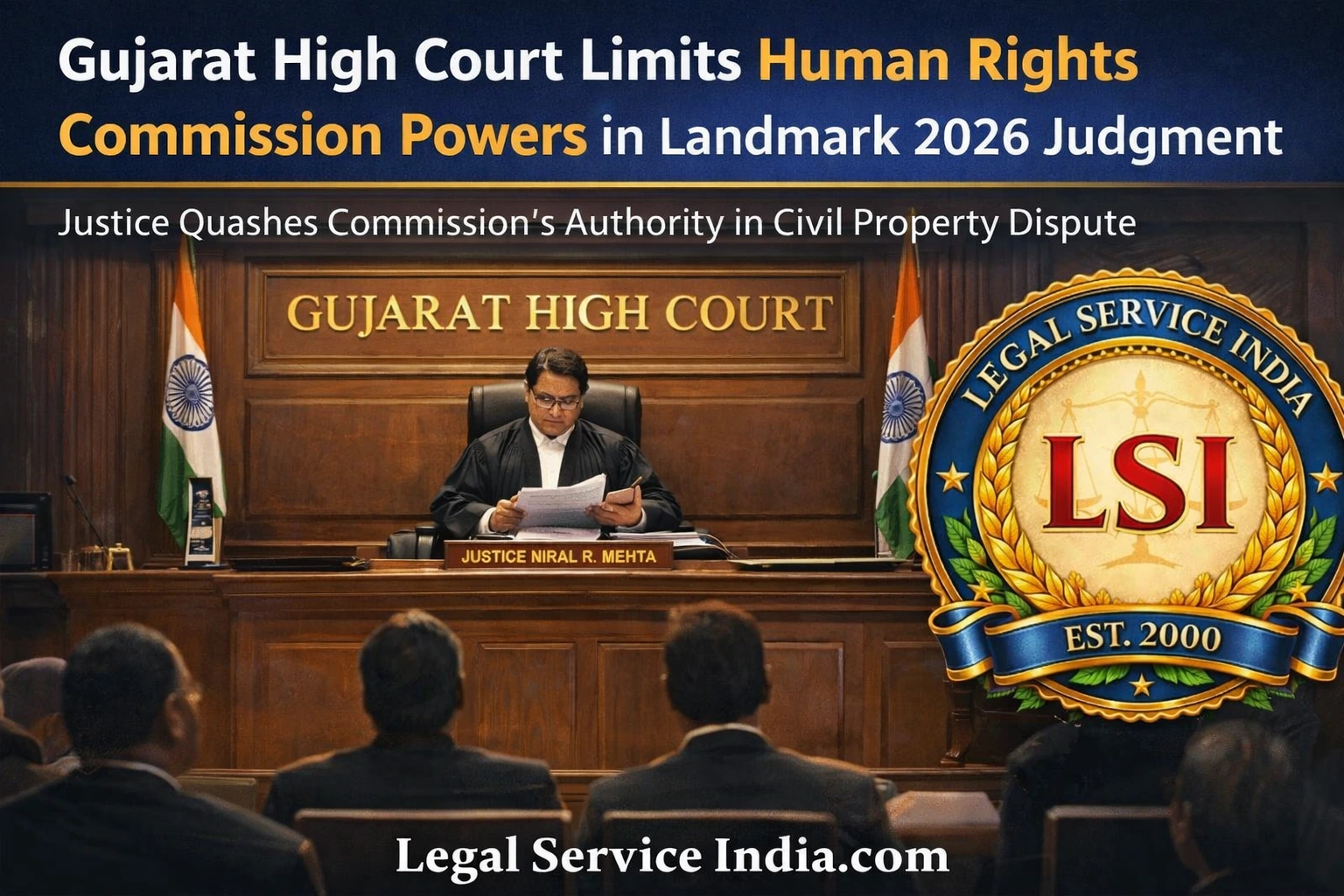
In a landmark judgment dated January 15, 2026, the Gujarat High Court in Mahendra Shanabhai Patel & Ors. v. The District Magistrate & Ors. (R/SCA No. 8914 of 2025) addressed critical issues concerning the jurisdiction and scope of powers exercised by State Human Rights Commissions under the Protection of Human Rights Act, 1993 (the Act). Justice Niral R. Mehta delivered a comprehensive judgment that not only quashed the impugned proceedings but also laid down detailed guidelines to prevent future misuse of the Commission’s authority.
The judgment represents a significant judicial intervention aimed at ensuring that Human Rights Commissions function strictly within their statutory mandate and do not overstep into matters that fall within the domain of civil courts. This article analyzes the key aspects of this judgment and examines the proper scope of human rights commissions’ authority in India.
Background Of The Case: Property Dispute
The case originated from a family property dispute involving multiple survey lands in village Zundal, District Gandhinagar. The properties had passed through succession from Jethabhai Lallubhai Patel through various legal heirs, with proper revenue entries being made at each stage of succession and transfer. The dispute centered around Shardaben Naranbhai, who had relinquished her share in the properties through a registered release deed dated December 15, 2015.
Subsequently, Shardaben filed Regular Civil Suit No. 149 of 2025 in April 2025 before the Principal Senior Civil Judge, Gandhinagar, seeking cancellation of her relinquishment deed along with declarations, injunctions, and partition. This civil suit was pending adjudication when she simultaneously approached the Gujarat State Human Rights Commission claiming violation of her human rights for not being given a share in the property.
The Human Rights Commission’s Intervention:
The Commission took cognizance of the complaint and issued notices dated May 9, 2025, and June 12, 2025, to the petitioners, the District Magistrate, and the Mamlatdar of Gandhinagar. Significantly, in the notice dated June 12, 2025, the Commission specifically directed the parties to resolve the dispute through mediation and give a share to the complainant as per prevailing custom.
The manner and timing of this intervention raised serious concerns. The complainant had not disclosed the pendency of the civil proceedings before the Commission. Moreover, the Commission’s directive effectively sought to resolve a private property dispute that was already sub judice before a competent civil court, without obtaining permission from that court.
The Statutory Framework:
Definition Of Human Rights
Section 2(d) of the Protection of Human Rights Act, 1993, defines human rights as rights relating to life, liberty, equality, and dignity of the individual guaranteed by the Constitution or embodied in International Covenants and enforceable by courts in India. The Court emphasized that this definition creates a clear boundary—only those rights which have a direct nexus with constitutional guarantees can be considered human rights under the Act.
The judgment clarified that private property disputes between individuals, which must be adjudicated by civil courts, do not fall within the scope of human rights as defined by the Act. The essential requirement is that the right must be constitutionally guaranteed, not merely a civil or contractual entitlement.
Functions And Powers Under Section 12:
Section 12 of the Act delineates the functions of the Commission. The most relevant provisions for this case are:
- Section 12(a): Empowers the Commission to inquire into complaints of violation of human rights or negligence in preventing such violation by a public servant.
- Section 12(b): Allows the Commission to intervene in proceedings involving alleged human rights violations pending before a court, but only with the approval of such court.
The Court noted that Section 12(a) contains two critical limitations:
- The matter must involve human rights as defined under the Act.
- There must be involvement of a public servant either in committing the violation or in being negligent in preventing it.
A purely private dispute between individuals does not satisfy either requirement.
Key Limitations Summary
| Provision | Scope | Limitation Highlighted By Court |
|---|---|---|
| Section 2(d) | Definition of Human Rights | Must relate to constitutional rights (life, liberty, equality, dignity) |
| Section 12(a) | Inquiry into violations | Requires involvement of a public servant |
| Section 12(b) | Intervention in court proceedings | Requires prior approval of the concerned court |
Regulation 9: Matters Not Entertainable
Regulation 9 of the National Human Rights Commission (Procedure) Regulations, 1994, applicable to State Commissions under Section 29 of the Act, specifically lists categories of complaints that should be dismissed in limine. These include:
- Issues relating to civil disputes such as property rights and contractual obligations
- Allegations not against any public servant
- Matters that are sub judice before a court or tribunal
- Matters barred under Section 36(2)—complaints made after one year from the alleged violation
- Allegations that do not make out any specific violation of human rights
The Court observed that the complaint in this case fell squarely within multiple exclusions under Regulation 9, particularly as it involved a civil property dispute, was sub judice, involved no public servant, and was filed nearly ten years after the alleged violation.
The Court’s Analysis
Lack of Jurisdiction
Justice Mehta categorically held that the Commission exceeded its jurisdiction and assumed powers not conferred upon it under law. The judgment emphasized that the dispute was purely a private property matter between family members regarding succession and partition—precisely the type of civil dispute expressly excluded from the Commission’s purview.
The Court noted that even if the Commission believed there was a human rights violation, it was still required to first ascertain whether civil proceedings were pending and, if so, obtain permission from the concerned court before proceeding. This fundamental procedural safeguard was completely ignored.
Absence of Preliminary Inquiry:
A critical deficiency identified by the Court was the Commission’s failure to conduct any preliminary inquiry before taking cognizance. The Court stated that the Commission should have first examined:
- Whether the complaint was fit to be entertained
- Whether it had prima facie jurisdiction over the matter
- Whether the dispute fell within the exclusions under Section 36 or Regulation 9
- Whether there was any involvement of a public servant
Instead, the Commission acted with undue haste, mechanically issuing notices and summons, and even directing parties to settle the dispute through mediation. This directive, contained in the notice dated June 12, 2025, revealed that the Commission had prejudged the matter and was effectively attempting to enforce a settlement in favor of the complainant.
Usurpation of Civil Court Jurisdiction:
The Court held that the Commission’s intervention amounted to usurpation of the powers of the civil court. When Regular Civil Suit No. 149 of 2025 was already pending before the competent civil judge—filed by the complainant herself—the Commission’s parallel proceedings directly interfered with the judicial process.
More troublingly, by issuing summons and warrants that pressured the petitioners into a settlement, the Commission effectively granted the complainant the relief she sought through her civil suit, but without any judicial adjudication. The Court observed that this rendered the civil proceedings virtually otiose and defeated the rule of law.
Coercive Methods and Abuse of Process:
The judgment noted the concerning manner in which the Commission conducted its proceedings. By issuing notices not only to the petitioners but also to senior revenue officers—the District Magistrate and Mamlatdar—in a purely private property dispute, the Commission created an atmosphere of pressure and potential coercion.
Furthermore, the Commission issued both bailable and non-bailable warrants against the petitioners. The Court found that under such pressure, the petitioners were compelled to settle the dispute on terms favorable to the complainant. This approach was held to be an abuse of the legal process, whereby the complainant used the Commission as an alternative forum to circumvent the civil court proceedings she had herself initiated.
Comprehensive Guidelines Issued by the Court
Recognizing that this case exemplified a broader pattern of jurisdictional overreach, the Court exercised its powers under Article 226 of the Constitution to issue detailed directions and guidelines for future conduct of Human Rights Commissions. These guidelines are designed to ensure that the Act’s provisions are properly implemented and its processes not misused.
1. Prima Facie Scrutiny and Preliminary Inquiry
Before taking suo motu cognizance or entertaining any complaint, the Commission must conduct primary scrutiny to ascertain whether the allegation prima facie discloses any violation of human rights as defined under Section 2(1)(d) of the Act.
For suo motu actions, the Commission must be particularly vigilant. Such powers should not be exercised on casual information but must be based on prima facie trustworthy material. The reasons for taking suo motu cognizance must be recorded in writing in the order.
2. Consideration of Regulation 9 Exclusions
When taking cognizance of complaints, the Commission must specifically consider whether the matter falls within any of the categories listed in Regulation 9 of the 1994 Regulations. If the complaint involves a civil dispute, service matter, labour dispute, or any other excluded category, it must be dismissed at the threshold.
3. Exclusion of Private Civil Disputes
The Commission shall not entertain any complaint that predominantly involves private civil disputes, including:
- Disputes relating to title, possession, or ownership of property
- Succession and partition matters
- Release deeds and family settlements
- Contractual disputes
- Other matters squarely falling within civil court jurisdiction
The only exception would be where there is demonstrable involvement of state action resulting in a recognizable human rights violation—a high threshold that must be clearly established.
4. Declaration Regarding Pending Court Proceedings
The Commission must require complainants to declare whether any proceedings are ongoing before any court of law for the same subject matter. If parallel proceedings exist, the Commission must:
- Refrain from proceeding further without court approval
- Avoid usurping the powers of the competent civil court
- Ensure its inquiry does not run parallel to or overlap with judicial proceedings
- Prevent conflicting determinations on issues pending adjudication
5. Written Orders Recording Satisfaction
Any decision to take cognizance must be supported by a brief written order recording the Commission’s satisfaction that:
- The complaint discloses a prima facie case of human rights violation
- The inquiry is legally maintainable under the Act
- This requirement ensures transparency and provides a reviewable record of the Commission’s decision-making process.
6. Due Diligence Before Issuing Summons and Warrants
The Commission must exercise due diligence before issuing summons, notices, or warrants. Specifically:
- Such measures must be taken only after proper application of mind
- Issuance of warrants must not be done in a casual manner—it should be a last resort
- Brief reasons must be recorded when issuing warrants
- The tone and tenor of all communications must be neutral and judicial in character
This guideline addresses the concern that coercive methods can be misused to pressure parties into settlements that bypass proper adjudication.
7. Limited Involvement of Public Officials
Unnecessary impleadment of public officials in purely private matters must be strictly avoided. Public officials should not be:
- Called upon personally before the Commission in a casual manner
- Arraigned as parties in private disputes
- Required to appear physically when online proceedings would suffice
The Court referenced the Supreme Court’s judgment in State of Uttar Pradesh v. Association of Retired Supreme Court and High Court Judges at Allahabad (Civil Appeal Nos. 23-24 of 2024) (2024) 3 SCC 1, which emphasized that officials’ time and resources must be respected.
8. Training and Capacity Building
The Commission must periodically undertake training of its members and staff on:
- Statutory limits of jurisdiction under the Act
- The critical distinction between civil rights and human rights
- Proper exercise of powers while undertaking inquiries
This institutional capacity-building measure aims to prevent future instances of jurisdictional overreach.
9. Adherence to Legislative Intent
Finally, the Court directed that the Commission must be guided by the legislative intent behind the Act and must ensure that it functions as a protector of genuine human rights violations—not as an alternative forum for civil dispute resolution.
Implications and Significance: Defining the Boundaries
This judgment is significant for clearly demarcating the jurisdictional boundaries of Human Rights Commissions in India. While these bodies play a vital role in protecting fundamental rights, they cannot become catch-all forums for any and every grievance. The distinction between human rights violations (which involve constitutional guarantees and typically state action) and civil rights disputes (which involve private relationships and property rights) must be maintained.
Preventing Forum Shopping
The judgment addresses the problem of forum shopping, where litigants approach Human Rights Commissions as an alternative or parallel avenue to ongoing civil litigation. By requiring declarations about pending proceedings and mandating respect for civil court jurisdiction, the Court has prevented the misuse of the Commission’s processes.
Protecting Public Officials
The guidelines regarding involvement of public officials recognize that government servants have important duties to discharge and should not be unnecessarily dragged into private disputes under the guise of human rights complaints. This protection helps ensure efficient governance while still holding officials accountable when they are genuinely involved in human rights violations.
Institutional Integrity
By emphasizing proper procedures—preliminary inquiry, written reasons, due diligence before coercive measures—the judgment strengthens the institutional integrity of Human Rights Commissions. These bodies derive their legitimacy from careful, judicious exercise of their statutory powers. Overreach and casual exercise of jurisdiction undermine that legitimacy.
What Constitutes A Human Rights Violation?
Based on the statutory framework and this judgment, human rights violations that fall within the Commission’s jurisdiction typically involve:
Violations Within The Commission’s Jurisdiction
- Violations by Public Servants: Actions or negligence by government officials, police, or other public servants that violate constitutional rights
- Custodial Violence: Deaths, torture, or inhuman treatment while in police or judicial custody
- Encounter Killings: Alleged fake encounters or extrajudicial killings
- Rights of Prisoners: Violations of rights in jails, detention centers, or mental health institutions
- Bonded Labour: Cases of forced labor or modern slavery
- Rights of Marginalized Communities: Systematic violations against scheduled castes, tribes, minorities, women, children, and disabled persons by state actors
- Access to Justice: Denial of legal aid, failure to register FIRs, or obstruction of justice by officials.
Matters Outside The Commission’s Jurisdiction
Conversely, matters that do not fall within the Commission’s jurisdiction include:
- Private property disputes and partition matters
- Contractual disagreements between private parties
- Service matters and employment disputes
- Labour and industrial disputes
- Family law matters such as divorce, maintenance, and custody
- Any dispute where the alleged violator is not a public servant
Procedural Safeguards Reinforced
The One-Year Limitation Period
Section 36(2) of the Act bars the Commission from inquiring into any matter after one year from the date of the alleged violation. This limitation period serves important purposes:
- Prevents stale complaints that may be difficult to investigate
- Ensures timely intervention when violations occur
- Protects respondents from indefinite jeopardy
In the present case, the alleged violation occurred in 2015 when the relinquishment deed was executed, but the complaint was filed in 2025—nearly ten years later. This alone should have resulted in dismissal of the complaint at the threshold.
Respect For Sub Judice Matters
Section 36(1) bars the Commission from inquiring into matters pending before another Commission. More importantly, Regulation 9(xi) explicitly excludes matters sub judice before courts and tribunals. Section 12(b) allows intervention in court proceedings only with court approval.
These provisions recognize the separation of powers and the primacy of judicial proceedings. When a civil court is seized of a matter, parallel proceedings before the Commission can lead to:
- Conflicting findings and conclusions
- Interference with judicial determinations
- Multiplicity of proceedings
- Abuse of process through forum shopping
The Balancing Act: Protecting Rights While Preventing Misuse
The judgment must be understood in proper context. The Court has not diminished the powers or importance of Human Rights Commissions. These institutions remain vital for protecting vulnerable populations and holding the state accountable for human rights violations.
However, unchecked power—even power vested in bodies created for laudable purposes—can be misused. When commissions stray beyond their statutory mandate, several problems arise:
Issues Arising From Overreach
- Dilution of Purpose: When commissions become alternative civil courts, their focus on genuine human rights violations gets diluted. Resources and attention get diverted from serious cases.
- Loss of Credibility: Overreach damages the commission’s institutional credibility. If seen as just another litigation forum, the moral authority needed to address actual human rights abuses erodes.
- Undermining Rule of Law: When commissions usurp civil court jurisdiction or conduct parallel proceedings, it undermines the established judicial system and creates legal uncertainty.
- Potential for Harassment: As this case showed, the commission’s coercive powers—summons, warrants, involvement of senior officials—can be weaponized in private disputes to pressure settlements.
The guidelines issued by the Court create a framework for preventing such misuse while preserving the commission’s essential functions. They establish checks and balances that should have been present from the beginning, drawn from the Act itself and its implementing regulations.
Comparative Perspective: International Best Practices
The Protection of Human Rights Act, 1993, was enacted in pursuance of India’s obligations under international human rights covenants. The Paris Principles, adopted by the UN General Assembly in 1993, provide guidelines for national human rights institutions. These emphasize:
| Principle | Description |
|---|---|
| Clear Mandate | The institution should have a clearly defined and broad mandate based on universal human rights standards |
| Autonomy | Independence from government in both structure and decision-making |
| Accessibility | Easy access for all individuals and groups, especially vulnerable populations |
| Cooperation With Civil Society | Engagement with NGOs and civil society organizations |
However, the Paris Principles also contemplate that human rights institutions work within established legal frameworks and respect the jurisdiction of courts. The Gujarat High Court’s judgment aligns with this balanced approach—protecting the commission’s independence while ensuring it operates within its proper sphere.
Practical Guidance for Litigants and Practitioners
For Complainants
Individuals seeking to approach Human Rights Commissions should carefully consider:
- Nature of Violation: Does your complaint involve constitutional rights violated by state actors, or is it primarily a private civil dispute?
- Appropriate Forum: If your issue involves property rights, contracts, family law, or employment, a civil court or specialized tribunal may be the proper forum.
- Timelines: Complaints must be filed within one year of the alleged violation unless extraordinary circumstances exist.
- Disclosure: Be transparent about any pending litigation or other proceedings related to the same matter.
For Respondents
If you receive notice from a Human Rights Commission in a matter where jurisdiction appears questionable:
- Raise Preliminary Objections: Immediately raise objections regarding jurisdiction, citing relevant provisions of the Act and Regulations.
- Highlight Pending Proceedings: If the matter is pending in court, bring this to the commission’s attention with documentary proof.
- Seek Legal Remedies: Consider approaching the High Court under Article 226 if the commission persists despite lacking jurisdiction.
- Document Everything: Maintain records of all notices, proceedings, and communications for potential writ proceedings.
For Legal Practitioners
Lawyers advising clients on Human Rights Commission matters should:
- Conduct Threshold Analysis: Before filing or responding to a complaint, analyze whether the matter truly falls within the commission’s jurisdiction.
- Cite This Judgment: The Mahendra Shanabhai Patel judgment provides comprehensive guidance that can be cited before commissions and courts.
- Know the Regulations: Familiarize yourself with Regulation 9 and other procedural regulations that govern the commission’s functioning.
- Strategic Forum Selection: Advise clients on the most appropriate forum for their grievances, avoiding the temptation to use the commission as a shortcut in civil disputes.
Conclusion
The Gujarat High Court’s judgment in Mahendra Shanabhai Patel v. District Magistrate serves as an important reminder that statutory bodies, however well-intentioned, must operate within the bounds of their legal authority. Human Rights Commissions play a crucial role in India’s constitutional framework, but that role is specific and limited by statute.
By clearly delineating what constitutes a human rights violation, emphasizing the requirement of state action or involvement of public servants, and insisting on respect for pending court proceedings, the judgment strengthens rather than weakens these institutions. It ensures that commissions focus their resources and attention on genuine human rights abuses while leaving private civil disputes to the appropriate forums.
Key Guidelines Issued by the Court
| Guideline | Description |
|---|---|
| Preliminary Inquiry | Requirement for initial scrutiny before taking cognizance |
| Written Reasons | Mandatory recording of reasons for taking cognizance |
| Due Diligence | Verification before adopting coercive measures |
| Limited Public Official Involvement | Ensuring jurisdiction applies only where appropriate |
| Training | Periodic training of members and staff |
Ultimately, the judgment protects both individual rights and institutional integrity. It prevents misuse of the commission’s processes for private gain while ensuring that genuine victims of human rights violations have access to an effective remedy. It upholds the rule of law by maintaining proper spheres of jurisdiction among different institutions of governance.
As Justice Niral R. Mehta concluded, the Commission must be guided by legislative intent and must ensure that it functions as a protector of genuine human rights—not as an alternative forum for civil dispute resolution. This balance is essential for the credibility, effectiveness, and continued relevance of Human Rights Commissions in India’s democratic framework.

