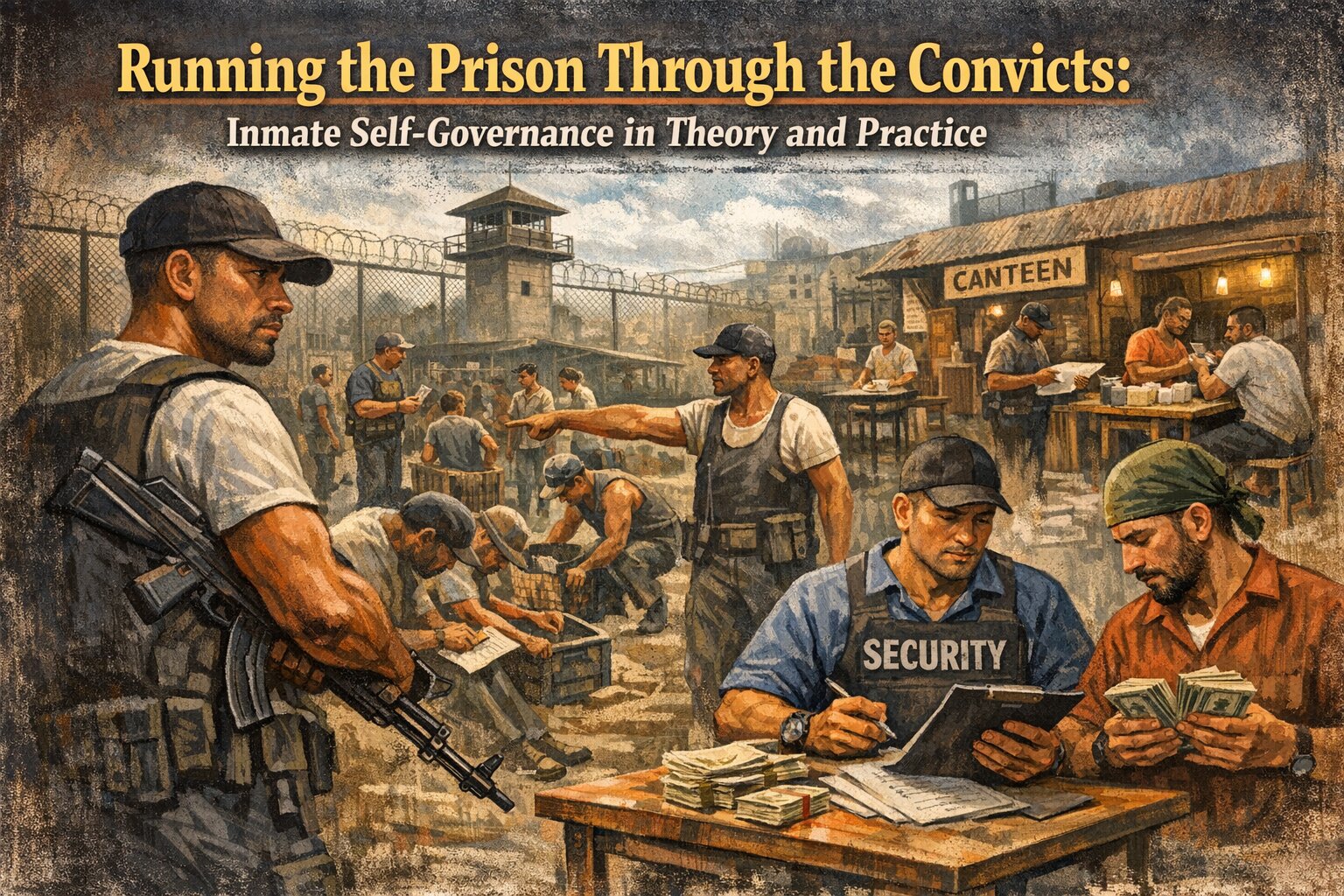
In some prisons around the world, the phrase “running the prison through the convicts” means that inmates—not the guards—take charge of daily life inside. Instead of top-down control by officials, prisoners manage security, discipline, administration, and even business activities. This isn’t just a rare event or a riot—it’s a system that has existed for decades in places like the American South, Latin America, and parts of Asia. These setups often begin due to lack of resources, certain beliefs, or neglect. While they may seem efficient or helpful for rehabilitation, they often lead to corruption, violence, and power struggles that challenge the authority of the state.
The Roots: From Plantation Pragmatism to Progressive Reform
The idea of prisoners running prisons started in the American South after the Civil War. When the harsh system of convict leasing ended, states needed a cheap way to manage large prison farms. So they created the “trusty system,” first used around 1901 at Mississippi’s Parchman Farm and later in other Southern states.
At Parchman, a very large prison farm with cotton fields and animals, about 1,900 prisoners were looked after by only 150 staff. Most of the prisoners were Black and kept in separate camps. Some prisoners, called “trusty shooters,” were given guns and horses. They guarded the fields, made sure others worked, and punished those who did not.
Other trusted prisoners did office work, cleaning, and even gave medicines. They also suggested punishments like whipping or chaining. In simple terms, prisoners themselves were doing much of the daily work of running the prison.
Supporters said the system saved money and gave responsible inmates useful roles. But critics exposed serious problems—racism, violence, and abuse of power. Courts finally stepped in. In Gates v. Collier (1974), a judge banned trusty shooters, racial segregation, and inmate-led punishment. Similar rulings followed in Texas and other states, and by the 1980s, the trusty system was replaced with better-regulated inmate worker programs.
At the same time, a more hopeful idea began to grow. In the early 1900s, reformer Thomas Mott Osborne spent a week in a New York prison pretending to be a prisoner. He was shocked by the harsh conditions.
He then started the Mutual Welfare League, where prisoners could choose their own leaders, deal with rule-breaking, and help plan activities. Later, Osborne became the warden of Sing Sing and tried to improve the system by giving prisoners more responsibility and encouraging reform.
Although many people opposed his ideas, they later influenced efforts to make prisons more fair, humane, and democratic.
Modern Micro-States: When the State Steps Back
Today, the clearest examples of prisons run by inmates are found in poorer countries of the Global South. Overcrowding, corruption, and too few guards leave gaps that prisoners fill with their own systems of control.
- Bolivia – San Pedro Prison: Built for 600 people but holding nearly 3,000, it works like a small city inside San Pedro Prison. Police only guard the outside; inside, prisoners run everything. A “boss” and his council are in charge, while a group called Disciplina keeps order through threats and violence.
Prisoners can buy or rent rooms, from cheap and unsafe shared spaces to more comfortable rooms with bathrooms and TV. Families are allowed to live inside, and there are shops, small restaurants, and other services. Everyone has to pay fees, and drugs are common.
Some people see a few positives, like families staying together, but there are also many serious problems and abuses.
- Honduras – Marco Aurelio Soto Prison: In some prisons, inmate bosses called toros control different sections. New prisoners must pay money or do work to stay. Beds and private cells also require monthly payments.
These bosses collect money from activities like gambling, drugs, weapons, and alcohol. They even decide punishments or help arrange escapes in return for money. Guards often work with them, bringing in illegal goods and taking a share.
This system makes a lot of money and works almost like a small government inside the prison. Similar systems exist in Venezuela, where powerful inmate leaders called pranes control prisons and collect regular payments from other prisoners.
- Philippines – New Bilibid Prison (NBP): Once holding over 23,000 inmates in space meant for 5,500, New Bilibid Prison shows a mix of official control and prisoner control. Gangs, called pangkats, share power with prison staff. Some selected prisoners work as “assistant guards,” helping to settle disputes and keep order.
Gang leaders control cell blocks, collect money, and run illegal businesses. Investigations have found special “VIP” rooms for rich drug lords, private spaces, and corruption. While gangs help manage the prison due to very few guards (sometimes one guard for 300 prisoners), they also lead to extortion and unfair treatment.
The Double-Edged Sword: Pros, Cons, and Lessons
- Advantages: In prisons with little money or staff, allowing inmates to manage some activities can reduce costs and maintain basic order. Reform-based models, like the one started by Thomas Mott Osborne, help prisoners learn responsibility, leadership, and self-respect. This can support rehabilitation. Some studies suggest that when inmates have clear roles, violence may decrease and they may be better prepared to return to society.
- Disadvantages: However, the problems are often greater than the benefits. Without proper supervision, the strongest or most violent inmates take control. They may abuse others, demand money, or enforce unfair rules. Poor or weaker prisoners suffer, while powerful ones benefit. The authority of the prison officials becomes weak, and prisons can turn into centers of organized crime that spreads outside. Human rights groups say such systems fail to protect vulnerable prisoners.
- Scholars’ View: Experts like David Skarbek say that inmate control usually develops when prisons lack resources. It fills the gaps left by neglect, but it is rarely fair or truly democratic.
The Indian Scenario
- Historical Context
India has not seen large-scale inmate‑run prisons like those in Latin America, but traces of convict self‑management have appeared in under‑resourced jails. Overcrowding, staff shortages, and corruption sometimes push prison authorities to rely on “inmate leaders” or “ward representatives” to maintain order. These figures often act as intermediaries between guards and prisoners, handling chores, discipline, or distribution of food and supplies. While this arrangement helps manage daily routines, it also risks creating informal hierarchies inside the prison walls and corruption.
- Present Challenges
In many Indian prisons, especially in states with high inmate populations, the guard‑to‑prisoner ratio is extremely low. This gap allows stronger or more influential inmates to dominate weaker ones, sometimes with tacit approval from staff. Reports from human rights groups highlight issues such as extortion, violence, and unequal access to food and facilities. Inmate leaders may control barracks, decide who gets better sleeping space, or even influence access to work assignments. Such practices blur the line between official authority and parallel power structures.
- Reform and Oversight
Recent reforms emphasize professional prison management and rehabilitation rather than informal inmate governance. The Model Prison Manual (2016) and Supreme Court directives stress transparency, accountability, and protection of prisoners’ rights. Efforts include better staffing, use of technology for monitoring, and structured inmate participation through welfare committees or vocational programs. The goal is to replace informal power with regulated involvement—where prisoners can contribute positively without undermining official authority. This approach seeks to balance discipline with dignity, ensuring prisons remain institutions of reform rather than breeding grounds for exploitation.
A Path Forward?
Running the prison through the convicts is neither purely evil nor a panacea. In its coercive trusty form, it was a tool of racial and class control. In its Bolivian or Honduran variant, it is a symptom of state failure. In Osborne-style experiments, it hints at genuine reform.
The lesson is clear: pure inmate self-rule without transparency, accountability, and external checks invites abuse. Yet ignoring the reality that prisoners will always form their own social order is naïve. Modern correctional philosophy increasingly explores “co-governance” models—structured inmate councils, peer mediation, and limited administrative roles—paired with adequate staffing, independent oversight, and rehabilitation programs. Reducing overcrowding by increasing the number of prisons remains the foundational fix.
As global prison populations swell, the question is not whether convicts will influence how prisons run. They always have. The real challenge is whether societies will design systems that channel that influence toward justice, dignity, and eventual freedom—rather than simply outsourcing the dirty work of incarceration to the incarcerated themselves.
Conclusion
In conclusion, inmate self-governance in prisons is a complex reality shaped more by necessity than choice. While it may offer short-term order and limited opportunities for reform, it often reflects deeper failures of the state—overcrowding, underfunding, and weak oversight. Left unchecked, it creates parallel systems of power marked by violence, inequality, and exploitation. True prison reform cannot rely on prisoners policing themselves. Instead, it requires strong institutions, humane policies, and accountability. The goal must be clear: to ensure prisons remain spaces of justice and rehabilitation, not shadow states where authority is abandoned and the vulnerable are left unprotected.