Abstract
Sir Garfield Barwick (1903–1997) remains one of the most influential—and controversial—figures in Australian legal and political history. His life story spans poverty, intellectual brilliance, high political office, landmark judicial rulings, and a decisive role in one of Australia’s greatest constitutional crises.
For readers of LegalServiceIndia.com, Barwick’s career offers a fascinating study of how law, politics, and constitutional principles often intersect in dramatic ways. His life illustrates how a lawyer can shape national institutions not only in the courtroom but also in the corridors of political power.
Sir Garfield Barwick: The Lawyer Who Shaped Australia’s Constitutional History
From Poverty to Legal Greatness
Garfield Edward John Barwick was born in 1903 in Sydney, Australia, into a modest family. His early life embodied the classic story of the “poor boy who made good.” Through determination and academic brilliance, he secured scholarships that enabled him to pursue higher education.
After completing his studies at the University of Sydney, Barwick was admitted to the bar in the late 1920s. At a time when the legal profession was highly competitive and dominated by established elites, he quickly began building a formidable reputation as a courtroom advocate.
During the 1930s, Barwick emerged as one of the most talented barristers of his generation. His advocacy skills, sharp legal reasoning, and command over constitutional law soon earned him recognition in complex commercial and constitutional disputes.
Key Characteristics of Barwick’s Early Legal Career
- Exceptional courtroom advocacy skills
- Strong command over constitutional law
- Ability to handle complex commercial disputes
- Rapid rise within a competitive legal profession
Landmark Legal Battles in the 1940s
Barwick’s rise to prominence accelerated in the 1940s, when he argued several significant cases that helped shape Australian economic and constitutional law.
Two major legal battles in which he played a key role were:
Major Cases Argued by Barwick
| Case | Legal Issue | Outcome | Significance |
|---|---|---|---|
| The Interstate Airlines Case | Aviation regulation and competition | Supported interstate airline competition | Strengthened principles of free enterprise in Australia’s aviation sector |
| The Bank Nationalisation Case | Government attempt to nationalise banks | Privy Council ruled against nationalisation | Preserved private banking and reinforced constitutional limits on state power |
1. The Interstate Airlines Case
In a landmark dispute concerning aviation regulation, Barwick argued successfully in favor of allowing interstate airlines to compete rather than be restricted by monopolistic policies. This case strengthened the principles of free enterprise and competition in Australia’s aviation industry.
2. The Bank Nationalisation Case
One of the most significant constitutional cases of the era concerned the federal government’s attempt to nationalise Australia’s banking system. The case eventually reached the Privy Council in London, which ruled against the government’s nationalisation policy.
The decision preserved the private banking system and reaffirmed constitutional limits on government economic intervention. Barwick’s advocacy in this matter significantly elevated his national reputation.
Defender of the Constitution in Ideological Battles
Australia in the early Cold War era was deeply divided by ideological struggles. The government attempted to outlaw the Communist Party, arguing that it posed a threat to national security.
Barwick appeared for the government before the High Court to defend the legislation declaring the Communist Party illegal. Despite his persuasive advocacy, the High Court ultimately ruled against the government and struck down the law.
However, Barwick’s legal career continued to flourish. A few years later, he successfully defended the Australian intelligence agency (ASIO) during the famous Petrov Affair of 1954, a Cold War espionage scandal involving a Soviet defector.
Entry Into Politics: A Legal Mind In Government
Robert Menzies, Australia’s long-serving Prime Minister, recognized Barwick’s extraordinary abilities and persuaded him to enter politics.
Barwick contested a parliamentary seat as a member of the Liberal Party and was quickly elevated to high office. His political career moved at remarkable speed.
He soon became:
- Attorney-General of Australia
- Minister for External Affairs
As Attorney-General, Barwick introduced important reforms. His legislative record reflected a complex mixture of conservative and progressive ideas.
Conservative Measures
He introduced amendments to the Crimes Act, strengthening certain national security provisions during a time of ideological tension.
Progressive Reform
At the same time, Barwick championed the Matrimonial Causes Act, a groundbreaking reform that modernized Australia’s divorce laws and introduced greater uniformity across the country. At the time, this was widely regarded as a significant liberal reform in family law.
He also strongly supported the introduction of a Trade Practices Act, aimed at regulating anti-competitive business practices, although the legislation did not succeed during his tenure.
Major Legal Reforms Introduced
| Reform Area | Key Measure | Purpose |
|---|---|---|
| National Security | Amendments to the Crimes Act | Strengthened security provisions during ideological tensions of the Cold War era |
| Family Law | Matrimonial Causes Act | Modernized divorce laws and created greater legal uniformity across Australia |
| Competition Law | Proposed Trade Practices Act | Aimed to regulate anti-competitive business practices |
Foreign Affairs And Cold War Diplomacy
As Minister for External Affairs, Barwick helped shape Australia’s international policies during a turbulent geopolitical period.
His diplomatic record reflected both pragmatism and ideological conviction.
Indonesia And West New Guinea
Barwick played a significant role in shaping Australia’s evolving approach toward Indonesia, particularly regarding the dispute over West New Guinea. His diplomacy contributed to a gradual adjustment of Australia’s regional strategy.
The Vietnam War
Barwick was a firm supporter of Australia’s involvement in the Vietnam War. He believed the conflict was a legitimate response to communist expansion in Asia.
Even years later, when critics argued that the war was a mistake, Barwick maintained that the conflict had been justified and that the North Vietnamese aggression posed a genuine threat to regional stability.
Chief Justice Of Australia (1964–1981)
In 1964, Garfield Barwick was appointed Chief Justice of the High Court of Australia, a position he held for seventeen years.
During his tenure, he presided over some of the most influential constitutional and taxation cases in Australian legal history.
A Strict Interpretation Of Tax Law
Barwick became particularly known for his interpretation of taxation statutes.
He viewed taxation laws almost as penal provisions, insisting that governments must draft them with absolute clarity. His reasoning was simple:
Courts interpret the law; they do not rewrite it.
If Parliament wished to impose taxes, it had to express its intentions clearly. If ambiguities existed, the courts could not repair them.
Critics argued that his judgments allowed taxpayers to exploit loopholes. Supporters countered that Barwick was merely enforcing the rule that Parliament—not the judiciary—must legislate clearly.
The 1975 Australian Constitutional Crisis
Despite his long and distinguished legal career, Barwick is remembered most for his role in the 1975 Australian constitutional crisis.
This event remains one of the most dramatic political confrontations in Australia’s history.
The Political Deadlock
In 1975, the opposition-controlled Senate blocked the government’s budget (Supply Bills). Without supply, the government could not legally fund its operations.
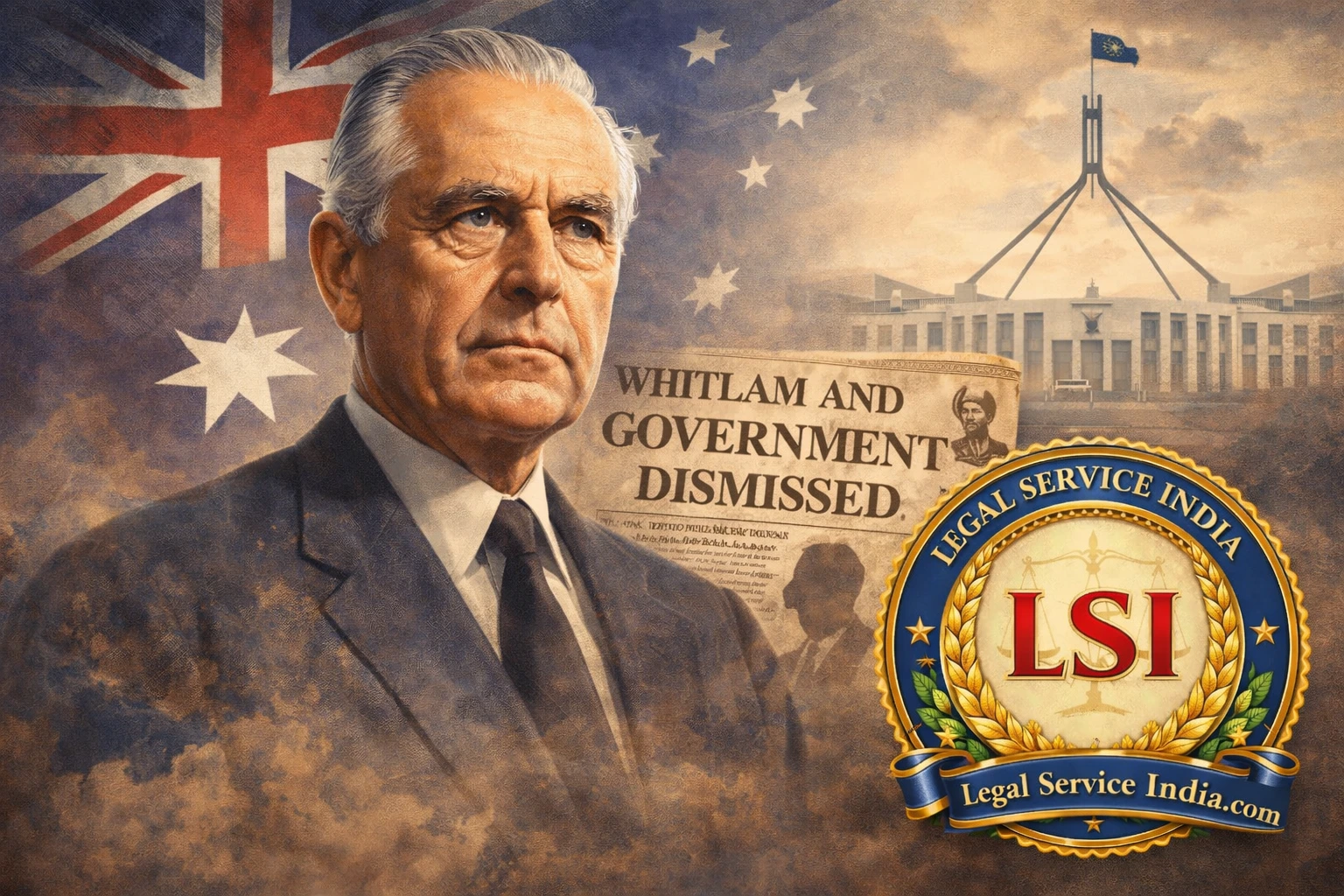
Prime Minister Gough Whitlam refused to call an election, insisting that the Senate had no constitutional right to block supply.
The political deadlock escalated rapidly.
Governor-General Kerr Seeks Advice
Governor-General Sir John Kerr, who represented the British monarch in Australia’s constitutional system, sought legal advice from Chief Justice Barwick.
Barwick provided Kerr with a written legal opinion stating that the Governor-General possessed the constitutional authority to dismiss the Prime Minister if the government could not secure supply.
On 11 November 1975, Kerr exercised that power and dismissed Whitlam, appointing opposition leader Malcolm Fraser as caretaker Prime Minister.
A Divisive Constitutional Legacy
The dismissal shocked the nation and remains deeply controversial even today.
Supporters of Barwick’s position argue that:
- A government must maintain parliamentary confidence.
- Without supply, governance becomes impossible.
- Constitutional mechanisms allow the Governor-General to intervene in extraordinary circumstances.
Critics argue that:
- The Senate’s blocking of supply violated democratic convention.
- The Governor-General abused reserve powers.
- Barwick’s advice improperly influenced the decision.
The crisis ignited fierce debate about the role of the monarchy in Australia and significantly strengthened the Australian republican movement.
Barwick’s Own Defence
Barwick himself never expressed regret for his role.
He consistently argued that parliamentary democracy required the government to resign or seek an election if it could not secure supply.
In his view, the constitutional system demanded decisive action to break the political deadlock.
He maintained that the crisis began earlier, when Whitlam made controversial political appointments that altered the Senate balance.
A Complex And Contradictory Figure
Barwick’s career defies simple labels.
He was simultaneously:
- A brilliant courtroom advocate
- A powerful political figure
- A transformative Chief Justice
- A central actor in a constitutional crisis
His decisions reflected a deep commitment to legal formalism—the belief that courts must strictly interpret the law rather than reshape it.
Yet his career also reveals the unavoidable interaction between law and politics at the highest levels of governance.
Legacy In Legal History
Sir Garfield Barwick’s legacy continues to provoke debate among historians, constitutional scholars, and lawyers.
Some view him as a guardian of constitutional principle, who insisted that Parliament must bear responsibility for the laws it enacts.
Others see him as a figure whose legal advice altered the course of Australian democracy.
What is undeniable, however, is that Barwick left an indelible mark on Australian law.
His life reminds us that the law is not merely a technical discipline—it is a living institution that shapes the destiny of nations.
- For legal scholars and practitioners, Barwick’s career offers a powerful lesson:
the interpretation of constitutional principles can determine the fate of governments and influence the trajectory of democracy itself.