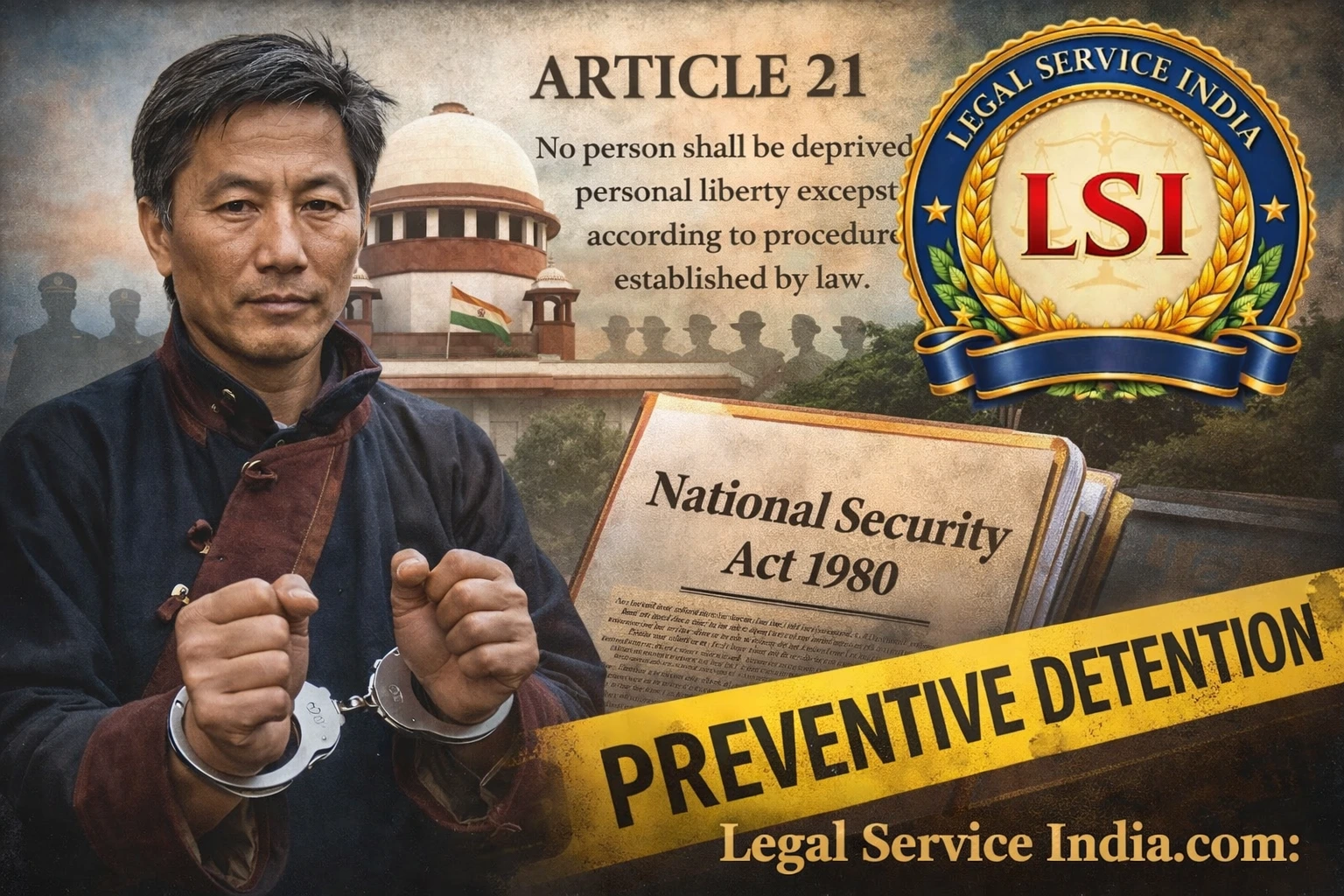
Introduction
Preventive detention laws have always occupied a controversial space in India’s constitutional framework. While the State possesses the authority to detain individuals in the interest of national security and public order, such powers operate in direct tension with the fundamental right to personal liberty guaranteed under Article 21 of the Constitution of India.
A recent controversy involving climate activist and education reformer Sonam Wangchuk has once again brought the National Security Act, 1980 (NSA) under judicial and public scrutiny. The Union Government’s decision to revoke Wangchuk’s detention under Section 14 of the NSA—after nearly six months of custody and just before a crucial Supreme Court hearing—has triggered serious constitutional questions.
The episode raises several critical issues:
- Can the government revoke preventive detention simply to avoid judicial scrutiny?
- Does revocation automatically render the matter infructuous?
- Can courts still examine the legality of detention after release?
This article examines the legal framework of preventive detention under the NSA, the circumstances surrounding the Wangchuk case, and the constitutional jurisprudence developed by the Supreme Court regarding preventive detention and personal liberty.
Preventive Detention In India: Constitutional Framework
Preventive detention is recognised under Article 22 of the Constitution, which allows the State to detain individuals without trial under specific statutory laws.
However, the Constitution also imposes safeguards:
- The detainee must be informed of the grounds of detention.
- The detainee must be given the earliest opportunity to make a representation.
- The detention must be reviewed by an Advisory Board within prescribed time limits.
Despite these safeguards, preventive detention laws have often been criticised for enabling executive overreach.
The Supreme Court has repeatedly warned that preventive detention is an exceptional power that must be exercised sparingly.
Rekha v. State Of Tamil Nadu (2011) 5 SCC 244
Preventive detention is a serious invasion of personal liberty and must be strictly construed.
The National Security Act, 1980
The National Security Act, 1980 allows preventive detention of individuals to maintain:
- National security
- Public order
- Essential supplies and services
A person can be detained for up to 12 months without trial.
Relevant Provisions
| Section | Provision | Description |
|---|---|---|
| Section 3 | Preventive Detention Orders | Allows Central or State Governments or District Magistrates to order preventive detention. |
| Section 13 | Maximum Period Of Detention | Limits the maximum detention period to 12 months. |
| Section 14 | Revocation Or Modification | Empowers the government to revoke or modify a detention order at any time. |
While Section 14 clearly authorizes revocation, historically it has rarely been invoked by the Central Government in politically sensitive cases.
Background Of The Sonam Wangchuk Detention
Sonam Wangchuk, widely known as a climate activist and education innovator from Ladakh, had been leading a peaceful movement demanding constitutional safeguards for the region.
His demands reportedly included:
- Sixth Schedule status for Ladakh
- Greater democratic representation
- Environmental protections for Himalayan ecosystems
In September 2025, during a prolonged hunger strike and public mobilisation in Leh, tensions reportedly escalated in the region. Authorities claimed that the protests had begun affecting public order.
Subsequently, on 26 September 2025, Wangchuk was detained under the National Security Act by the District Magistrate of Leh.
Civil society organisations and activists argued that the detention was disproportionate, particularly because the protests were largely peaceful.
Habeas Corpus Petition Before The Supreme Court
The detention was challenged before the Supreme Court of India through a habeas corpus petition filed by Wangchuk’s wife.
Senior Advocate Kapil Sibal argued that:
- The detention was unconstitutional.
- The grounds of detention were vague.
- The material relied upon by authorities was not properly supplied to the detainee.
The Supreme Court bench reportedly raised important procedural questions, including:
- Whether the complete material relied upon by authorities had been provided.
- Whether translations of the material were supplied.
- Whether the alleged speeches had any direct nexus with violence.
Procedural fairness is crucial in preventive detention cases.
Icchu Devi Choraria v. Union Of India (1980) 4 SCC 531
The burden lies on the State to strictly justify preventive detention.
The Government’s Sudden Revocation Of Detention
Just before a scheduled Supreme Court hearing in March 2026, the Union Ministry of Home Affairs revoked Wangchuk’s detention under Section 14 of the NSA.
The government justified the decision on the grounds that:
- Wangchuk had already undergone nearly half of the detention period.
- Revocation would help restore peace and stability in Ladakh.
- The government wished to encourage constructive dialogue.
However, the timing of the revocation raised significant legal and political questions.
Critics suggested that the move might have been intended to render the Supreme Court proceedings ineffective.
Can Courts Still Examine Detention After Release?
Indian constitutional jurisprudence clearly indicates that release does not automatically close the matter.
The Supreme Court has repeatedly examined the legality of detention even after the detainee was freed.
Key Precedents
1. Rudul Sah v. State Of Bihar (1983) 4 SCC 141
The Supreme Court ordered compensation for illegal detention, observing that mere release from custody does not remedy the violation of fundamental rights.
Article 21 would lose its meaning if courts could not grant compensation for unlawful detention.
2. Dhanya M v. State Of Kerala (2018)
The Supreme Court examined the legality of preventive detention despite the detainee’s release, emphasising the importance of safeguarding liberty.
3. Pankaj Bansal v. Union Of India (2023)
Though relating to arrest under the Prevention of Money Laundering Act, the Court reiterated that procedural safeguards protecting liberty must be strictly followed.
Preventive Detention Must Not Replace Ordinary Criminal Law
Another recurring principle in constitutional jurisprudence is that preventive detention should not be used where ordinary criminal law is sufficient.
In Pankaj Kumar v. State of Telangana and Sneha Sheela v. State of Telangana (2021), the Supreme Court ruled:
Preventive detention cannot be invoked merely because criminal prosecution may be inconvenient.
Similarly, in Ameena Begum v. State of Telangana (2023), the Court warned:
Preventive detention laws, meant for exceptional circumstances, are increasingly being used as routine instruments.
This observation has broader implications for the Wangchuk case.
Procedural Safeguards: A Core Constitutional Requirement
The Supreme Court has consistently emphasised that preventive detention must strictly comply with procedural safeguards.
Khudiram Das v. State Of West Bengal (1975) 2 SCC 81
The Court ruled that detention orders are subject to judicial review on grounds of mala fide, non-application of mind, or absence of relevant material.
Anuradha Bhasin v. Union Of India (2020) 3 SCC 637
The Court reiterated that restrictions affecting fundamental rights must satisfy the test of proportionality.
Thus, the key issue in Wangchuk’s case is whether the detention order satisfied constitutional requirements when it was initially issued.
Key Legal Questions Raised By The Case
The controversy surrounding the revocation of Wangchuk’s detention raises several important legal questions:
- Legality Of The Original Detention
Did the authorities possess sufficient material linking Wangchuk’s speeches to a genuine threat to public order? - Procedural Compliance
Were all documents and evidence properly supplied to the detainee as required under Article 22? - Judicial Scrutiny After Revocation
Should the Supreme Court continue to examine the legality of detention even after release? - Misuse Of Preventive Detention Laws
Was preventive detention used in a situation where ordinary criminal law would have sufficed?
Overview Of Legal Issues Raised
| Legal Issue | Key Constitutional Concern |
|---|---|
| Legality Of Detention | Whether the detention order was supported by credible evidence of threat to public order |
| Procedural Compliance | Whether safeguards under Article 22 were followed |
| Judicial Review | Whether courts can continue examining legality after revocation |
| Misuse Of Preventive Detention | Whether preventive detention replaced ordinary criminal law mechanisms |
Preventive Detention And The Future Of Civil Liberties
India’s preventive detention laws have historically been controversial.
Even during the framing of the Constitution, several members of the Constituent Assembly expressed concern about granting such sweeping powers to the executive.
Dr. B. R. Ambedkar acknowledged that preventive detention was necessary in exceptional circumstances but warned that it should not become a routine instrument of governance.
Over the decades, courts have tried to balance national security concerns with individual liberty, often reiterating that personal liberty is the most cherished constitutional value.
Conclusion
The revocation of Sonam Wangchuk’s detention under the National Security Act represents an unusual legal development. While Section 14 clearly empowers the government to revoke detention orders, the timing of the decision—just before judicial scrutiny—has raised legitimate constitutional questions.
Ultimately, the core issue remains whether the original detention complied with constitutional safeguards.
Indian courts have repeatedly emphasised that preventive detention laws are extraordinary powers that must be exercised with extreme caution. The outcome of the Supreme Court proceedings may therefore have significant implications not only for this case but also for the future application of preventive detention laws in India.
In a constitutional democracy committed to the rule of law, the delicate balance between state security and individual liberty must always tilt in favour of liberty unless compelling reasons dictate otherwise.