





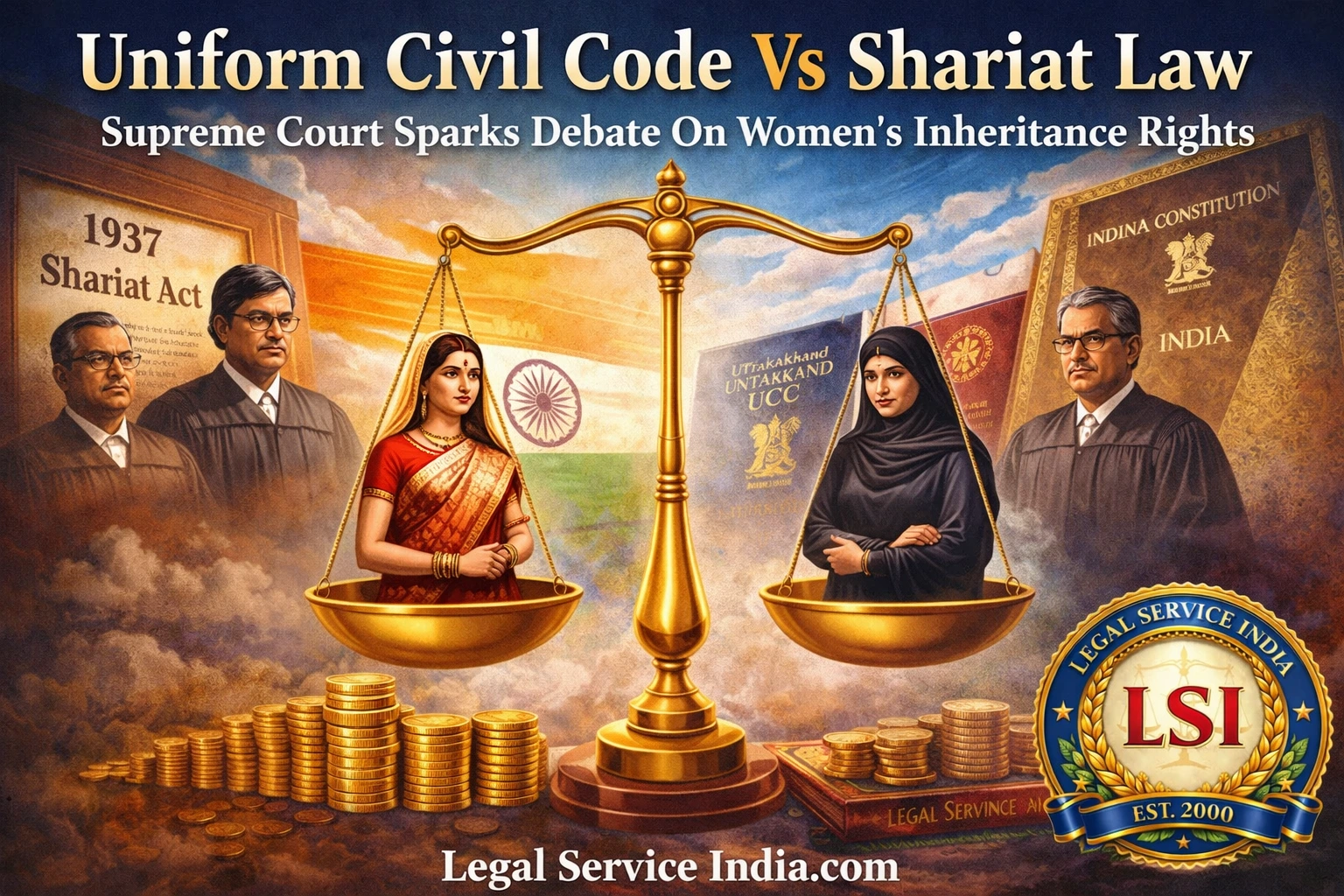
Ucc Observation By The Supreme Court
The Uniform Civil Code is the answer.” This was the recent observation by the Supreme Court of India. The Chief Justice made this remark while hearing a crucial petition. This petition challenged the 1937 Muslim Personal Law (Shariat) Application Act. The petitioners alleged that its rules of succession blatantly discriminate against Muslim women. They argued for equal inheritance rights. The Court, however, refused to simply strike down the law. Doing so would create a sudden legal vacuum. Instead, the Court deferred to the legislature. It pointed to the Uniform Civil Code (UCC) as the ultimate solution for equality. [1]
Historical Context Of The 1937 Shariat Act
But before discarding the 1937 Shariat Act, its history must be understood. Why was it enacted in the first place? In British India, diverse and deeply patriarchal customary laws ruled the land. These indiscriminate local customs routinely denied Muslim women any right to own or inherit property. The 1937 Act was brought in by force of ulama on British government to specifically kill those oppressive customs. It replaced them with formal Shariat law. This shift formalized the property rights of Muslim women. It secured them mandatory, fixed shares in inheritance that local customs had historically blocked. [2]
Criticism Based On Inheritance Math
Critics today point straight to the math. Under Islamic inheritance, a daughter typically receives a 1/2 share compared to a son’s full share. A widow receives a 1/8th share of the property if there are children, and a 1/4th share if there are none. [3] Through the modern lens of formal equality, these numbers look highly unequal. However, judging these proportions in isolation is a mistake. Substantive equality looks at the complete picture. Islamic law does not distribute wealth in a vacuum. It directly links a person’s inherited wealth to their mandatory financial burdens.
Inheritance Share Breakdown
| Category | Share |
|---|---|
| Daughter | 1/2 of son’s share |
| Son | Full share |
| Widow (With Children) | 1/8th |
| Widow (Without Children) | 1/4th |
Economic Responsibilities And Balance
The disparity in inheritance is balanced by strict economic duties. In Islamic law, a man bears the absolute legal and financial responsibility to maintain his household. He must provide for his wife, his children, parent and minor siblings. A woman carries zero legal obligation to spend her money on the family. Furthermore, she receives an absolute right to Mahr (dower) upon marriage. [4] Therefore, the son receives a double share because his wealth is legally tied to family maintenance. The daughter receives a single share, but that wealth is her pure, untouched surplus. To call this system anti-women is to judge a complex economic balance through a narrow, single-lens view of equality.
Article 14 And Reasonable Classification
Article 14 guarantees the “equal protection of the laws.” The Supreme Court has repeatedly ruled that this allows for “reasonable classification.” This doctrine means the state cannot blindly treat different groups identically if their historical, social, and economic realities are completely different. A blanket UCC pushes for pure formal equality. It assumes every community operates with the exact same social architecture.
Formal Equality Vs Substantive Equality
This brings us to a fundamental misunderstanding of the Indian Constitution. The Constitution promises substantive equality, not merely formal equality. Formal equality demands strict, blind uniformity. Substantive equality, however, demands equity. It recognizes that different communities have different historical and social contexts. Contexualising every situation with a single lens of perceived equality i.e formal equality is the biggest omission which ultimately defeat the spirit of justice, fairness is the key and not just identical provision. A forced uniform law ignores the unique socio-economic frameworks that govern different communities. If a UCC forces a 50-50 inheritance split but fails to equalize the financial burdens of maintaining a household, it actually disadvantages the woman. It disrupts the substantive equality already present in the Islamic framework. When a state ignores these nuanced, internal balances and forces the majority’s concept of “equality” onto a minority, it omits the nuances.
Bias In The Ucc Narrative
Furthermore, the urgent push for a UCC often relies on a biased narrative. It assumes all religious personal laws are inherently unreasonable towards women. Seeing every religious law as oppressive is a grave mistake. It is like viewing all religions through a single, narrow lens of discrimination. This ignores the nuanced legal protections that already exist within these faiths.
Uttarakhand Ucc Act Analysis
To understand the reality of a UCC, we must examine the actual models being proposed. Take the recent Uttarakhand UCC Act. Its supporters hail it as a perfect template for a secular society. However, a closer reading reveals a very different reality. The Act heavily mirrors existing Hindu family laws, particularly regarding marriage and succession. Yet, it explicitly exempts tribal communities from its jurisdiction.
Key Observations
- The Act mirrors Hindu family law structures.
- Tribal communities are exempted.
- Uniformity is selectively applied.
If the ultimate goal is absolute legal uniformity, why allow massive exemptions? This selective application exposes the Act’s true nature. It strongly appears to be a majoritarian premise wrapped tightly in a secular sheath. It effectively pressures minority communities to assimilate into the majority’s legal and cultural framework, all under the guise of national integration.
Law Commission Of India’s Stance
Legal experts have already warned the nation against this exact approach. The 21st Law Commission of India extensively studied family law reform. In their landmark 2018 consultation paper, they firmly stated that a UCC is “neither necessary nor desirable at this stage.” [5]
- Cultural diversity should not be erased by legislation.
- Internal reform within religions is preferred.
- Discriminatory practices should be removed selectively.
The Commission recognized a vital truth. Cultural diversity cannot and should not be erased by legislative fiat. Instead of a top-down blanket law, they advocated for internal reform. They suggested weeding out genuinely discriminatory practices from within each religion. [6] A robust democracy thrives on accommodating differences, not erasing them.
Impact Of A Uniform Law
A uniform law might look appealing and simple on paper. But delivering justice in a highly diverse nation is complex. Imposing a majoritarian code will not magically create a progressive, secular society. It will simply alienate minorities and erase their distinct legal identities. True secularism does not mean bulldozing over differences. It means ensuring justice and equity exist within those differences.
Historical Comparison Of Women’s Property Rights
To have a better understanding, it is pertinent to look at how rights were secured. The history reveals a massive double standard.
Muslim Women’s Rights
- Divinely ordained by the Quran.
- Fixed property shares existed for over a millennium.
- 1937 Act formalized these rights.
Hindu Women’s Rights
- Result of legislative activism.
- Traditionally excluded from joint family property.
- 1956 law denied coparcenary rights.
- 2005 amendment finally granted equality.
Muslim women’s inheritance rights did not come from modern state activism. They are divinely ordained by the Quran. For over a millennium, Islamic law granted women fixed property shares. The 1937 Shariat Act simply formalized this to override deeply patriarchal local customs.
Contrast this with Hindu women’s rights. Their right to ancestral property is purely the result of legislative activism. For centuries, traditional Hindu law completely barred women from joint family property.
When the state introduced the Hindu Code Bill in the 1950s to grant women absolute ownership, the backlash was fierce. Prominent conservative leaders in the majority heavily opposed it. They argued it would destroy the Hindu family and religion.
Because of this intense resistance, the state compromised. The 1956 Hindu Succession Act deliberately excluded daughters from coparcenary (joint ancestral) property. It took another fifty years to fix this. Only in 2005 did an amendment finally make Hindu daughters equal coparceners.
This history shatters the myth of a naturally progressive majority. It took decades of forceful state intervention to secure these rights on paper. End Notes:
- ‘UCC Is The Answer’ : Supreme Court On Plea Challenging Shariat Inheritance Law As Discriminatory Against Muslim Women, LiveLaw
https://www.livelaw.in/top-stories/ucc-supreme-court-hariat-inhertiance-law-discriminating-against-muslim-women-525789 - “How a challenge to 1937 Shariat Act frames inheritance law,” The Indian Express
https://indianexpress.com/article/explained/explained-law/shariat-act-muslim-inheritance-law-challenge-supreme-court-10583255/ - “Fundamentals of Inheritance (Faraid) in Islam: Ensuring Fair Distribution”, IslamOnWeb
https://en.islamonweb.net/fundamentals-of-inheritance-faraid-in-islam-ensuring-fair-distribution - “Why Muslims are against the Uniform Civil Code,” IslamOnWeb
https://share.google/pd3MgC5pwDuUFGzEG - Law Commission of India, Consultation Paper on Reform of Family Law, August 2018
https://archive.pib.gov.in/documents/rlink/2018/aug/p201883101.pdf - “The Mirage Of Uniformity: Why Internal Reform Must Precede A Common Code,” LiveLaw
https://www.livelaw.in/articles/uniformity-mirage-internal-common-code-526466

