Introduction
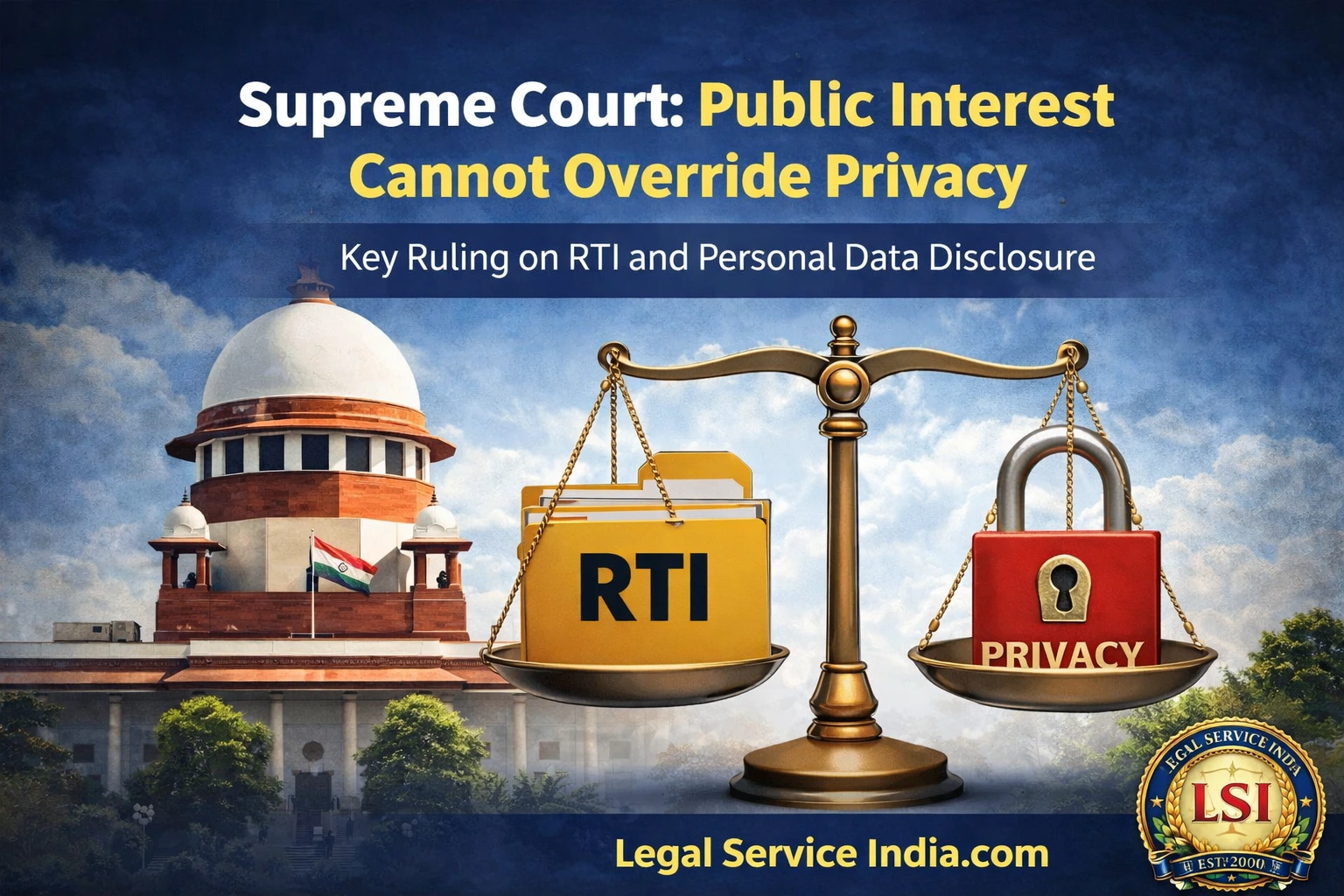
In a significant constitutional ruling, the Supreme Court of India has reiterated that public interest alone cannot be used as a blanket justification for disclosure of personal data. The Court emphasized that even public officials do not lose their fundamental right to privacy merely because they hold public office.
The judgment provides important guidance on the delicate balance between the Right to Privacy under Article 21 and the Right to Information under the transparency framework, particularly in the era of increasing data disclosure and digital governance.
The decision strengthens the constitutional principles first articulated in the landmark privacy judgment in Justice K.S. Puttaswamy v. Union of India (2017) and clarifies how privacy must be weighed against transparency claims.
Law Report Headnote (SCC / Manupatra Style)
Constitution of India — Articles 21 and 19(1)(a)
Right To Privacy Vs Right To Information
Disclosure Of Personal Data — Limits Of Public Interest
Public interest cannot automatically justify disclosure of personal information. Even individuals holding public office retain a protected sphere of privacy. Courts must undertake a careful balancing exercise between transparency obligations and the constitutional guarantee of privacy.
Disclosure of personal data must satisfy the tests of legality, necessity, and proportionality. Mere curiosity, political interest, or generalized claims of transparency cannot override the fundamental right to privacy.
Where information sought involves personal data unrelated to public duties or accountability, protection of privacy must prevail.
Digest (SCC / Manupatra Style)
Constitution Of India — Art. 21 — Right To Privacy — Scope And Protection
The right to privacy, recognized as a fundamental right, protects personal information against unjustified disclosure. The State and public authorities must ensure that any invasion of privacy satisfies the principles of legality, necessity and proportionality.
Right To Information — Transparency — Disclosure Of Personal Data
Public interest cannot be invoked mechanically to compel disclosure of personal information. A demonstrable nexus between the requested information and a legitimate public purpose must be established.
Public Officials — Privacy Rights — Extent
Holding public office does not eliminate an individual’s right to privacy. While greater scrutiny is permissible with respect to official conduct and accountability, purely personal information remains protected.
Balancing Of Fundamental Rights
Where the Right to Information intersects with the Right to Privacy, courts must adopt a balancing approach. The competing constitutional values of transparency and privacy must be harmonized rather than allowing one to automatically override the other.
Detailed Article
Constitutional Context
The Indian Constitution recognizes multiple fundamental rights that occasionally overlap or conflict.
Two such rights are:
- Right to Privacy under Article 21
- Right to Information, which flows from Article 19(1)(a)
While transparency is essential for democratic accountability, the protection of personal autonomy and dignity remains equally fundamental.
The Supreme Court’s ruling highlights that neither transparency nor privacy is absolute, and both must coexist through careful judicial balancing.
Privacy Is Not Lost By Holding Public Office
A central clarification in the judgment is that public officials retain privacy rights.
In modern governance, it is often argued that individuals in public service must accept unlimited scrutiny. The Court rejected this broad assumption and held that:
- Accountability relates primarily to official acts and public duties
- Personal data unrelated to public functions remains protected
For example, disclosure of financial or personal details that have no bearing on public decision-making cannot be justified merely on the ground of curiosity or generalized public interest.
Public Interest Must Be Genuine And Specific
The Court emphasized that the phrase “public interest” cannot be used as an automatic override. Instead, authorities must demonstrate:
- A clear public purpose
- A rational connection between the information sought and that purpose
- That disclosure is necessary and proportionate
Without satisfying these requirements, disclosure of personal data would violate constitutional protections.
The Test Of Proportionality
The Court reiterated the proportionality test, which is now a central feature of Indian constitutional law.
Any attempt to intrude upon privacy must meet four conditions:
| Condition | Explanation |
|---|---|
| Legality | There must be a law permitting the intrusion |
| Legitimate Aim | The objective must serve a legitimate public purpose |
| Necessity | The intrusion must be necessary to achieve the objective |
| Proportionality | The degree of intrusion must be balanced and minimal |
This framework ensures that privacy is not sacrificed unnecessarily in the name of transparency.
Implications For RTI And Data Protection
The judgment carries important implications for the future of transparency and data governance in India.
1. RTI Authorities Must Apply Balancing Tests
Public Information Officers and appellate authorities must now carefully assess:
- Whether requested information involves personal data
- Whether a real public interest justifies disclosure
Routine disclosure without such evaluation could be constitutionally problematic.
2. Stronger Protection For Personal Data
The ruling aligns with India’s emerging data protection framework and reinforces the idea that personal information deserves heightened protection.
It signals that privacy considerations must guide government handling of citizen data.
3. Guidance For Courts
The judgment also provides a clear roadmap for courts faced with privacy vs transparency disputes.
Instead of prioritizing one right over the other, courts must harmonize competing constitutional values.
Broader Constitutional Significance
This ruling further consolidates the constitutional doctrine established after the Puttaswamy judgment, which recognized privacy as intrinsic to human dignity and liberty.
By insisting on a careful balancing process, the Court has reaffirmed that:
- Privacy remains a core fundamental right
- Transparency must operate within constitutional limits
Conclusion
The Supreme Court’s decision represents an important step in defining the relationship between privacy and transparency in the digital age.
By holding that public interest alone cannot justify disclosure of personal data, the Court has strengthened safeguards against misuse of information requests while preserving the spirit of democratic accountability.
The ruling will likely influence future disputes involving RTI requests, personal data disclosure, and data protection laws, ensuring that constitutional values remain at the heart of India’s evolving information regime.