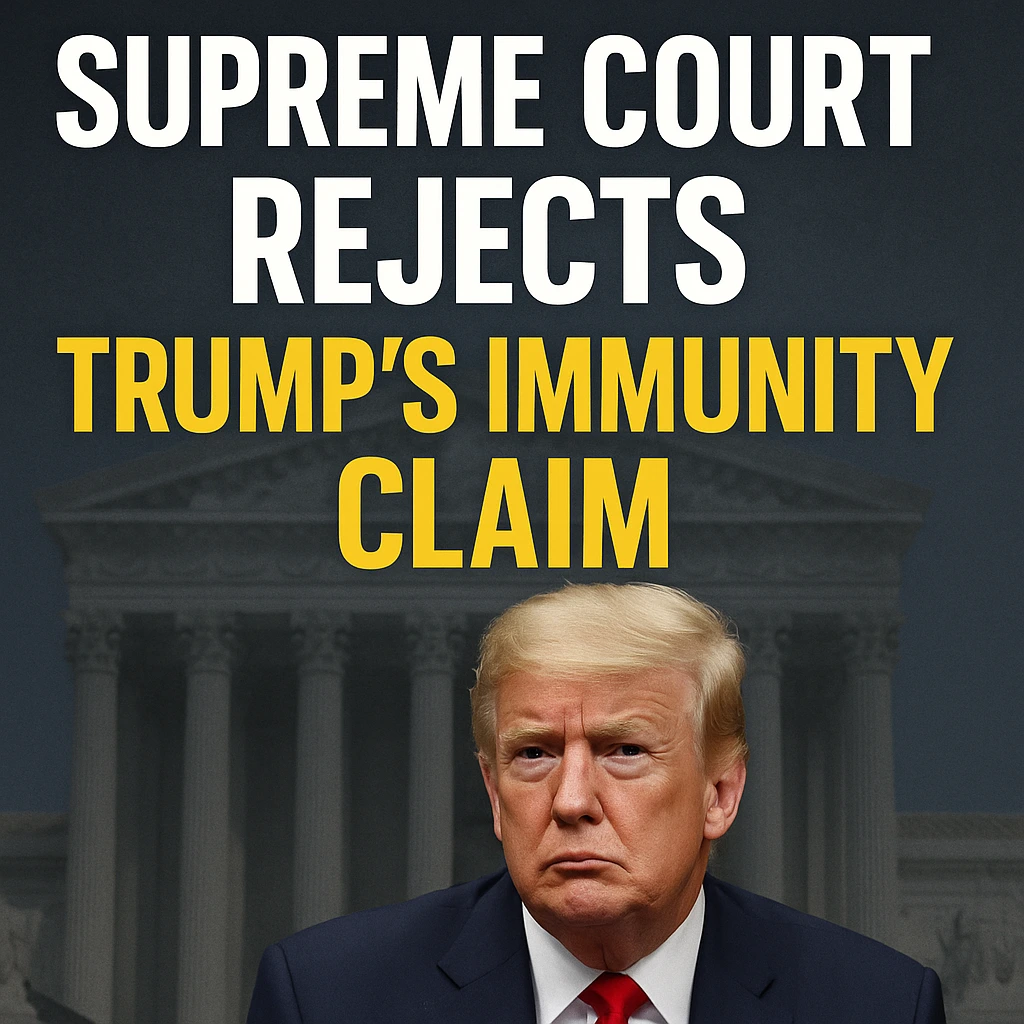
In One of the Most Consequential Legal Rulings in Modern American History
In one of the most consequential legal rulings in modern American history, the U.S. Supreme Court has overwhelmingly rejected former President Donald Trump’s claim of absolute presidential immunity. The 7–2 judgment, delivered in a decisive and unambiguous opinion, marks the strongest judicial setback of Trump’s political career — and it included votes against him from his own three Supreme Court appointees.
Beyond its legal implications, the ruling has triggered political tremors across Washington and even drew an unexpected reaction from Warren Buffett, adding an economic dimension to an already explosive moment.
A Legal Fortress That Finally Crumbled
For nearly two years, Trump’s legal strategy had rested on a single foundation: the belief that a president’s official actions place him beyond the reach of criminal prosecution. His team argued that actions taken while in office — regardless of their nature — are protected by sweeping immunity.
This Position Became the Cornerstone of Trump’s Defense Across Multiple Federal Indictments Involving:
- Classified documents
- The January 6 Capitol attack
- Election interference
- Abuse of executive authority
But the Supreme Court found this interpretation far too extreme. The justices noted that accepting such an argument would effectively place a president above the law, contradicting the Constitution’s core principle that no public official is beyond accountability.
Why the Ruling Is So Significant
Historic Constitutional Question
The ruling answers a historic constitutional question:
Can a former president be prosecuted for acts committed while in office?
The Supreme Court’s answer: Yes.
Limits of Presidential Immunity
- Chief Justice John Roberts, writing for the majority, stressed that presidential immunity has limits.
- A president cannot claim blanket protection for actions that potentially violate federal criminal law.
Legal Impact and Comparisons
Legal scholars have compared the magnitude of this judgment to the landmark United States v. Nixon decision, which forced President Nixon to hand over Watergate tapes in 1974.
Response from Conservative Legal Analysts
- Many conservative legal analysts — including some who have defended Trump previously — described the ruling as “legally bulletproof.”
- Others called it “the end of the road” for immunity arguments.
Trump’s Reaction: Anger, Accusations, and Political Fallout
Public Response
Trump publicly expressed deep frustration with the decision, accusing the justices of weakness and betrayal.
A Pattern of Turning on Allies
Historically, Trump has turned on allies he perceives as insufficiently loyal, including:
- Jeff Sessions
- Bill Barr
- Mike Pence
- Kevin McCarthy
Now, a similar pattern appears to be unfolding toward his own Supreme Court appointees:
- Neil Gorsuch
- Brett Kavanaugh
- Amy Coney Barrett
Republican Divisions
The backlash has also created divisions within Republican circles. Senator Lindsey Graham urged restraint and criticized Trump’s aggressive attacks on the judiciary — a rare moment of disagreement from one of his longtime supporters.
Warren Buffett Breaks His Silence
Buffett’s Statement
In an unexpected twist, billionaire investor Warren Buffett issued a public statement after the ruling, breaking years of silence on Trump-related political issues. Buffett emphasized that:
“No one is above the law. The market depends on the rule of law. When that principle is questioned, the foundation of the American economic system is threatened.”
Market Reaction
His statement resonated strongly across Wall Street. Berkshire Hathaway stock even saw a brief after-hours uptick as investors interpreted Buffett’s remarks as a vote of confidence in institutional stability.
Implications For The 2024 Election
With this ruling, Trump now faces multiple federal cases without the protective shield of immunity. Trials that were stalled pending this Supreme Court decision are expected to accelerate.
Politically, this moment could reshape the 2024 election narrative:
For Democrats
They will likely frame the ruling as proof that Trump views himself as “above the law,” reinforcing the argument that democratic norms must be protected.
For Republicans
The ruling deepens existing fractures. Moderates worry about electoral consequences, while hardcore supporters accuse the Court of siding with the “deep state.”
For Independent Voters
The verdict may reinforce concerns about chaos, legal instability, and governance issues — areas where Trump has already faced declining trust.
A Bigger Question: The Future Of American Democracy
Beyond the courtroom, the decision underscores a critical constitutional principle: no president is exempt from the law.
Had Trump’s absolute immunity argument succeeded, it would have permanently altered the balance of power, allowing future presidents — not just Trump — to potentially commit crimes without fear of prosecution.
The ruling reaffirms:
- The independence of the judiciary
- The strength of constitutional checks and balances
- The U.S. commitment to the rule of law
At a time when democratic norms worldwide are under pressure, this judgment sends a strong signal about the resilience of American institutions.
What Happens Next?
The next phase promises to be turbulent:
- Federal prosecutors will resume criminal proceedings.
- Trump’s legal team must prepare for multiple trials.
- Republican leaders must decide how closely to align themselves with Trump as the 2024 race intensifies.
- Markets will watch closely to understand the political and economic fallout.
The story is far from over — in fact, it is entering its most consequential chapter.
Quick Reference: Actors And Expected Effects
| Actor | Expected Effect |
|---|---|
| Federal Prosecutors | Resume paused cases; proceed to trials where evidence supports charges. |
| Trump’s Legal Team | Reassess strategy; prepare defenses for multiple, potentially concurrent prosecutions. |
| Republican Leaders | Face a strategic choice: defend Trump vigorously or distance to limit electoral damage. |
| Independent Voters | May shift perception toward valuing stability and rule-of-law assurances. |
| Markets & Investors | Monitor political risk; price in legal and governance uncertainty. |