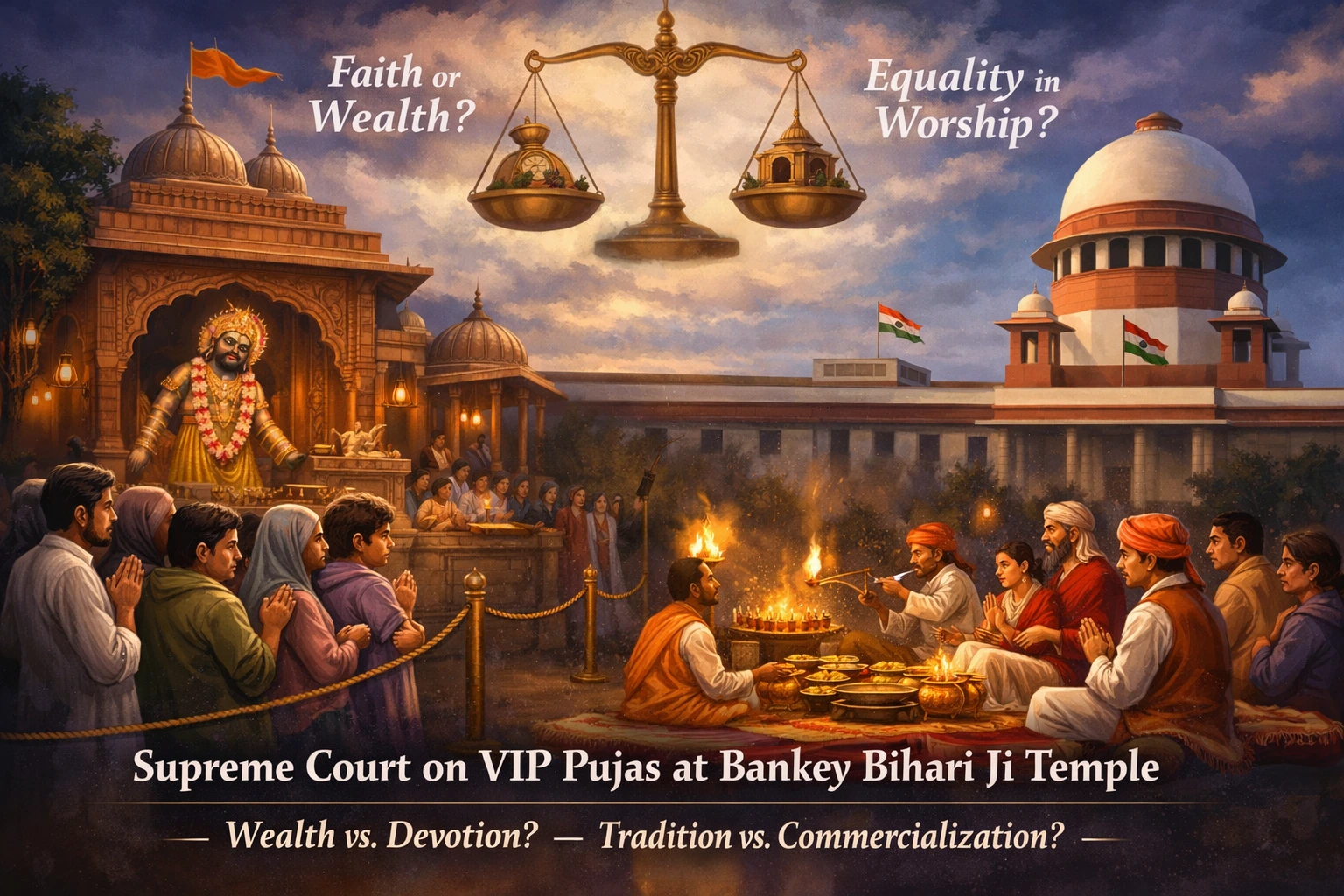
Supreme Court Scrutiny Of VIP Pujas At Bankey Bihari Ji Temple
The Supreme Court of India, in Management Committee of Thakur Shri Bankey Bihari Ji Maharaj Temple v. High-Powered Temple Management Committee & Others (W.P.(C) No. 1228 of 2025), has reopened an uncomfortable but crucial conversation about equality, tradition, and the monetisation of religious practices. The case, arising from the iconic Bankey Bihari Ji Temple at Vrindavan, places judicial scrutiny on the practice of special or VIP pujas allegedly reserved for affluent devotees at the cost of age-old ritual discipline.
The Temple And The Dispute
Shri Bankey Bihari Ji Temple is not merely a place of worship; it is a centuries-old institution governed by deeply entrenched customs, especially concerning darshan timings, ritual sequences, and the symbolic “rest” of the deity. Traditionally, these practices have been regulated by hereditary sevayats and temple committees, reflecting the belief that the deity is a living presence with a defined daily routine.
The controversy traces its roots to August 2025, when the Supreme Court stayed the Uttar Pradesh Shri Bankey Bihari Ji Temple Trust Ordinance, 2025, which sought to restructure the temple’s governance. In its place, the Court appointed a High-Powered Temple Management Committee to oversee administration temporarily.
What followed was resistance from the existing temple management.
What The Petitioners Alleged
The Management Committee of the Temple, representing traditional servitors, approached the Supreme Court challenging decisions taken by the High-Powered Committee. Their core grievances were:
- Alteration of darshan timings, which allegedly interfered with internal rituals.
- Discontinuation of “Dehri Puja”, a long-followed traditional practice.
- Allowing special pujas for wealthy devotees after normal temple closure, during the deity’s designated resting period.
- Excessive administrative intrusion into matters considered essential religious practices.
According to the petitioners, these changes were not mere managerial adjustments but fundamental disruptions of religious tradition, carried out without community consensus.
The Supreme Court Hearing
The matter came up for hearing on 15 December 2025 before a Bench comprising:
- Chief Justice of India Surya Kant
- Justice Joymalya Bagchi
- Justice Vipul M. Pancholi
Senior Advocate Shyam Divan, appearing for the petitioners, argued that temple rituals are not negotiable conveniences but sacrosanct practices refined over generations. He contended that administrative bodies cannot override spiritual customs in the name of efficiency or revenue.
Sharp Judicial Observations On VIP Pujas
It was during this hearing that the Supreme Court made strong oral observations that captured national attention. The Bench expressed concern over allegations that:
- After ordinary devotees were turned away,
- The temple allegedly remained open for affluent individuals who could afford hefty payments, and
- The deity was not allowed even symbolic rest, contrary to established ritual norms.
The Chief Justice remarked, in substance, that such practices give the impression that faith is being graded by financial capacity, and that religious institutions must not become marketplaces where devotion is auctioned to the highest bidder.
Though the Court stopped short of issuing immediate prohibitory directions, the tone of the observations was unmistakably critical.
Interim Orders And Current Status
The Supreme Court:
- Issued notice to the High-Powered Temple Management Committee and the State of Uttar Pradesh, including the District Magistrate, Mathura.
- Sought detailed responses on:
- Changes in darshan timings,
- Discontinuation of traditional pujas, and
- Allegations of special or VIP pujas.
- Listed the matter for further hearing in January 2026.
Importantly, no final judgment has yet been delivered, and no blanket ban on special pujas has been ordered so far. The case remains pending.
Why This Case Matters Beyond One Temple
This litigation raises questions that extend far beyond Vrindavan:
- Equality before faith: Can wealth justify preferential religious access?
- Limits of state intervention: Where does administration end and religious autonomy begin?
- Commercialisation of devotion: At what point does revenue generation erode spiritual legitimacy?
The Supreme Court’s observations resonate with earlier judicial discomfort over VIP darshan culture, where queues, tickets, and privileges often mirror social hierarchies that the Constitution seeks to dismantle.
The Road Ahead
When the matter returns to court, the Supreme Court is expected to balance:
- Articles 25 and 26 of the Constitution, protecting religious freedom and denominational autonomy,
- Against the need to prevent arbitrary, unequal, or exploitative practices within religious institutions.
Whether the Court ultimately lays down binding guidelines on VIP pujas or limits its intervention to the peculiar facts of Bankey Bihari Ji Temple, the case has already sent a clear message: faith cannot be allowed to rest on unequal foundations.
In questioning VIP pujas, the Supreme Court is not judging devotion—it is examining whether devotion itself is being quietly divided into classes.