





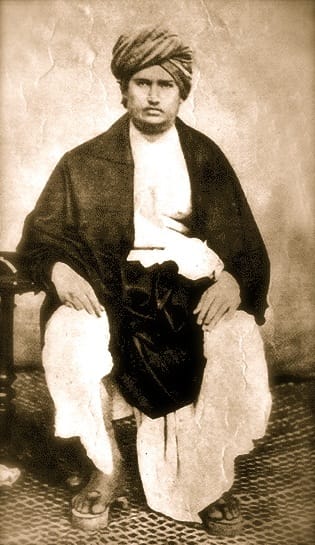
The Monk Who Challenged the Gods of Stone
Swami Dayanand Saraswati was one of the greatest religious reformers and social thinkers of modern India. He dedicated his life to reviving the true spirit of Hinduism by returning to the teachings of the Vedas. He was the founder of the Arya Samaj, a movement that aimed to remove social evils and restore Vedic values. His life was full of sacrifice, knowledge, and courage, and his teachings influenced millions of people.
Birth, Childhood, and Early Life
| Detail | Information |
|---|---|
| Date of Birth | Swami Dayanand Saraswati was born on 12 February 1824 |
| Place | in Tankara, located in present-day Gujarat |
| Childhood Name | His childhood name was Mool Shankar Tiwari |
| Family Background | He was born into a wealthy and religious Brahmin family |
| Father | His father, Karshanji Lalji Tiwari, was a learned man and a devotee of Lord Shiva |
Early Education and Training
From a young age, Mool Shankar showed exceptional intelligence and curiosity. He learned Sanskrit, religious rituals, and scriptures at home. He was trained to perform prayers, fasting, and religious ceremonies. However, he had a questioning mind and always sought logical answers rather than blind belief.
The Mahashivratri Temple Incident
One famous story from his childhood changed his life forever. On the night of Mahashivratri, he stayed awake in a temple to worship Lord Shiva. During the night, he saw a mouse climbing on the idol and eating the offerings. This shocked him deeply. He wondered how a God who could not protect himself from a mouse could protect humans. This incident made him question idol worship and started his lifelong search for truth.
Reflection on Life and Death
He also witnessed death at a young age when his sister and uncle died. This made him think deeply about life, death, and liberation. He began to seek spiritual knowledge and the meaning of existence.
Education And Search For Truth
Mool Shankar was highly educated in Sanskrit, grammar, philosophy, and religious texts. However, he was not satisfied with traditional teachings. At the age of 21, he left home secretly to become a wandering monk in search of truth.
He traveled across India for many years, meeting saints, scholars, and philosophers. He studied various religious systems but was not fully satisfied. Finally, he met his guru, Swami Virajanand, in Mathura.
Guru Swami Virajanand
Swami Virajanand was a great blind scholar and strict teacher. He believed only in the authority of the Vedas and rejected superstition and idol worship. The relationship between Swami Dayanand and his guru was very deep and disciplined.
Swami Virajanand trained him rigorously in Vedic knowledge, grammar, and philosophy. As guru dakshina (offering to the teacher), Swami Virajanand asked Dayanand to dedicate his life to spreading Vedic knowledge and removing ignorance and superstition from society. Dayanand accepted this mission and devoted his entire life to fulfilling his guru’s wish.
Work And Mission Of His Life
After completing his education, Swami Dayanand traveled throughout India delivering lectures and debates. He strongly opposed social evils such as:
- Idol worship
- Child marriage
- Blind faith and superstition
- Caste discrimination based on birth
He believed that true Hinduism was based on knowledge, truth, and equality. His most famous book, Satyarth Prakash (meaning “The Light of Truth”), explained his philosophy and teachings. In this book, he emphasized rational thinking, Vedic authority, and social reform.
He encouraged people to question blind traditions and seek truth through knowledge. His famous slogan was: “Back to the Vedas.”
Foundation Of Arya Samaj
In 1875, Swami Dayanand founded the Arya Samaj in Mumbai. The Arya Samaj was a religious and social reform organization. The main objectives of Arya Samaj were:
| Objective | Description |
|---|---|
| Promote Vedic knowledge | Encourage study and understanding of the Vedas |
| Oppose idol worship and superstition | Reject blind rituals and irrational practices |
| Promote education for all | Support learning opportunities including for women |
| Encourage equality and social justice | Fight caste discrimination and inequality |
| Promote truth and moral living | Encourage ethical and righteous conduct |
Arya Samaj played a major role in reforming Indian society.
Teachings and Views on Vedas and Idol Worship
Swami Dayanand believed that the Vedas were the oldest and most perfect source of knowledge. According to him, the Vedas contained scientific, spiritual, and moral truths. He strongly opposed idol worship. He believed that God is:
- Formless
- Omnipresent
- Omniscient
- All-powerful
He argued that God cannot be represented by idols made of stone or metal. He believed that idol worship led to superstition and ignorance. Instead, he encouraged people to worship God through:
- Meditation
- Prayer
- Knowledge
- Good deeds
His teachings promoted rational thinking and spiritual purity.
His Disciples and Their Contributions
Swami Dayanand had many important disciples who continued his mission. One of his most famous followers was Lala Lajpat Rai, who became a great freedom fighter and social reformer. He helped spread Arya Samaj ideas and worked for India’s independence.
Another important disciple was Swami Shraddhanand, who worked to promote education and social reform. He established educational institutions and promoted Vedic teachings.
Mahatma Hansraj was another important follower. He helped establish the DAV College Trust and Management Society, which built many schools and colleges based on Arya Samaj principles.
The Arya Samaj also established Gurukul Kangri University, which promoted Vedic education and traditional Indian values. These disciples played a major role in spreading Dayanand’s teachings across India.
| Disciple | Contribution |
|---|---|
| Lala Lajpat Rai | Spread Arya Samaj ideas and contributed to India’s freedom movement |
| Swami Shraddhanand | Promoted education, social reform, and Vedic teachings |
| Mahatma Hansraj | Helped establish DAV educational institutions |
Core Teachings of Arya Samaj
Arya Samaj is based on ten main principles. Some of the important teachings include:
- God is the ultimate source of all true knowledge.
- God is formless, eternal, and all-powerful.
- The Vedas are the source of true knowledge.
- People should always follow truth and reject falsehood.
- Everyone should promote knowledge and education.
- People should work for the welfare of society.
- Ignorance and superstition should be removed.
These teachings helped create a more rational and equal society.
Stories Showing His Courage
Swami Dayanand was fearless and bold. He openly challenged priests and religious leaders who promoted superstition. He participated in debates across India and defeated many scholars through his knowledge and logic.
- Challenged superstition and blind practices
- Debated scholars across India
- Used knowledge and logic to defend truth
He also supported women’s education and widow remarriage, which were controversial ideas at that time. His ideas helped improve the condition of women in Indian society. He influenced many freedom fighters and inspired nationalism.
| Reform | Impact on Society |
|---|---|
| Women’s Education | Improved literacy and awareness among women |
| Widow Remarriage | Helped restore dignity and rights of widows |
| Opposition to Superstition | Encouraged rational thinking |
Death and Legacy
Swami Dayanand Saraswati died on 30 October 1883 in Ajmer, located in Rajasthan. It is believed that he was poisoned by enemies who opposed his reform movements. Despite medical treatment, he could not survive.
Even after his death, his teachings continued to inspire millions.
| Year | Event |
|---|---|
| 1883 | Death in Ajmer |
| Post-1883 | Teachings continued to influence society |
Conclusion
Swami Dayanand Saraswati was a great reformer, philosopher, and spiritual leader. From his childhood as Mool Shankar to becoming a great monk, his life was dedicated to truth and knowledge.
His guru Swami Virajanand shaped his mission, and he fulfilled it by spreading Vedic teachings. Through Arya Samaj, he worked to remove superstition, promote education, and create equality.
- Spread Vedic teachings
- Promoted education
- Opposed blind faith
- Encouraged equality
His book Satyarth Prakash and his teachings continue to guide people even today. His disciples carried forward his mission and established schools, colleges, and social reform movements.
Swami Dayanand Saraswati’s life teaches us to seek truth, reject blind faith, and work for the betterment of society. He remains one of the greatest spiritual reformers in Indian history, and his legacy continues to influence modern India. Written By: Madhura Amol Gavali – BALLB -3

