The digital revolution has delivered transformative technologies, but it has also introduced new forms of risk. Synthetic speech—AI-generated voices capable of closely mimicking real individuals—illustrates this duality. While the technology offers remarkable benefits in accessibility, creativity, and communication, it simultaneously raises serious concerns regarding fraud, misinformation, and identity misuse.
On the positive side, synthetic speech supports visually impaired users through advanced text-to-speech systems, enhances realism in video games and virtual environments, improves interactive online education, enables multilingual dubbing, and helps preserve cultural or historical voices. These innovations demonstrate the immense social and cultural value of AI-driven voice technologies.
However, the same tools can be misused in harmful ways. Scammers can impersonate family members or corporate executives in fraudulent calls, fabricated audio statements by public figures can spread misinformation, and deepfake voices can be deployed to influence elections, damage reputations, or facilitate harassment through non-consensual voice cloning.
Recognizing these risks, governments and regulators worldwide are beginning to develop legal frameworks that allow beneficial innovation while preventing abuse. Two core regulatory principles are increasingly emphasized: consent, meaning permission to use an individual’s voice, and disclosure, requiring clear labelling when content is AI-generated.
The Nature of Synthetic Speech
Synthetic speech relies on advanced artificial intelligence capable of replicating not only spoken words but also tone, accent, emotional expression, and personal vocal characteristics. Modern systems can generate audio that is often indistinguishable from authentic recordings.
While this capability enables creative applications and accessibility tools, it also creates significant risks, including:
- Deepfake scams involving fraudulent voice calls.
- Election interference through fabricated political speeches.
- Defamation through false or manipulated audio recordings.
- Non-consensual or harassing content generated through voice cloning.
Legal Concerns
The rapid advancement of synthetic speech technologies raises several legal and ethical challenges:
- Identity and Privacy Violations: Unauthorized voice cloning can infringe on personal identity rights and privacy protections.
- Fraud and Misrepresentation: Synthetic voices may be used deceptively in financial transactions, contracts, or personal communications.
- Defamation and Misinformation: Fabricated audio recordings can spread quickly online, undermining public trust in media and institutions.
- Intellectual Property and Publicity Rights: For celebrities, artists, and public figures, their voices constitute valuable commercial assets that may require legal protection.
Emerging Legal Responses
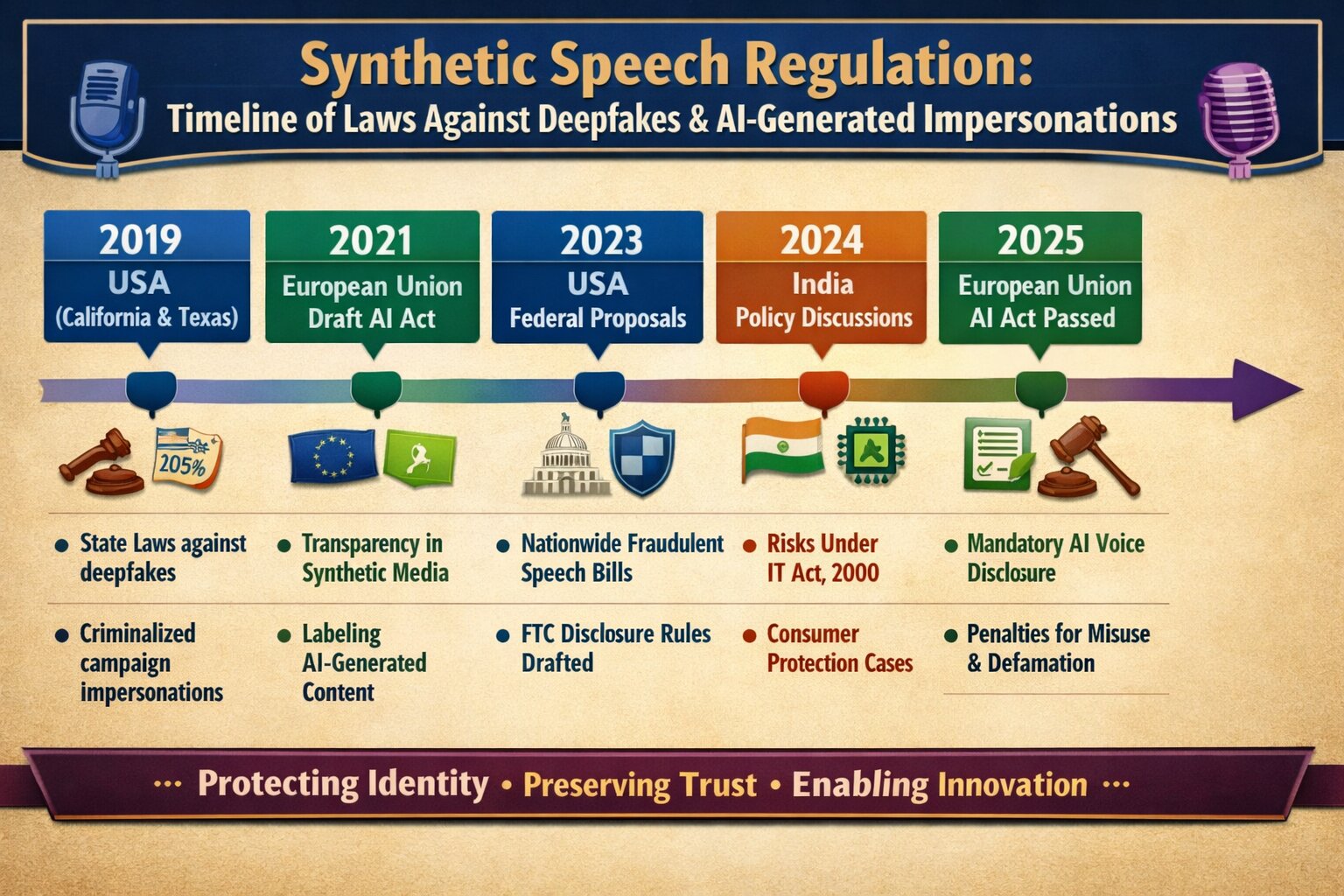
United States: The United States currently relies on a patchwork of state laws addressing specific harms related to synthetic media. Early initiatives emerged in states such as California and Texas around 2019–2020, targeting election-related deepfakes and non-consensual content.
Tennessee’s ELVIS Act (2024) expanded right-of-publicity protections to explicitly include voice and likeness, safeguarding artists against AI-generated impersonations. At the federal level, the TAKE IT DOWN Act (2025) focuses on criminalizing and removing non-consensual intimate deepfakes, with platform takedown requirements expected to become fully operational by 2026.
European Union: The European Union has adopted one of the most comprehensive approaches through the AI Act (2024). Under Article 50, which becomes fully applicable in August 2026, providers of generative AI must ensure transparency for synthetic content. AI-generated audio, video, and images must be clearly marked in machine-readable formats, and deployers must disclose the use of deepfakes through visible labels or disclaimers.
Violations can result in substantial penalties, reaching up to €15 million or 3% of global annual turnover. A detailed Code of Practice is expected to finalize implementation standards.
India: India currently does not have a dedicated synthetic speech law, but the Information Technology (Intermediary Guidelines and Digital Media Ethics Code) Amendment Rules, 2026 introduce the concept of “synthetically generated information” (SGI). This category includes AI-generated or AI-altered audio-visual content such as voice cloning and deepfakes.
Under these rules, online platforms must label synthetic content, embed traceable metadata, and remove unlawful material within strict timelines—generally within three hours, or two hours for severe cases such as non-consensual intimate deepfakes. Existing legislation such as the Information Technology Act, 2000 and the Consumer Protection Act, 2019 may also address fraud and misrepresentation arising from synthetic media.
Global Regulatory Trend
Across jurisdictions, a common regulatory pattern is emerging. Policymakers increasingly emphasize:
- Consent before cloning or using a real person’s voice.
- Disclosure and labelling of AI-generated audio or audiovisual content.
- Technological safeguards, including watermarking and detection tools.
- Platform accountability, requiring intermediaries to monitor and remove harmful content.
Despite these developments, enforcement approaches differ. The European Union prioritizes comprehensive transparency rules, the United States focuses on targeted harms through state laws, and India emphasizes intermediary responsibility and rapid takedown mechanisms.
Balancing Innovation and Regulation
Synthetic speech technology holds enormous potential for democratizing creative expression, improving accessibility for speech-impaired individuals, and preserving linguistic heritage. Excessively restrictive regulation could hinder these beneficial applications.
Effective governance therefore requires a balanced approach that includes:
- Mandatory Consent: Explicit authorization before replicating an individual’s voice, especially for commercial or deceptive purposes.
- Clear Disclosure: Labels, watermarks, or audible disclaimers identifying AI-generated content.
- Platform Liability: Legal duties for online platforms to detect and remove harmful synthetic media.
- Ethical Standards: Industry codes of conduct, improved detection technologies, and international cooperation.
Timeline: Synthetic Speech Regulation (2019–2026)
2019–2020 – United States: Early state laws in California, Texas, and Virginia target election deepfakes, non-consensual imagery, and impersonation.
2021 – European Union: The draft AI Act introduces transparency obligations for synthetic media.
2023–2024 – United States: Tennessee enacts the ELVIS Act (2024), protecting voice and likeness from AI misuse.
2024 – European Union: The AI Act is formally adopted, initiating phased implementation.
2025 – United States: The TAKE IT DOWN Act is signed, focusing on non-consensual intimate deepfakes and platform takedown obligations.
India begins policy discussions on regulating AI-generated content.
2026 – Global Developments:
- The EU’s Article 50 transparency rules under the AI Act become fully applicable.
- India implements amendments to its IT Rules defining “synthetically generated information.”
- The United States begins operational implementation of platform obligations under the TAKE IT DOWN Act.
Conclusion
Synthetic speech regulation represents the legal system’s effort to keep pace with rapidly evolving artificial intelligence technologies. By addressing deepfakes and AI-driven impersonations, emerging legal frameworks aim to protect individual identity, preserve public trust, and safeguard democratic processes.
The evolution from early state-level measures to broader regulatory frameworks—such as the EU’s AI Act and India’s recent amendments—demonstrates a growing consensus around the principles of consent, transparency, and accountability. Going forward, effective regulation will depend on robust enforcement, advances in detection technologies, international coordination, and careful policy design that protects society without stifling innovation. In doing so, the goal remains clear: ensuring that the human voice continues to symbolize authenticity rather than becoming a tool of deception in the digital age.