





Introduction: Why Taxation Matters in a Developing Economy
Taxation forms the financial backbone of any modern State, and in a country like India, its importance becomes even more pronounced. Public infrastructure, healthcare schemes, education policies, defence expenditure, and welfare programmes such as rural employment guarantees or food security initiatives largely depend on tax revenue collected from citizens and businesses. In simple terms, taxes enable the government to redistribute resources and promote economic stability.
However, taxation also creates tension between the State’s need to collect revenue and taxpayers’ desire to minimise financial burden. This tension gives rise to two commonly discussed concepts in tax law — tax evasion and tax avoidance. While both aim at reducing tax liability, they differ significantly in legality, intent, and ethical acceptance.
Understanding this distinction is crucial not only for legal professionals but also for responsible citizens, especially in an economy where compliance culture continues to evolve.
Understanding Tax Evasion
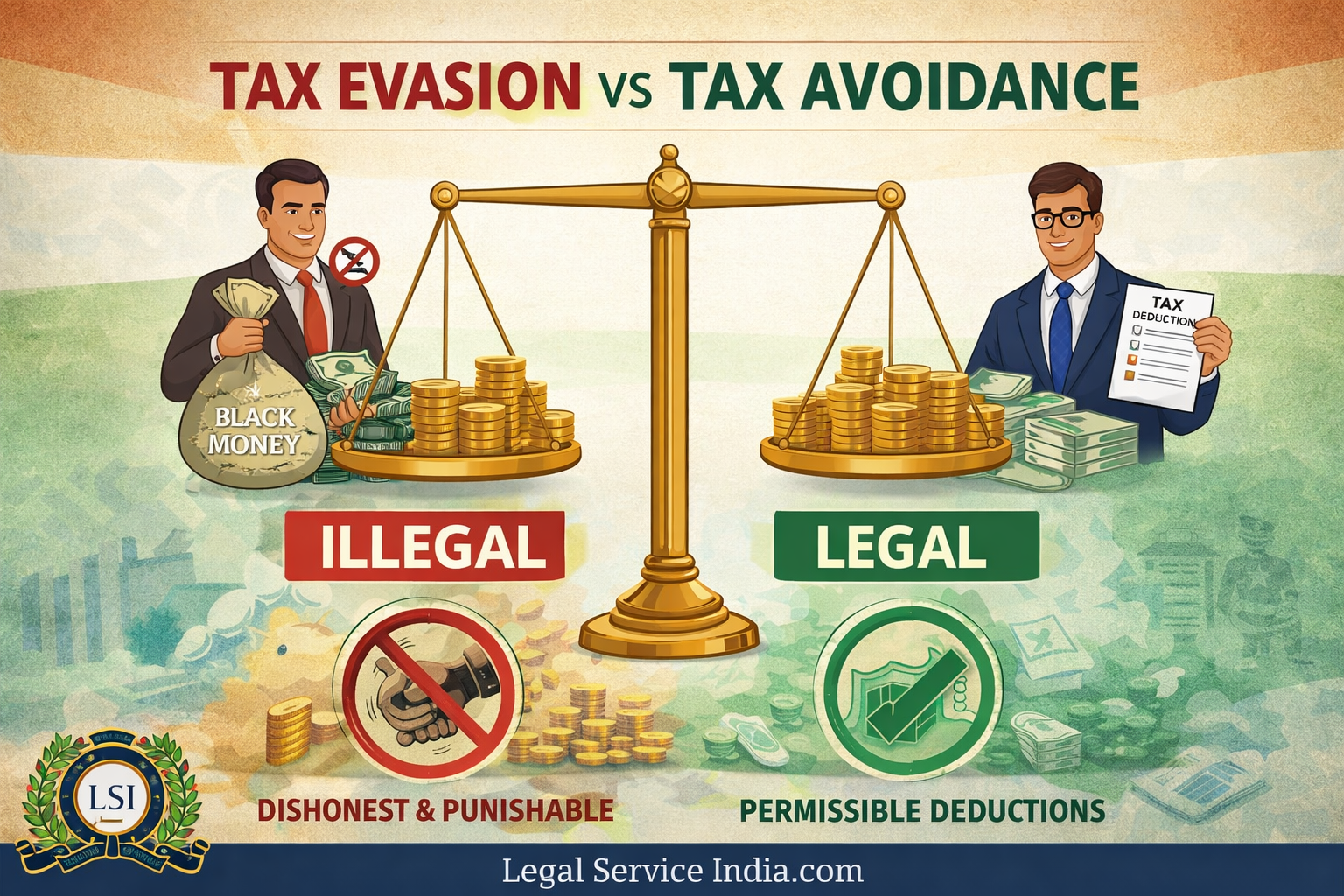
Tax evasion refers to the illegal act of deliberately avoiding payment of taxes by concealing income, falsifying accounts, or misrepresenting financial information. It involves dishonest conduct intended to defeat tax laws.
In India, tax evasion commonly occurs through practices such as:
- Non-reporting of income
- Maintaining parallel or “black money” accounts
- Inflating business expenses
- Using fake invoices or shell companies
- Conducting cash transactions to avoid tax records
For example, a business owner who earns substantial profits but records only part of the income in official books to reduce taxable income is committing tax evasion. Similarly, professionals accepting large payments in cash without issuing receipts to escape taxation also fall within this category.
Tax evasion directly violates statutory provisions under the Income-tax Act, 1961, making it a punishable offence. The essential element here is fraudulent intention.
Understanding Tax Avoidance
Tax avoidance, on the other hand, operates within the boundaries of law. It refers to the arrangement of financial affairs in such a way that tax liability is reduced by legally permissible means.
Unlike evasion, avoidance does not involve concealment or falsification. Instead, taxpayers utilise deductions, exemptions, incentives, or loopholes provided within legislation.
Common examples in India include:
- Investing in Public Provident Fund (PPF) or ELSS funds to claim deductions under Section 80C
- Structuring business operations to benefit from lower tax jurisdictions
- Choosing salary components such as house rent allowance (HRA) for tax efficiency
- Corporate restructuring or mergers designed to optimise tax outcomes
For instance, an individual investing in life insurance policies or tax-saving mutual funds to reduce taxable income is engaging in legitimate tax planning — a recognised form of tax avoidance.
Thus, tax avoidance relies on legal interpretation, not deception.
Tax Evasion Vs Tax Avoidance: The Core Legal Difference
Although both concepts aim at minimising tax burden, the distinction lies in legality and intent.
| Basis | Tax Evasion | Tax Avoidance |
|---|---|---|
| Nature | Illegal | Legal |
| Method | Concealment or fraud | Legal tax planning |
| Intention | Dishonest | Strategic |
| Legal Consequence | Penalties & prosecution | Generally permissible |
| Ethical Standing | Widely condemned | Debatable |
Indian courts have repeatedly emphasised this distinction. Earlier judicial thinking permitted aggressive tax planning, reflected in decisions allowing taxpayers to arrange affairs to minimise taxes. However, modern jurisprudence has gradually shifted toward discouraging artificial arrangements lacking genuine commercial purpose.
The Supreme Court has clarified that while legitimate tax planning is acceptable, colourable devices created solely to escape tax liability cannot be encouraged.
Indian Legal Framework And Penalties
India has developed an extensive statutory framework to combat tax evasion while regulating abusive tax avoidance practices.
1. Income-tax Act, 1961
The primary legislation governing taxation imposes strict consequences for evasion:
| Section | Provision |
|---|---|
| Section 270A | Penalty for under-reporting or misreporting income. |
| Section 271AAC | Penalty relating to unexplained income. |
| Section 276C | Prosecution for wilful attempt to evade tax. |
| Section 277 | Punishment for false statements or verification. |
Punishments may include heavy monetary penalties and imprisonment extending up to seven years depending on the seriousness of the offence.
2. General Anti-Avoidance Rules (GAAR)
Recognising that technically legal arrangements could still undermine tax collection, India introduced GAAR in 2017.
GAAR empowers tax authorities to deny tax benefits if an arrangement:
- Lacks commercial substance,
- Exists primarily to obtain tax advantage,
- Misuses legal provisions.
For example, if a company routes investments through a foreign jurisdiction solely to claim treaty benefits without real business activity there, authorities may disregard the arrangement under GAAR.
This reflects India’s transition from merely punishing evasion to scrutinising aggressive avoidance.
3. Government Measures Against Tax Abuse
The Indian government has undertaken several initiatives to strengthen compliance:
- Digitisation of tax filing systems, reducing manipulation,
- PAN–Aadhaar linkage for financial transparency,
- GST implementation, tracking supply chains electronically,
- Crackdown on shell companies and benami transactions,
- Information-sharing agreements with foreign jurisdictions.
Demonetisation in 2016 also aimed, among other objectives, to identify undisclosed income circulating outside formal taxation systems.
Practical Indian Examples
The distinction between evasion and avoidance becomes clearer through everyday scenarios.
Example Of Tax Evasion
A contractor receives payment for government construction work but records only partial income while maintaining cash reserves outside official accounts. This hidden income escapes taxation and constitutes criminal liability.
Example Of Tax Avoidance
A salaried employee restructures compensation to include travel allowance, medical benefits, and retirement contributions eligible for deductions. The tax burden reduces legally without violating any law.
Corporate-Level Illustration
Many multinational corporations historically routed investments through countries like Mauritius to take advantage of favourable Double Taxation Avoidance Agreements (DTAAs). While once lawful tax avoidance, regulatory reforms later tightened these arrangements to prevent treaty abuse.
These examples demonstrate how legality often depends on transparency and genuine economic purpose.
Ethical Perspective: Beyond Legality
The real debate begins where legality ends. Tax avoidance raises an important ethical question: Should something be considered acceptable merely because it is legal?
1. Fairness And Equality
Taxes function on the principle of shared responsibility. When wealthy individuals or corporations exploit sophisticated tax planning strategies unavailable to ordinary citizens, inequality widens.
A middle-class salaried taxpayer usually has limited scope for avoidance since income is automatically reported. In contrast, large corporations with expert advisors may significantly reduce liabilities through complex structures. This creates perceptions of unfairness within the tax system.
2. Social Responsibility
Taxes finance public goods used by all sections of society — roads, courts, policing, education, and welfare programmes. Excessive avoidance, though lawful, may undermine collective welfare by shrinking government revenue.
From an ethical standpoint, citizens benefiting from economic opportunities created by the State arguably owe a moral duty to contribute fairly.
3. Economic Impact
Large-scale tax evasion directly harms the economy by generating black money, distorting markets, and reducing public spending capacity. Avoidance, while subtler, may still affect revenue mobilisation if widely practised through artificial arrangements.
Developing economies like India rely heavily on tax compliance to fund development goals. Ethical tax behaviour therefore contributes to long-term economic stability.
4. Corporate Ethics And Reputation
Modern businesses increasingly recognise taxation as part of corporate governance. Companies engaging in aggressive avoidance often face reputational criticism even without legal violations.
Public scrutiny now evaluates corporations not only on profitability but also on responsible contribution to society.
Changing Judicial And Policy Attitudes
Indian legal thinking has gradually evolved from strict legal formalism toward ethical interpretation.
Courts today examine the substance over form principle — focusing on the real intention behind transactions rather than merely their legal structure. This approach attempts to strike balance between taxpayer autonomy and national economic interest.
The shift reflects global trends influenced by international efforts against Base Erosion and Profit Shifting (BEPS), encouraging transparency and fairness in taxation.
Conclusion: Is Tax Avoidance Ethically Justified?
Tax evasion clearly stands condemned both legally and morally. It involves deception, weakens governance, and places unfair burden on honest taxpayers. There is little debate regarding its illegitimacy.
Tax avoidance, however, occupies a grey area. The law permits individuals to organise their financial affairs efficiently, and taxpayers cannot be compelled to pay more tax than legally required. From this perspective, reasonable tax planning is both rational and lawful.
Yet, when avoidance crosses into aggressive manipulation lacking genuine economic purpose, ethical concerns arise. Excessive reliance on loopholes may comply with the letter of law while violating its spirit.
In a developing democracy like India, sustainable taxation ultimately depends not only on enforcement but also on voluntary compliance and civic responsibility. Legal permissibility should ideally be accompanied by ethical restraint.
Therefore, while tax avoidance may be legally justified, its ethical acceptability depends on intent, fairness, and societal impact. Responsible taxpayers — whether individuals or corporations — must recognise that taxation is not merely a legal obligation but a contribution toward collective national development.
In the long run, a strong tax culture is built not through fear of penalties alone, but through trust, transparency, and a shared understanding that economic growth and social justice are interconnected.

