Abstract
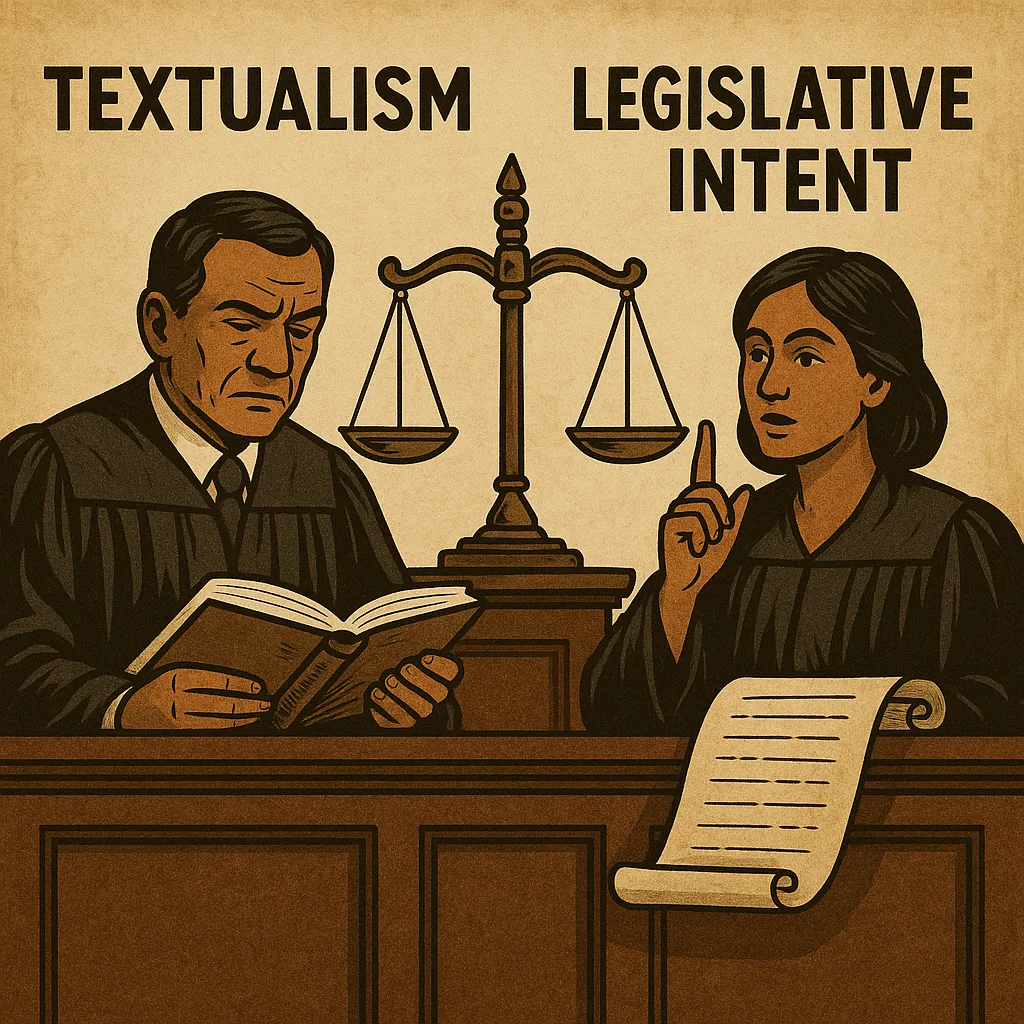
This article examines the global debate on Textualism versus legislative intent through the influential Herbert W. Vaughan Lecture delivered by Professor Richard Ekins of the University of Oxford and evaluates its deep relevance for Indian statutory interpretation. While Textualism prioritises the ordinary meaning of statutory text, Professor Ekins argues that the true object of interpretation is the intended legal change enacted by the legislature.
Drawing parallels with Indian judicial practice, this article shows how Indian courts have historically balanced textual clarity with purposive reasoning to uphold parliamentary supremacy while preventing injustice. In an era of complex legislation, delegated lawmaking, and regulatory expansion, the article argues that a text-anchored yet intent-driven approach remains essential to preserve the legitimacy of both Parliament and the judiciary in India’s constitutional framework.
If You Watch That Harvard Lecture With Indian Eyes
If you watch that Harvard lecture with Indian eyes, it’s not just about American judges arguing over words. It’s really about a deeper question that haunts every legal system, including India’s:
When Parliament writes a law, what exactly are judges supposed to obey –
the words on the page, or the mind behind the words?
Let’s turn Professor Richard Ekins’ lecture into a story, and then pull it straight into the world of Indian courts, Indian Parliament, and Indian constitutional debates.
1. The Big Fight: Text Vs Intention
In the lecture, Professor Ekins takes on Textualism – the idea that judges should focus on the ordinary meaning of the statutory text and more or less stop there.
He says:
- The statute is not just a text.
- It is an act – a deliberate exercise of legislative power.
When Parliament enacts a law, it is doing something to the legal world: changing rights, duties, powers, liabilities.
So the real task of a judge, he argues, is:
- Not “What do these words usually mean?”
- but “What legal change did the legislature intend to make by using these words in this context?”
Text is crucial, but it’s not holy; it’s evidence of what the legislature meant, not the whole story.
2. Why This Is Not Just An American Problem
In the US, this fight is framed as Textualism vs Purposivism.
In India, the language is slightly different, but the tension is very familiar:
| Literal rule | vs purposive rule |
| “Plain meaning” | vs “mischief rule” |
| “Judicial restraint” | vs “judicial innovation” |
Indian courts constantly juggle:
- Respect for Parliament’s authority
- The need to avoid absurd, unjust, or unconstitutional outcomes
- The practical realities of bad drafting, massive laws, and rapidly changing technology
So when Ekins says, “The text is not the law; the law is the change that Parliament intended to make,” he’s actually speaking into the heart of Indian statutory interpretation too.
3. Language Is Messy – And So Is Law
Ekins makes a simple but powerful point about language that every Indian lawyer will recognise:
- Words have a semantic (dictionary) meaning.
- But what a speaker (or Parliament) means by using those words can be:
- narrower than the dictionary,
- broader, or
- even different in a particular context.
For example, think of an Indian statute that uses words like:
- “communication device”
- “public order”
- “corruption”
- “terrorist act”
Every lawyer knows: if you just pull out the Oxford dictionary and stop there, you will either:
- Criminalise half the country, or
- Make the law totally useless.
So, like Ekins says:
- The real question isn’t “What do these words usually mean?”
- It’s “What did this legislature, in this legal setting, at this time, intend to achieve by using these words?”
That is exactly what Indian courts do when they talk about:
- “contextual reading”
- “purposive interpretation”
- “reading a statute as a whole”
- “the mischief sought to be remedied”
4. India’s Own Version of the Same Debate
Indian courts, especially the Supreme Court, have long moved away from a rigid, mechanical literalism – but they also don’t want to be seen as rewriting laws. That’s the same tightrope Ekins is describing.
Some familiar Indian patterns mirror what he is criticising or defending:
a) The “Plain Meaning” Temptation
Sometimes, Indian judgments say something like:
“The language of the provision is plain and unambiguous; therefore, we must give effect to it, regardless of consequences.”
This is the textualist instinct:
- If the text seems clear, stop thinking too hard.
Ekins would respond:
- Be careful.
- “Plain meaning” often feels clear only because you have silently assumed a lot of context.
- And even then, Parliament may have meant something slightly different, especially in a complex regulatory or constitutional scheme.
b) The “Purpose At All Costs” Temptation
On the other side, Indian courts sometimes stretch a statute to achieve broad social justice or policy objectives, even if the text fights back a bit.
That’s the hyper-purposive instinct:
“We know what the law ought to do, so let’s read it that way.”
Ekins is also unhappy with that. He says:
- You can’t ignore the text and chase abstract ideals.
- Your job is not to become a parallel Parliament.
- The purpose that matters is the actual legislative plan, not whatever broader value a judge personally likes.
Indian readers will immediately think of cases where:
- The Court was praised for “creativity” and “progressive interpretation”,
- But critics complained, “This is legislation from the bench.”
Ekins would say: both fanatical textualism and unrestrained purposivism betray legislative authority in different ways.
5. Legislative Intent: Does Parliament Really Have a Mind?
One of the most interesting parts of the lecture is Ekins’ defence of legislative intent.
Textualists often say:
- “There is no such thing as legislative intent.”
- “Parliament is a crowd, not a person.”
- “All we really have is the text plus the formal process.”
Ekins says: that’s a mistake.
His view (which fits India surprisingly well):
- We should treat Parliament as an institutional agent.
- The fact that individual MPs or MLAs may not have read every line doesn’t mean the legislature as a body didn’t act intentionally.
Legislative intent is not the private thoughts of 543 MPs; it’s:
- The plan of action that the institution of Parliament adopts when it enacts a statute.
In India, this way of thinking is very natural:
- We routinely talk about “the intention of the legislature” in our judgments.
- We treat Parliament and State Legislatures as rational law-making bodies that:
- Identify a problem (mischief),
- Decide on a solution (scheme),
- Enact rules (sections, provisos, explanations) to implement that solution.
Ekins is basically giving a philosophical defence of what Indian courts have long said in practical terms.
6. Absurdity, Equity and Common Sense – Indian Style
One of Ekins’ worries about strict textualism is this:
it can force judges to embrace absurd or cruel results and say:
“Well, that’s what the words say. Our hands are tied.”
He thinks that’s unhealthy and unnecessary.
Instead, he argues:
- If a reading leads to self-contradiction, nonsense, or extreme unfairness, that’s a signal that Parliament probably did not intend that reading.
- So judges should use common sense, context, background rules, and equitable principles as tools to uncover intent, not as a licence to invent new law.
Indian law already does this in many ways:
- Presumption against absurdity
- Presumption against retrospective penalisation
- Presumption in favour of constitutionality
- Use of equity and fairness in interpreting beneficial statutes, welfare laws, tax exemptions, etc.
Think of Indian cases where the Supreme Court says:
- “We cannot assume Parliament intended a manifestly unjust result.”
- “The provision must be interpreted in a way that advances the remedy and suppresses the mischief.”
- “A literal reading would defeat the very purpose of the Act.”
That is exactly the nuanced approach Ekins is defending: intent-based, text-conscious, context-sensitive interpretation.
Why This Matters for India Right Now
This isn’t an abstract seminar topic. In India, it touches:
Key Areas Affected in India
| Area | Core Question Raised |
|---|---|
| Constitutional Amendments | How do we read amendments that affect federalism, fundamental rights, or institutional design? Literally, or in light of the deeper structure of the Constitution? |
| Regulatory Statutes | Telecom, technology, environment, money laundering, data, digital platforms – these often use broad, vague terms. Do we read them in a broad literal sense, or in a way that reflects the specific policy design behind them? |
| Criminal Law Reform | When new offences or procedures are introduced, how strictly do we stick to the bare words, and how much do we look at the mischief and safeguards Parliament had in mind? |
| Delegated Legislation & “Major Questions” | When the executive uses vague statutory powers to make massive policy moves (in India, via rules, notifications, guidelines), courts face a question similar to the US “major questions doctrine”: Did Parliament really intend to hand over this much power, or is the executive stretching the text? |
| Judicial Role | In all these areas, Indian judges are effectively answering the same question Ekins poses: Will we treat Parliament as a real, rational lawmaker whose plan we must respect and uncover – or as a kind of word-printing machine whose text we mechanically process without asking what it was actually doing? |
8. So, What Could Indian Courts Take From Ekins?
If we translate his lecture into Indian judicial practice, the “takeaways” might look like this:
Key Takeaways for Indian Courts
- Respect the text – but don’t worship it.
The statutory text is the primary, authoritative signal of Parliament’s choice.
But it is a signal, not the whole story. - Keep legislative intent at the centre.
Not by rummaging through every debate or speech,
but by asking: what legal change, in this legal and social context, was Parliament trying to make? - Use context and canons honestly.
Read the Act as a whole.
Use established presumptions (against absurdity, against retrospectivity, etc.) not to smuggle in your own politics, but to reconstruct a rational legislative plan. - Beware of both extremes.
- Extreme literalism: “We see the words, we stop thinking.”
- Extreme purposivism: “We know the ideal goal, we stretch the words endlessly.”
- See Parliament as a constitutional partner, not a rival.
The court’s dignity lies not in showing how “powerful” it is,
but in being faithful to the law that another constitutional organ had the authority to make.
9. Bringing It Home: The Indian Reader’s Lens
For an Indian lawyer, judge, legislator, or student, the lecture is an invitation to do three things:
Practical Reflections for Indian Readers
- Look again at your own habits of reading statutes.
Do you secretly rely on dictionary meanings and stop there?
Or do you wander off into pure policy without anchoring yourself in the enacted scheme? - Ask better questions in court.
Instead of arguing, “This is the plain meaning,” or “This would be socially good,” ask:
“Given the legal background and the structure of this Act, which reading fits best with the kind of change Parliament was enacting?” - Defend legislative authority in a more mature way.
Respecting Parliament doesn’t mean being a text robot.
It means taking Parliament seriously as a reason-giving, plan-making institution.
In that sense, Professor Ekins’ debate with American textualists is not foreign to India at all. It’s the same conversation we’re having — just with a different accent and different case citations.