





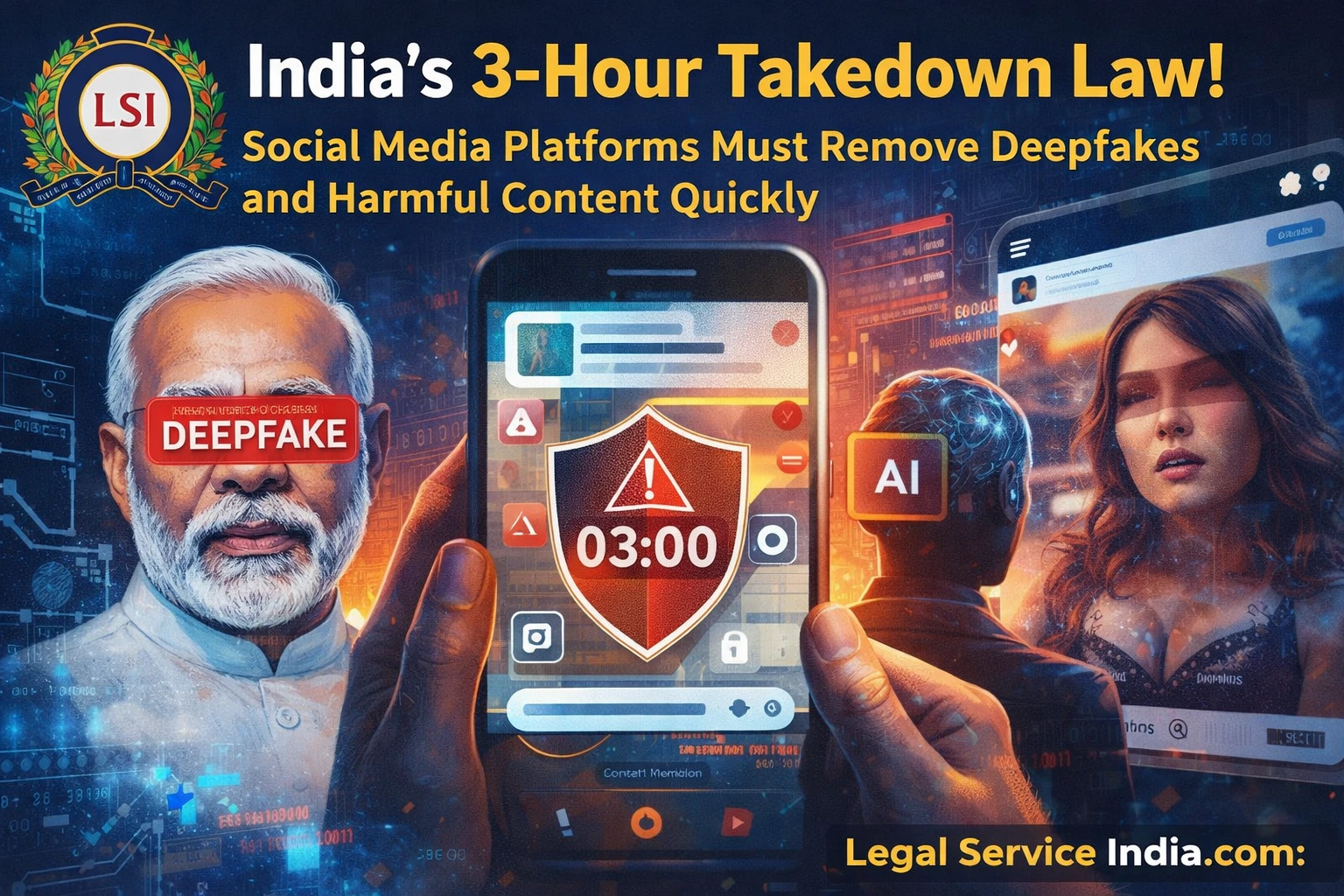
The 3-Hour Takedown Law: India’s New Digital Content Regulation
In the fast-evolving world of online content, where a deepfake video can go viral in minutes, India’s government has drawn a hard line. On February 10, 2026, the Ministry of Electronics and Information Technology (MeitY) notified the Information Technology (Intermediary Guidelines and Digital Media Ethics Code) Amendment Rules, 2026, effective from February 20.
Dubbed the 3-Hour Takedown Law, these rules slash the time social media platforms have to remove flagged harmful content from 36 hours to just three for synthetically generated information (SGI) like deepfakes or even two hours for non-consensual intimate imagery (revenge porn). It’s a seismic shift from passive hosting to proactive policing, but one that raises thorny questions about free speech and tech overreach.
From Passive Shields to Proactive Duties
India’s digital regulation journey started with the Information Technology Act, 2000 (IT Act), particularly Section 79, which grants intermediaries “safe harbour” immunity from liability for user-generated content if they exercise “due diligence.”
The 2011 Intermediary Guidelines were light-touch, focusing on basic content removal without strict timelines.
Regulatory Evolution of Intermediary Guidelines
| Year / Framework | Key Features |
|---|---|
| Information Technology Act, 2000 | Section 79 granted intermediaries “safe harbour” protection from liability for third-party content if due diligence was followed. |
| Intermediary Guidelines, 2011 | Light-touch regulation with basic obligations for removing unlawful content, without strict timelines. |
| Intermediary Rules, 2021 | Expanded compliance requirements, including appointment of compliance officers, grievance officers, and nodal contacts in India. |
| Amendment Rules, 2026 | Introduced strict takedown timelines for synthetically generated information and non-consensual intimate imagery. |
Compliance Requirements Under the 2021 Rules
That changed with the 2021 Rules, ramped up oversight amid rising misinformation and OTT streaming concerns. Platforms had to appoint chief compliance officers, grievance officers, and nodal contacts in India.
- Grievances required acknowledgment within 24 hours.
- Resolution had to be provided within 15 days.
- Takedowns for serious content operated under a 72-hour window for specific categories.
- General appeals often resulted in a practical removal timeline of around 36 hours.
Rise of Deepfakes and Digital Manipulation
Yet, these timelines proved too lax. Deepfakes exploded: In 2023, a morphed video of actress Rashmika Mandanna sparked outrage, followed by a 280% surge in incidents by Q1 2024, fuelled by election scams and voice clones of politicians like Manoj Tiwari.
By 2025, deepfakes targeted dignitaries’ fake videos “apologizing” for ops circulated widely and personal harms like revenge porn proliferated. Platforms often dragged their feet, citing verification needs, eroding trust.
The 2026 Amendment Rules and the Definition of SGI
Enter the 2026 amendments, amending the 2021 Rules under IT Act Section 87.
They explicitly define SGI as “synthetically generated or altered audio, visual, or audio-visual content that appears authentic and indistinguishable,” excluding benign edits like filters.
New Obligations for Online Platforms
- Platforms must label AI content with watermarks or disclaimers.
- Platforms must verify user declarations on uploads.
- Platforms must deploy automated tools for detection.
Crucially, safe harbour evaporates for non-compliance, turning platforms into liable publishers.
The Reason Of The 3 Hour Rule
Government or court orders (from DIG-rank officers with written justification) demand removal within three hours for SGI threatening public order, sovereignty, or decency down from 36 hours. Non-consensual deepfakes of nudity or sex acts must be removed in two hours. Grievances get faster tracks: acknowledgment in hours, resolution in days, with monthly appellate reviews.
Platforms must update terms of service quarterly, warn users on violations, and report non-compliant accounts. SSMIs need 24/7 monitoring, likely AI-driven, and must share user data with police under Bharatiya Nyaya Sanhita, 2023 . Violations trigger fines or bans, harmonizing with the Digital Personal Data Protection Act, 2023 (DPDP) for privacy harms.
Timeline Comparison
| Process | Pre-2026 (2021 Rules) | Post-2026 Amendments |
|---|---|---|
| Grievance Acknowledgment | 24 hours | Immediate (within an hours) |
| General Resolution | 15 days | 7 days |
| Sensitive Takedown (e.g., NCII) | 72 hours / 24-36 hours | 2 hours |
| SGI/Deepfakes | No specific; ad hoc | 3 hours |
| Safe Harbour Risk | Due diligence failure | Timeline miss + no labels |
Real World Triggers
The rules stem from chaos. Post-2024 elections, AI-cloned voices spread false voting info; 2025 saw financial scams via deepfake family calls, like a Kerala man’s Rs 40,000 loss. Revenge porn cases overwhelmed helplines, with rural Aadhaar misuse enabling SIM fraud for distribution. Globally, the EU’s AI Act inspired watermark mandates, but India’s focuses enforcement speed.
MeitY consultations in 2025 highlighted platform’s delays, prompting the February push. Early compliance reports show Meta and Google deploying AI moderators, but smaller apps scramble.
Free Speech Or Truth
Proponents hail it as a “saviour of truth,” protecting dignity under Article 21 while curbing Article 19(2): banned speech like defamation or incitement. It empowers victims revenge porn takedowns now rival emergency responses.
But detractors warn of the “death of the 36-hour window” as overkill. Three hours forces AI bots to moderate humans, risking accidental censorship of satire. Who verifies “indistinguishable” SGI amid blurry real-vs-fake lines? Government flags could stifle dissent, echoing 2021 Rule challenges in courts like Bombay HC. Resource-strapped startups face shutdowns, consolidating power with Big Tech.
Legally, it tests proportionality: Does speed trump accuracy? Past rules balanced via appeals; now, errors are irreversible viral.
Global Echoes And The Road Ahead
India’s 3-Hour Takedown Law represents the most aggressive experiment in intermediary regulation to date. By collapsing takedown windows from days to mere hours, the amendments shift platforms from passive conduits to active gatekeepers of online speech. This transformation, however, cannot be viewed in isolation. As Shreya Singhal v. Union of India reminds us, restrictions on speech must be precise and proportionate; as Ramkumar v. Union of India shows, courts are increasingly unwilling to tolerate delays in removing harmful content. The jurisprudence thus frames a delicate balance: urgency in protecting dignity and sovereignty versus the constitutional demand for accuracy and fairness.
Globally, India now enforces the fastest takedown regime, outpacing the US DEEPFAKES Act and the EU’s AI Act. Yet speed alone does not guarantee legitimacy. The law’s survival will hinge on judicial review, particularly whether courts accept that three hours is a constitutionally proportionate response to the harms of synthetic media. If upheld, India may set a precedent for rapid-response digital governance. If struck down, it will reaffirm the constitutional guardrails against executive overreach. Either way, the 3-Hour Rule marks a turning point: the digital battlefield is no longer governed by technology alone, but by constitutional law in real time.

