





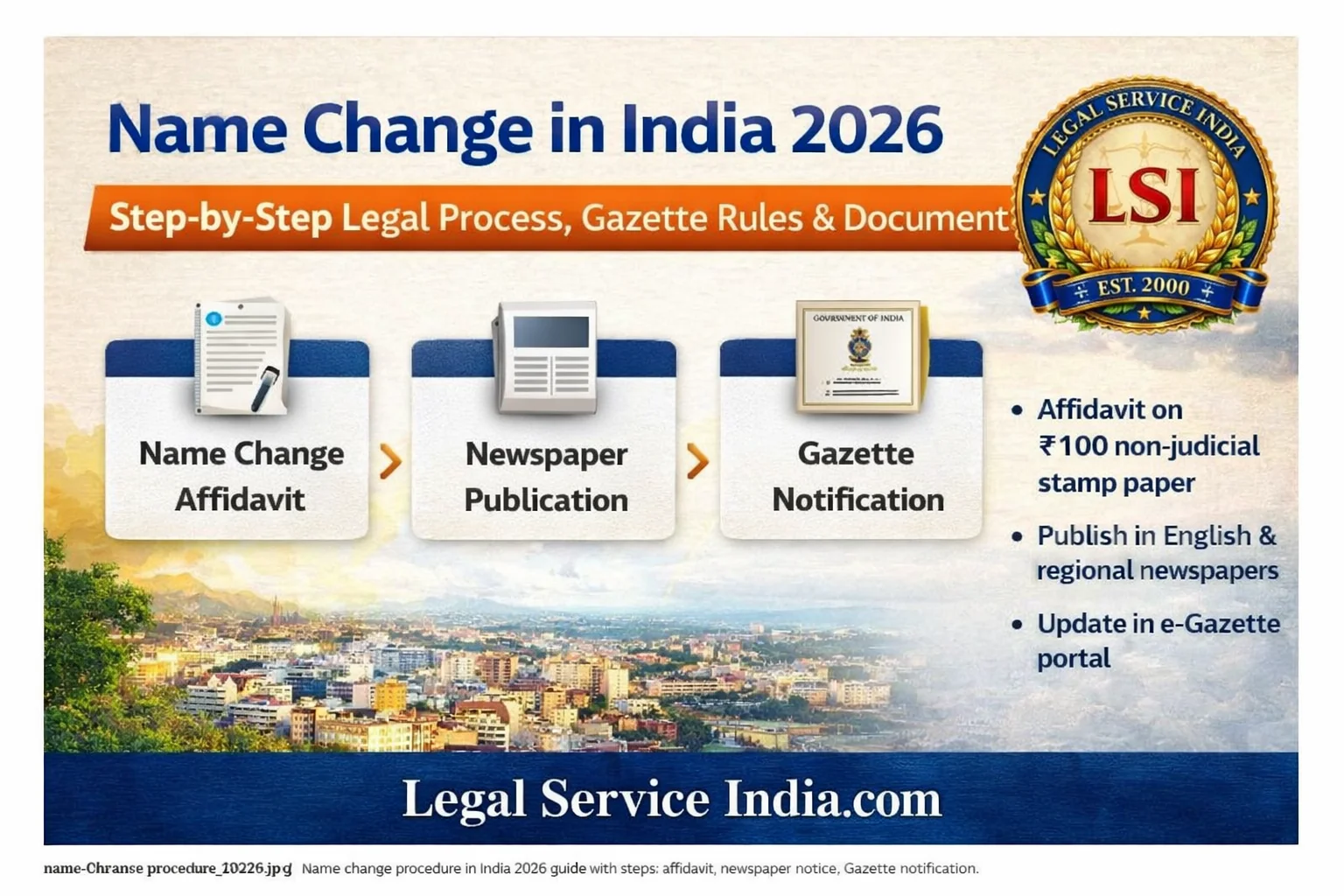
Name Change in India (2026): Legal Procedure, Rights & Complete Guide
In the digital-first administrative landscape of 2026, a name is more than just a label—it is a critical “legal footprint.” Whether necessitated by marriage, divorce, religious conversion, or a desire for a new self-identity, the process of changing one’s name in India has evolved into a streamlined, constitutionally protected right.
This guide provides the most current legal framework, judicial precedents, and step-by-step procedures for Indian citizens and NRIs looking to update their legal identity. :contentReference[oaicite:0]{index=0}
The Constitutional Foundation: Why Your Name Matters
The Supreme Court of India and various High Courts have consistently held that the right to choose or change one’s name is a facet of the Fundamental Right to Freedom of Speech and Expression under Article 19(1)(a) and the Right to Life and Personal Liberty under Article 21.
In the landmark 2025 ruling of Mohd. Hassan v. Union Territory of J&K & Ors., the High Court reaffirmed that an individual must retain complete control over their name as it is a foremost indicator of identity. Similarly, the 2021 Supreme Court judgment in Jigya Yadav v. CBSE established that administrative efficiency cannot override an individual’s right to their chosen identity.
The 3-Step Legal Procedure (2026 Update)
India does not have a single “Name Change Act.” Instead, the process is governed by a standardized three-tier procedure accepted by all government bodies, including the UIDAI (Aadhaar), Passport Seva, and Income Tax Department (PAN).
1. The Name Change Affidavit
- The foundation of the process is a sworn affidavit. In 2026, while the standard is a ₹100 non-judicial stamp paper, digital e-stamp papers are now preferred in most states.
Requirements:
- The affidavit must state the old name, the new name, the reason for the change (e.g., “post-divorce resumption of maiden name”), and a declaration that the change is not intended for fraudulent purposes.
Notarization:
- It must be signed by the applicant and attested by a Notary Public or an Executive Magistrate.
2. Newspaper Publication
- A public notice must be published to invite any objections.
Mandatory Rule:
- You must publish the notice in two newspapers—one in the English language and one in the regional language of your place of residence.
Content:
- The ad must include the old name, new name, father’s/husband’s name, and residential address.
- Retain at least 3-4 original copies of the newspaper for future verification.
3. Gazette Notification (The e-Gazette Transition)
- The final and most crucial step is the publication of the change in the Official Gazette of India (Central Gazette) or the respective State Gazette.
Central vs. State:
- While a State Gazette is sufficient for local matters, a Central Gazette Notification is mandatory for updating Passports and is highly recommended for NRIs and Central Government employees.
Digital Submission:
- As of 2026, the Department of Publication in Delhi and most state portals have transitioned to a fully digital submission model.
- For residents of Karnataka, the process can be handled through the state’s dedicated Online Gazette Application Portal, which significantly reduces the processing time to 25-45 days.
Fees and Timelines in 2026
| Category | Details |
|---|---|
| Government Fees | Approximately ₹1,100 to ₹1,700 for the Central Gazette (payable via the Bharatkosh portal) |
| Processing Time | Usually 4 to 6 weeks from the date of submission |
| Digital Proof | Physical “hard copies” of the Gazette are no longer issued; the downloadable PDF from egazette.nic.in is legally valid under the IT Act, 2000 |
Special Cases and Recent Judicial Shifts
Post-Divorce Name Change
- Courts have made it easier for women to revert to their maiden name.
- The production of a Divorce Decree alongside the affidavit is usually sufficient for Gazette publication.
Minor Children
- In a 2026 Karnataka High Court ruling, the court held that a mother’s surname on a child’s birth certificate reflects the “real family environment”.
- It can be updated even in the absence of the biological father, provided it serves the child’s best interests.
Gender Identity
- Following the Transgender Persons (Protection of Rights) Act, 2019, individuals transitioning can change their name and gender simultaneously via the Gazette.
- This is done with a simplified medical certificate.
Updating Your Documents: The Hierarchy
Once the Gazette is published, update your records in this specific order to avoid rejection:
- Aadhaar Card: Use the Gazette PDF as “POI” (Proof of Identity).
- PAN Card: Use the updated Aadhaar and Gazette.
- Bank Accounts: Essential for financial continuity.
- Passport: The Ministry of External Affairs requires the Gazette notification for a “Total Change of Name.”
Conclusion
Changing your name is a significant legal transition. While the procedure has become digital and more accessible in 2026, precision in documentation is vital. Any spelling mismatch between the affidavit, newspaper ad, and the Gazette application can lead to a rejection by the Controller of Publications.
For those navigating state-specific requirements, especially in South India, utilizing specialized regional guides such as the Karnataka Online Gazette Guide is recommended to ensure compliance with local administrative nuances.

