Guy de Maupassant is one of the greatest short story writers. He often showed how ordinary life hides dark truths. The Devil (Le Diable) is one of his most frightening stories. It is not about ghosts or magic, but about greed, cruelty, and death. Maupassant wrote it during the painful last years of his life, when his view of the world had become very bleak.
The story takes place in the quiet countryside of Normandy. An unnamed visitor comes to the house of an old woman who is dying. Her son, a doctor, hires Honoré Bontemps—called La Rapet—to watch over her. La Rapet is known for sitting with dying people in exchange for money. Her pay depends on how quickly death comes.
She expects the old woman to die soon, but when the woman lingers, La Rapet grows angry. She sees the delay as a loss of money. What happens next is not supernatural but deeply cruel. Maupassant shows how an ordinary washerwoman can become “the devil” through her actions.
The story’s strength lies in this twist: evil does not always look strange or monstrous. Sometimes it looks ordinary.
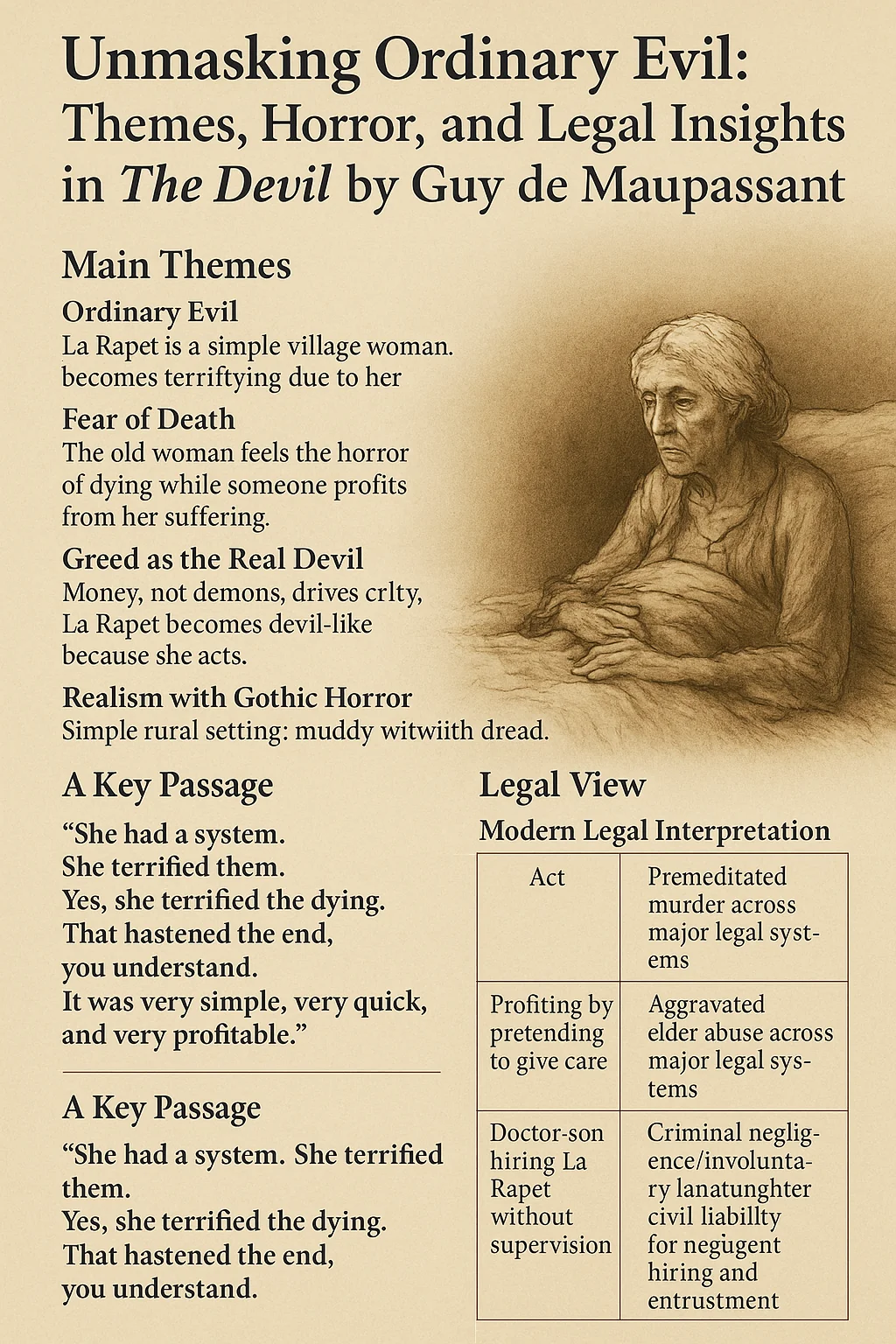
Main Themes
- Ordinary Evil
Evil here is not dramatic. La Rapet is just a simple village woman. Her greed makes her terrifying.
- Fear of Death
The old woman feels the horror of dying while someone profits from her suffering.
- Greed as the Real Devil
Money, not demons, drives the cruelty. La Rapet becomes devil-like because she acts without pity.
- Realism with Gothic Horror
The setting is simple—muddy roads, peasants, small houses—but the atmosphere is heavy with dread.
Style and Technique
- Calm, Cold Narration
Maupassant does not add drama. He simply shows events, which makes them more chilling.
- Short and Sharp
The story is under 2,000 words. Every line adds to the tension.
- Action Instead of Explanation
The horror comes from watching choices unfold, not from long explanations.
A Key Passage
“She had a system. She terrified them.
Yes, she terrified the dying.
That hastened the end, you understand.
It was very simple, very quick, and very profitable.”
This shows how cruelty and profit are linked in the story.
Why It Still Matters
Even today, The Devil feels real. It shows how greed can corrupt care for the weak. Exploiting the vulnerable, turning care into business, and ignoring morality are problems that still exist.
The story also reflects Maupassant’s own struggles. As illness and hallucinations haunted him, death became his obsession. This tale may be part warning, part confession.
Legal View
If the events of Maupassant’s “The Devil” took place today, La Rapet’s deliberate starvation and neglect of a helpless 92-year-old woman—solely to hasten death and collect her fee—would constitute premeditated murder in every major legal system (French Code pénal Art. 221-1; Bharatiya Nyaya Sanhita Section 103; English common-law malice aforethought; most U.S. jurisdictions’ first- or second-degree murder), while simultaneously qualifying as aggravated elder abuse resulting in death and fraud by false pretences of care; civilly, the estate could recover heavy damages for wrongful death, intentional infliction of emotional distress, and breach of a caregiver’s fiduciary duty; and the doctor-son who hired this stranger without vetting, instructed her merely to “watch until the end,” and exercised no supervision would face criminal liability for gross negligence/involuntary manslaughter and civil claims for negligent hiring and entrustment—transforming Maupassant’s grim Norman tale of greed into a modern case of contract killing masquerading as end-of-life care and a chilling warning of what happens when financial incentives, zero oversight, and vulnerability collide.
Conclusion
The Devil is more than a horror story. It is a study of human cruelty. Maupassant shows that terrible acts can come from ordinary people. Short, brutal, and unforgettable, it proves that the worst horrors are created by humans themselves.
Once read, its images—like the sound of wet sheets in a dying woman’s room—stay with you long after.