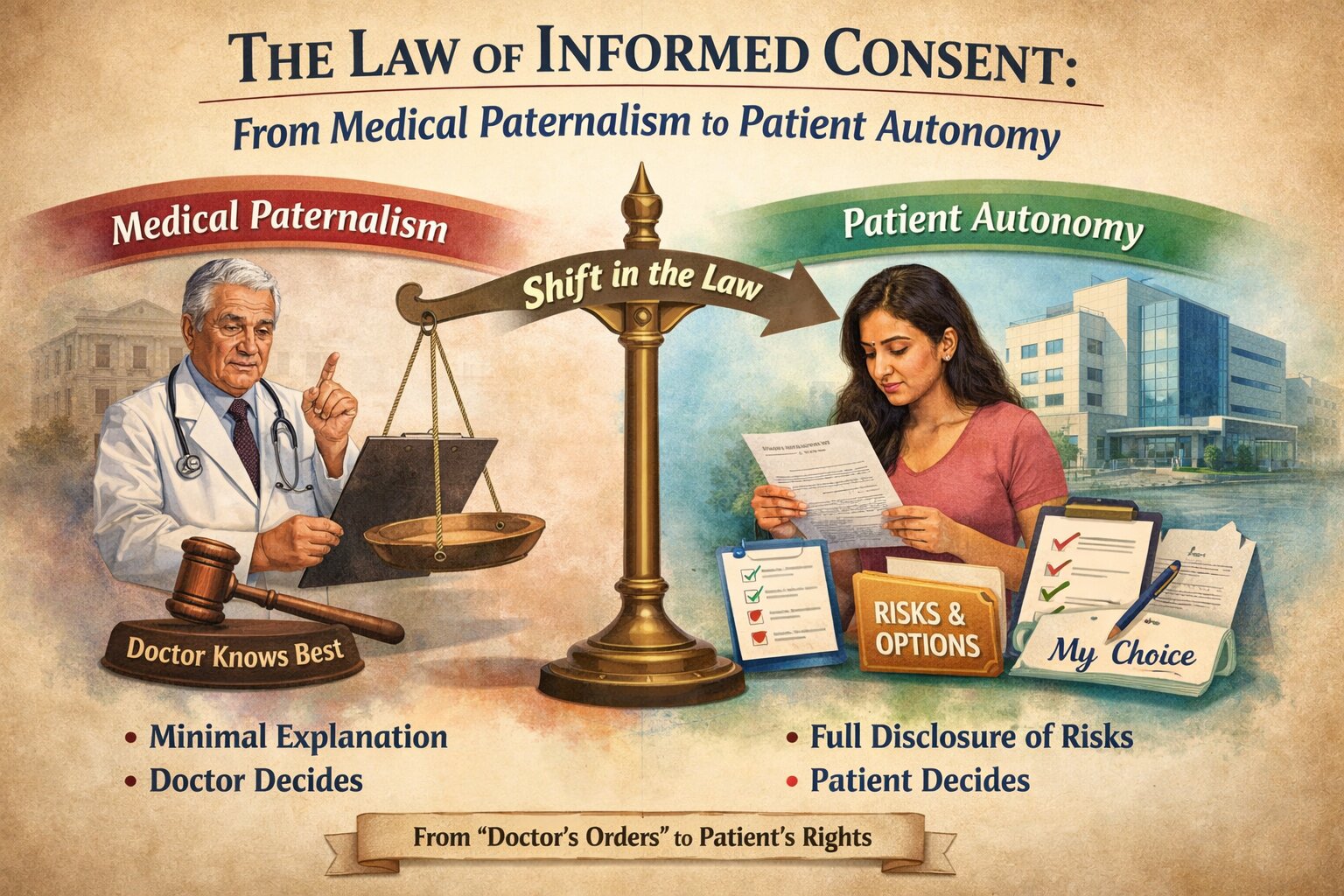
Informed consent lies at the core of the modern doctor–patient relationship and represents a major shift in medical jurisprudence. Historically, medicine was dominated by paternalism, where doctors made decisions on behalf of patients under the belief that the physician always knew what was best. Over time, however, legal and ethical standards evolved to recognize the patient’s fundamental right to make decisions about their own body. Today, informed consent requires that patients receive adequate information about the nature, risks, benefits, and alternatives of a medical procedure before agreeing to it.
From a legal standpoint, performing a medical procedure without a patient’s informed permission is no longer considered merely a professional error; it may amount to a violation of bodily autonomy and can even be treated as a form of battery. The doctrine has developed through influential judicial decisions in the United States and the United Kingdom and has been progressively interpreted by Indian courts as well. This article examines the evolution of informed consent and explores how the law attempts to balance the principle of patient autonomy with the practical realities of medical practice.
Historical Foundations: From Battery to Patient Sovereignty
The idea of informed consent began in early 20th-century American law. In the case of Schloendorff v. Society of New York Hospital (1914), Judge Benjamin Cardozo stated an important principle: every adult person of sound mind has the right to decide what happens to their own body. If a doctor performs a medical procedure without the patient’s permission, it can be treated as an unauthorized touching amounting to battery in law.. This case laid the foundation for the modern concept of patient autonomy.
After the atrocities of medical experiments during World War II, the importance of voluntary consent became even clearer. The Nuremberg Code (1947) declared that voluntary consent of a person is absolutely essential in medical research. Later international guidelines such as the Declaration of Helsinki (1964) and the Belmont Report (1979) strengthened this principle. These standards require doctors and researchers to clearly explain risks and allow patients to refuse or withdraw from treatment or research at any time.
The Evolution of Disclosure Standards: Canterbury to Montgomery
The legal rule about how much information a doctor must give a patient has developed over time through two important stages.
- The Reasonable Patient Standard: In the case of Canterbury v. Spence (1972), a U.S. court changed the earlier rule. Before this, doctors followed the “professional standard,” meaning they only disclosed what other doctors thought was necessary. The court replaced this with the “reasonable patient” standard. It said doctors must tell patients about any risks that a reasonable person would consider important when deciding whether to undergo treatment. This decision reduced doctors’ control over deciding what patients should know.
- The Patient-Centric Approach: A major development later came in the UK case of Montgomery v. Lanarkshire Health Board (2015). The court moved away from the traditional Bolam Test, which had protected doctors if their actions matched accepted medical practice. The court ruled that doctors must make sure patients know about material risks of a treatment. A risk is considered material if a reasonable patient would think it is important, or if the doctor knows that the particular patient would consider it important when making their decision.
The Indian Landscape: Constitutional Basis and Court Decisions
In India, the idea of informed consent is connected to Article 21 of the Constitution of India, which protects the right to life and personal liberty. Courts have interpreted this right to include the right to health, dignity, and control over one’s own body.
- Laws and Regulations: The ethical rules for doctors are mainly provided by the National Medical Commission through its Code of Ethics. At the same time, the Consumer Protection Act, 2019 allows patients to complain if a doctor performs treatment without proper consent. In such cases, the lack of informed consent can be treated as a deficiency in service, and patients can approach consumer courts for compensation.
- The Important Court Case: A key decision in India is Samira Kohli v. Dr. Prabha Manchanda (2008). In this case, a patient agreed to a diagnostic procedure but underwent a major surgery while under anaesthesia. The Supreme Court of India laid down important rules:
- Real Consent: Consent must be voluntary and based on proper information.
- Specific Consent: Permission for a diagnostic test does not automatically allow doctors to perform major surgery unless there is a life-threatening emergency.
- Balanced Approach: The Court did not fully adopt the strict U.S. standard from Canterbury v. Spence. Instead, it followed a “real consent” approach, which requires doctors to give patients enough information to understand the nature and purpose of the treatment and its important risks, while not obligating them to explain every rare or remote possibility.
Lack of informed consent may also form part of a claim for medical negligence when a patient suffers harm due to undisclosed risks.
Comparative Analysis and Contemporary Challenges
In many Western countries such as the United Kingdom, Canada, and Australia, the law has moved toward a strong patient-centred approach, where patients must receive detailed information before making medical decisions. In India, however, courts follow a more practical and balanced approach. This approach tries to respect patient autonomy while also considering the realities of a busy and resource-limited healthcare system.
At the same time, modern medicine has created new challenges:
- Digital Medicine: The Telemedicine Practice Guidelines (2020) require doctors to adopt new ways of recording and documenting patient consent during online consultations.
- Protection of Vulnerable Patients: The New Drugs and Clinical Trials Rules, 2019 require audio-video recording of the informed consent process in certain clinical trials to prevent exploitation.
- End-of-Life Decisions: In Common Cause v. Union of India (2018), the Supreme Court of India recognized Living Wills (advance directives), allowing individuals to state their medical wishes in advance for end-of-life care.
Conclusion: From Compliance to Partnership
Ultimately, informed consent should not be treated as a mere legal formality or a signed document. It represents the patient’s right to participate meaningfully in decisions about their own body and health. When properly practiced, informed consent transforms the doctor–patient relationship from one of authority and compliance into a partnership based on trust, communication, and respect for human dignity.