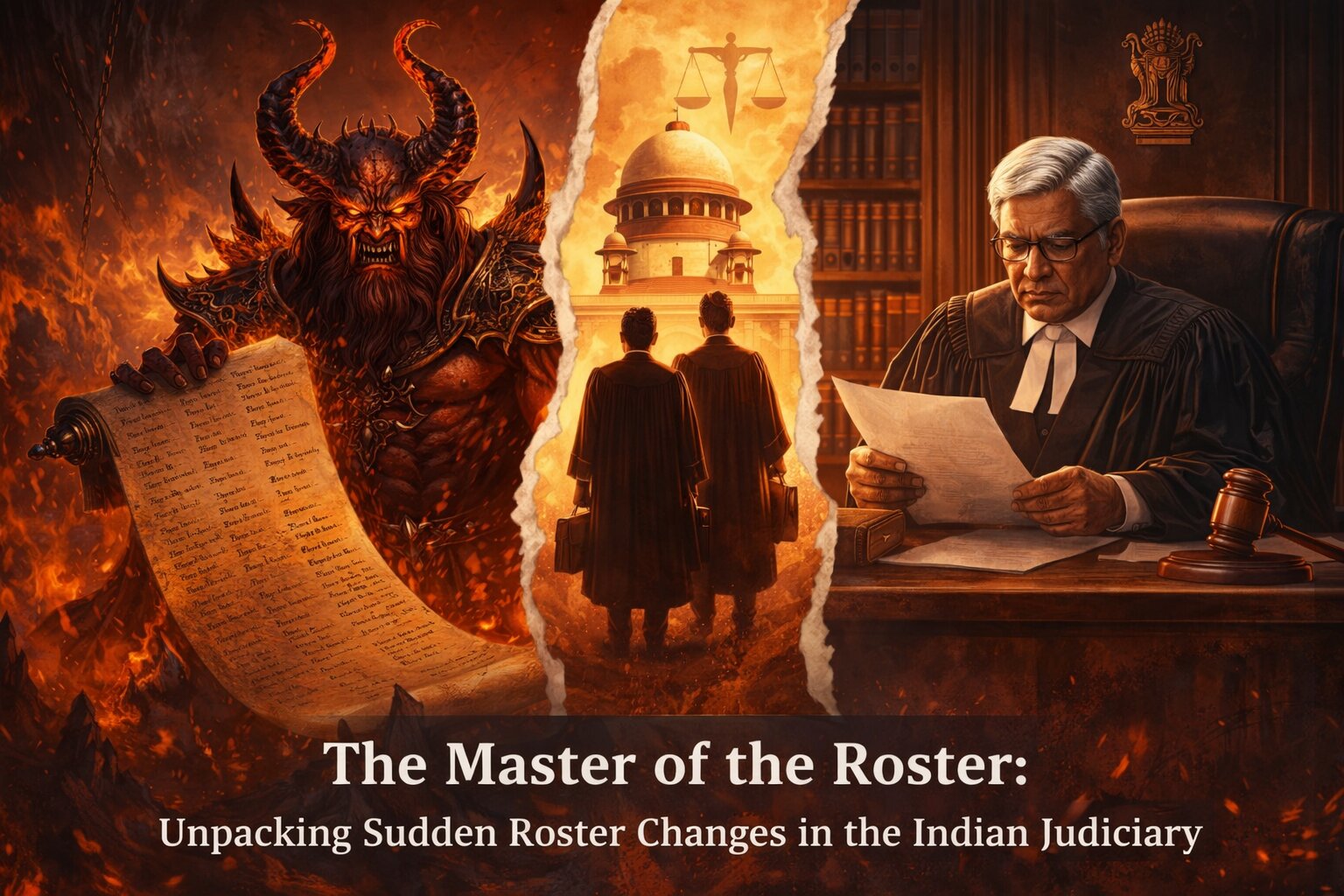
In the grand architecture of Indian democracy, the judiciary is the “sentinel on the qui vive,” the ever-watchful guardian of the Constitution. However, behind the solemn pronouncements and black-robed authority lies a complex administrative engine. One of the opaquest and intensely debated parts of this engine is the Judicial Roster—the system that determines which judge hears which case.
When a high-profile case is suddenly moved from one bench to another, or when an entire roster is overhauled overnight, it sends ripples through the legal fraternity and the public alike. To understand why these changes happen, one must delve into the controversial principle of the “Master of the Roster.”
- The “Master of the Roster” Doctrine
In India, the Chief Justice of India (CJI) and the Chief Justices of the various High Courts are considered the “Master of the Roster.” This isn’t just a title; it is a profound administrative power.
- Legal Basis: This authority is not explicitly written in the Constitution but has been solidified through landmark judgments like State of Rajasthan v. Prakash Chand (1998) and Asok Pande v. Supreme Court of India (2018).
- The Logic: The courts argue that for a massive judicial system to function, someone must have the final word on the distribution of work. Without a single authority, there would be chaos—judges might “pick and choose” cases, leading to a breakdown of discipline.
- Why the Sudden Changes? The Administrative Perspective
From an institutional standpoint, roster changes are often presented as routine “course corrections.” There are several legitimate, non-controversial reasons for a sudden shift:
- Subject Matter Specialization: As cases evolve, a Chief Justice may realize a particular bench has greater expertise in a niche area (e.g., Taxation, Intellectual Property, or Habeas Corpus).
- Managing Vacancies and Retirements: In India, judges retire at 62 (High Courts) or 65 (Supreme Court). When a judge retires, the benches they led must be reconstituted immediately, causing a domino effect across the entire roster.
- Efficiency and Pendency: If one bench is bogged down by a massive, year-long trial, the Chief Justice may “offload” their other categories to a different bench to keep the court moving.
- Internal Recusals: Sometimes, a judge may privately inform the Chief Justice of a personal conflict of interest in a newly assigned category, necessitating an immediate swap.
- The Shadow of Controversy: “Bench Hunting” and “Cherry Picking”
While the administrative reasons are clear, the suddenness of changes in “sensitive” cases—those involving political figures, civil liberties, or government policy—often triggers accusations of “Bench Hunting” or “Cherry Picking.”
The 2018 unprecedented press conference by four senior-most Supreme Court judges was the “Big Bang” of this controversy. They alleged that “cases having far-reaching consequences for the nation” were being selectively assigned to junior benches of the Chief Justice’s preference, bypassing senior judges.
The “Chilling Effect” and Government Friction
In recent years, several instances have fuelled public debate:
- Sudden Transfers: When a judge makes sharp critical remarks against the executive in an ongoing case, and the case is moved to a different bench the next day, it creates a perception of executive interference or judicial “softening.”
- Article 142 Interventions: The Supreme Court occasionally uses its extraordinary powers to direct that a specific judge not hear a certain type of case if their prior orders were deemed “absurd” or “legally unsustainable,” as seen in recent censures of High Court judges.
- The Tension: Judicial Independence vs. Judicial Discipline
The debate over sudden roster changes is essentially a tug-of-war between two vital concepts:
|
Concept |
The Argument |
The Risk |
|
Judicial Independence |
Each judge is an independent constitutional authority; their work should not be “managed” to suit an outcome. |
A “rogue” judge could pass orders that contradict settled law without oversight. |
|
Judicial Discipline |
The Chief Justice must ensure a uniform application of law and manage the court’s reputation. |
The power can be used to “punish” brave judges or “reward” pliant ones. |
Notable Recent Instances of Sudden Roster Changes
In recent years, the exercise of the “Master of the Roster” power has drawn sharp attention across India’s higher judiciary, especially when roster changes coincide with politically sensitive or high-profile matters. A striking example occurred in January 2024 at the Calcutta High Court, where Chief Justice T.S. Sivagnanam reassigned all education-related cases away from Justice Abhijit Gangopadhyay. This administrative move followed a rare public disagreement between judges over a CBI investigation into medical college admissions, raising questions about internal judicial discipline and the timing of the roster shift.
Similar concerns surfaced in late 2023 at the Madras High Court. Justice N. Anand Venkatesh, known for initiating suo motu revisions of acquittals involving senior ministers, was reassigned from the MP/MLA portfolio to the Madurai Bench. Though officially described as routine, the timing and impact of the reshuffle sparked debate over whether such transfers dilute judicial continuity in politically charged matters. The reassignment was seen by some observers as a subtle recalibration of judicial exposure to sensitive cases.
At the Supreme Court level, leadership transitions often trigger comprehensive updates to the “Subject-Wise Roster.” When the new Chief Justice of India assumed office in November 2025, several Special Bench matters—including reviews of investigative powers under the PMLA and electoral roll disputes—were redistributed. While such changes are procedurally normal, they frequently invite scrutiny over whether administrative reshuffles affect the trajectory of judicial reasoning, especially in cases with long procedural histories or constitutional implications.
Recent Cases of Roster Change
In 2026, sudden roster changes continued to attract scrutiny across India’s superior courts, with notable shifts in the Supreme Court, Allahabad High Court, and Delhi High Court. These changes often involved sensitive portfolios, constitutional matters, and high-stakes litigation, raising debates about judicial continuity and administrative discretion.
Supreme Court of India (March 2026)
- March 23–25, 2026: The Supreme Court issued multiple notices regarding changes in the Chief Justice’s Court and other benches. Chamber matters and review petitions were deleted or reassigned across Court Nos. 3, 6, 7, 9, 12, and 15.
- Impact: These sudden changes affected the listing of review petitions and oral mentioning matters, sparking discussions about whether such administrative interventions disrupt the flow of sensitive cases, especially those involving constitutional interpretation and investigative powers.
Allahabad High Court (March 2026)
- March 24, 2026: A fresh roster was notified, significantly reallocating case portfolios across benches. Justice Atul Sreedharan was newly assigned family appeals and Senior Citizen Act matters, marking a major shift in judicial workload.
- Impact: While officially framed as an efficiency measure, the reassignment of crucial family and elderly law cases drew attention to how roster changes can alter the trajectory of socially sensitive litigation.
Delhi High Court (January 2026)
- January 5, 2026: A new roster came into effect under Chief Justice Devendra Kumar Upadhyaya. Division Benches were reassigned to handle Public Interest Litigations, constitutional validity challenges, and Letters Patent Appeals spanning 2018–2026.
- Impact: The redistribution meant that PILs and writ petitions challenging statutory rules—including those affecting criminal investigations and prosecutions—were concentrated under specific benches. This raised questions about how roster changes influence the handling of politically sensitive or constitutionally significant matters.
The 2026 roster changes across the Supreme Court, Allahabad High Court, and Delhi High Court highlight the continuing tension between administrative discretion and judicial continuity. While officially justified as routine or efficiency-driven, these sudden shifts often occur in contexts involving sensitive constitutional, political, or socially impactful cases, thereby fuelling debates about transparency, judicial independence, and the balance of administrative powers within the judiciary.
- The Path Toward Reform: Transparency is the Antidote
The “suddenness” of roster changes is often what breeds suspicion. If the process were predictable and transparent, the controversy would diminish. Potential reforms include:
- Automated Allocation: Moving toward a computer-generated, random allocation for all non-specialized cases to remove human discretion.
- A “Consultative” Master: Instead of the CJI acting alone, the roster could be decided by the “Top 3” or “Top 5” judges (the Collegium) to ensure collective wisdom.
- Public Rationales: When a sensitive case is moved mid-hearing, the Registry could issue a brief “Administrative Note” explaining the move (e.g., “Judge A is unavailable for the next month due to medical reasons”).
- Permanent Benches: Establishing permanent constitution benches or subject-matter benches would reduce the need for frequent reshuffling.
Comparative Analysis: Case Allocation Systems
While India’s “Master of the Roster” system gives a single individual—the Chief Justice—significant administrative discretion, other global democracies have moved toward more structured or collective models of case allocation to ensure perceived and actual neutrality.
|
Feature |
India (Supreme Court) |
USA (Supreme Court) |
United Kingdom (Supreme Court) |
|
Primary Authority |
Chief Justice of India (CJI) as “Master of the Roster.” |
The Full Court (En Banc); all 9 Justices hear almost every case. |
The Registrar, under the direction of the President of the Court. |
|
Method of Allocation |
Discretionary; CJI assigns cases to specific benches (usually 2-3 judges). |
No “allocation” needed; the court sits as a single unit for all arguments. |
Assigned to panels of 5, 7, or 9 judges based on the case’s importance. |
|
Specialization |
Subject-wise rosters are created, but can be changed “suddenly” by the CJI. |
None; all Justices are generalists for every constitutional matter. |
High; judges are often selected for panels based on their specific legal expertise. |
|
Risk of “Bench Hunting” |
High; since the CJI selects the specific judges, critics often allege bias. |
Zero; because the bench is fixed and identical for every single case. |
Low; panels are usually determined by rotation and technical necessity. |
|
Administrative Transparency |
Relatively opaque; changes are often made via “office reports” or new rosters. |
High; the process of “granting certiorari” is a public, collective vote. |
High; the criteria for panel size and composition are published and regulated. |
Key Takeaways from the Comparison
- The Indian “Bench” Culture: Unlike the U.S. Supreme Court, where all nine justices sit together, the Indian Supreme Court operates through dozens of smaller benches. This makes the power to pick those benches the most powerful administrative tool in the country.
- The UK Hybrid Model: The UK Supreme Court uses panels (like India) but leans toward a more bureaucratic and expertise-driven allocation. The President of the UK Supreme Court rarely moves a case “suddenly” without a documented reason regarding a judge’s specialized knowledge in areas like maritime law or human rights.
- The American “Stability”: In the USA, the roster never changes because the court is “integrated.” You know exactly who will hear your case from the moment it is accepted. This eliminates the “sudden roster change” controversy entirely but places immense pressure on the judicial appointment process itself.
The Emerging Global Standard
Most modern legal scholars argue that as judiciaries grow in size (India now has 34 Supreme Court judges), the “Master of the Roster” model should evolve into a “Committee of the Roster” to prevent the concentration of power in a single office and ensure that “sudden changes” are backed by a collective, transparent rationale.
Conclusion: The Integrity of the Roster
A judicial roster is more than a timetable; it is the blueprint of justice. In a country like India, where the judiciary is the last hope for millions, the perception of fairness is just as important as fairness itself.
Sudden roster changes may often be born of administrative necessity, but when they occur without explanation in the middle of high-stakes battles, they risk bruising the public’s faith. The “Master of the Roster” power is a sacred trust—it must be exercised not just with authority, but with an unwavering commitment to the appearance of neutrality.