Adverse Possession Doctrine Overview
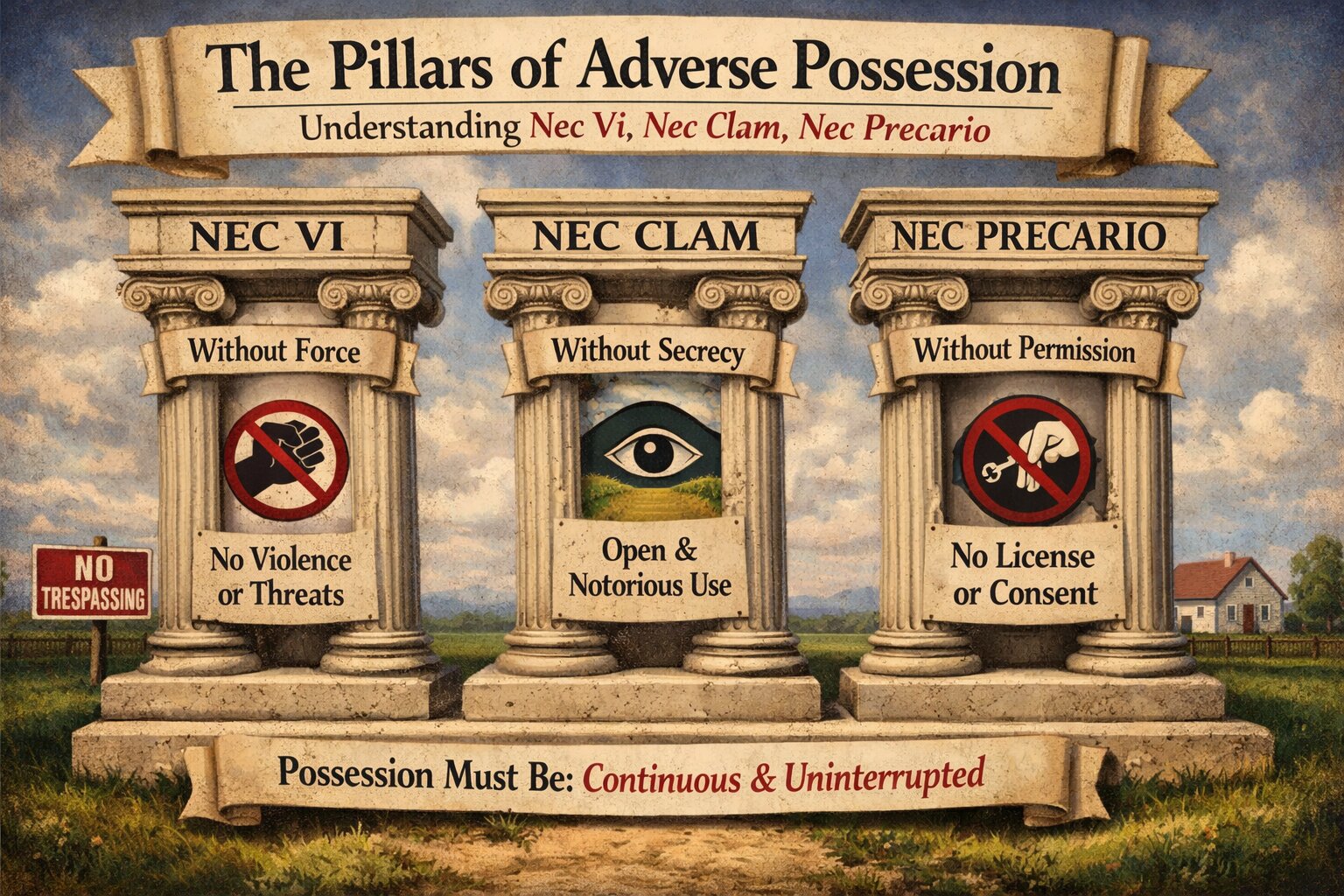
In the realm of property law, the doctrine of adverse possession stands as a fascinating, albeit controversial, legal principle. It allows a person who is not the legal owner of a land to acquire valid title to it simply by occupying it for a specific duration. However, the law does not reward “land grabbing” in a vacuum. For a possession to mature into ownership under the Limitation Act, 1963, it must satisfy the three ancient Latin qualifiers: nec vi, nec clam, and nec precario.
The Legal Origin and Meaning
Derived from Roman law and solidified through English Common Law, these three phrases serve as the “litmus test” for any claim of adverse possession. To succeed, the occupant must prove that their possession was peaceful, open, and hostile to the true owner.
Key Legal Terms Explained
| Legal Term | Literal Translation | Essential Requirement |
|---|---|---|
| Nec Vi | Without Force | Possession must be peaceful and settled, not a series of trespasses. |
| Nec Clam | Without Secrecy | Possession must be open and “notorious” so the owner can see it. |
| Nec Precario | Without Permission | Possession must be adverse; it cannot be based on a license or lease. |
Essential Requirements Summary
- Peaceful Possession: The occupation should not involve force or violence (Nec Vi).
- Open Possession: The occupation must be visible and known, not hidden (Nec Clam).
- Hostile Possession: The occupation must be without the true owner’s permission (Nec Precario).
Breaking Down the Three Pillars
Nec Vi: Possession Without Force
The requirement of NEC VI dictates that the possession must be peaceful. If an occupant maintains their stay through constant physical violence, armed guards, or frequent skirmishes with the true owner, the law views this as a criminal act rather than a “settled possession.”
- The Logic: The law of limitation seeks to protect “settled” states of affairs. Violence suggests a state of flux rather than a stable, long-term claim to the land.
Nec Clam: Possession Without Secrecy
For the limitation clock to start, the possession must be open and notorious. The occupant must use the land in a way that is visible to the community and, most importantly, to the true owner.
- The Logic: You cannot “steal” land by hiding. The owner must have a reasonable opportunity to notice the intrusion and take legal action (the “Vigilance” principle). If you farm the land, build a fence, or pay property taxes, you are acting as a nec clam.
- The Test: Would a reasonable owner, visiting their property, notice someone else is using it? If the answer is yes, the requirement is met.
Nec Precario: Possession Without Permission
This is the most critical pillar. “Precario” refers to a “precarious” tenure—one held at the “pleasure” or permission of the owner. To be adverse, the possession must be hostile (known as animus possidendi).
- Permissive Possession: If you are a tenant, a caretaker, or a family member staying with permission, your possession is precarious. No matter how many decades you stay, you can never claim adverse possession unless you perform an “ouster”—an explicit act of defying the owner’s title.
- The “Hostile” Intent: The occupant must hold the land with the intention of excluding the whole world, including the true owner.
The Indian Statutory Context
In India, these principles are read into Section 27 and Article 65 of the Limitation Act, 1963.
| Rule | Time Period | Applicability |
|---|---|---|
| 12-Year Rule | 12 Years | For private property, the adverse possession must remain uninterrupted for 12 years. |
| 30-Year Rule | 30 Years | For government land, the period is extended to 30 years. |
- Extinguishment of Right: Unlike most limitation laws that only bar the “remedy” (the right to sue), Section 27 actually extinguishes the right of the original owner. If they fail to sue within the timeframe, their ownership dies, and the adverse possessor’s title becomes “perfect.”
Modern Judicial Trends: “The Grabbing” vs. “The Using”
Modern courts, including the Supreme Court of India in cases like P.T. Munichikkanna Reddy v. Revamma, have become increasingly strict. The judiciary now emphasizes that
- Possession is not Title: Mere long possession is not enough; the “hostile intent” (nec precario) must be proven through clear evidence.
- The Burden of Proof: The person claiming adverse possession carries a heavy burden to show exactly when their possession became adverse.
- Human Rights: There is a growing legal sentiment that “adverse possession” is a harsh law that may conflict with the right to property. Therefore, Nec Vi, Nec Clam, and Nec Precario are interpreted very strictly.
Conclusion
The triad of Nec Vi, Nec Clam, and Nec Precario ensures that while the law rewards the productive use of land, it does not reward stealth or violence. It creates a balance where only those who occupy land peacefully, openly, and independently for a decade or more can claim the protection of the Limitation Act. Without these three pillars, property rights would be in constant, chaotic peril.