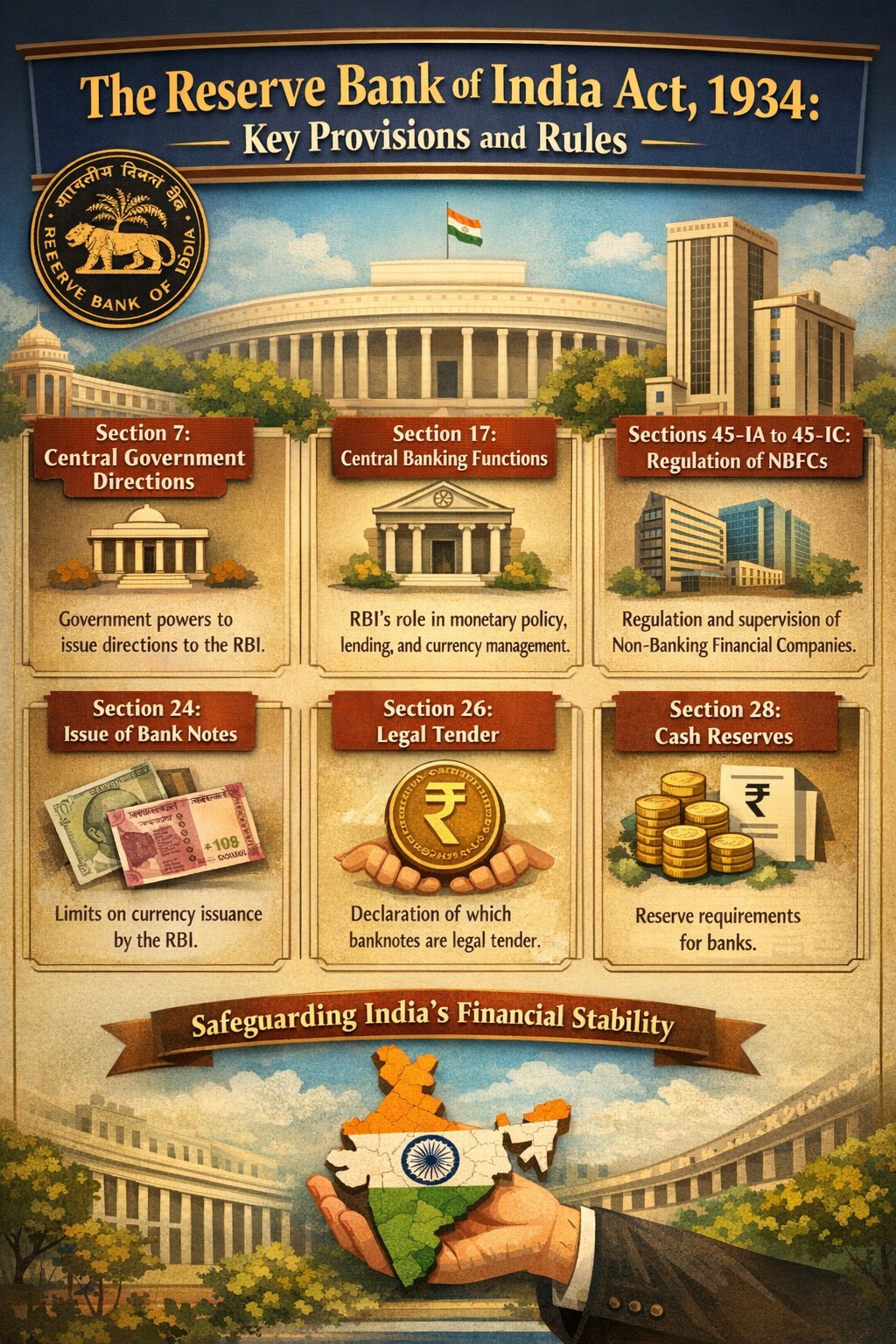
The Reserve Bank of India Act, 1934 is the main law that governs how the Reserve Bank of India (RBI) works. It explains the powers, duties, and functions of India’s central bank. Under this Act, the RBI controls banks, issues currency notes, manages money supply, and works to keep the financial system stable.
For example, the RBI issues Indian currency notes like ₹100 and ₹500, gives licenses to banks such as SBI or private banks, and sets rules on how much banks can lend. During financial stress, it can support banks with funds to avoid panic. Over time, the Act has been updated to include new areas like digital payments, non-banking finance companies (NBFCs), and modern banking practices.
Objective of the RBI Act
The primary objective of the RBI Act is to give clear powers to the Reserve Bank of India to manage the country’s money and banking system. It allows the RBI to issue currency notes, keep prices stable, and make sure banks and financial institutions work smoothly. The Act also helps the RBI support useful sectors of the economy, such as agriculture, industry, and small businesses, by guiding the flow of credit.
Legal Framework of the RBI Act
The Reserve Bank of India Act, 1934 provides the legal foundation for the establishment, powers, and functions of India’s central bank. Its key provisions are given below:
Section 3 – Establishment of the RBI
This section establishes the Reserve Bank of India as a body corporate with permanent existence and a common seal. The RBI was originally headquartered in Kolkata, but its central office was shifted permanently to Mumbai in 1937.
Section 7 – Government Directions
This provision allows the Central Government to give directions to the RBI in the public interest, after consultation with the Governor. Though rarely used, it reflects government oversight while largely preserving the RBI’s day-to-day independence.
Section 8 – Central Board of Directors
This section defines the composition of the RBI’s Central Board. It includes the Governor, up to four Deputy Governors, and directors nominated by the Central Government, ensuring expert and representative decision-making.
Section 17 – Business of the RBI
Section 17 lists the types of business the RBI may conduct. These include accepting deposits without interest, buying and selling bills of exchange, lending to banks and governments, and carrying out open market operations.
Section 18 – Power of Direct Discount
Under Section 18 of the RBI Act, 1934, the Reserve Bank of India may grant emergency loans and advances, including direct discounts of eligible bills, to scheduled banks or State co-operative banks facing special or unusual difficulties. This provision strengthens the RBI’s role as lender of last resort, enabling swift liquidity support to avert banking distress and preserve overall financial stability.
Sections 20–21 – Banker to Government
Under Section 20 of the RBI Act, 1934, the Reserve Bank of India is obligated to act as banker to the Central Government by accepting monies, making payments, handling remittances, exchange, and managing public debt of the Union. Section 21 grants the RBI the exclusive right to transact the Central Government’s banking business in India. For State Governments, similar functions apply via agreements under Section 21A.
Section 22 – Right to Issue Currency
This section grants the RBI the exclusive right to issue bank notes in India, giving it full control over currency issuance and management.
Section 24 – Denominations of Bank Notes
Section 24 specifies the denominations of bank notes that the RBI may issue, with a maximum denomination limit of ₹10,000.
Section 26 – Legal Tender and Demonetisation
This provision declares RBI-issued bank notes as legal tender throughout India. Section 26(2) also empowers the government to demonetise specific series of notes, as exercised in 2016.
Sections 33–34 – Issue Department Assets
These sections require that currency issued by the RBI be backed by approved assets such as gold, gold bullion, and foreign securities, ensuring confidence in the monetary system.
Section 42 – Cash Reserve Ratio (CRR)
Section 42 mandates that scheduled banks maintain a specified percentage of their deposits as Cash Reserve Ratio with the RBI. This is an important tool for controlling liquidity and credit in the economy.
Section 45 – Collection and Furnishing of Credit Information
This section, along with Sections 45A–45E of the RBI Act, 1934 (Chapter IIIA), empowers the Reserve Bank of India to collect credit information from banks and NBFCs and furnish it to specified entities for credit assessment. NBFC registration, supervision, deposit-taking, and governance are primarily regulated under Chapter IIIB (Sections 45-I to 45-IC and related provisions).
Sections 45Z–45ZO – Monetary Policy Framework
Chapter IIIF of the RBI Act, 1934 (Sections 45Z to 45ZO) establishes India’s modern monetary policy framework. It sets an inflation target (Section 45ZA), constitutes the Monetary Policy Committee (MPC) under Section 45ZB to decide policy rates, and mandates publication of decisions and Monetary Policy Reports. The RBI uses tools like repo/reverse repo rates, CRR, and SLR to maintain price stability while supporting growth.
Sections 46A–46D – Developmental Funds
These sections establish special funds such as the Reserve Fund and National Funds for rural and industrial credit, enabling the RBI to support economic development beyond price stability.
Sections 47–49 – Profits and Bank Rate
These provisions deal with the transfer of RBI surplus profits to the Central Government after maintaining reserves and require the RBI to publish the Bank Rate used for discounting eligible bills.
Together, the above provisions form a comprehensive legal framework that defines the RBI’s authority, independence, and responsibility in maintaining monetary stability and supporting India’s economic growth.
Repo and Reverse Repo Rates, CRR, and SLR – Definition with Examples
The Repo Rate is the interest rate at which banks borrow money from the RBI for short-term needs. For example, if a bank needs ₹100 crore for a week, it can borrow from the RBI at the current repo rate, say 6%.
The Reverse Repo Rate is the interest rate at which banks deposit their extra funds with the RBI to earn interest. For instance, if a bank has ₹50 crore surplus, it can park it with the RBI and earn interest at the reverse repo rate, say 3.5%.
The Cash Reserve Ratio (CRR) is the minimum percentage of a bank’s total deposits that it must keep with the RBI. For example, if the CRR is 4% and a bank has ₹1,000 crore in deposits, it must keep ₹40 crore with the RBI and can lend the remaining ₹960 crore.
The Statutory Liquidity Ratio (SLR) is the minimum portion of a bank’s net deposits that must be invested in government-approved securities. For example, if the SLR is 18% and a bank has ₹1,000 crore in deposits, it must invest ₹180 crore in government bonds or securities before lending the rest.
These tools help the RBI control money supply, inflation, and liquidity in the economy.
Regulation of Banks and Financial Institutions (Sections 22-36, 42-44)
The RBI controls and supervises banks to keep the financial system safe. No bank can start or run its business without a license from the RBI. The RBI regularly checks whether banks are financially strong, have enough capital, and are working properly. It has the power to inspect bank records, accounts, and rules to make sure laws are followed. The RBI can also give instructions to banks on how much and to whom they can lend, including loans to priority sectors like agriculture and small businesses.
Foreign Exchange and Currency Management (Sections 44-44M)
Under Sections 44 to 44M, the RBI manages foreign exchange and currency matters in India. It regulates foreign exchange transactions in line with the RBI Act and the Foreign Exchange Management Act (FEMA). The RBI monitors imports, exports, and external borrowing to keep the value of the rupee stable. It also manages India’s foreign reserves, including gold, foreign currencies, and government securities, to ensure confidence and stability in the economy.
RBI as Lender of Last Resort (Section 17)
When banks or financial institutions face serious money shortages during a crisis, the Reserve Bank of India steps in as the lender of last resort. Under Section 17 of the RBI Act, it provides emergency funds to solvent institutions to help them meet their immediate obligations. This support helps maintain confidence in the banking system, prevents panic withdrawals by depositors, and protects the overall stability of the financial system.
Amendments and Modern Rules
Over the years, the RBI Act, 1934 has been amended to address evolving needs, including provisions for Central Bank Digital Currency (CBDC) via 2022 amendments and enhanced governance through the Banking Laws (Amendment) Act, 2025 (effective in phases from August 2025, with key provisions from November/December 2025).
This Act amends the RBI Act alongside other banking laws to strengthen governance, ensure uniform reporting to the RBI, improve audit quality in public sector banks, raise the “substantial interest” threshold to ₹2 crore, extend cooperative bank director tenures, enhance depositor protection (e.g., improved nomination facilities), and align cooperative banks with robust regulation.
These changes modernize oversight without altering core RBI independence. The RBI supplements the Act with Master Directions and Notifications on risk management, KYC, AML, and fintech/digital payments.
Key Takeaways
- The Reserve Bank of India Act, 1934 lays down the basic legal framework for India’s banking, monetary, and financial system. It defines the role, powers, and responsibilities of the RBI as the country’s central bank.
- The Act gives the RBI wide powers to control money supply and credit, regulate banks and non-banking financial institutions, manage the government’s banking and public debt, and issue and manage India’s currency.
- All banks and financial institutions operating in India are required to follow the rules, directions, and guidelines issued by the RBI under this Act, ensuring stability, safety, and public confidence in the financial system.
- The Act has been amended from time to time to respond to economic changes, financial crises, new technology, and global developments, allowing the RBI to remain effective in a modern and evolving financial environment.
Criticisms and Limitations of the Reserve Bank of India Act, 1934
- The RBI Act, 1934 provides a strong legal foundation for the RBI and has been updated through several amendments, including provisions for Central Bank Digital Currency (CBDC) in 2022 and governance reforms in 2025. However, the Act still carries features shaped by the pre-liberalisation economic framework.
- A major concern is Section 7, which allows the Central Government to give directions to the RBI in the public interest after consulting the RBI Governor. Although this power has officially never been fully used to overrule the RBI, its broad wording raises fears about possible interference in the RBI’s independence, especially in monetary policy matters.
- The Act does not fully deal with modern financial challenges. Even after amendments covering NBFCs and monetary policy, it lacks clear legal rules for fintech, digital finance, cryptocurrencies, shadow banking risks, and cross-border capital movements.
- Because of these gaps, the RBI often depends on circulars, guidelines, and master directions instead of clear statutory provisions, which can create uncertainty for banks and financial institutions.
- The Act also has weak provisions on accountability and transparency. It gives the RBI wide powers but does not clearly require regular parliamentary review or public evaluation of major policy decisions.
- There is no strong legal framework for coordination between the RBI and other regulators like SEBI and IRDAI, which can lead to overlaps or gaps in regulating the financial system.
- These shortcomings show the need for regular reforms so that the RBI Act stays relevant, protects financial stability, and keeps pace with new technology and global financial changes.
Conclusion
Enacted in 1934, the Reserve Bank of India Act, 1934 is the main law governing India’s monetary and financial system. It gives the RBI power to issue currency, regulate banks and financial institutions, manage foreign exchange, control money supply and inflation, and support economic growth. The Act is flexible, allowing the RBI to respond to changing economic conditions, global trends, and new technology. Through this law, the RBI protects financial stability, reduces risks in the system, and maintains public trust in banks. Even after many amendments over time, the Act remains the foundation of the RBI’s role in ensuring monetary stability and economic progress in India.