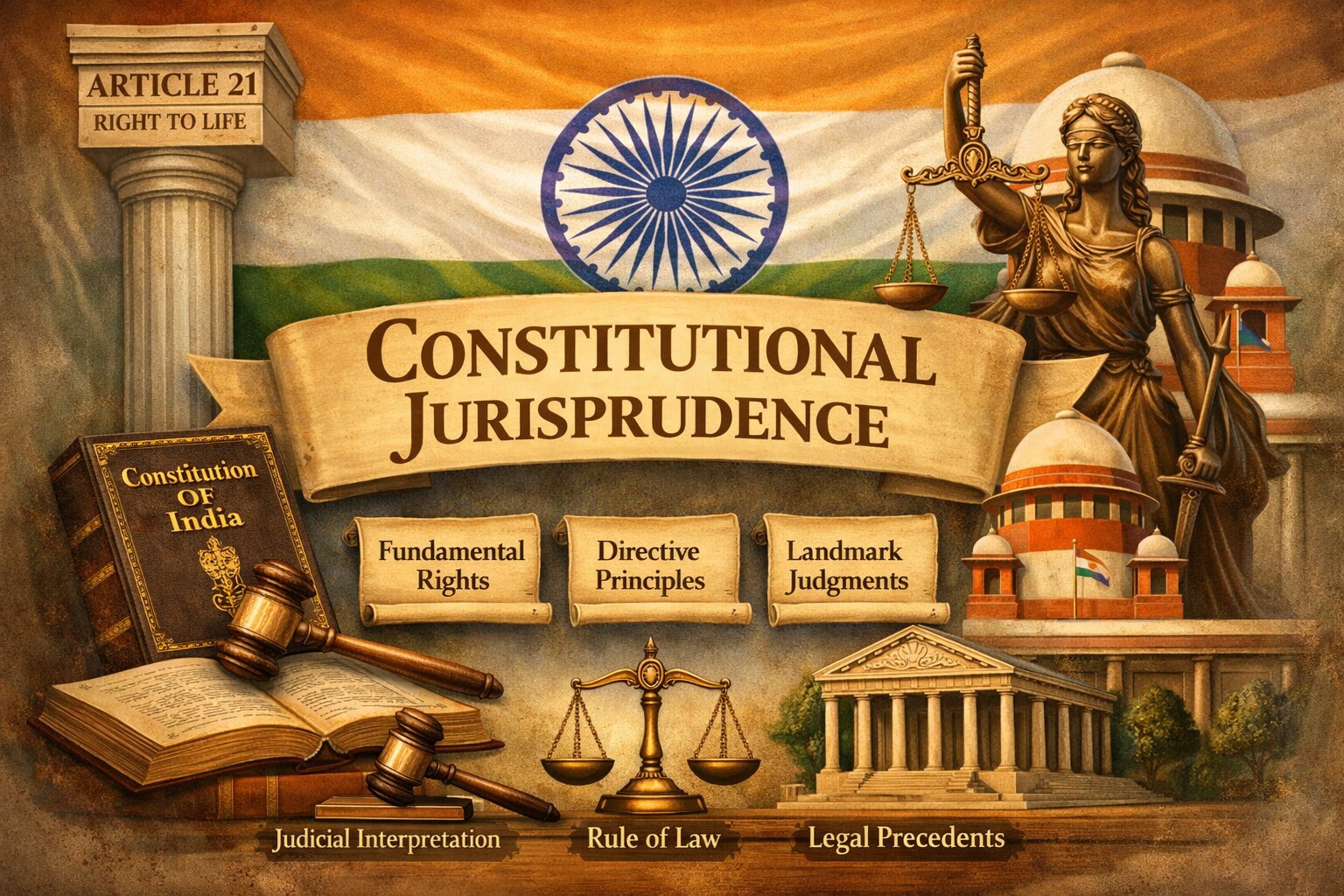
The evolution of the Right to Health represents one of the most significant developments in modern constitutional and human rights law. What began as an aspirational norm in international instruments has, in several jurisdictions, matured into an enforceable legal entitlement.
In India, this transformation is particularly striking. The Constitution of India, 1950, does not explicitly recognize health as a Fundamental Right. Instead, it locates public health within the Directive Principles of State Policy under Part IV—traditionally viewed as non-justiciable. However, through sustained judicial innovation, the higher judiciary has fundamentally reshaped this position.
By applying the Doctrine of Integrated Interpretation, courts have expanded Article 21 (Right to Life) to include the right to live with dignity, thereby incorporating health as an essential component of life itself. This judicial metamorphosis has effectively elevated the Right to Health from a directive ideal to a justiciable constitutional guarantee.
The International Legal Matrix: From Aspiration to Obligation
Conceptual Foundations of Health: The modern legal understanding of health goes beyond the narrow biomedical model. The Constitution of the World Health Organization (1946) defines health as a state of complete physical, mental, and social well-being. This definition reflects a broader social determinants approach, recognizing that health is influenced by economic, environmental, and social conditions.
The ICESCR and the AAAQ Framework: Article 12 of the International Covenant on Economic, Social and Cultural Rights (ICESCR) is the cornerstone of the global right to health. India ratified this covenant in 1979, thereby assuming binding international obligations.
The interpretative framework for Article 12 is provided by General Comment No. 14 (2000), which introduces the AAAQ Framework:
- Availability: Adequate healthcare facilities, infrastructure, and essential medicines must exist.
- Accessibility: Healthcare must be accessible without discrimination, physically reachable, affordable, and supported by access to information.
- Acceptability: Services must respect medical ethics and cultural norms.
- Quality: Healthcare must meet scientific and medical standards, with trained professionals and safe medicines.
This framework serves as the global benchmark for assessing state compliance.
Nature of State Obligations
The ICESCR imposes three layers of obligations on states:
- Respect: Avoid interference with access to healthcare.
- Protect: Prevent third parties from violating health rights.
- Fulfil: Take positive steps to ensure access.
These obligations operate within two key doctrines:
- Progressive Realization: States must improve health outcomes over time, subject to resources.
- Core Obligations: Immediate duties, including access to essential medicines, basic nutrition, and primary healthcare.
Failure to meet core obligations may constitute a violation irrespective of resource constraints.
The Indian Constitutional Landscape: Judicial Transformation
From Directive Principle to Fundamental Right: The Indian Constitution places public health under Article 47, directing the State to improve nutrition and health standards. Although non-justiciable, this provision has significantly influenced judicial interpretation.
Through the Doctrine of Integrated Interpretation, courts have read Directive Principles alongside Fundamental Rights, particularly Article 21. This has resulted in a composite understanding of the right to life as encompassing dignity, health, and well-being.
Jurisprudential Evolution: The Indian judiciary has progressively expanded the scope of the Right to Health through landmark rulings:
- Bandhua Mukti Morcha v. Union of India (1984): Recognized that the health and strength of workers are integral to the right to live with dignity.
- Parmanand Katara v. Union of India (1989): Established the absolute right to emergency medical care, binding on all medical professionals.
- Paschim Banga Khet Mazdoor Samity v. State of West Bengal (1996): Held that lack of resources cannot justify denial of emergency treatment.
- Recent Developments (2025–2026): Judicial trends indicate expansion into newer domains such as mental health and menstrual dignity, signalling a shift toward a more holistic conception of health.
These decisions demonstrate a consistent judicial commitment to transforming socio-economic rights into enforceable guarantees.
Legislative Developments and the “Rajasthan Precedent”
While judicial activism has driven much of the progress, legislative action has been comparatively limited at the national level. However, state-level innovation has begun to bridge this gap.
The Rajasthan Right to Health Care Act, 2023 represents a landmark development. It is the first statute in India to convert the constitutional vision of health into a concrete statutory entitlement.
Key Features:
- Statutory Right to Healthcare: Guarantees free outpatient (OPD) and inpatient (IPD) services at public facilities and designated private institutions.
- Emergency Care Without Prepayment: Ensures immediate treatment without financial barriers.
- Grievance Redressal Mechanism: Introduces a structured, multi-tier system for enforcement, reducing reliance on Public Interest Litigation.
This model marks a transition from court-driven enforcement to institutional accountability.
Structural Challenges: The Gap Between Law and Reality
Despite strong legal recognition, the practical realization of the Right to Health in India remains constrained by systemic challenges.
- Fiscal Constraints: Public health expenditure in India remains around 8%–1.9% of GDP, significantly below the 2.5% target set by the National Health Policy, 2017. This underinvestment directly affects infrastructure, staffing, and service delivery.
- High Out-of-Pocket Expenditure (OOPE): India continues to experience high OOPE levels (approximately 45%–50%). This undermines the Accessibility component of the AAAQ framework and leads to “catastrophic health expenditure,” pushing millions into poverty annually.
- Federal Imbalance: Health is primarily a state subject, yet fiscal capacity varies widely across states. The growing burden on states, coupled with limited central contribution, creates disparities in healthcare access.
- Urban–Rural Divide: Healthcare infrastructure remains concentrated in urban areas, leaving rural populations underserved. This violates the principle of equitable access and weakens the universality of the right.
- Comparative Perspective: Compared to other major economies, India’s health expenditure is significantly lower, both as a percentage of GDP and on a per capita basis. This disparity highlights the tension between legal recognition and material capability.
Legal Implications of Underfunding
From an international law perspective, persistent underinvestment may amount to a failure of Progressive Realization under the ICESCR.
Where a state possesses growing economic capacity but fails to allocate adequate resources to health, it risks breaching its obligation to utilize the “maximum available resources.” This creates a normative gap between legal commitments and policy priorities.
The Way Forward: Toward a National Framework
The future of the Right to Health in India lies in moving from fragmented judicial and state-level initiatives toward a coherent national framework.
- Model Right to Health Legislation: A centrally proposed Model Right to Health Act could ensure uniform minimum standards across states while respecting federal autonomy.
- Budgetary Ring-Fencing: Legislative mandates ensuring minimum health expenditure (e.g., 2.5% of GDP) can prevent regression and ensure sustained investment.
- Strengthening Primary Healthcare: Shifting focus toward preventive and promotive care will reduce long-term costs and improve overall health outcomes.
- Digital Inclusion and Privacy: As digital health initiatives expand, ensuring equitable access and safeguarding patient data must remain central priorities.
Conclusion: The “Multiplier Right”
The Right to Health occupies a foundational position within the constitutional order. It is not merely one right among many, but a multiplier right—a prerequisite for the meaningful exercise of other rights such as education, livelihood, and dignity.
India’s journey reflects a remarkable transformation—from non-justiciable directives to enforceable rights through judicial creativity. However, the next phase must be driven by legislative clarity and fiscal commitment.
Only when legal recognition is matched by institutional capacity and adequate funding will the right to health move from a constitutional promise to a lived reality for all citizens.