Introduction
Delays in civil trials were historically driven by routine and repeated adjournments. To address this problem and ensure faster justice, Parliament amended the Code of Civil Procedure, 1908 in 2002 and introduced a key restriction under Order XVII Rule 1—popularly known as the Three‑Adjournment Rule.
This rule states that no party should be granted more than three adjournments during the hearing of a suit. Its purpose is to prevent misuse of adjournments, promote judicial efficiency, and uphold fairness in the trial process.
History of the Three-Adjournment Rule under the CPC
The Three-Adjournment Rule under Order XVII Rule 1 of the Code of Civil Procedure, 1908 (CPC) was introduced to address the chronic delays that plagued civil litigation in India. Originally, the CPC did not impose any numerical restriction on adjournments, leaving courts with wide discretion that was often misused, leading to repeated postponements and mounting arrears.
Recognising adjournments as a major cause of delay, the Justice V.S. Malimath Committee (1990) recommended strict regulation and case-management reforms. Acting on these recommendations, Parliament introduced a cap of three adjournments through the Code of Civil Procedure (Amendment) Act, 1999, which was further clarified and strengthened by the Code of Civil Procedure (Amendment) Act, 2002.
The constitutional validity of this reform was upheld by the Supreme Court in Salem Advocate Bar Association v. Union of India, where the Court emphasised that although limited discretion remains in exceptional circumstances, the provision is mandatory in spirit and aims to curb dilatory tactics.
The Court reinforced strict adherence in Shiv Cotex v. Tirgun Auto Plast Pvt. Ltd., cautioning against mechanical grant of adjournments. Historically, the rule signifies a shift from procedural flexibility to judicial discipline, forming part of a broader movement toward ensuring speedy and efficient civil trials in India.
The Three-Adjournment Rule under the CPC in International Context
The Three-Adjournment Rule under Order XVII Rule 1 of the Code of Civil Procedure, 1908 reflects a global shift toward stricter judicial case management and time-bound trials. Historically, many common law jurisdictions permitted broad judicial discretion in granting adjournments, which often resulted in delay and procedural abuse.
However, reform movements in countries such as the United Kingdom led to the introduction of structured case management under the Civil Procedure Rules 1998 following the Woolf Reforms, emphasising efficiency, proportionality, and judicial control over proceedings.
Similarly, in the United States, the Federal Rules of Civil Procedure promote active judicial management and discourage unnecessary continuances, aligning with the broader principle of speedy justice.
India’s statutory cap of three adjournments, introduced through the 1999 and 2002 amendments to the CPC, mirrors these international developments by limiting party-driven delay and strengthening court-led discipline. While other jurisdictions may not impose a fixed numerical cap, they increasingly rely on strict scheduling orders, sanctions, and cost consequences to prevent tactical postponements.
Thus, the Three-Adjournment Rule situates India within the global movement toward modern procedural reform, reflecting a shared international objective: balancing fairness to litigants with the imperative of expeditious and efficient dispute resolution.
Statutory Framework
Order XVII Rule 1 CPC
After the 2002 amendment, the Court may, if sufficient cause is shown, at any stage of the suit grant time to the parties or to any of them, and may from time to time adjourn the hearing of the suit for reasons to be recorded in writing—provided that no such adjournment shall be granted more than three times to a party during the hearing of the suit.
Courts are also required to impose costs (or higher costs as deemed fit) in every case of adjournment.
Importantly, as clarified by the Supreme Court in Salem Advocate Bar Association v. Union of India (2005) and reiterated in subsequent judgments – K.K. Velusamy v. N. Palanisamy (2011), adjournment is not a right of a party—not even the first, second, or third. The grant remains a matter of judicial discretion, exercisable only upon showing sufficient (and in many cases, special or extraordinary) cause, and cannot be claimed routinely or mechanically.
The purpose of this rule is to strike a balance between fairness to litigants, judicial discipline, and the need for speedy disposal of cases. It ensures that adjournments are not misused as a dilatory tactic while still allowing genuine requests in exceptional circumstances beyond a party’s control.
The rule applies per party (i.e., each litigant—plaintiff or defendant—can ordinarily receive up to three adjournments), though in practice courts often interpret it cumulatively to avoid excessive overall delays in the suit and to uphold the spirit of speedy disposal.
Rationale Behind the Rule
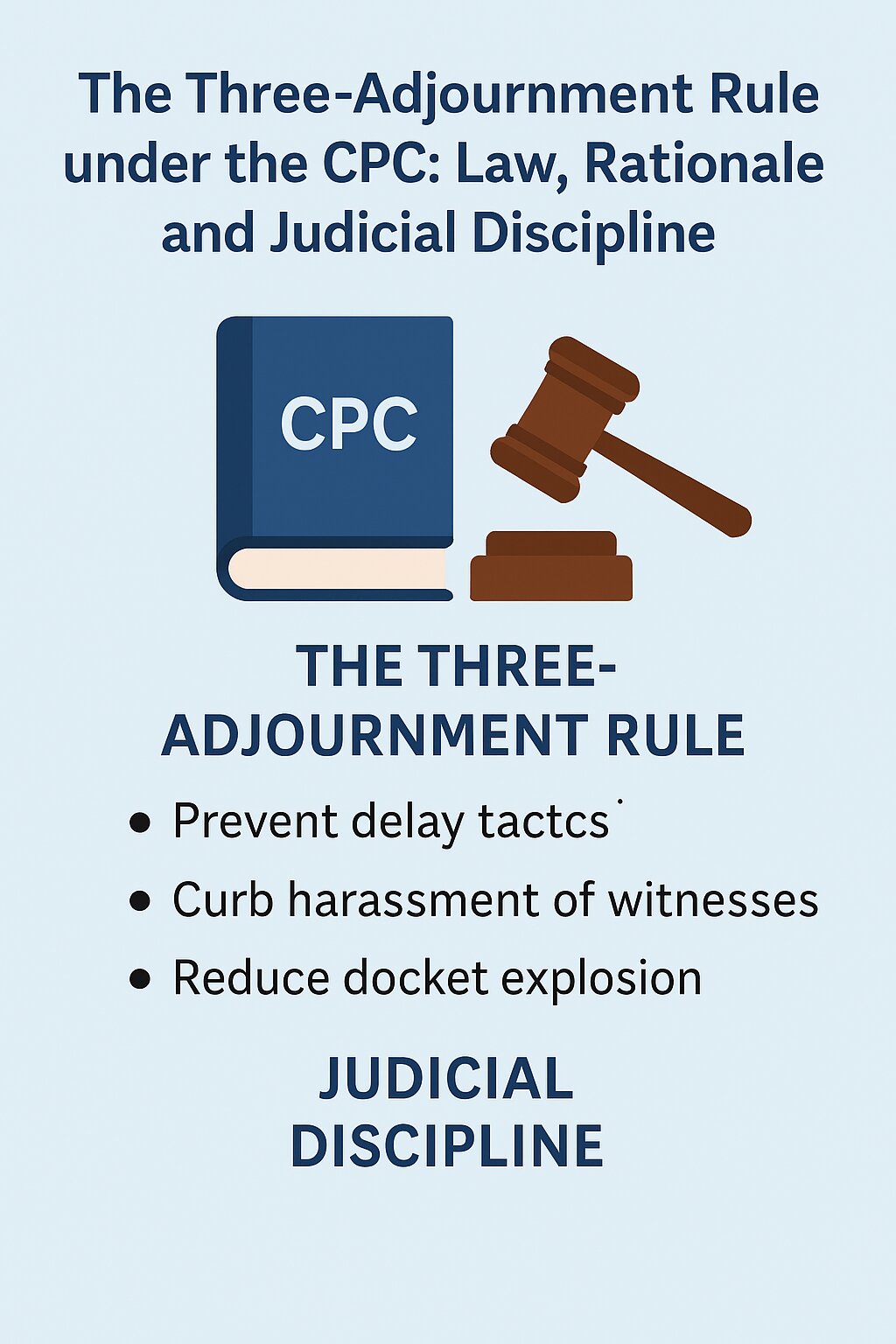
The legislature introduced the Three‑Adjournment Rule to prevent delay tactics, curb harassment of witnesses, reduce the growing backlog of cases, and uphold the constitutional mandate of speedy justice under Article 21. By limiting adjournments, the law seeks to instill discipline in trial proceedings and ensure efficiency. The Supreme Court has repeatedly emphasized that adjournments should remain the exception, not the norm, reinforcing the principle that justice delayed is justice denied.
Applicability to Criminal Cases
The Three‑Adjournment Rule under Order XVII Rule 1 CPC applies specifically to civil proceedings. Criminal trials are governed by the Bhartiya Nagarik Suraksha Sanhita, 2023 (BNSS), which does not impose a similar numerical limit on adjournments. However, the Supreme Court has emphasized that even in criminal cases, adjournments should be granted only for valid reasons and not as a routine practice. Thus, while the rule itself is confined to civil suits, the principle of minimizing delay extends to criminal trials as well.
Important Supreme Court Judgments
- Salem Advocate Bar Association v. Union of India: The Supreme Court upheld the constitutionality of the 2002 amendments and clarified that the three‑adjournment rule is valid. Courts retain discretion in exceptional circumstances, but the object is to curb dilatory tactics. The Court emphasized that the provision is directory yet must be strictly followed in spirit.
- Shiv Cotex v. Tirgun Auto Plast Pvt. Ltd.: Here, the trial court granted several adjournments beyond three. The Supreme Court disapproved this practice, holding that courts must enforce the legislative intent. It observed that repeated adjournments defeat the very purpose of the amendment and weaken trial discipline.
- Bagai Construction v. Gupta Building Material Store: In this case, evidence was repeatedly delayed. The Supreme Court refused further indulgence and held that courts must maintain procedural discipline. The principle laid down was that procedural law is meant to advance justice, not to be exploited for delay.
- Mohammad Yusuf v. Faij Mohammad: The Court reiterated that adjournments should not be granted routinely and stressed that costs imposed must be realistic. This reinforced the idea that judicial discretion must be exercised responsibly to prevent misuse of adjournments.
Illustrative Examples
Valid Adjournment: If a key witness meets with an accident on the date fixed for evidence, the first adjournment may be granted. A second adjournment could follow if medical records justify continued absence, and a third may serve as the final indulgence. However, if a fourth request is made without compelling reason, it should ordinarily be rejected to maintain trial discipline.
Dilatory Tactic: When a defendant repeatedly seeks adjournments with excuses such as counsel being busy, files not traceable, or the party being out of station, the court should act firmly. After three adjournments, it may close evidence, proceed ex parte, or impose heavy costs to prevent misuse and ensure timely justice.
Exceptional Circumstance: In rare situations, such as a natural calamity or pandemic-related closure disrupting court functioning, the rule allows flexibility. Even if three adjournments are exhausted, the court may grant further time by exercising judicial discretion, provided special reasons are recorded. This ensures fairness while preserving the spirit of discipline.
Is the Rule Mandatory or Directory?
The Supreme Court has clarified that the Three‑Adjournment Rule is directory in exceptional cases, but mandatory in spirit. Courts must not treat it casually, and any deviation requires strong justification. In practice, this means the rule is not an inflexible bar, yet judges are expected to enforce it strictly, allowing exceptions only when genuine circumstances demand. This balanced interpretation ensures discipline in trials while safeguarding fairness in extraordinary situations.
Consequences of Violation
If adjournments exceed three without proper reasons recorded, higher courts may intervene, proceedings can be set aside, and questions may arise about judicial discipline. This undermines the purpose of the rule, which is to ensure fairness and efficiency in trials, and highlights the importance of judges exercising discretion responsibly and transparently.
Practical Impact on Trial Courts
The Three‑Adjournment Rule has helped trial courts reduce casual adjournments, encourage stricter scheduling, promote better case management, and impose more realistic costs on parties who delay proceedings. These changes have improved efficiency and discipline in the conduct of trials.
However, the rule’s true effectiveness depends on consistent and strict enforcement. Without firm judicial resolve, adjournments may still be granted mechanically, undermining the purpose of the reform and slowing the delivery of justice.
Critical Evaluation
Advantages
The Three‑Adjournment Rule promotes speedy justice by discouraging unnecessary delays. It reduces harassment of witnesses, who often face repeated summons, and strengthens trial discipline by ensuring proceedings move forward in a structured manner. This helps courts uphold efficiency and credibility in the justice system.
Concerns
At the same time, over‑rigidity may cause hardship in genuine cases where adjournments are unavoidable. Courts also sometimes grant adjournments mechanically, undermining the rule’s intent. Recognizing this, the Supreme Court has advocated a balanced approach—strict but fair—so that discipline is maintained without sacrificing justice.
Recent Contexts Reinforcing the Three-Adjournment Rule
In recent years, the Three-Adjournment Rule under Order XVII Rule 1 CPC has seen renewed emphasis through institutional mechanisms aimed at reducing judicial delays. The Department of Justice’s Ease of Doing Business (EODB) reforms highlight strict adherence in Dedicated Commercial Courts (under the Commercial Courts Act, 2015), where High Courts like Delhi, Bombay, Calcutta, and Karnataka issued advisories directing compliance with the three-adjournment limit and timelines. Reports indicate active enforcement in over 50% of cases in these courts (Delhi, Mumbai, Kolkata, Bengaluru), contributing to faster disposal—e.g., commercial case resolution time dropped significantly from 1,445 days (2020) to 626 days (2022) in some metrics.
Additionally, the e-Committee of the Supreme Court has reinforced the rule via the Case Information System (CIS) software, introducing colour banding (green/orange/red indicators) to flag judges when adjournments approach or exceed three in a case. This tech-driven monitoring promotes accountability and aligns with broader judicial advisories for minimizing routine adjournments, ensuring the rule’s spirit is upheld even in high-volume or commercial litigation.
Conclusion
The Three-Adjournment Rule under Order XVII Rule 1 of the Code of Civil Procedure, 1908 represents a decisive legislative attempt to transform Indian civil trials from a culture of delay to one of discipline. Through the 1999 and 2002 amendments, and judicial affirmation in Salem Advocate Bar Association v. Union of India and Shiv Cotex v. Tirgun Auto Plast Pvt. Ltd., the Supreme Court has clarified that adjournments are not a litigant’s entitlement but a matter of controlled judicial discretion. The rule seeks to balance procedural fairness with the constitutional commitment to speedy justice by preventing tactical delays and ensuring structured progression of trials.
Ultimately, the effectiveness of the Three-Adjournment Rule depends not merely on its statutory wording but on consistent and principled enforcement by courts. While flexibility must remain available in exceptional circumstances, routine or mechanical adjournments undermine both efficiency and public confidence in the justice system. When applied in its true spirit—strict yet fair—the rule strengthens trial management, reduces backlog, and reinforces the foundational principle that justice delayed is justice denied.