





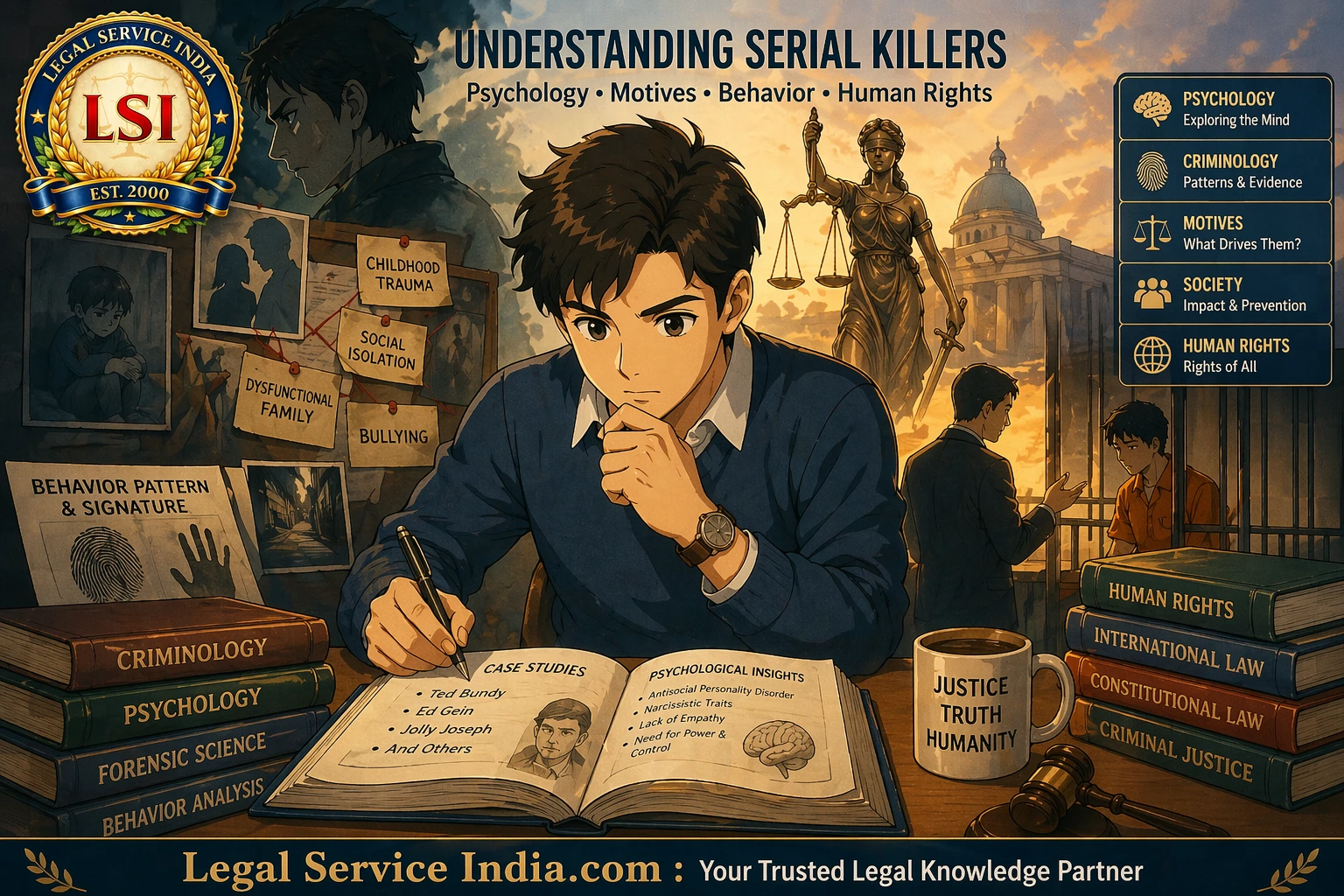
Abstract
In today’s world, when we hear about serial killers, we only think about Netflix series and how brutal they are, but we tend to forget about how much they have to go through to come to this stage. This dissertation will examine the psychological, criminological, and sociological aspects, and it will also focus on the motives and behavior patterns that provoke them.
- Childhood trauma
- Dysfunctional family environments
- Social isolation
- Bullying
It also explores factors like childhood trauma, dysfunctional family environments, social isolation, bullying, and how these factors contribute to the development of serial killers. This study aims to provide a holistic view of serial killers and why they commit repeated murders.
The serial killers depicted in the Netflix series are not only what is shown, but they are far vaster than that. People only know about a sexual serial killer like Dahmer, Ted Bundy, etc., but there are other serial killers, like contract killers, people who kill for money.
Even within a specific category, such as serial killers, there are many different motivations, tactics, instruments, and other distinctions.[1] This dissertation explores serial killers’ thoughts from a human perspective by analyzing psychological traits, societal impacts, and legal concerns.
Human Rights Perspective
It also evaluates the applicability of international human rights standards, such as those found in the Universal Declaration of Human Rights and the International Covenant on Civil and Political Rights, to individuals who have been accused of or convicted of serial killing. The study aims to balance the rights of victims and offenders while understanding the motivations behind serial killings in the context of criminal justice.
Introduction
When a person hears the word serial killer, they only think about a person who is a monster and has killed more than 3 people over a decade or a month. But they don’t think about what the real definition of a serial killer is.
Definition Of Serial Killer
So the real definition of serial killer is “Previous definitions of serial murder specified a certain number of murders, varying from two to ten victims,” according to FBI.gov. A serial murder was distinguished from other types of murder (such as single, double, or triple murder) by this quantitative requirement. A time interval between the killings was also necessary for the majority of the definitions. [1]
“Serial murderers are those who, either alone or with an accomplice, kill at least three people over a period of time, with ‘cooling-off’ periods between the murders, indicating premeditation of each killing,” is the definition of a serial killer. [2]
Behavior Patterns And Signatures
Serial killers are generally identified through their signature move or step they leave on the victim’s body or at a crime scene. Whenever they plan a murder, they plan the whole environment of how to kill and they also chose their victim based on their study.
Psychological Examples
| Serial Killer | Behavior Pattern | Psychological Insight |
|---|---|---|
| Ted Bundy | Asked help from young women | Dominant and controlling nature with sadistic desire for power |
| Ed Gein | Made body suit from a woman’s body | Unresolved issues related to his mother |
Sometimes they chose a victim which shows their psychological problems they are facing, for example, Ted Bundy, who only asked help from young women. After all, he has a nature which is dominant and controlling, and has a deep rooted sadistic desire for absolute power over females, another example of Ed Gein, he made a body suit from a woman’s body because he has unresolved issues related to his mother.
Importance Of Study
By studying the factors of serial killers, it will be easier for researchers and legal professionals to understand the criminal intent and behavior of serial killers. It will also help them develop the best strategies for crime prevention and assist in delivering justice.
The Fascination Of Society With Serial Killers
Serial killers perform horrible atrocities that can shame society, yet they frequently excite fascination as well as revulsion and fear. The public is interested in learning more about them and looking into the motivations behind their acts, which have harmed the victims and their families. For individuals and society as a whole, this is the only explanation. The public’s infatuation with serial killers is demonstrated by the abundance of books, TV shows, podcasts, and movies about them. Serial killers are an excellent source of material for the popular genre “crime happened in real life.” This may also lead to attraction and curiosity about serial killers.
A fascination with serial killers satisfies this psychological need since our brains are hardwired to remain alert for disaster. When experienced in a secure setting, the rush of excitement that real crime frequently offers can be enjoyable. Because serial killers sometimes appear “normal” until they are apprehended, people may be encouraged to study the “signs” to avoid discovery.
Too much media attention can sometimes overshadow what has happened to the victim kind of mental suffering the victim and their families have gone through. When we hear these references that are conveyed to us in songs and on screen, we become absorbed in the tales of the serial killers and the high-stakes terror that sets them apart.[1] Well, many experts have identified this obsession as hybristophillia, which is an arousal towards a person who has committed something outrageous or forbidden, and is most commonly associated with females who write letters to men in prison. The human mind is complex and research-oriented. It works 24 hours, and sometimes these minds only prove to be research on serial killers, which leads to this kind of fascination.
Theories Explaining The Motive Of Serial Killings
Biological Theories
a. Lombroso’s Theory
Cesare Lombroso was a 19th-century Italian criminologist often called the father of modern criminology. He believed that criminals are born, not made. Physical traits like facial features and skull size supported his idea. However, his theories are now considered outdated due to advances in psychology and other fields. It’s also said that his theory is unscientific; his work was an early attempt to study crime through observation and data collection. He gathered data from prisoners and autopsies to identify biological patterns, believing anatomy revealed moral character—though this evidence was deeply flawed. Most criminologists before Lombroso focused on laws, moral responsibility, and abstract concepts of justice. Lombroso rejected this approach and embraced empirical, scientific observation. He argued that researchers should examine both the body and mind of offenders to understand crime.
b. Genetic Predisposition
Genetic predisposition, which can affect both biological risk and the influence of environmental or behavioral factors on health outcomes, is the inherited propensity of developing specific diseases or disorders because of one’s genetic composition.[1] It means that a specific type of individual may inherit biological traits that make them develop some kind of behavior which is different from normal human and they also develop psychological tendencies which is alsi different from the human.
- Inherited biological traits may influence abnormal behavior patterns
- Psychological tendencies may differ from normal human behavior
- Extreme traits may include aggressive nature, violent behavior, or antisocial behavior
The theory explains that some human develop some psychological or biological traits which is extreme in nature for example aggressive nature, violent behavior, or antisocial behavior. Most of the most common and dangerous serial killers had a genetic predisposition to act in an antisocial manner and were raised in a setting that fostered a disdain for other people’s lives.[2] This concept is studied in disciplines like genetics and criminology. Well, it is important to know that genetic predisposition doesn’t mean that the person is meant to be serial killer it is just a small part to know about a person thoroughly. Rather it means that certain genes are inherited which may create alarming risk when connected to the environment and society.
c. Brain Dysfunction
According to this view, criminal behavior may be influenced by neurological issues, such as brain damage or anomalies in brain function. Important brain regions that govern empathy, impulse control, and decision-making are especially important for comprehending criminal behavior.
| Brain Area | Function | Impact on Behavior |
|---|---|---|
| Prefrontal Cortex | Moral judgment, self-control | Reduced control may lead to violent acts |
| Social Cognition Areas | Understanding others | Reduced empathy |
| Emotional Processing Regions | Emotional regulation | Increased impulsivity |
Studies have revealed that anomalies in areas such as the prefrontal cortex, which is in charge of moral judgment and self-control, may be a major factor in the violent acts of serial killers. A serial killer’s lack of impulse control and moral thinking may be attributed to brain damage, developmental abnormalities, or neurological dysfunctions.[1]
Murderers’ brains differ from those of those convicted of other crimes; these differences may be related to how they interpret morality and empathy. A prominent neuroscientist from the University of Chicago co-authored a recent study that examined brain scans of over 800 convicted men and discovered that those who had committed or attempted homicide had less gray matter than those who had committed other crimes. These decreases were particularly noticeable in areas of the brain linked to social cognition, behavioral regulation, and emotional processing.[2]
The brain dysfunction means that specific individuals take part in utmost violent acts like serial killing of murder which can be due to their structural or functional impairments in their brain.
2. Psychological Theories
a. Psychodynamic Theory
According to Sigmund Freud’s psychodynamic theory, early experiences—especially those involving trauma or neglect—have an impact on an adult’s conduct. According to Freud, maladaptive behaviors like violence or hostility can be the result of unresolved unconscious tensions from infancy. Freud’s theories may be supported by the fact that many serial killers describe early life trauma, including physical or sexual assault. These early events may cause deep-seated unconscious tensions that later show up as violent tendencies when the person tries to use criminal activity to cope with prior traumas.[1]
The unconscious motivations that underlie a person’s personality and conduct are the main focus of psychodynamic theories. Childhood experiences are thought to have a significant impact on an individual’s personality, conduct, and psychological thinking later in life, especially when it comes to psychological distress and dysfunction. Understanding the function of the unconscious is thought to depend on Freud’s drive theory, which involves the three states of being (id, ego, and superego). The superego is the conscious moral reasoning based on one’s moral standards and society’s values, the id is the unconscious that pursues self-gratification and feeds impulses, and the ego acts as a mediator between the id and the superego, attempting to make decisions based on the id’s instincts.[2]
- Id: The unconscious part that seeks immediate gratification and drives impulses.
- Ego: The mediator that balances instinctual desires with reality.
- Superego: The moral conscience shaped by societal values and ethics.
b. Anti-Social Personality Disorder
Antisocial personality disorder, often known as sociopath, is a mental illness in which a person continuously disregards morality and other people’s rights and emotions. Antisocial personality disorder sufferers frequently intentionally infuriate or disturb other people, manipulate them, or treat them cruelly or indifferently. They don’t feel regret for their actions. Antisocial personality disorder sufferers frequently break the law and turn into criminals. They may lie, act impulsively or violently, and struggle with alcohol and drug abuse. They struggle to regularly fulfill obligations to their families, jobs, or educational institutions.[1]
Typically, antisocial personality disorder starts before the age of fifteen. Conduct disorder is the initial diagnosis. A pattern of violent or disobedient behavior that might cause harm to others is exhibited by children with conduct disorder. They might steal, lie, disobey the law, or harass other kids. Animal abuse and starting fires are two behaviors that are indicative of ASPD in children.[2]
| Aspect | Description |
|---|---|
| Core Trait | Disregard for others’ rights and emotions |
| Behavior | Manipulation, aggression, impulsivity |
| Legal Issues | Frequent law-breaking and criminal tendencies |
| Onset | Before age 15 (Conduct Disorder) |
c. Attachment Theory
Attachment theory is a psychological theory of emotional connections and relationships among individuals. It examines early attachment patterns developed in childhood and their impact on trust, intimacy, and behavior in relationships with a partner in adulthood. Attachment theory holds that individuals are born with a desire to seek intimacy and safety with caregivers. Such initial attachments form the basis of subsequent relationships and still affect attachments later in life. The nature of these early attachments may determine the manner in which individuals interact with others, such as the extent to which they feel secure, anxious or avoidant in intimate relationships.[1]
This theory elucidates how a child is cared for through his mother, which means the early emotional bond between the mother and child influences child development. This helps the child in developing of forming emotional connections with others and also helps in the overall development and behavior of the person in society. This theory is studied in psychology and in criminology also because it helps in understanding the person’s past how his/her early relationship has formed the personality and behavior.
- Secure Attachment: Healthy emotional bonds and trust in relationships.
- Anxious Attachment: Fear of abandonment and dependency.
- Avoidant Attachment: Emotional distance and difficulty trusting others.
3. Sociological Theories
The sociological theories of crime concentrate on the influence of crime by social structures and variables instead of individual characteristics. Unlike psychological or biological perspectives, sociological perspectives focus on the impact of institutions, interactions and societal conditions on the decisions and actions of people.
- Influence of social structures
- Impact of institutions and interactions
- Role of societal conditions in shaping behavior
These perceptions propose that injustices within the society, the absence of a community spirit, absence of economic prospects or the burdens that individuals face within the social environments are all typical causes of crime.[1]
Crime is socially related and is not merely a form of deviance by an individual. Rather, crime is considered as a reaction to multiple environmental and structural factors which influence both individuals and groups.
The sociological explanations of crime are attempts to explain the causes of crime in terms of social factors:
- Interrelations
- Systems
- Conventions
- Inequalities
They explain that crime is not a one-off event but a creation of the society where it occurs. Crime is characterized by considering the ways in which different aspects of society like class stratification, cultural values and institutions contribute to conditions that increase the probability or even acceptability of crime.
Sociologists have developed several hypotheses to explain criminality and each of these hypotheses presents different approaches to the social processes that occur.
This theory study the how society is shaped. How a person behaves while living in the society and also how society influences the person in violent act.
Sociological theory in crime helps in study theories that explain how a person’s behavior is the result of the social structure and environmental influences.
4. Human Rights Approach To Serial Killers
The human rights perspective of serial killers is the study of how the legal system, the society and the government react to these types of criminals and yet maintain the principles of human rights.
This topic leads to a very significant question in Criminology and Human Rights Law:
How Can Society Be Able To Both Guarantee Justice To The Victims As Well As Safeguard The Rights Of Even The Most Heinous Of The Offenders?
Serial killers do not appear to be deserving of rights at first sight since their crimes are too gruesome and cruel. The contemporary systems of law, however, are founded on the fact that the rights of humanity are universal and are applicable to everyone, irrespective of what one does.
International organizations like the United Nations and documents like the Universal Declaration of Human Rights highly endorse this concept.
a. Right To Life And The Death Penalty
The Human Rights Act’s Article 2 safeguards your right to life. This means that nobody can even attempt to kill you, including the government.
- Government must protect life through laws
- Authorities must intervene in life-threatening situations
- Decisions impacting life must be carefully evaluated
It also implies that in case your life is under threat the government ought to take action to safeguard you by passing laws that safeguard you and in some instances, by intervening to save you.
Your right to life should also be considered when the officials in the government make decisions that may jeopardize you or even cut short your life.
An investigation may be ordered in case a member of your family dies under state-related circumstances. Also, the state has to investigate suspicious deaths, such as those that happen when an individual is kept in custody.
According to judicial rulings, the right to die is not part of the right to life.[1]
The death penalty denies the fundamental human right that states should acknowledge the right to life.
b. Right To Fair Trial
A fair trial is recognized under Article 10. However, it is only possible for a fair trial to be conducted when the proceedings take place in an open court, where there is a neutral and independent judge presiding over the hearing.
- Open court proceedings
- Neutral and independent judiciary
- Presumption of innocence
A fair trial right is entrenched within the rights set out under Articles 6, 7, 8, and 9 of the UDHR, and it is among the civil and political rights.
Besides, everyone is assumed to be innocent until it is proved otherwise under Article 11.
Social and political activities can only be undertaken through civil and political rights. This set of rights also ensures that individuals cannot be subjected to arbitrary oppression, discrimination, and government intervention.
A suspect involved in a criminal process enjoys his/her rights as stated under Article 10. Every individual needs to be able to present their own defense should they face allegations of misconduct.[1]
The right to a fair trial and an independent tribunal is found in Article 14 of the International Covenant on Civil and Political Rights external link (ICCPR).
c. Protection From Torture And Inhumane Treatment
Article 5 Torture and cruel, inhuman, or humiliating treatment or punishment is forbidden. The main argument presented in this article is that torture is prohibited.
- No physical torture
- No psychological coercion
- No inhumane punishment
The use of severe physical or psychological suffering by the government or on its behalf to coerce a confession or create fear is known as torture. This term is used by the United Nations Convention against torture.
This paper is composed in such a manner that the prohibition cannot be broken–even in case of an emergency. It is highly prohibited.
Torture is also prohibited in article 7 of the 1966 International Covenant on Civil and Political Rights (ICCPR).
There is a certain addition to the ICCPR: no one shall, without his free consent, be subjected to medical or scientific experimentation.[1]
The protection from cruelty and inhumane treatment ensures that every convicted person, whether a serial killer, has to be treated with basic dignity and humanity.
It is a fundamental human right; it applies to all human beings. This ensures that the justice system is lawful and will protect a person’s humanity.
This right is recognized under international frameworks such as the Universal Declaration of Human Rights and even in United Nations conventions.
5. Case Studies
a. Ted Bundy (The Campus Killer)
The only few villains that have attracted the attention of the people are Ted Bundy, one of the most prolific and mysterious serial killers in America. Beginning in 1974–and perhaps earlier–Bundy executed dozens of brutal, inhuman murders throughout the United States. But he was able to escape suspicion even from experienced homicide investigators with his pleasant manner, law-school attitude, and handsome, well-dressed appearance. The two jail escapes that Bundy managed to succeed in won him some publicity, but after assaults in a college town in Florida where two women were killed and three others severely beaten, his fate was sealed, and he was captured.[1] The life of Bundy in his early years was not easy; he had a strained relationship with his stepfather and was often bullied because of his timidity.
- Active Period: Beginning in 1974 (and perhaps earlier)
- Criminal Pattern: Dozens of brutal murders across the United States
- Key Traits: Pleasant manner, law-school attitude, well-dressed appearance
- Turning Point: Florida college town assaults
- Outcome: Captured after increased public attention
b. Ed Gein (Butcher of Plainfield)
Ed Gein, also referred to as the Butcher of Plainfield, was an American criminal whose life and activities greatly contributed to the psychology of crimes and popular culture. Born in 1906, he had a troubled childhood because of his abusive father and extremely religious mother who instilled in him a strong aversion towards sex. Gein was deteriorated mentally after the death of his mother and other relatives in 1945 and he engaged in several heinous crimes. He was discovered to have dug up bodies from nearby cemeteries and used their remains to make a variety of grotesque objects, such as clothing and furniture made of human skin. He is suspected of murdering at least two women.In 1957, Gein was arrested when the police discovered the body of Bernice Worden and some of the preserved body parts of some women on his farm. He was eventually found guilty of murder but exonerated due to insanity after being initially ruled incapable to stand trial. Gein died in 1984 after spending the rest of his life in mental hospitals.
- Nickname: Butcher of Plainfield
- Birth Year: 1906
- Psychological Background: Abusive father and extremely religious mother
- Criminal Activities: Grave robbing and creation of objects from human remains
- Arrest: 1957 (Discovery of Bernice Worden’s body)
- Legal Outcome: Found guilty but exonerated due to insanity
- Death: 1984 in mental hospital
c. Jolley Joseph (Jolly Cyanide)
Police allege that Jolly Joseph has confessed to murdering six of her relatives during a span of 14 years, his husband, parents, and a 2-year-old niece. According to the authorities, she is accused of trying to inherit valuable property and other assets belonging to the family she married into and that she will be charged with six counts of premeditated murder. The authorities believe that she is among the most cunning serial killers in India and her weapon of choice is cyanide which is delivered in soups, snacks and Ayurveda beverages.[1] Psychologically, the case brings in issues of motive and personality traits. Although the precise motive is one that is determined by the courts of law, potential reasons have been brought up and they are: monetary benefit, ownership of family assets, and individual disputes.
- Allegations: Murder of six relatives over 14 years
- Victims: Husband, parents, and a 2-year-old niece
- Suspected Motive: Property inheritance and financial gain
- Method: Cyanide poisoning in food and beverages
- Psychological Aspects: Motive, personality traits, and family disputes
Comparative Analysis Of Case Studies
| Case | Location | Primary Motive | Method | Psychological Factors |
|---|---|---|---|---|
| Ted Bundy | United States | Unclear / Psychological Urges | Physical Violence | Charm, Manipulation, Dual Personality |
| Ed Gein | United States | Psychological Trauma | Grave Robbing / Murder | Isolation, Maternal Influence, Mental Illness |
| Jolly Joseph | India | Financial Gain | Cyanide Poisoning | Greed, Family Conflict, Calculated Behavior |
Conclusion
The analysis of serial murders is one of the most difficult and disturbing fields in the sphere of Criminology and Psychology. This project has covered different aspects of serial killing such as behavioural patterns, psychological theories, motives, case studies and the human rights perspective. With this detailed study, it is clear that serial killing is not a result of one factor and therefore, it is a combination of biological, psychological, and sociological factors.
End Notes:
- https://www.nytimes.com/2019/10/19/world/asia/india-koodathayai-murder.html
- https://www.aetv.com/articles/ted-bundy
- https://www.uu.nl/en/education/universal-declaration-of-human-rights-75-years/udhr-in-words-and-images/udhr-articles-1-30/article-5-prohibition-of-torture
- https://www.uu.nl/en/education/universal-declaration-of-human-rights-75-years/udhr-in-words-and-images/udhr-articles-1-30/article-10-fair-trial
- https://www.equalityhumanrights.com/human-rights/human-rights-act/article-2-right-life
- https://lawbhoomi.com/sociological-theories-of-crime/
- https://www.verywellmind.com/what-is-attachment-theory-2795337
- https://www.mayoclinic.org/diseases-conditions/antisocial-personality-disorder/symptoms-causes/syc-20353928
- https://my.clevelandclinic.org/health/diseases/9657-antisocial-personality-disorder
- https://csi.pressbooks.pub/uncserkill/chapter/chapter-2-criminological-theories-and-serial-killers/
- https://www.sciencedirect.com/topics/social-sciences/psychodynamic-theory
- https://news.uchicago.edu/story/scientists-studied-brains-more-800-prisoners-heres-what-they-found
- https://www.sciencedirect.com/topics/social-sciences/genetic-predisposition
- https://www.psychologytoday.com/us/blog/the-superhuman-mind/201803/do-all-serial-killers-have-a-genetic-predisposition-to-kill
- https://www.queensjournal.ca/piecing-the-puzzle-together-societys-fascination-with-serial-killers/
- https://csi.pressbooks.pub/uncserkill/chapter/chapter-1-what-is-a-serial-killer/
- https://www.hoganassessments.com/blog/personality-serial-killers/

