





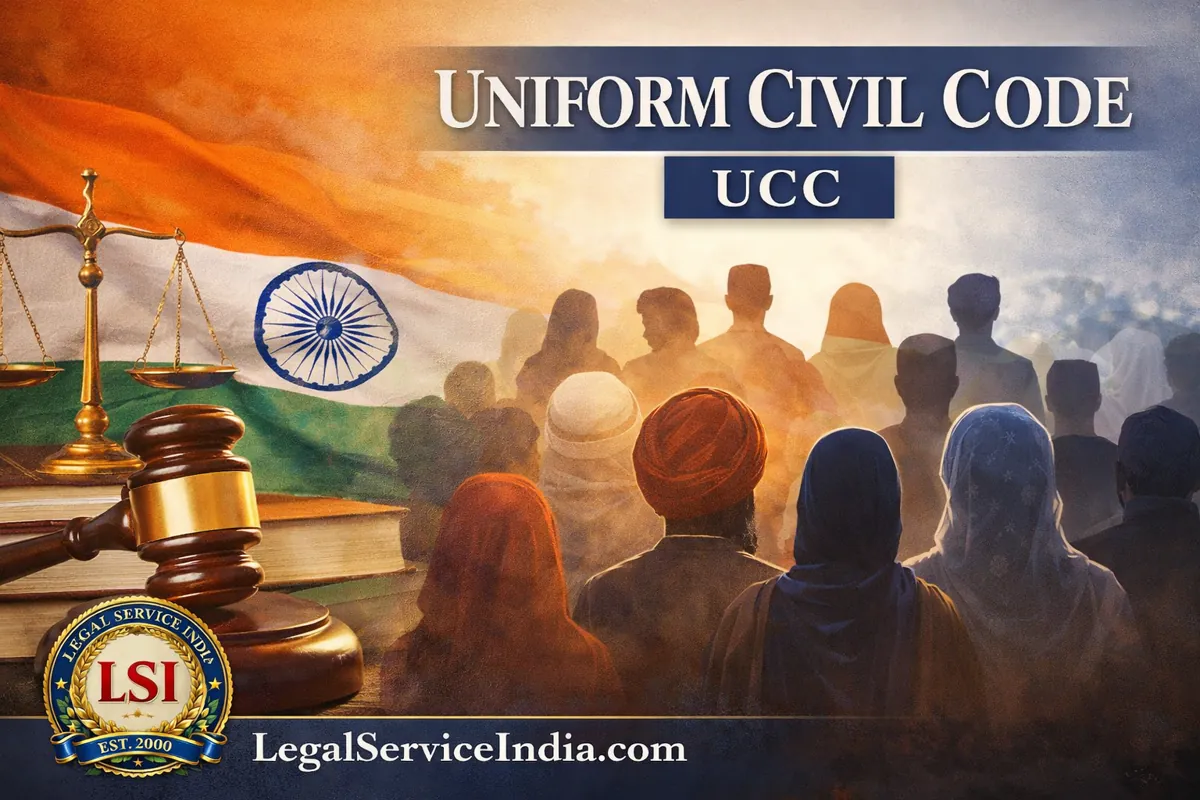
The Debate Surrounding The Implementation Of A Uniform Civil Code (UCC) In India
The debate surrounding the implementation of a Uniform Civil Code (UCC) in India is one of the most profound and persistent constitutional, legal, and social discussions in the nation’s history. At its heart, the UCC represents a constitutional ideal: the vision of a common set of civil laws governing crucial personal matters such as marriage, divorce, inheritance, adoption, and maintenance for all citizens, irrespective of their religious affiliation.
This pursuit is fundamentally rooted in the constitutional pillars of equality, justice, and the ambition for genuine national integration. While India prides itself on its secular fabric, personal laws remain governed by a diverse, and often conflicting, array of religious customs. The UCC seeks to address the legal diversity and inherent inequalities arising from this fragmented system by replacing it with a uniform legal framework grounded firmly in constitutional values.
Historical Background Of The Uniform Civil Code
The roots of the UCC debate extend deep into India’s legal and political past, highlighting an enduring tension between religious tradition and the modernist imperative for a unified legal system.
Pre-Independence Period
Prior to British colonial rule, the subcontinent was a patchwork of diverse customary laws that varied significantly by region, caste, and community. The British administration, adopting a policy of non-interference in religious and personal matters—primarily to maintain political stability and avoid widespread unrest—allowed different communities to largely follow their personal laws.
This established a critical distinction in colonial law. The British, however, recognized the necessity of order and governance, and consequently introduced uniform criminal laws. This act, of unifying the criminal domain while leaving the civil domain fragmented along religious lines, laid the groundwork for the modern debate and institutionalized the dichotomy between secular public law and religious private law.
The Constituent Assembly Debates
The framing of the Constitution in the post-independence era brought the issue of UCC to a critical juncture. The debate in the Constituent Assembly was intense, pitting the desire for a modern, egalitarian state against the concerns of religious autonomy and cultural preservation.
Visionary leaders and reformers like Dr. B.R. Ambedkar, who chaired the Drafting Committee, Jawaharlal Nehru, India’s first Prime Minister, and K.M. Munshi, were staunch proponents of the UCC. They viewed it as an indispensable tool for achieving social reform, ensuring gender parity, and cementing national unity. Their argument centered on the idea that personal freedoms and civil rights should not be subordinate to the dictates of religious customs.
Conversely, a segment of the assembly expressed deep reservations, fearing that the imposition of a uniform code would be perceived as an infringement upon the fundamental right to religious freedom and the distinct cultural identities of various communities.
The outcome was a political compromise that defined the future course of the debate: the UCC was placed under Article 44 in Part IV of the Constitution, the Directive Principles of State Policy (DPSP).
Constitutional Placement Of UCC Under Article 44
| Aspect | Explanation |
|---|---|
| Article | Article 44 of the Constitution of India |
| Part Of Constitution | Part IV – Directive Principles of State Policy (DPSP) |
| Nature | Non-Justiciable |
| Implication | No citizen can compel the state to implement it through a court of law |
| Purpose | An aspirational goal for the state to strive for while governing |
This classification rendered the UCC non-justiciable—meaning no citizen could compel the state to implement it through a court of law—but simultaneously stamped it as an aspirational goal for the state to strive for in its governance.
This placement reflects the foundational tension:
- Recognizing the UCC’s constitutional merit
- Respecting the political sensitivities of a newly formed, diverse republic
Post-Independence Developments
Following independence, the nascent government, despite the non-justiciable status of Article 44, proceeded with selective, yet monumental, legal reforms.
The most significant of these were the Hindu Code Bills in the 1950s. These bills dramatically modernized and codified Hindu personal laws, granting Hindu women unprecedented rights in marriage, divorce, and inheritance.
Key Features Of The Hindu Code Bills
- Modernization and codification of Hindu personal laws
- Expanded legal rights for Hindu women
- Recognition of divorce through legal procedures
- Reform of inheritance rights
- Outlawing discriminatory practices such as polygamy
While this reform was a major step towards uniformity within the Hindu community, it simultaneously reinforced the uneven legal landscape.
The personal laws of other communities, particularly the Muslim community, largely remained untouched, a decision driven by political cautiousness and minority concerns.
This disparity instantly led to debates on unequal treatment and served to reinforce the constitutional and moral imperative for a comprehensive UCC.
The Constitutional And Social Imperative For UCC
The arguments in favour of the Uniform Civil Code are multi-faceted, rooted in fundamental principles of human rights, constitutional law, and the practical demands of a modern state.
Equality Before Law (Article 14)
The foremost constitutional argument for the UCC lies in Article 14, which guarantees equality before the law and equal protection of the laws to all persons within the territory of India. The existence of diverse personal laws directly contradicts this principle. Under the current fragmented system, the legal rights, remedies, and outcomes for citizens in matters like property division or maintenance can depend solely on their religion, rather than universal standards of justice.
The UCC aims to dismantle this religious basis for civil rights, ensuring that every citizen enjoys equal civil rights and obligations under a single, secular statute, thereby honouring the supreme mandate of the Constitution.
Gender Justice And Dignity (Articles 14, 15, And 21)
A critical and powerful motivation for the UCC is the promotion of gender justice. Numerous provisions within various personal laws, which are often archaic or patriarchal, contain inherent biases that discriminate against women. This is evident in matters relating to the grounds for divorce, the quantum of maintenance, and, most starkly, inheritance rights.
For example, traditional laws in certain communities grant women a lesser share of ancestral property than men or make divorce proceedings disproportionately difficult for them.
By establishing a uniform code based on equity and human dignity, the UCC seeks to eliminate these systemic inequalities. It aligns personal law with fundamental rights, particularly:
- Article 15 (prohibition of discrimination on grounds of religion or sex)
- Article 21 (right to life and personal liberty, interpreted to include the right to dignity)
The goal is to ensure that gender equality, a non-negotiable constitutional value, permeates the most intimate aspects of an individual’s life.
National Integration And Common Citizenship
The creation of a common civil code is viewed as an essential step toward strengthening the feeling of unity and common citizenship. A shared national identity is often fostered through shared civic institutions and laws.
When the civil domain—the space that governs how citizens marry, raise families, and manage property—is governed by different religious texts, it inadvertently fosters religious fragmentation and emphasizes community divisions over national allegiance.
A secular, common civil code would:
- Reduce religious fragmentation in civil matters
- Create a shared national legal framework
- Encourage citizens from all backgrounds to operate under a common legal language
- Reinforce the idea of a cohesive and unified nation
Simplification And Efficiency Of The Legal System
From a purely jurisprudential and administrative perspective, the multitude of personal laws creates immense confusion and complexity for the judiciary, lawyers, and the general public.
Judges must often interpret and apply different, sometimes conflicting, laws based on the religious background of the litigants.
This complex, multi-layered system is a significant barrier to justice because it makes the law:
- Less accessible
- Less predictable
- Less efficient
The UCC would simplify the civil legal landscape, making it more streamlined, transparent, and easier for the common person to understand and navigate.
Protection Of Individual Rights Over Group Rights
A central tenet of modern liberal democracy is the prioritization of individual rights over the rights of a group or community. Traditional personal laws often derive their authority from customs and religious texts, which may not prioritize the individual’s autonomy or freedom.
When a community’s customs curtail a member’s fundamental rights (for example, through pressure against inter-faith marriage or discriminatory inheritance rules), the state has a duty to intervene.
The UCC ensures that the individual’s constitutional rights are paramount, including:
- Personal freedom
- Dignity
- Autonomy
These rights cannot be curtailed by regressive or outdated customs enforced by the group.
Effects Of A Uniform Civil Code
The introduction of the UCC would generate profound and interconnected changes across the social, legal, and cultural dimensions of Indian society.
Social Effects
The social impact of the UCC would be primarily progressive and modernizing. It would encourage progressive social reforms by establishing a baseline of equitable practices across the nation.
By mandating principles such as:
- Equal inheritance for sons and daughters
- Non-discriminatory divorce laws
the UCC would systematically reduce discriminatory practices within communities.
Most importantly, it would significantly promote gender equality and child rights, ensuring that the best interests of women and children are protected by a secular law, free from customary pressures.
For instance, mandatory registration of marriages and live-in relationships, as seen in the Uttarakhand model, enhances the legal security and rights of vulnerable partners and their children.
Legal Effects
The legal landscape would be transformed by the uniform application of civil laws, ensuring judicial consistency and predictability nationwide.
This uniformity would lead to:
- A substantial reduction in legal ambiguity
- Less dependence on multiple religious texts
- Greater clarity in judicial interpretation
Ultimately, the successful implementation of the UCC would constitute a major victory for strengthened constitutional supremacy, establishing that the Constitution, and its values of equality and justice, stand above all other legal sources in matters of civil rights.
Cultural Effects
Culturally, the UCC would facilitate a gradual but decisive shift from religious identity to a civic identity in civil matters.
Personal faith and religious practice would remain robustly protected under Article 25 (Freedom of Conscience and Free Profession, Practice, and Propagation of Religion), but the legal framework governing citizenship rights would be uniformly civic.
This would lead to:
- A balanced coexistence of secular law and religious freedom
- Equal civil rights for all citizens
- Respect for the private sphere of religion
The UCC is not intended to homogenize cultures, but rather to establish a common civic floor of rights upon which diverse cultures can stand equally.
State and Judicial Achievements
The notion that the UCC is a utopian or unachievable ideal is countered by significant historical and contemporary evidence of its partial implementation and successful operation.
The Goa Civil Code: A Historical Precedent
Goa stands as India’s foremost and oldest example of a successful UCC. This code, inherited from the Portuguese colonial administration, has been in force for over a century and was retained after Goa’s liberation in 1961. The Goa Civil Code proves that a uniform system can coexist harmoniously with India’s cultural diversity. Key features include:
| Feature | Description |
|---|---|
| Equal Inheritance Rights | The law mandates equal rights for sons and daughters in inherited property, ensuring gender parity. |
| Compulsory Registration | Marriages, irrespective of religion, must be compulsorily registered, adding legal security and transparency. |
| Uniform Divorce Laws | All communities are subject to the same, secular process for divorce. |
| Joint Ownership | Spouses equally share ownership of the assets acquired during the marriage, protecting women’s financial interests. |
The Goa’s experience serves as a powerful model, demonstrating that UCC is not a threat to cultural life but a guarantor of civic justice.
Hindu Code Reforms: Intracommunity Uniformity
While not a nationwide UCC, the post-independence Hindu Code Bills were a massive achievement in legal reform and uniformity within one of India’s largest communities. These reforms effectively established key principles based on constitutional values:
- Monogamy: Prohibiting polygamy and reinforcing spousal dignity.
- Women’s Inheritance Rights: Granting women substantial rights over property.
- Legal Divorce Procedures: Introducing secular, structured, and equitable procedures for the dissolution of marriage.
These acts established the state’s capacity to enact comprehensive legal reform in the personal sphere to achieve constitutional ends.
The Uttarakhand Uniform Civil Code: A Contemporary Test Case
The state of Uttarakhand became the first Indian state post-independence to implement its own UCC (Portuguese Civil Code or Goa Civil Code being inherited). This pioneering initiative provides a modern template and a live test case for the rest of India. Its key achievements and features include:
- Uniform Laws: Comprehensive secular laws for marriage, divorce, inheritance, and succession across all communities within the state (excluding tribal communities, a common legal protection).
- Mandatory Registration: Requirement for mandatory registration of marriages and, controversially but significantly, live-in relationships, offering legal recognition, security, and maintenance rights to partners and children of such unions.
- Absolute Gender Equality: Strict guarantee of equal inheritance rights for sons and daughters, widows, and widowers, with no distinction based on religion or gender.
- Prohibition of Polygamy: Prohibition of polygamy and other discriminatory practices across all communities.
The Uttarakhand model is significant as it demonstrates the practical application of UCC principles, increasing legal clarity, transparency, and protection of women and children against outdated customs. Its success or failure in reconciling reform with public acceptance will undoubtedly shape the future trajectory of the nationwide UCC debate.
Judicial Interventions: The Voice of Constitutional Conscience
The Indian judiciary has repeatedly highlighted the constitutional necessity of the UCC, often using its judgments to resolve conflicts between personal laws and fundamental rights and to urge the Parliament to act on Article 44. These judgments form a powerful body of case law reinforcing the UCC’s urgency.
Shah Bano Case (1985)
In this landmark case, the Supreme Court granted maintenance to Shah Bano, a divorced Muslim woman, under the secular Section 125 of the Criminal Procedure Code (CrPC). The judgment explicitly noted the conflict between her personal law, which limited maintenance to the period of iddat, and her fundamental right to life and dignity. The Court went on to passionately emphasize the need for a UCC to ensure gender justice for all women, stating that a common code would help the cause of national integration by removing diverse loyalties to laws which conflict with the paramount loyalty to the law of the land.
Sarla Mudgal Case (1995)
The Sarla Mudgal case involved Hindu men converting to Islam solely to practice bigamy, thereby circumventing the monogamy provisions of the Hindu Marriage Act. The Court strongly condemned this misuse of religious conversion as a legal loophole for matrimonial fraud. It powerfully reiterated the constitutional necessity of a UCC to prevent such legal maneuverings and reinforce the uniform application of the law of the land, asserting that Article 44 has remained a “dead letter” for too long.
Shayara Bano Case (2017)
In a judgment that marked a decisive victory for gender justice, the Supreme Court declared the practice of instantaneous triple talaq (talaq-e-biddat) unconstitutional. The Court ruled that triple talaq was arbitrary, violated the dignity of Muslim women, and was therefore contrary to fundamental rights under Articles 14, 15, and 21. This decision reinforced the core principle that personal laws are not immune from constitutional scrutiny and must conform to the constitutional values of equality and dignity. The judiciary’s intervention in this case underscored the state’s responsibility to protect citizens from discriminatory religious practices, a primary goal of the UCC.
Uttarakhand UCC Implementation and Legal Security
The contemporary developments surrounding the Uttarakhand UCC, particularly the registration of live-in relationships and uniform inheritance laws, provide a fourth case study. These provisions offer legal security and maintenance rights to vulnerable parties, but they have also sparked essential debates regarding privacy, the definition of marriage, and personal freedom. This implementation demonstrates that while the UCC offers enormous benefits in terms of security and equity, its drafting and execution must be sensitive, consultative, and robust enough to withstand legal and cultural challenges.
Challenges and the Path Forward
Despite the compelling arguments and constitutional mandate, the path to a nationwide UCC is fraught with challenges, primarily stemming from India’s unique social and religious pluralism.
Resistance From Religious And Community Groups
The most significant hurdle is the fierce resistance from various religious and community organizations, particularly minority groups, who view the UCC as an imposition on their religious freedom and cultural autonomy. They often argue that a uniform law will lead to the forced assimilation of their distinct identities into a monolithic legal framework.
The key to addressing this resistance is a process that is genuinely inclusive, transparent, and consultative, ensuring that the final code is not a mere copy-paste of existing laws, but a synthesized, modern law that incorporates the best, most equitable principles from all existing traditions while rejecting all discriminatory elements.
The Myth Of Homogenization
Opponents often frame the UCC as a tool for cultural homogenization, confusing legal uniformity with cultural destruction.
Proponents must clearly articulate that the UCC targets the legal rights of the citizen, not their private religious or cultural practices. Citizens would remain free to practice their rituals, ceremonies, and faiths under Article 25; the UCC would only mandate that the resulting legal status—of being married, divorced, or an heir—is defined by a common secular standard.
Drafting Complexity And Inclusivity
The task of drafting a single code that replaces hundreds of complex, community-specific laws and customs is an immense legislative and jurisprudential challenge.
- The code must be secular and equitable.
- It must be sensitive to genuine customary differences.
- It must not compromise constitutional standards.
It cannot be based on the personal law of any single majority community; rather, it must be a completely new, rights-based statute derived from universal principles of justice.
This requires deep consultation with:
- Legal experts
- Sociologists
- Theologians
- Women’s rights advocates from all communities
Conclusion: A Constitutional Ideal For A Just Society
The Uniform Civil Code is far more than a simple legal reform; it represents the culmination of India’s journey towards becoming a truly secular, egalitarian, and unified republic. It is a constitutional ideal, enshrined in Article 44, aimed fundamentally at achieving equality, justice, and unity for all citizens.
India’s profound diversity, while its greatest strength, should not be allowed to serve as a perpetual barrier to progressive reforms that ensure the dignity and equal rights of its citizens, especially women and children.
The successful experiences of the Goa Civil Code and the recent, pioneering implementation in Uttarakhand, coupled with the continuous, forceful interventions of the judiciary, demonstrate conclusively that the UCC is both feasible and immensely beneficial when conceived and executed thoughtfully.
Key Elements For The Path Forward
| Essential Element | Description |
|---|---|
| Political Will | Strong and committed leadership is necessary to initiate and sustain the reform process. |
| Public Debate | Informed and open national dialogue to address concerns and misconceptions. |
| Inclusive Legislative Process | Consultation with all communities and experts to create a fair and balanced civil code. |
| Rights-Based Framework | A modern legal structure grounded in equality, justice, and constitutional values. |
Such a code would not seek to diminish religious freedom but to elevate civic equality, ensuring that in the public domain of civil rights, the fundamental values of the Constitution—justice, liberty, equality, and fraternity—prevail unambiguously over any discriminatory custom or tradition.
By embracing the Uniform Civil Code, India can solidify its democracy, ensuring that every citizen is treated as an equal under the majestic authority of a single, unifying Law of the Land.

