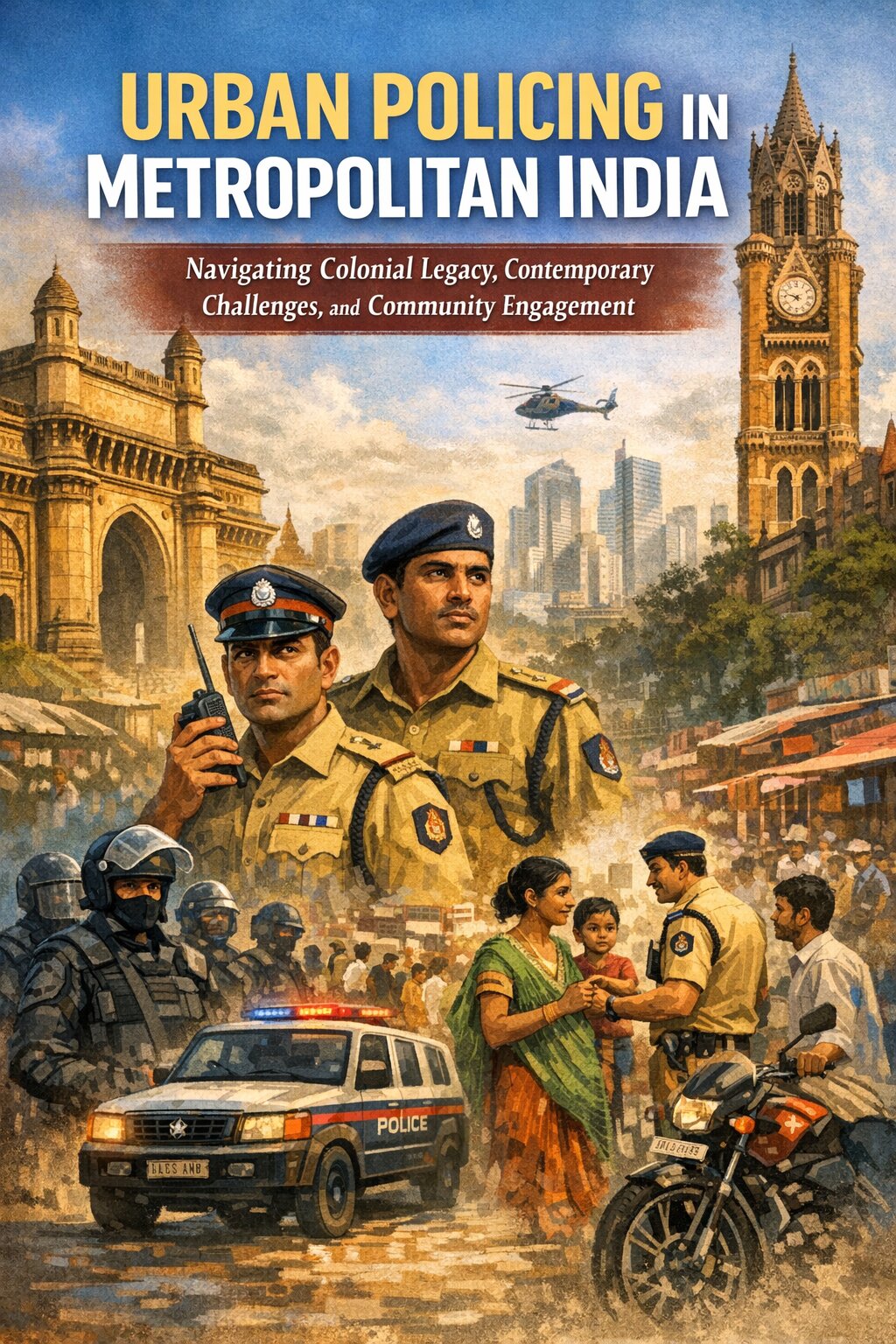
Urban policing in India’s metropolitan centres is shaped by dense populations, social diversity, intense political mobilization, and evolving crime patterns. Many of these cities operate under a Commissionerate System, a model that reflects a complex historical inheritance while adapting to post-independence reforms and contemporary urban realities.
Policing in a major metropolis extends beyond conventional crime control to include:
- Public Order Maintenance: Managing large-scale rallies and religious processions.
- Operational Demands: Handling massive public festivals where millions occupy public spaces.
- Emerging Threats: Specialized responses to cyber offences, narcotics trafficking, and economic crimes.
To meet these challenges, modern urban forces have strengthened preventive and community-oriented strategies through beat policing, “Safe City” CCTV surveillance, and civic volunteer participation. However, persistent manpower shortages, uneven modernization, and concerns over accountability remain significant constraints.
Historical Context and Colonial Legacy
Urban policing in India’s oldest metros originated during the colonial period. The institutional frameworks established in the mid-19th century emphasized order maintenance and surveillance over citizen-focused service, shaping a hierarchical and authority-driven culture.
While objectives shifted toward democratic governance after Independence, many colonial structures—designed to centrally control rapidly expanding port cities and industrial hubs—continue to influence practice. The transition to a truly “service-oriented” model remains a work in progress across India’s metropolitan landscapes.
Organizational Structure: The Commissionerate Model
Most major Indian cities utilize the Commissionerate System to address complex urban needs. Headed by a Commissioner of Police, this system provides greater operational autonomy and faster decision-making than the rural district-based model.
Functional Specialization
Modern metropolitan forces are typically divided into specialized branches:
- Traffic Wing: Managing chronic congestion and road safety.
- Detective/Crime Departments: Investigating heinous and complicated crimes.
- Special Task Forces (STF): Handling high-risk operations, organized crime, and arms recovery.
- Cyber Units: Addressing digital threats via dedicated help lines and forensic labs.
This structure allows a force to balance centralized command with field-level adaptability in diverse urban environments.
Key Functions and Preventive Strategies
The core of urban policing lies in proactive prevention rather than reactive enforcement. Given the historical density of political activism and social diversity in Indian cities, maintaining public order requires a blend of traditional presence and modern tactical innovations.
- Traffic & Mobility Management: Beyond basic regulation, police utilize Adaptive Traffic Control Systems (ATCS), AI-driven violation detection, and “green corridors” to ensure the seamless movement of emergency services through high-congestion zones.
- Large-Scale Event Management: For major festivals and rallies, forces deploy multi-layered cordoning, drone-based crowd density analysis, and integrated command centres to synchronize with fire, medical, and municipal services.
- Specialized Rapid Response: The shift toward mobility is marked by all-women motorcycle patrols (improving accessibility and safety for women) and bike-borne “first responder” units capable of navigating narrow urban lanes where traditional vehicles cannot reach.
- Technology-Led Surveillance: The expansion of Safe City Projects integrates facial recognition, Automated Number Plate Recognition (ANPR), and “smart” poles to create a 360-degree security umbrella in public transport hubs and sensitive zones.
- Data-Driven Resource Allocation: Leveraging predictive crime mapping and advanced analytics to identify geographical “hotspots.” By prioritizing bias-free algorithms and neutral data sets, forces can ensure the strategic deployment of beat patrols during peak hours while upholding the principles of non-discrimination.
- Cyber-Physical Security: Specialized units now monitor digital footprints to prevent “online-to-offline” escalations, ensuring that digital rumors do not manifest into physical urban unrest.
- Disaster & Crisis Resilience: Training and equipping personnel for urban search and rescue (USAR), specialized response to industrial accidents, and building collapses, positioning the police as the primary agency for metropolitan resilience.
Community Policing and Civic Engagement
To rebuild public trust, many forces have shifted toward a collaborative approach. This involves:
- Civic Volunteers: Local residents who assist in traffic regulation and neighbourhood surveillance.
- Vulnerable Group Outreach: Targeted programs for senior citizens (protective monitoring), street children (educational support), and youth engagement (sports and skill-building).
- Women’s Safety: The establishment of specialized police stations and “Safe City” initiatives to ensure a rights-sensitive environment.
- Digital Peacekeeping & Social Media Monitoring: Establishing “Digital Volunteer” groups and community-led fact-checking units to counter the spread of communal rumours and inflammatory content in real-time, preventing digital polarization from turning into physical unrest.
- Participatory Safety Audits: Conducting regular “safety walks” with local resident welfare associations and marginalized groups to identify “dark spots”—areas with poor lighting or infrastructure—where the fear of crime is high, thereby co-creating safer urban spaces.
- Conflict Resolution & Mediation Centres: Setting up community-based mediation cells at the precinct level to resolve petty disputes, domestic grievances, and neighbourhood conflicts before they escalate into formal criminal cases, reducing the burden on the judicial system.
- Institutionalized Feedback Loops: Implementing “Police-Public Interaction Days” and digital feedback systems where citizens can rate their experience at police stations. This data is used to incentivize professional behaviour and identify systemic gaps in service delivery.
- Disaster Management & First Response Integration: Training neighbourhood youth and local shopkeeper associations as certified first responders for urban disasters, such as fires, floods, or building collapses, ensuring an immediate community-led rescue effort before the heavy force arrives.
Modern community policing has evolved from mere ‘presence’ to ‘active partnership.’ By integrating digital literacy, participatory infrastructure audits, and localized mediation, metropolitan forces can transition from a reactive ‘force’ to a proactive ‘service’ that is deeply embedded in the social fabric of the city.
Modernization and Accountability Challenges
Despite advancements, several structural issues impact the efficiency of metropolitan policing:
|
Challenge |
Impact on Policing |
|
Manpower Shortage |
Low police-to-population ratios lead to burnout and limited specialization. |
|
Technological Gaps |
Legacy systems and inadequate training hinder the fight against cybercrime. |
|
Accountability |
Concentrated authority requires stronger internal oversight to maintain public trust. |
|
Privacy Concerns |
The expansion of surveillance networks raises questions about data protection and civil liberties. |
|
The Erosion of Social Cohesion |
The proliferation of divisive and communal narratives through print and digital media is intensifying social fragmentation, posing a direct threat to the pluralistic fabric of urban society. |
|
Preserving Non-Partisan Policing |
The susceptibility of police organizations to polarized social and political media narratives risks the communalization of the force, leading to a breakdown in public trust and the perceived impartiality of urban law enforcement. |
Conclusion and Future Prospects
The future of urban policing in India depends on a transition from an order-centric to a people-centric model. This requires:
- Ethical Technology: Using AI for predictive policing while maintaining transparent legal safeguards and without discrimination against the weaker sections of the society.
- Institutional Reform: Investing in continuous skill development for forensic and digital investigations.
- Sustained Partnerships: Strengthening the bond between the police and the diverse communities they serve.
- Augmenting Force Capacity: Expanding recruitment and deployment capabilities to match the increasing operational pressure on metropolitan law enforcement.
- Cultural Competency Training: Institutionalizing sensitization programs to ensure personnel navigate the diverse social and cultural fabric of the metropolitan environment with empathy and respect.
By balancing historical continuity with modern reform, metropolitan police forces can move toward a model that ensures both public order and the protection of individual rights in an increasingly complex society.