Introduction
Left Wing Extremism (LWE) remains one of the most complex internal security challenges in India, marked by ideological militancy, armed insurgency, and prolonged conflict with the State. While the operational and ideological dimensions of LWE have been extensively studied, the use and position of women within LWE outfits has received comparatively limited yet growing scholarly and policy attention.
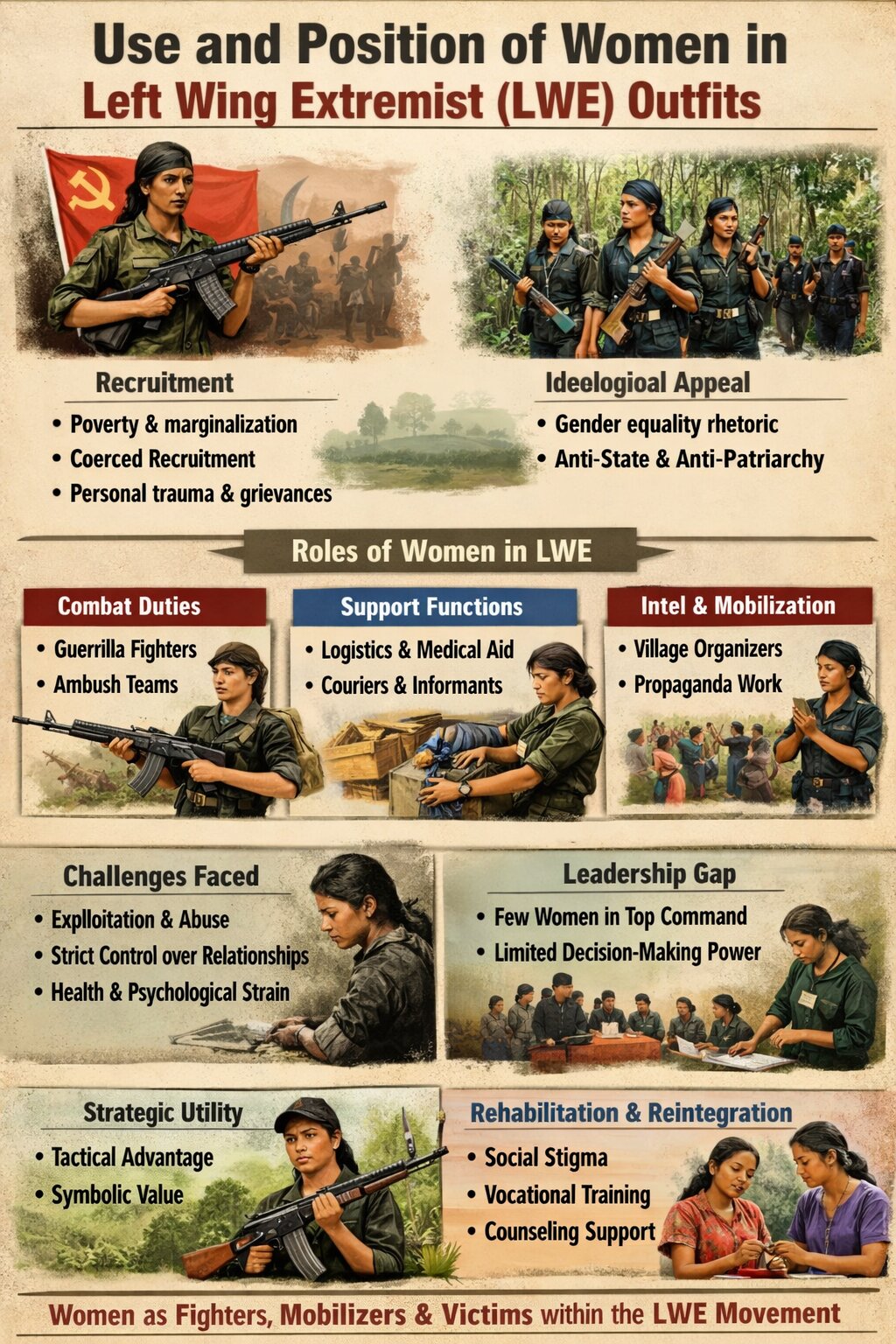
Women in LWE movements occupy a paradoxical space: they are projected as symbols of emancipation and equality, yet frequently experience structural subordination, coercion, and exploitation. LWE groups—most prominently the Communist Party of India (Maoist)—have systematically incorporated women into their ranks for ideological, operational, and strategic purposes.
Historical Context of Women in Revolutionary Movements
The participation of women in revolutionary and insurgent movements is not unique to India. Globally, leftist movements in China, Vietnam, Latin America, and parts of Africa have mobilised women as fighters, organisers, and symbols of revolutionary transformation. Drawing from Marxist–Leninist–Maoist ideology, Indian LWE groups conceptualise women as a “revolutionary force” capable of challenging both class oppression and patriarchy.
In the Indian context, women’s participation in left-wing movements can be traced back to peasant uprisings and communist mobilisation in the mid-20th century. However, the armed Maoist movement institutionalised women’s participation more systematically from the 1980s onward. Over time, women came to constitute a significant proportion— often estimated in open-source and security assessments at around 30–40 percent in certain regions—of armed cadres in certain LWE-affected regions, particularly in forested and tribal belts.
Ideological Positioning of Women in LWE Doctrine
LWE outfits project themselves as champions of women’s liberation. Official literature emphasises gender equality, resistance to feudal-patriarchal structures, and the transformation of traditional social relations. Women are portrayed as victims of State violence, landlord exploitation, caste oppression, and patriarchal customs.
From an ideological standpoint, LWE narratives frame women as:
- Revolutionary comrades equal to men
- Political educators within tribal and rural communities
- Symbols of resistance against State and social oppression
This ideological positioning serves two purposes. First, it legitimises the presence of women in armed struggle, challenging conventional gender roles. Second, it acts as a powerful recruitment tool in socially marginalised regions where women face chronic deprivation and violence.
Recruitment of Women into LWE Outfits
Socio-Economic Vulnerabilities
Most women recruited into LWE outfits come from tribal, Dalit, or economically marginalised backgrounds. Chronic poverty, lack of education, displacement due to mining or development projects, and limited access to justice create fertile ground for radicalisation. In such contexts, LWE outfits present themselves as alternative power structures promising dignity, security, and purpose.
Coercion and Forced Recruitment
While voluntary recruitment exists, coercion is a significant factor. Young women are sometimes forcibly recruited during village mobilisations or abducted from remote areas. Fear of reprisals against families often prevents resistance. Once inducted, exit becomes extremely difficult.
Personal Trauma as a Catalyst
Cases of sexual violence, domestic abuse, or State action against family members frequently act as emotional triggers. LWE recruiters exploit such trauma, reframing personal grievances into revolutionary anger and directing it against the State.
Operational Roles Performed by Women
Combat Roles
Contrary to stereotypes, women in LWE outfits actively participate in armed operations. They serve as:
- Rifle-bearing guerrillas
- Members of ambush teams
- Sentries and perimeter guards
In dense forest terrain, women are often perceived as less suspicious, allowing them to move more freely during reconnaissance and logistics operations.
Support and Logistical Functions
A large proportion of women cadres are assigned logistical roles such as:
- Carrying weapons, ammunition, and explosives
- Cooking and medical assistance
- Acting as couriers and messengers
These roles, though less visible, are critical to sustaining insurgent operations.
Intelligence and Mobilisation
Women play a key role in gathering local intelligence. Their interaction with village women allows them to assess security force movements, collect early warnings, and mobilise support during bandhs or protests. They also act as ideological educators, spreading propaganda and organising mass fronts.
Women in Leadership and Decision-Making
Representation at Lower and Middle Levels
Women do occupy leadership positions at lower and middle levels—such as squad leaders, area committee members, or organisers of women’s wings. These roles often involve discipline enforcement, political education, and coordination of village-level activities.
Glass Ceiling in Top Leadership
Despite ideological claims of equality, women remain underrepresented in top decision-making bodies. Strategic planning, military command, and ideological direction are overwhelmingly male-dominated. This reveals a persistent patriarchal structure beneath revolutionary rhetoric.
Gender Relations and Internal Realities
Romantic Relationships and Marriage
LWE outfits regulate personal relationships strictly. Romantic involvement often requires organisational approval, and marriages are arranged within the cadre structure. While presented as progressive alternatives to traditional marriage, such arrangements primarily serve organisational discipline rather than personal freedom.
Sexual Exploitation and Abuse
As indicated by multiple surrender testimonies reveal instances of sexual exploitation, coercion, and abuse. Complaints mechanisms are weak, and senior male cadres often enjoy impunity. Victims face social stigma and organisational retaliation if they speak out.
Motherhood and Control over Reproduction
Pregnancy is often discouraged or tightly regulated. Women cadres may be forced to undergo abortions or relinquish children to sympathisers. Motherhood is seen as incompatible with guerrilla life, highlighting the instrumental view of women as fighters rather than individuals.
Psychological Impact on Women Cadres
Life within LWE outfits exposes women to constant stress, violence, and deprivation. Prolonged separation from families, fear of encounters, and internal discipline contribute to psychological trauma. Many women surrendering later exhibit symptoms of depression, anxiety, and post-traumatic stress disorder (PTSD).
Strategic Utility of Women for LWE Groups
From a strategic perspective, women offer multiple advantages to LWE outfits:
- Lower suspicion during movement and reconnaissance
- Enhanced legitimacy among local populations
- Effective mobilisation of women-centric grievances
- Propaganda value in portraying the movement as inclusive and progressive
Thus, women’s participation is not merely ideological but also tactically calculated.
Challenges for Security Forces
Operational Sensitivities
Engagements involving women cadres pose moral and operational dilemmas for security forces. Use of force against women can be exploited for propaganda, while hesitation may be tactically disadvantageous.
Interrogation and Intelligence Gathering
Women cadres often possess valuable intelligence but may be reluctant to cooperate due to fear, indoctrination, or trauma. Gender-sensitive interrogation and rehabilitation frameworks are therefore essential.
Surrender, Rehabilitation, and Reintegration
Women who surrender face unique challenges:
- Social stigma in conservative rural communities
- Rejection by families
- Limited livelihood skills outside insurgency
Effective rehabilitation requires tailored approaches, including counselling, education, vocational training, and long-term social support.
Policy and Counter-LWE Implications
Understanding the use and position of women in LWE outfits has critical policy implications:
- Counter-narratives must expose the gap between ideological claims and lived realities
- Development interventions must address women-specific grievances
- Security responses should integrate gender-sensitive intelligence and rehabilitation strategies
Empowering women through governance, education, and justice delivery remains one of the most sustainable counters to extremist mobilisation.
Recent Case Studies
In 2025–2026, numerous high-profile surrenders and encounters highlighted women’s significant yet vulnerable roles in remaining CPI (Maoist) strongholds, particularly in Chhattisgarh’s Bastar region. Notable examples include the October 2025 mass surrender of 78 Maoists (including 43 women) across Sukma, Kanker, and Kondagaon districts, where many women cadres cited disillusionment, harsh guerrilla life, and exploitation as reasons for quitting; another in November 2025 involved two high-value women cadres—Sunita (Rs 14 lakh bounty) and Kamla Sodi alias Taruna (Rs 17 lakh bounty)—from the MMC zone, whose testimonies revealed widespread sexual exploitation, forced labor as cooks/porters, and unrest among female fighters due to abuse by senior leaders.
In early 2026, surrenders continued with groups like 51 armed Maoists (including 34 women) in Bijapur and Sukma in February, and multiple smaller batches (e.g., six including five women in Dantewada in February 2025), often involving area committee members. Encounters also reflected this trend: in January 2026, 14 Maoists (including six women) were killed in Sukma and Bijapur operations, underscoring women’s frontline combat exposure amid declining cadre strength and intensified security drives aiming for LWE elimination by March 2026.
Policy Recommendations
- Integrate gender-sensitive strategies into the existing National Policy and Action Plan (2015) for addressing Left Wing Extremism (LWE), including extensions through schemes like Security Related Expenditure (SRE), Special Central Assistance (SCA), Security and Infrastructure Scheme (SIS), and Surrender & Rehabilitation policies, to specifically target women’s roles and vulnerabilities in Maoist outfits.
- Intensify targeted counter-narratives through media campaigns, community outreach, and public perception management to highlight the discrepancy between Maoist claims of gender equality and the ground realities of sexual abuse, forced abortions, subordination, and exploitation of women cadres.
- Enhance women-centric development interventions in tribal and LWE-affected areas by prioritizing schemes under MGNREGA, NRLM, education, skill training, healthcare (including maternal and reproductive health), and livelihood programs to directly address socio-economic drivers like poverty, displacement, and lack of opportunities that fuel women’s recruitment.
- Adopt humane, trauma-informed rehabilitation for surrendered women Maoists, featuring psychological counselling for PTSD and trauma, protection mechanisms against social stigma and retaliation, tailored vocational training suited to rural women, family reintegration support, and financial incentives aligned with state-specific surrender policies (e.g., enhanced rewards, cash assistance, and stipends as seen in recent Odisha and Chhattisgarh revisions).
- Strengthen gender-sensitive approaches in security operations, including intelligence gathering from women in communities, interrogation protocols that account for trauma and indoctrination, operational guidelines to handle engagements involving female cadres ethically, and training for forces to build trust and minimize propaganda exploitation.
- Promote long-term governance and rights-based improvements in affected regions through accelerated implementation of schemes like Road Connectivity Project for LWE Areas (RCPLWE), fortified police stations, and full enforcement of constitutional provisions such as Panchayats (Extension to Scheduled Areas) Act (PESA) and Forest Rights Act (FRA) to ensure justice, entitlements, land rights, and inclusive growth, thereby reducing grievances that disproportionately affect women and prevent future radicalization.
Conclusion
The participation of women in LWE outfits reflects a complex interplay of ideology, coercion, vulnerability, and strategic calculation. While LWE groups project themselves as liberators of women, internal structures often replicate the very inequalities they claim to fight. Women are simultaneously fighters, mobilisers, symbols, and victims within the insurgent framework.
A nuanced understanding of this duality is essential for policymakers, security practitioners, and civil society actors. Addressing the root causes that push women toward extremism—while exposing the exploitative realities within LWE outfits—remains key to weakening insurgent influence and building lasting peace in affected regions.
Recognising women not merely as cadres but as stakeholders in peace is essential to any durable counter-LWE strategy.